
 Worksheets
POST-TEST PRAKTIKUM ANATOMI 1.4
Total questions: 10
Worksheet time: 8mins
The structure that connects the cerebrum with the cerebellum and the spinal medulla, and serves as the vital center for respiration and heartbeat is...
Cerebellum
Diencephalon
Lateral ventricle
Brainstem
Limbic system
The channel that carries urine from the kidney to the urinary bladder is...
Urethra
Ureter
Collecting tubule
Ureter
Sigmoid colon
The duct that carries spermatozoa from the epididymis to the prostatic urethra is...
Seminiferous tubules
Vas deferens (ductus deferens)
Ureter
Urethra
Ejaculatory duct
The hormone produced by the pancreas that functions to lower blood glucose is...
Glucagon
Insulin
Somatostatin
Cortisol
Adrenaline
In a cross-section of the brainstem, the area that appears darker in color and contains many neuronal cell bodies is...
Brainstem nuclei (gray matter)
Pyramidal tract (white matter)
Medial lemniscus (white matter)
Reticular formation
Cerebral peduncle
A patient with a pituitary tumor compressing the optic chiasm will experience a disturbance of...
Hearing
Smell
Visual fields
Balance
Coordination
A patient with diabetes mellitus develops renal failure. This illustrates...
An endocrine system disorder that can affect the genitourinary system.
A nervous system disorder that can affect the genitourinary system.
A reproductive system disorder that can affect the urinary system.
A digestive system disorder that can affect the endocrine system.
A cardiovascular system disorder that can affect the nervous system.
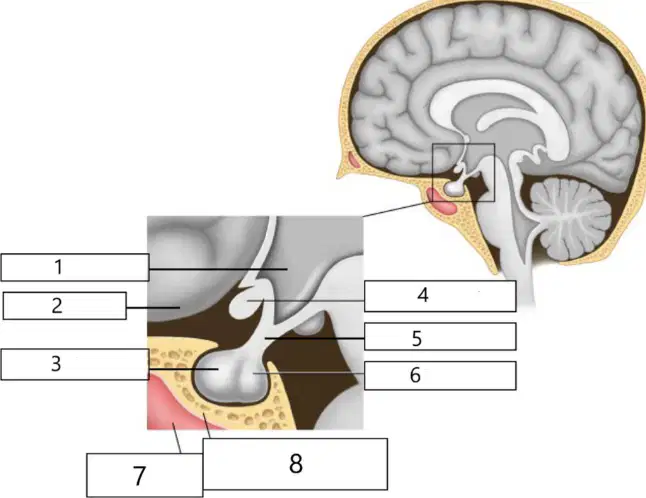
Refer to the sagittal brain and pituitary diagram with numbered arrows. What is the name of the organ indicated by arrow number six (6)?
Cerebrum
Hypothalamus
Pituitary pars anterior
Pituitary pars posterior
Optic chiasm
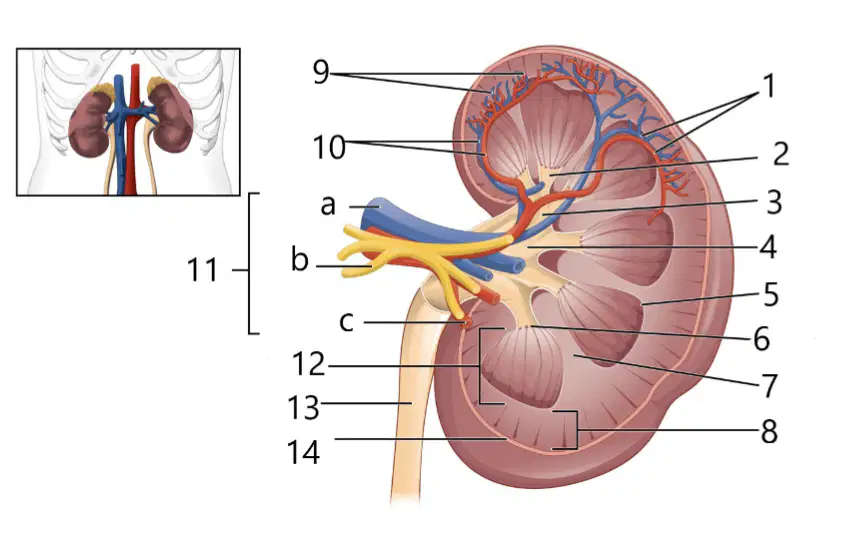
Refer to the labeled kidney diagram. What is the name of the organ indicated by arrow number five (5)?
Cortex
Medula
Major Calyx
Minor Calyx
Pyramid
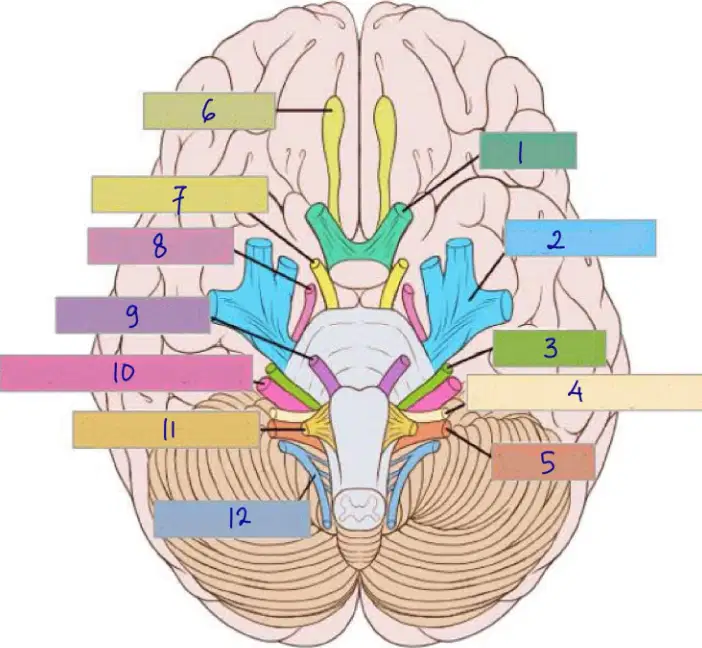
Refer to the inferior view of the brain with cranial nerves labeled. What is the name of the nerve indicated by arrow number two (2)?
N. Opticus (CN. II)
N. Oculomotorius (CN. III)
N. Vestibulocochlearis (CN. VIII)
N. Trigeminus (CN. V)
N. Glossopharyngeal (CN. IX)

