
 Worksheets
Air Masses and Fronts QC Review 2025
Total questions: 25
Worksheet time: 17mins
Mila and Javier are studying different types of air masses for their science project. They want to know where a continental tropical air mass can form. Which location should they choose?
Northern Pacific
Canada
Florida
Desert
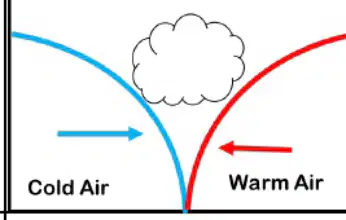
Milo and Hadassa are watching the weather report and see that a warm air mass and a cold air mass are at a standstill over their town. What type of front is this?
cold front
warm front
occluded front
stationary front
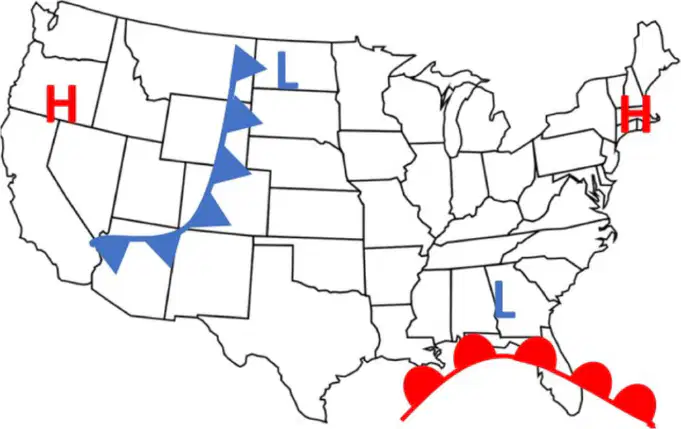
Destiny and Javier are planning a trip to Florida and check the weather map shown. Based on the map, what type of weather should they expect during their visit?
Drizzly rain with increased temperatures.
Many days of cloudy, wet weather.
Heavy snow and cold temperatures.
Thunderstorms and possible tornadoes.
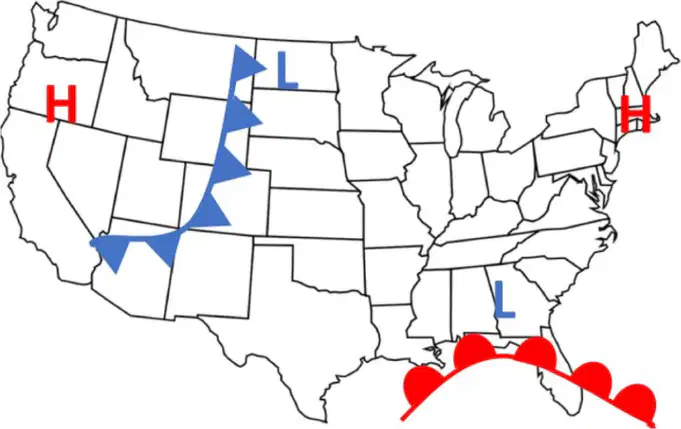
Mila and TJ are watching the weather map to plan their road trip across the western United States. They notice a cold front marked by blue triangles. Which direction is the cold front moving?
North
South
East
West
Oakland and Paris are planning a hot air balloon trip and want to understand why the air pressure changes as they travel from the equator to the poles. What causes differences in air pressure around the Earth?
Warm air rises at the equator and cold air sinks at the poles.
Warm air sinks at the equator and cold air rises at the poles.
Warm air rises at the equator and cold air rises at the poles.
Cold air rises at the equator and warm air sinks at the poles.
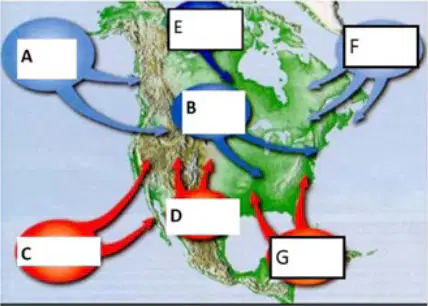
Destiny and Sirius are planning a summer picnic and want to choose a day when the weather will be warm and moist. They check the weather map, which shows different air masses labeled A, B, C, D, E, F, and G moving toward North America. Which two air masses would bring WARM, MOIST air for their picnic?
A, B
E, F
A, D
C, G
Mila and Paris are planning a sailing trip and want to learn about the types of air masses they might encounter over the ocean. Which air mass forms over the ocean?
continental
maritime
tropical
polar
Paris and Mila are learning about weather patterns in their science class. Their teacher asks them to identify the two main properties that define air masses. What are these two properties?
temperature and density
temperature and mass
temperature and humidity
humidity and mass
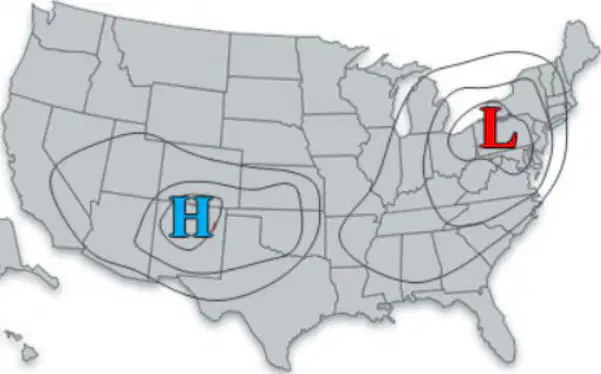
Jayden and Mila are planning a road trip across the United States. They check a weather map that shows a blue H (high pressure) over the Southwest and a red L (low pressure) over the Northeast, with isobars surrounding each. Based on this information, in which direction will the wind move?
east to west
west to east
north to south
south to north
Paris and TJ are watching the weather forecast and learn that two air masses with different temperatures are moving toward each other. What forms when these air masses meet?
storms
thunder
fronts
currents
Rue and Michael are planning a winter road trip across the Midwest and want to know what type of air mass is most likely to bring dry and cold weather to the region. Which type of air mass should they be prepared for?
Maritime polar
Continental tropical
Continental polar
Maritime tropical
Destiny and Jayden are planning a picnic, but they hear that a cold front is moving into their area. What kind of weather should they expect?
Light drizzle and fog
Cloudy skies and thunderstorms
Warm temperatures and sunshine
Clear skies and calm winds
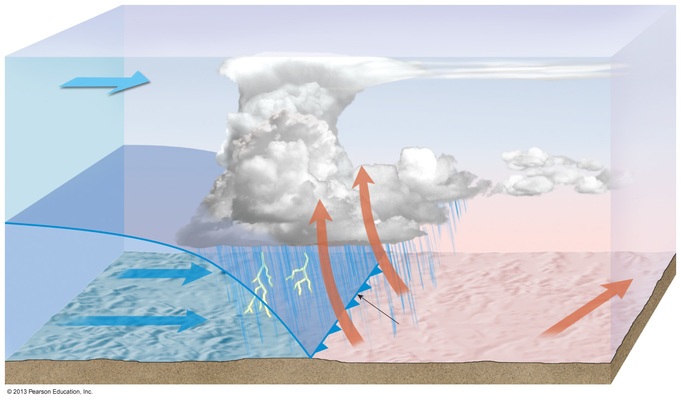
Hadassa and Oakland are watching the weather report and see a map showing a storm front like the one in the image above, where cold air is pushing under warm air, causing thunderstorms and heavy rain. What type of storm front is this?
warm front
cold front
stationary front
occluded front

Javier and Mila are studying weather maps in class and see this symbol on one of the maps. They want to know what type of front it represents. This is the symbol for which type of front?
cold front
warm front
occluded front
stationary front
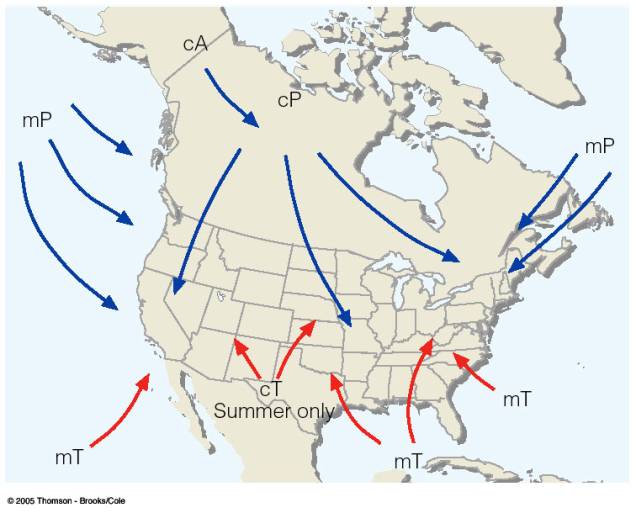
Marc and Paris are planning a hiking trip in the Pacific Northwest and want to know what type of air mass might bring cold and moist conditions to the region. Which abbreviation of an air mass should they look out for?
cP
mP
cT
mT

TJ and Destiny are planning a road trip across Texas and check the weather map for March 24, 1913. They want to know what type of front is currently over Texas. What type of front do they see?
warm front
cold front
stationary front
occluded front
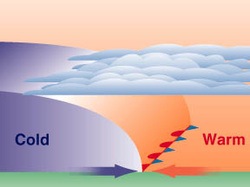
Oakland and Mila are studying weather patterns and come across the diagram shown. They want to know: Which type of front is pictured?
Cold front
Warm front
Occluded front
Stationary front
Hadassa and Rocky are planning a picnic and check the weather forecast. They notice that a low pressure system is moving into their area. What kind of weather should they expect?
Sunny
Calm
Stormy
Paris and Destiny are planning a picnic and check the weather forecast. They see that a high pressure system is moving into their area. Based on this, what kind of weather should they expect for their picnic?
clear and dry
cloudy and wet

Paris and Mila are planning a trip and want to avoid rain. They look at the weather table for four cities. Based on the information in the table, in which city will it most likely rain?
City W
City X
City Y
City Z
While visiting a science museum, Marc and Katia noticed a demonstration showing that warm air rises at the equator and cold air sinks at the poles. This process creates
tornadoes.
hurricanes.
convection currents.
the Coriolis Effect.
During a science experiment, Marc and Paris observed that a balloon filled with warm air started to rise. What causes the warm air to rise?
Warm air is more dense than cooler air.
Warm air is less dense than cooler air.
Warm air has less gravitational attraction than cooler air.
Warm air has more gravitational attraction than cooler air.
Destiny and Milo were sitting in a room on a cold winter day. They noticed that the air near the window felt colder and seemed to move downward. What did they observe about the air as it cooled?
It stays put because its density doesn’t change.
It rises as its density increases.
It sinks as its density increases.
It explodes as its density decreases.
Marc drops a small rock into a glass of water. The rock is more dense than the water. What does the rock tend to do?
Rise
Sink
Marc pours oil into a glass of water. The oil is LESS dense than the water. What does the oil tend to do?
Rise
Sink

