
 Worksheets
Transformations: Congruence and Similarity
Total questions: 104
Worksheet time: 3hrs 34mins
Translations, Reflections, and Rotations create _________ figures.
Congruent
Similar
Dilations create _________ figures.
Congruent
Similar

What type of transformation occurred?
Translation
Rotation
Reflection across the y-axis
Reflection across the x-axis

Where was this image reflected?
across the x-axis
across the y-axis

Describe the translation
Left 6, up 5
Left 6, down 5
Right 6, up 5
Right 6, down 5

Which two figures are congruent?
A & B
A & C
A & D

What is the sequence of transformations?
Reflection across the x-axis, translation down 4 and right 1
Rotation 180° about the origin, translation down 1 and right 2
Rotation 180° about the origin, translation down 2 and right 2
Reflection across the x-axis, translation down 6 and right 3
What is the rule ?
Translate 5 units left and 6 units up
*No Spaces
(a)

Yes
No
What is the translated coordinate ?
Translate 5 units left and 6 units up
(-2, -9)
*No Spaces
(a)
In a dilation, if the scale factor is greater than 1 the image gets ________
Bigger
Smaller
What was the scale factor used?
A(2,4), B(10, 18) C(6,8)
A'(1,2), B'(5,9), C'(3,4)
(a)

Which image shows a rotation?
A
B
C

Which image shows a translation?
A
B
C

Which image shows a reflection?
A
B
C

What combination of transformations is shown?
translation, then reflection
translation, then rotation
rotation, then reflection
Rotation, then translation

What sequence of transformations will map trapezoid A to its image A'?
Reflection, then translation
Rotation, then translation
Reflection, then rotation
Rotation, then dilation

What sequence of transformations could map ∆ABC onto its image ∆A''B''C''?
a reflection followed by a rotation
a reflection followed by a translation
a translation followed by a rotation
a translation followed by a reflection

Which of the following describes the sequence of transformations shown?
Reflect across the x-axis and then rotate 90 degrees clockwise around the origin
Rotate 90 degrees clockwise around the origin and then translate down.
Reflect across the x-axis and then reflect across the y-axis.
Translate up and then rotate 90 degrees counterclockwise about the origin.

Which transformation is shown?
Translation
Reflection over the x-axis
Reflection over the y-axis
180o rotation

Which transformation is shown?
Translation
Reflection over the x-axis
Reflection over the y-axis
180o rotation

Which transformation is shown?
Translation
Reflection over the x-axis
Reflection over the y-axis
90o counterclockwise rotation


Identify the sequences of transformations from the green image to the red image to the blue image.
rotation then translation
translation then rotation
translation then reflection
rotation then reflection

Identify the sequences of transformations from the red image to the blue image to the green image.
translation then translation
rotation then reflection
rotation then rotation
reflection then translation

Which sequence of transformations will result from shape F to its image shape F''?
Reflection over both axes
Reflection, then rotation
Translation, then reflection
Rotation, then translation


What combinaton of transformations is shown?
Rotation, then translation
Translation, then reflection
Rotation, then reflection
Translation, then rotation

What combination of transformations is shown?
Reflection, then rotation
Translation, then rotation
Translation, then reflection
Reflection, then translation

What are the final coordinates of B after a rotation of 180 degrees counterclockwise and a reflection over the y-axis
(3, -4)
(3, 4)
(-4, 3)
(4, -3)


Point A is rotated 180 degrees and then flipped over the y-axis. What is A" if A is (2,7)
(2,7)
(-2, -7)
(-2, 7)
(2, -7)


A transformation that “turns” a figure about a fixed point is a _____________________.
rotation
translation
reflection
dilation


Identify the transformation from ABCD to A'B'C'D'.
Translation
Reflection across the x-axis
Reflection across the y-axis
90o counter clockwise rotation
Translated figures are always __________________.
Congruent
Bigger
Smaller
Rotated
A type of transformation where a geometric figure slides horizontally, vertically, or both.
dilation
translation
rotation
reflection

A reflection ____________________.
turns a figure around a point.
slides an object form one place to another.
flips or mirrors an object across a line.
changes the size of an object.

Identify the transformation from ABC to A'B'C'.
90o clockwise rotation
90o counter clockwise rotation
Reflection across the y-axis
Reflection across the x-axis

Translations, reflections and rotations are all known as ________________________.
Geometry
Rigid Transformations
Congruent
Rigid transformations do not change the _____ and _____ of an object.
size
shape
location
direction
A ______ is a flip of a figure over a line.
Translation
Rotation
Reflection
Dilation

Figure ABCD is the pre-image and is transformed into the other figures.
HIJK is a (a) of ABCD.
Figure ABCD is the pre-image and is transformed into the other figures.
AEFG is a (a) of ABCD.
Figure ABCD is the pre-image and is transformed into the other figures.
LMNO is a (a) of ABCD.
When part of an original figure matches up with a copy, we call them _. These could be points, segments, or angles.
(a)

GHIJKL is the image of ABCDEF. Which angles have the same measure? (there are 2 correct answers)
∠B and ∠J
∠E and ∠K
∠F and ∠H
∠A and ∠G

GHIJKL is the image of ABCDEF.
BC corresponds to
GH
HI
KJ
JI
GHIJKL is the image of ABCDEF.
AF corresponds to
GH
GL
KJ
ED

PQRST is the image of ABCDE. Select the three correct answers.
This is an example of a reflection.
This is an example of a dilation
RS corresponds to DC
∠B corresponds to ∠Q
∠R corresponds to ∠D
Having the same size and shape; ≅.
Congruent
Similar
Image
Preimage
Corresponding sides of a congruent figure are_____.
Congruent
Not congruent
Corresponding angles of congruent figures are _________.
Congruent
Not congruent

Which figure is a translation of Figure I?
Figure A
Figure B
Figure C
None of the above

What kind of transformation is this?
Reflection
Translation
Rotation

What kind of transformation is this?
Rotation
Reflection
Translation

ΔXYZ≅ΔTRS
Which side corresponds to side XY?
TR
RS
ST

Δ RST ≅ -------
Δ WYX
Δ WXY
Δ XWY
Δ XYW
Triangle DEF has vertices D(2,0), E(1,-2), and F(2,1). The triangle is rotated 90˚clockwise about the origin.What are the coordinates of vertex F' ?
(-2, -1)
(-1, -2)
(1, -2)
(-2, 1)

Find the coordinates of A' if ΔABC is reflected across the y-axis.
(1, -2)
(-1, 2)
(-1, -2)
(1, 2)
Which sequences make congruent figures?
translations only
rotations, reflections, and translations
rotations and reflections only
dilations, reflections, rotations, and translations

Describe the translations that were applied to quadrilateral ABCD when it was translated to quadrilateral A'B'C'D'
down 1 unit, left 5 units
down 4 units, left 9 units
5 units right, 1 unit up
9 units right, 4 units up

What sequence of transformations will get you from figure 1 to figure 3?
reflection, then rotation
rotation, then translation
reflection, then translation
Translation, then reflection

What sequence of transformations will get you from ΔBCD to ΔB"C"D" ?
Rotation, then rotation
rotation, then dilation
translation, then reflection
reflection, then rotation

Identify the transformation of figure PQRSTU to figure P"Q"R"S"T"U"
translation across the y-axis
reflection across the x-axis
reflection across the y-axis
rotation 90˚ about the origin

Which transformation would be used on quadrilateral KLMN to create quadrilateral K'L'M'N' ?
rotation 90˚ clockwise around the origin
reflection across the x-axis
translation to the right
reflection across the y-axis
Which expression describes the translation of a point (-2, 6) to (3, -1) ?
5 units right and 7 units up
5 units left and 7 units down
5 units left and 7 units up
5 units right and 7 units down

What will be the coordinates of point V after a reflection of ΔUVW across the x-axis?
(-4, 4)
(-4, 1)
(4, -4)
(4, -1)
Define congruent figures
two figures that are the same shape
two figures that are the same size and the same shape
two figures that are the same size
two figures that are both rectangles
Which of the following sets of pre-images and images show a rotation?


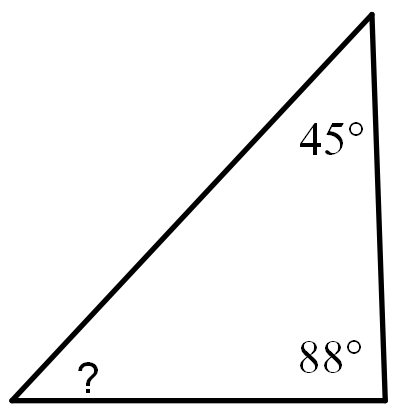
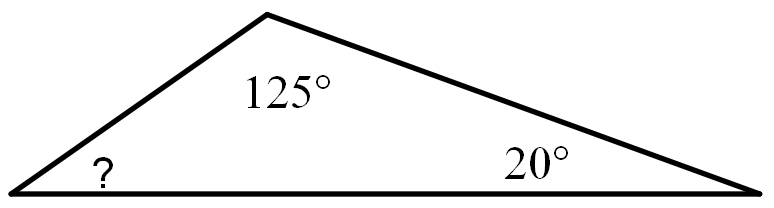
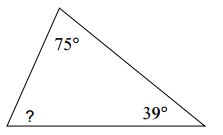

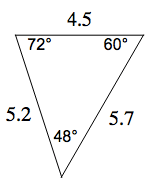
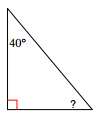

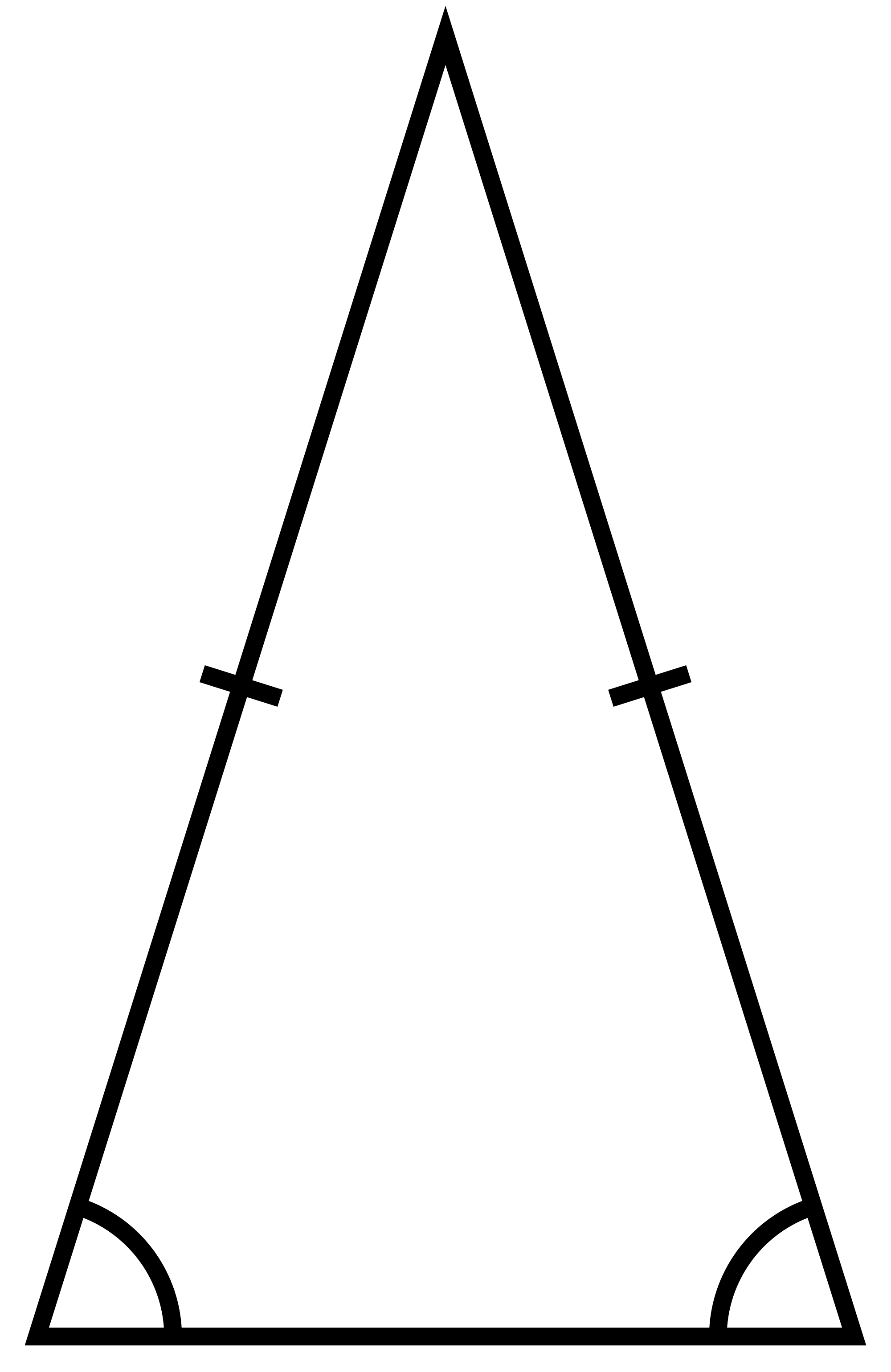

Find x
40 degrees
21 degrees
42 degrees
39 degrees

Find the measure of angle A.
75o
60o
30o
38o



