wayground logo

Free Printable Worksheets

Font size

S
M
L
XL
Worksheets

Algebra 2 Honors Midterm Prep

Total questions: 108

Worksheet time: 6hrs 49mins

Name
Class
Date
1.

The vertex of the function below is ...


f(x)=x3+4f\left(x\right)=\left|x-3\right|+4  

a)

(3, 4)

b)

(-3, 4)

c)

(3, -4)

d)

(-3, -4)

2.

The vertex of the function below is ...


f(x)=12x+107f\left(x\right)=-\frac{1}{2}\left|x+10\right|-7  

a)

(-10, 7)

b)

(-10, -7)

c)

(10, -7)

d)

(10, 7)

3.

The vertex of the function below is ...


f(x)=2x+6f\left(x\right)=2\left|x\right|+6  

a)

(0, 6)

b)

(0, 12)

c)

(2, -6)

d)

(2, 12)

4.
24 ÷ 6 + 42
a)
12
b)
2
c)
20
5.
(15 ÷ 3)2 + 9 ÷ 3
a)
11.3
b)
28
c)
13
6.
3 x 22 + 24 ÷ 8
a)
15
b)
10.5
c)
4.5
7.

If f(x) = 2x + 1, find f(1).

a)

f(1) = 1

b)

f(1) = 4

c)

f(1) = 0

d)

f(1) = 3

8.

If f(x) = 6x - 9, find f(4).

a)

(4, 1)

b)

(4, 33)

c)

(4, 15)

d)

(4, -7)

9.
f(x) = x2 + 7
x(2) = ______
a)
10
b)
11
c)
13
d)
12
10.
a)

1

b)

-1

c)

19

d)

-19

11.
Evaluate the following expression:
25x(x - 4) when x = -1
a)
100
b)
115
c)
125
d)
130
12.

Evaluate m² + 12q if m = 5 and q = -3

a)

10

b)

-25

c)

-11

d)

13

13.
8y + 12 - 2z
for y = 4 and z = 2
a)
40
b)
20
c)
84
d)
34
14.
Slopes of parallel lines are...
a)
opposite reciprocals.
b)
opposites.
c)
identical.
d)
always 7.
15.
Slopes of perpendicular lines are...
a)
opposite reciprocals.
b)
opposites.
c)
identical.
d)
always 7.
16.
y = 5/7x +2
y = 5/7x - 30
These lines are...
a)
Parallel
b)
Perpendicular
c)
Neither
17.
y = -2/3x + 2
y = 3/2x + 9
These lines are...
a)
Parallel
b)
Perpendicular
c)
Neither
18.
y = 6x + 2
y = -6x + 2
These lines are...
a)
Parallel
b)
Perpendicular
c)
Neither
19.
a)

Function

b)

Not a Function

20.
a)

Function

b)

Not a Function

21.
a)

Function

b)

Not a Function

22.
a)

Function

b)

Not a Function

23.
a)

Function

b)

Not a Function

24.
a)

Function

b)

Not a Function

25.
a)

Function

b)

Not a Function

26.
a)

Function

b)

Not a Function

27.

Simplify the Expression:


2x2 - 7x + 10 - x2

a)

-4x2 + 10

b)

20x

c)

x2 - 7x + 10

d)

3x2 - 7x - 10

28.
7x2-5x+3-2x2-2x-1
a)
5x2-7x+2
b)
9x2-3x+4
c)
5x2+7x+2
d)
6x2+2
29.
10x2+9x-5+3x2-8x-7
a)
13x2+17x+12
b)
14x2-12
c)
13x2+x-12
d)
2x2
30.
What is the x-intercept of the equation?
3x - 3y = 21
a)
x = 7 or (7, 0)
b)
x = 3 or (3, 0)
c)
x = -7 or (-7, 0)
d)
None of these.
31.
What is the y-intercept of the equation?
3x + 6y = 24
a)
x = 3 or (3, 0)
b)
y = 6 or (0, 6)
c)
x = 8 or (8, 0)
d)
y = 4 or (0, 4)
32.
What is the y-intercept of the equation?
3x - 3y = 21
a)
y = -3 or (0, -3)
b)
y = 3 or (0, 3)
c)
y = 7 or (0, 7)
d)
y = -7 or (0, -7)
33.
What is the x-intercept of the equation?
-x + 5y = 45
a)
x = 45 or (45, 0)
b)
x = -1 or (-1, 0)
c)
x = -45 or (-45, 0)
d)
None of these.
34.

What is the standard form of a Quadratic function?

a)

ax2+bx+c

b)

ax2+bx-c

c)

ax2-bx+c

d)

ax2-bx-c

35.

What is the range?

a)

-3 ≤ y < ∞

b)

-1 ≤ y < ∞

c)

All real numbers

d)

-∞ < y ≤ -1

36.

Identify the domain and range of the function.

a)

Domain: -6 ≤ x ≤ 2

Range: -3 ≤ y ≤ 5

b)

Domain: All real number

Range: -3 ≤ y ≤ 5

c)

Domain: All real numbers

Range: -∞ < y ≤ 3

d)

Domain: All real numbers

Range: 3 ≤ y < ∞

37.

What is the range for the function below?

a)

-∞ < y ≤ 4

b)

4 ≤ y < ∞

c)

All real numbers

d)

-3 ≤ y ≤ 1

38.
Does the following quadratic equation have a maximum or minimum value? How can you tell?
y=x
²+2x-3
a)
Minimum value, because the a value is positive
b)
Maximum value, because the b value is positive
c)
Maximum value, because the a value is positive
d)
Minimum value, because the c value is negative
39.
Does the following quadratic equation have a maximum or minimum value? How can you tell?
y=x
²+2x-3
a)
Minimum value, because the a value is positive
b)
Maximum value, because the b value is positive
c)
Maximum value, because the a value is positive
d)
Minimum value, because the c value is negative
40.
Identify the vertex and whether the graph opens up or down.
a)
(-1, 4); opens up
b)
(-1, 4); opens down
c)
(1, 4); opens up
d)
(1, 4); opens down
41.
A parabola is upside-down when a is:
a)
negative
b)
positive
c)
0
d)
infinite
42.
2x - 3 + 4x = 27
a)
x= 12
b)
x = 4
c)
x = 5
d)
x = 15
43.

Solve |x|= 9

a)

x = 9

b)

x = -9 or x = 9

c)

No Solution

d)

x = -9

44.

52x=9\left|5-2x\right|=9  

a)

No Solution

b)

x = 7 or x = 2x\ =\ -7\ or\ x\ =\ 2   

c)

x = 2 or x = 7x\ =\ -2\ or\ x\ =\ 7  

d)

x = 2x\ =\ -2  

45.

Given h(x)=3x22x+8 what is h(1)?Given\ h\left(x\right)=3x^2-2x+8\ what\ is\ h\left(-1\right)?  

a)

13

b)

8

c)

16

d)

answer not here

46.

Given f(x) = 3x2 + 1, what is f(t + 2)?

a)

3t2 + 3

b)

(3t + 2)2 + 1

c)

3(t + 2)2 + 1

d)

none of these

47.

What is the DOMAIN of the function?

a)

All Real Numbers

b)

x ≤ 4

c)

x > 4

d)

0 ≤ x ≤ 4

48.

Evaluate f(0)

a)

0

b)

19

c)

9

d)

-19

49.

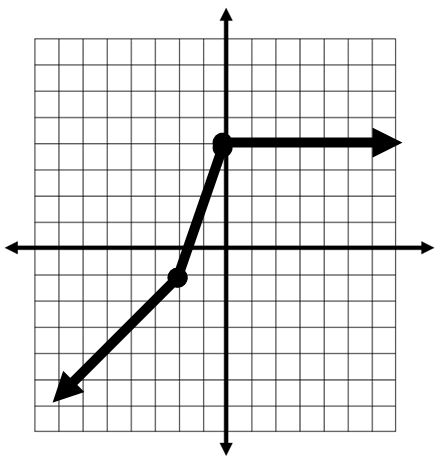
What is the domain interval for the green piece of this function?

a)

-2 < x ≤ 1

b)

-1 < x ≤ 0.5

c)

x > -2

d)

x ≤ 1

50.

What is the RANGE of the function?

a)

All Real Numbers

b)

y ≤ 4

c)

y < 4

d)

0 < y < 4

51.
a)
Left 2, Down 2, Vertical Stretch
b)
Right 2; Up 1; 
c)
Vertical Stretch; Right 2; Up 1
d)
Left 2; Down 2;
52.
a)
Absolute Value
b)
Quadratic
c)
Cubic
d)
Linear
53.
a)
Cubic
b)
Quadratic
c)
Absolute Value
d)
Square Root
54.
a)
Square Root
b)
Quadratic
c)
Absolute Value
d)
Linear
55.

Name the parent function

f(x)=x2

a)

Quadratic

b)

Cubic

c)

Absolute Value

d)

Exponential

56.

State the transformations of the function from the Parent Function

g(x)=(x2)2+3g\left(x\right)=\left(x-2\right)^2+3  

a)

Shift Left 2

and

Shift Down 3

b)

Shift Right 2

and

Shift Up 3

c)

Shift Right 2

and

Shift Down 3

d)

Shift Left 2

and

Shift Up 3

57.

Describe the transformation of

the function from its Parent Function

g(x)=2x73g\left(x\right)=2\left|x-7\right|-3  

a)

Vertical Stretch by 2, Shift Right 3 and Shift Down 7

b)

Vertical Stretch by 2, Shift Right 7 and Shift Down 3

c)

Vertical Stretch by 2, Shift Left 7 and Shift Down 3

d)

Horizontal Stretch by 2, Shift Right 7 and Shift Down 3

58.

What is the y- intercept of the graph of y = -5x + 6

a)

5

b)

-5

c)

6

d)

-6

59.
Which equation represents the following graph?
a)
y = 3x + 2
b)
y = -2x + 3
c)
y = 2x + 3
d)
y = -3x + 2
60.
Write the equation of the line.
a)
y = -1/3x - 2
b)
y = 1/3x - 2
c)
y = 3x - 2
d)
y = -3x - 2
61.
Find the slope of:
(1,8) and (3,12)
a)
2
b)
1/2
c)
9/7
d)
-2
62.
Find the slope of:
(7,1) and (-2,1)
a)
0
b)
-1/2
c)
undefined
d)
-8
63.

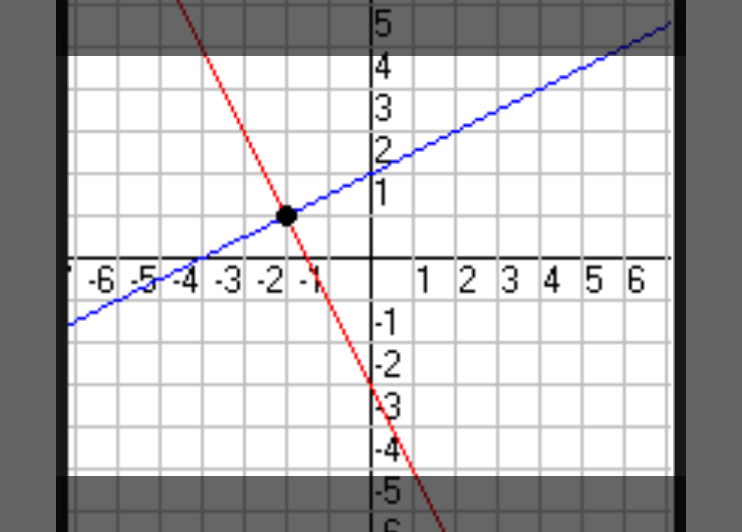
What is the solution to the system of equations graphed below?

a)

No Solution

b)

Infinite Solutions

c)

One Solution: (1, -2)

d)

One Solution: (-2, 1)

64.
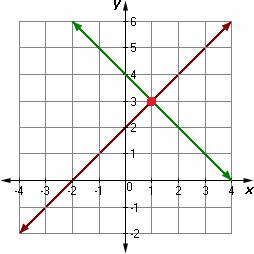
What is the solution to the system?
a)
(0, 3)
b)
(1, -1)
c)
(-3, 1)
d)
(1, 3)
65.

Solve the system of equations.

a)

(-23, 4)

b)

(-4, -3)

c)

(-2, -4)

d)

No solution

e)

Infinite solutions

66.
Solve by graphing. Show all work on a graph paper.
a)
(2, 7)
b)
(7,6)
c)
(-6,1)
d)
No Solution
67.
Solve by using substitution method.
a)
(2, 7)
b)
(0, 1)
c)
(2/5, 9/5)
d)
(2, 5)
68.
Solve by using elimination method.
a)
(3, 1)
b)
( 5, -5)
c)
(2, 5)
d)
(15, 1)
69.
Which of the following inequalities matches the given graph?
a)
y ≥ 2/5x + 1
b)
y ≥ -2/5x + 1
c)
y≤  2/5x + 1
d)
y ≥ -2/5x - 1
70.
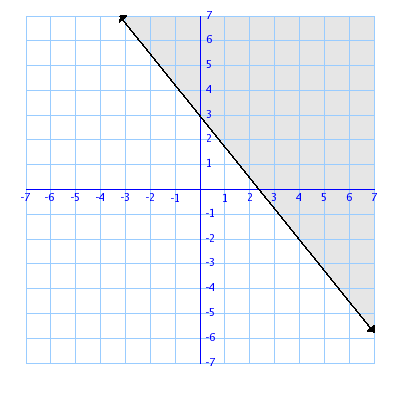
Which of the following inequalities matches the given graph?
a)
y ≤ -3/4 x + 3
b)
y ≥ -3/4 x + 3
c)
y < -3/4 x + 3
d)
y > -3/4 x + 3
71.

Factor Completely.
4x2+24x644x^2+24x-64  

a)

4(x+8)(x2)4\left(x+8\right)\left(x-2\right)  

b)

4(x2+6x16)4(x^2+6x-16)  

c)

4(x2+24x16)4\left(x^2+24x-16\right)  

d)

4(x8)(x+2)4\left(x-8\right)\left(x+2\right)  

72.

Factor Completely.
3x2+24x+483x^2+24x+48  

a)

3(x+4)23\left(x+4\right)^2  

b)

3(x2+8x+16)3\left(x^2+8x+16\right)  

c)

3(x4)23\left(x-4\right)^2  

d)

3(x2+24x+48)3\left(x^2+24x+48\right)  

73.

Factor Completely.
3x2+6x1053x^2+6x-105  

a)

3(x2+2x35)3\left(x^2+2x-35\right)  

b)

3(x+7)(x5)3\left(x+7\right)\left(x-5\right)  

c)

3(x7)(x+5)3\left(x-7\right)\left(x+5\right)  

d)

Prime

74.

Factor as the product of two binomials.

x2+11x+18=x^2+11x+18=  

a)

(x+9)2\left(x+9\right)^2  

b)

(x+9)(x+2)\left(x+9\right)\left(x+2\right)  

c)

(x+3)2\left(x+3\right)^2  

d)

(x+2)(x2)\left(x+2\right)\left(x-2\right)  

75.
Factor x2 + 12x + 20
a)
(x + 2)(x + 10)
b)
(x + 3)(x + 4)
c)
(x + 4)(x + 5)
d)
(x + 4)(x + 6)
76.
Factor: 4x² - 20x + 25
a)
(4x - 25) (x -1)
b)
(2x + 5) (2x - 5)
c)
(2x - 5)²
d)
(4x - 5) (x - 5)
77.
x2 = 16
a)
± 4
b)
± 8
c)
4
d)
8
78.
x2 + 4 = 68
a)
± 8
b)
± √8
c)
8
d)
± 64
79.
(x - 2) 2 = 9
a)
± 3
b)
5  or  -1
c)
-5  or  1
d)
± 9
80.

5m2 + 1 = 6

a)

m = 0

b)

m = 1 or -1

c)

m = √7

d)

m = 7/5 m = -7/5

81.
a)

2i√6

b)

8i√3

c)

-2√6

d)

-2i√6

82.
a)

i

b)

-1

c)

1

d)

-i

83.
a)
10
b)
-10
c)
10i
d)
-10i
84.
What is the complex conjugate of  4-3i?
a)
A.  1/(4-3i)
b)
B. 1/(4+3i)
c)
C.  -4 + 3i
d)
D.  4 + 3i
85.
Simplify:
i7
a)
i
b)
-i
c)
1
d)
-1
86.
(5-2i) + (-7+8i)
a)
-2+6i
b)
12+6i
c)
-35-16i2
d)
-35 -16i
87.
(3i)(-2+4i)
a)
-6+12i
b)
-12-6i
c)
-2+7i
d)
12+6i
88.
Multiply: 
(4 – 3i)(-7 – 2i)
a)
A.  -23 + 13i
b)
B.  -23 - 29i
c)
C.  -34 + 13i
d)
D.  -34 - 29i
89.

3+3i+82i73+3i+8-2i-7  

(a)  

90.

(3+2i)(68i)\left(-3+2i\right)\left(-6-8i\right)  

(a)  

91.

Which is the conjugate of (34i)\left(3-4i\right)  ?

a)

(34i)\left(3-4i\right)  

b)

(3+4i)\left(3+4i\right)  

c)

(34i)\left(-3-4i\right)  

d)

i-i  

92.

Solve  x22=17x^2-2=17  

a)

±19\pm\sqrt{19}  

b)

1±191\pm\sqrt{19}  

c)

±219\pm2\sqrt{19}  

d)

17±2i17\pm2i  

93.
The discriminant is
a)
aX2  + bX  +  c
b)
b - 4ac
c)
b2 - 4ac
d)
b2 + 4ac
94.

For the function below, is the discriminant positive, negative, or zero?

___________

y = x² + 4x + 4

a)

Positive

b)

Negative

c)

Zero

d)

Not Sure

95.

What is the discriminant of 6x2 − 2x − 3 = 0

a)

76

b)

29

c)

68

d)

none of these

96.

If the discriminant is positive, then the solution will be

a)

one real solution

b)

two real solutions

c)

no real solutions

d)

one imaginary solution

97.
A function has a discriminant of 25.
______________
How many solutions does it have?
a)
0
b)
1
c)
2
d)
5
98.

Use the quadratic formula to find the solutions for

y = -x2 - 5x + 12

a)

No Real Solution

b)
c)
d)
99.

Solve using the quadratic formula:

4x2 + 4x + 1 = 0

a)

x = -½

b)

x = -2

c)

x = 0

d)

x = ½

100.
What are the solutions to this equation?
(x-3)(x+2)=0
a)
x=3,-2
b)
x=-3,2
c)
x=2,3
d)
x=3,2
101.

Solve the equation by factoring:

x2 + 13x + 40 = 0

a)

-8, 5

b)

-40, -1

c)

5, 8

d)

-8, -5

102.
Convert to vertex form.
a)
y=3(x+1)2 - 8
b)
y=3(x-1) 2 - 8
c)
y=3(x+2)2 - 8
d)
y=3(x-2)2 - 8
103.
Find the solution.
a)
(2,3) and (3,4)
b)
(-3,-15) and (4,-8)
c)
(-3,10) and (8,4)
d)
(-8,3) and (-4,10)
104.
Find the solution.
a)
(0,7) and (0,-3)
b)
(2,6) and (7,4)
c)
(3,0) and (7,4)
d)
(-1,5) and (-3,9)
105.

How many solutions does this system of equations have?

a)

one solution

b)

two solutions

c)

three solutions

d)

no solutions

106.

Complete the square for

x2 + 12x + ____

(find the missing number in the blank)

a)

x2 + 12x + 144

b)

x2 + 12x + 36

c)

x2 + 12x - 36

d)

x2 + +12x - 144

107.

Complete the square for

x2 + 6x + ____

(find the missing value that goes in the blank)

a)

9

b)

12

c)

36

d)

- 9

108.

Convert to vertex form:


y = x2 + 8x + 2

a)

y = (x + 4)2 - 14

b)

y = (x + 4)2 - 6

c)

y = (x + 4)2 - 18

d)

y = (x + 4)2 + 6