
 Worksheets
Unit 5.1- Income and your Paycheck
Total questions: 16
Worksheet time: 9mins
Given the information about income and your paycheck, analyze why the amount you "take home" from your paycheck is often less than your total earnings. Use evidence from typical paycheck deductions to support your reasoning.
Because employers withhold taxes and other mandatory deductions from your gross income.
Because employees always receive bonuses that are not shown on paychecks.
Because the government pays extra money to employees.
Because paychecks only show net income, not gross income.
Imagine an individual receives money from a full-time job, rental properties, and stock dividends. Using reasoning, classify each source as earned income, passive income, or investment income, and explain your choices.
Full-time job: Earned Income; Rental properties: Passive Income; Stock dividends: Investment Income
Full-time job: Passive Income; Rental properties: Earned Income; Stock dividends: Investment Income
Full-time job: Investment Income; Rental properties: Earned Income; Stock dividends: Passive Income
Full-time job: Investment Income; Rental properties: Passive Income; Stock dividends: Earned Income
A person’s gross income for the year is $60,000, but after taxes and deductions, their net income is $45,000. Strategically explain the difference between gross income and net income using this scenario.
Gross income is the total earnings before deductions; net income is what remains after taxes and deductions.
Gross income is the amount after deductions; net income is the total earnings before deductions.
Gross income and net income are always the same amount.
Net income is always higher than gross income.
Given the following sources: salary, rental income, and interest from savings, reason which types of income they represent and discuss how each might impact an individual’s financial planning.
Salary: Earned Income; Rental income: Passive Income; Interest: Investment Income; Each provides different levels of stability and growth potential for financial planning.
Salary: Passive Income; Rental income: Earned Income; Interest: Gross Income; All sources are equally stable.
Salary: Investment Income; Rental income: Earned Income; Interest: Passive Income; None affect financial planning.
Salary: Net Income; Rental income: Gross Income; Interest: Passive Income; All sources are taxed the same way.
Imagine you just started a new job and are filling out your W-4 form. You want to minimize the amount of tax withheld from your paycheck each month. What strategic choices could you make on your W-4 form, and what are the potential consequences of these choices when you file your taxes at the end of the year?
Claim more allowances and exemptions, which will reduce tax withheld, but you may owe more taxes or pay penalties when filing your tax return.
Claim fewer allowances and exemptions, which will reduce tax withheld, and guarantee a refund at the end of the year.
Leave the W-4 form blank, which will result in no taxes being withheld and no consequences at tax time.
Only list your marital status, which will ensure the correct amount is withheld regardless of other factors.
Suppose you have experienced a major life change, such as getting married or having a child. How should you strategically update your W-4 form, and what evidence should you use to determine the correct adjustments to your tax withholding?
Update your W-4 form to reflect your new marital status and number of dependents, using official documents (marriage certificate, birth certificate) as evidence to ensure accurate withholding.
Do not update your W-4 form, as life changes do not affect tax withholding.
Only notify your employer verbally, without updating the W-4 form, since HR will automatically adjust your withholding.
Remove all exemptions from your W-4 form, regardless of your life changes, to avoid any tax issues.
Hannah works for a company that pays her a salary and deducts FICA taxes from each of her paychecks. Using strategic thinking, analyze why both Hannah (the employee) and her employer contribute to FICA – Social Security and FICA – Medicare, and how this affects the total amount paid into these programs.
Both the employee and employer contribute to FICA taxes to ensure that enough funds are collected for Social Security and Medicare entitlement programs, doubling the total contribution.
Only the employee contributes to FICA taxes, so the total amount paid is limited to the employee’s share.
The employer pays all FICA taxes, and the employee does not contribute.
FICA taxes are voluntary, so contributions vary and do not affect the total amount paid into the programs.
Mia just received her first paycheck and noticed that federal and state income taxes, as well as FICA taxes, were deducted from her earnings. Reason through why these payroll deductions are taken out of every paycheck, and how these deductions support government services.
These deductions provide necessary revenue for federal and state governments to fund services and entitlement programs such as Social Security and Medicare.
These deductions are only for administrative purposes and do not support any government services.
Payroll deductions are optional and do not impact government funding.
Only federal income taxes support government services, while other deductions are for private companies.
Imagine you have just received your first pay stub from a new job. Describe a strategic approach you would use to understand the different sections of the pay stub and ensure that you are being paid correctly.
Identify each section, compare gross and net pay, and verify deductions using your employment agreement.
Only look at the total amount paid and ignore the rest of the information.
Ask a coworker to explain it without reviewing the pay stub yourself.
Assume the employer calculated everything correctly and do not check any details.

Using the earnings statement provided, calculate the percentage of John Doe's gross income that was deducted for taxes during the current pay period. Show your reasoning.
27.77%
20.00%
35.00%
15.00%
Based on the year-to-date (YTD) figures in the earnings statement, analyze how John Doe’s net income compares to his gross income. What does this tell you about the impact of deductions over time?
Deductions have reduced net income by about 28% of gross income.
Deductions have reduced net income by about 10% of gross income.
Deductions have reduced net income by about 50% of gross income.
Deductions have not affected net income at all.
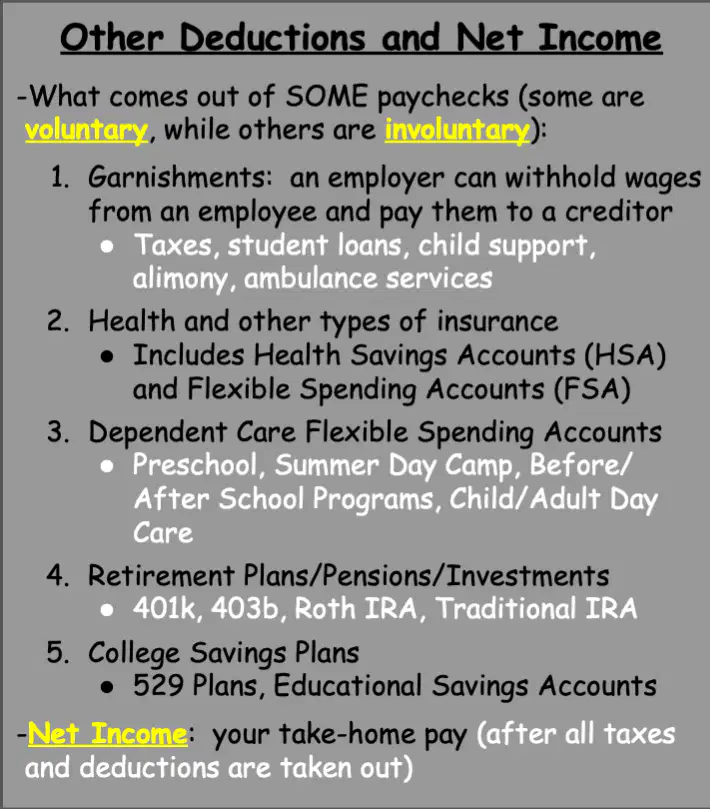
Imagine you are reviewing your paycheck and notice several deductions. Using strategic reasoning, explain how you would determine which deductions are voluntary and which are involuntary, and provide examples of each type based on common paycheck deductions.
Voluntary deductions are those chosen by the employee, such as retirement plans and health insurance; involuntary deductions are required by law or court order, such as garnishments for taxes or child support.
Voluntary deductions are always related to taxes, while involuntary deductions are related to health insurance.
Voluntary deductions are only for college savings plans, while involuntary deductions are only for retirement plans.
Voluntary deductions are those that the employer decides, while involuntary deductions are those the employee chooses.
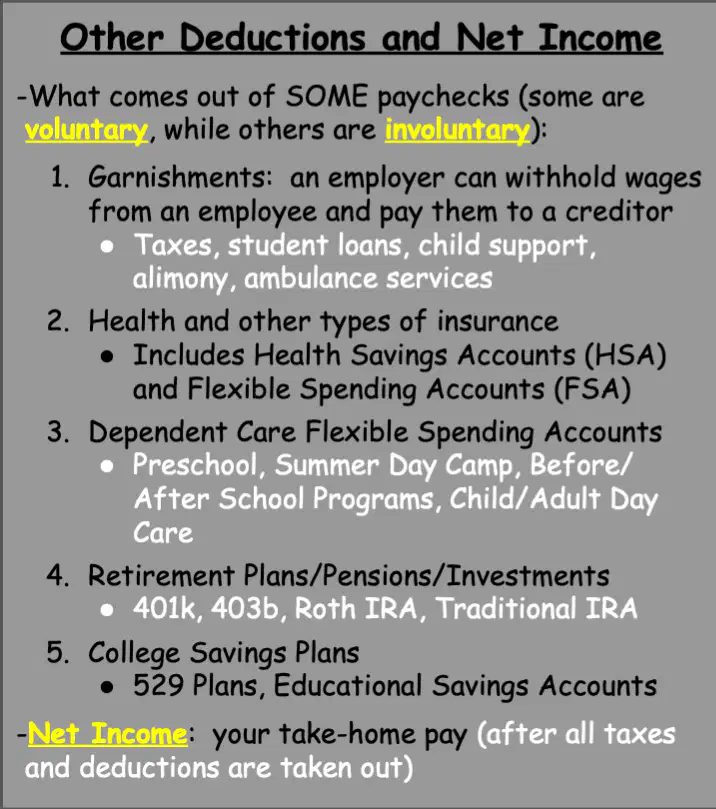
A family is planning their finances and wants to maximize their take-home pay (net income). Strategically analyze which types of deductions they should minimize or avoid, and explain how these choices would impact their net income.
They should minimize voluntary deductions like retirement plans and college savings plans, as these reduce net income, while involuntary deductions cannot be avoided.
They should avoid all deductions, including taxes and health insurance, to maximize net income.
They should only focus on increasing involuntary deductions to maximize net income.
They should increase all deductions to maximize net income.
Given the self-employment tax rate of 15.3% (12.4% for Social Security and 2.9% for Medicare), analyze how this tax structure impacts the net earnings of someone earning $1,000 from a side hustle, and explain the reasoning behind the calculation.
The individual would pay $153 in self-employment tax, reducing their net earnings to $847, because the tax applies to net earnings over $400.
The individual would pay $12.40 in self-employment tax, as only Social Security is taxed.
The individual would pay $29 in self-employment tax, as only Medicare is taxed.
The individual would not pay any self-employment tax, as the earnings are below the taxable threshold.
Evaluate the potential benefits and drawbacks of choosing a side hustle that is paid on a job-by-job basis, such as freelance writing, compared to traditional employment, using evidence from the provided material.
Benefits include flexible income opportunities and independence, but drawbacks include the need to manage taxes and lack of consistent pay, as side hustles are usually paid per job and require self-employment tax payments.
Benefits include guaranteed income and employer-managed taxes, but drawbacks include less flexibility and independence.
Benefits include employer-provided health insurance, but drawbacks include higher tax rates for side hustles.
Benefits include no need to report income to the IRS, but drawbacks include limited earning potential.


