
Font size
 Worksheets
Interim Assessment #2 Question Bank
Total questions: 165
Worksheet time: 3hrs 2mins
Ghana grew rich because of the trade of ______ and _______.
Salt and Iron
Gold and Iron
Gold and Salt
Salt and Ore
What is an impact of the establishment of Trans-Saharan Trade Routes in West Africa?
Europeans traveled to West Africa to study in Timbuktu
Islam and Arabic spread to West African centers of trade
Horses were transported to West Africa to carry goods.
Barber tribes were conquered and cease to exist.
(WHII.4e) All of the following were exports from Africa during the 1500s EXCEPT —
Slaves
Gold
Ivory
Manufactured goods
(WHII.5d) The Triangular Trade altered Africa’s economy by increasing dependence on —
slave exports
exploration of Asia
trade with China
independence movements
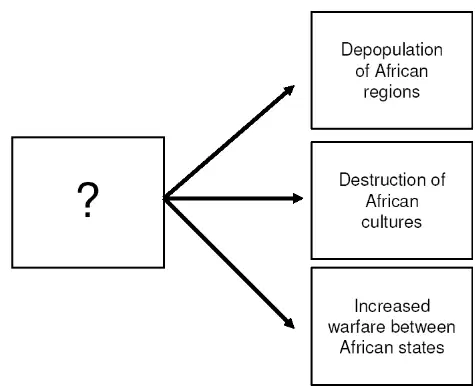
Use this information to answer the next question. Choose the answer that most accurately completes the chart above.
A. Triangle Trade
B. Balance of Trade
C. Northwest Passage
D. Treaty of Tordesillas
Which of the following describe the imports that began to appear in Africa during the 1500’s?
manufactured goods from Asia, Europe, and the Americas
raw materials from Asia, Europe, and the Americas
No imports arrived in Africa due to isolationist trading practices.
Africa only imported raw materials and manufactured goods from the Americas.
Which European country controlled the Congo during the imperial period?
Germany
Britain
Belgium
France
What event officially allowed Europeans to carve Africa into colonies?
Scramble for Africa
Treaty of Versailles
Industrial Revolution
Berlin Conference
What was the long-term impact of European-drawn borders in Africa?
Strong national unity
Civil wars and ethnic conflict
Economic prosperity
The end of cultural diversity
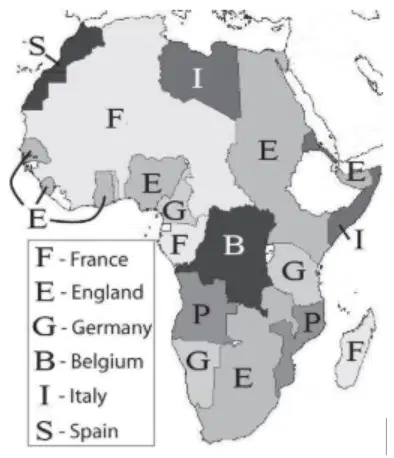
During the late 19th century, Africa was colonized and controlled by –
England and Russia.
most major European countries.
France.
Muslim traders.
What was the main purpose of the Berlin Conference of 1884–1885?
To end the Atlantic slave trade
To divide Africa among European powers
To support African independence movements
To create free trade zones in Africa
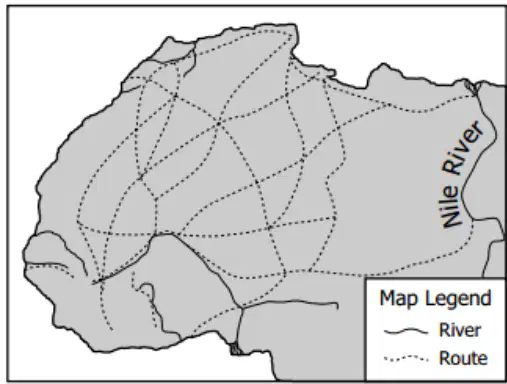
Refer to the map of Trans-Saharan Routes. These routes are historically significant primarily because they —
were used by invading armies
allowed people to explore new regions
provided access to food and water sources
made possible an exchange of goods and ideas
Which situation existed under the policy of apartheid in South Africa?
All people were guaranteed suffrage.
The white minority controlled society.
Social inequality was eliminated.
The black majority held most of the power.
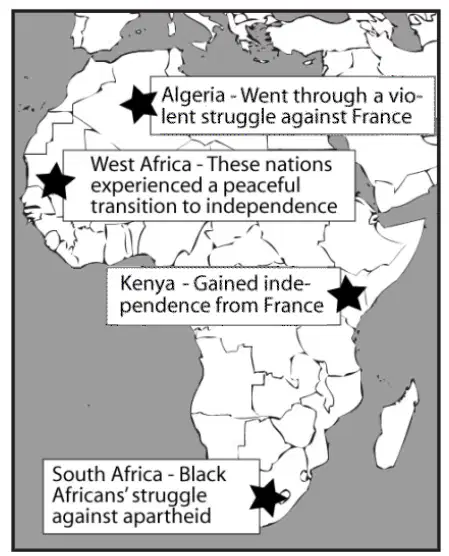
This map shows important events in Africa's independence from European countries. Which area's description is FALSE?
Kenya
South Africa
Algeria
West Africa
The first British colony south of the Sahara to achieve independence changed its name from the Gold Coast to –
Botswana.
Kenya.
Ghana.
Zimbabwe.

The table BEST exhibits what concept?
Separate but Equal
Apartheid
Paternalism
Pan-Africanism
Who became the first black President of the Republic of South Africa in 1994?
William de Klerk
Kwame Nkrumah
Patrice Lumumba
Nelson Mandela
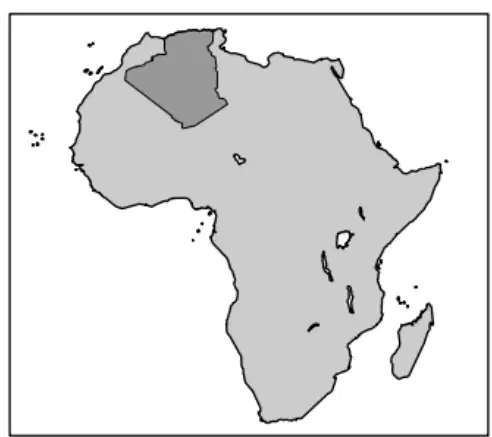
The darker-shaded nation on this map achieved its independence through —
democratic elections
violent conflict
foreign invasion
peaceful negotiations
Use this information to answer the next question.
Database Topics: - Africans forced to adopt Christianity - Africans lose lands to Europeans - Africans work for low wages - Africans lose right of self rule - African cultural values disappear
Which of the following would be a correct title for the above database?
Causes of the Industrial Revolution
Causes of the Triangle Trade
Effects of the Atlantic Slave Trade
Effects of European Imperialism
Which African political leader is described by this list?
- Supported nationalist movements to demand independence from colonial rule
- Jailed by the British for presumed connections to Mau Mau violence
- Negotiated with the British to enact his country's independence
- After independence, served as prime minister and then president
Kwame Nkrumah
Jomo Kenyatta
Patrice Lumumba
Haile Selassie
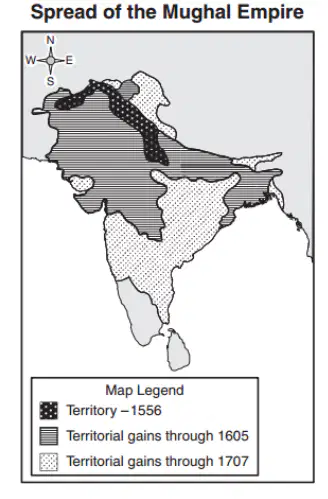
The Mughal Empire originated in the area known as--
Northern India
Southern India
the Middle East
The Balkan Peninsula
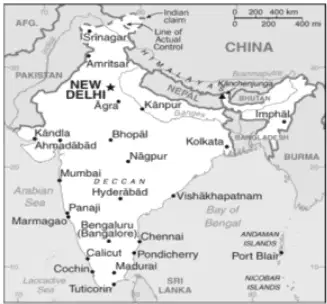
The lightly shaded region in the map above illustrates which of the following empires of the 1500’s?
Russia
Mughal
Spain
Maya
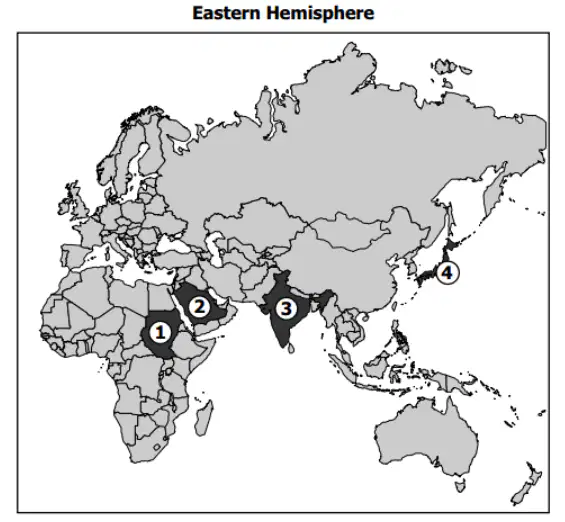
Which modern-day country includes the area once ruled by the Mughals?
1
2
3
4
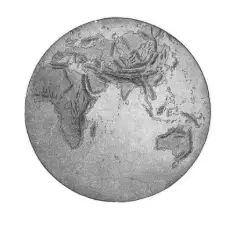
The map above BEST depicts which of the following water routes which was utilized for trade during the 1300’s?
northern European links with the Black Sea
western European sea and river trade
South China Sea
maritime routes across the Indian Ocean
What issue continues to plague south Asia in the modern era?
Religious & ethnic conflict
no economic growth
too much military expansion
Lack of education

Use this table to answer the next question:
Which product BEST completes the table above?
Porcelain
Astronomy
Paper
Textiles

To enshrine his wife’s memory, Shah Jahan ordered the building of a tomb “as beautiful as she was beautiful” that is now called the −
Hagia Sophia
Taj Mahal
St. Basil's Cathedral
Hanging Gardens
Due to increased religious tolerance in the Mughal Empire, what religion spread into India?
Buddhism
Islam
Christianity
Hinduism
European countries took control of the Suez Canal to –
facilitate their global trade efforts.
create a major work project for their surplus populations.
gain favor with Chinese and Japanese traders.
prevent the reunification of the Ottoman Empire.
Which BEST explains the historical significance of Vasco da Gama’s 1498 voyage to India?
It ended European interest in Asian trade.
It allowed the Mughal Empire to expand into Africa.
It resulted in immediate British dominance in India.
It created the first direct sea route between Europe and India, sparking competition for Indian Ocean trade.
What was the MAIN effect of the Sepoy Rebellion on Britain’s control of India?
The British East India Company gained more power.
The Mughal Empire regained rule in northern India.
Britain dissolved the East India Company and began direct Crown rule.
The rebellion succeeded in forcing Britain out of India.
Which BEST explains the connection between Indian textiles and the British Industrial Revolution?
Indian textiles led to Britain’s decline in global trade.
Indian weavers used British machines to dominate global markets.
Indian textiles were banned in Europe, ending trade with Asia.
The demand for Indian textiles inspired British mechanization, fueling the textile industry.
After World War II, which country finally agreed to grant independence to India?
France
Great Britain
Germany
Belgium
Mohandas Gandhi is best known for his –
desire to establish an Islamic nation.
opposition to Hindus holding political office.
encouragement of violence to end British rule.
use of passive resistance to achieve independence.
All of the following are outcomes of the Indian independence movement except –
A. political divisions between Pakistan and India.
B. end of British rule in India.
C. creation of new states like Bangladesh.
D. collapse of trading posts in Sri Lanka.
Which new state was created in the Indian sub-continent to replace East Pakistan?
Pakistan
Sri Lanka
Iran
Bangladesh
The partition of India and the division of Yugoslavia were similar in that both were divided –
as a result of the Berlin conference.
because of religious or ethnic differences.
to form communist and non-communist states.
to conform to United Nations’ guidelines.
Which Indian Ocean island was torn by ethnic discord between the Sinhalese and the Tamils?
Sicily
Sri Lanka
Pakistan
Bangladesh
The greatest influence in the partition of India into two nations was –
the formation of the Muslim League.
British desire to leave India.
fear that the Hindus and Muslims would never be able to live together in peace.
the assassination of Mohandas Ghandi.
After World War II, which country finally agreed to grant independence to India?
France
Great Britain
Germany
Belgium
Mohandas Gandhi is best known for his –
desire to establish an Islamic nation.
opposition to Hindus holding political office.
encouragement of violence to end British rule.
use of passive resistance to achieve independence.
All of the following are outcomes of the Indian independence movement except –
A. political divisions between Pakistan and India.
B. end of British rule in India.
C. creation of new states like Bangladesh.
D. collapse of trading posts in Sri Lanka.
Which new state was created in the Indian sub-continent to replace East Pakistan?
Pakistan
Sri Lanka
Iran
Bangladesh
The partition of India and the division of Yugoslavia were similar in that both were divided –
as a result of the Berlin conference.
because of religious or ethnic differences.
to form communist and non-communist states.
to conform to United Nations’ guidelines.
The 1936 elections in India caused tensions between what two groups of people?
Muslims and Croats
Christians and Jews
Hindus and Arabs
Muslims and Hindus
Which Indian Ocean island was torn by ethnic discord between the Sinhalese and the Tamils?
Sicily
Sri Lanka
Pakistan
Bangladesh
Which of these regions did NOT achieve independence from India after World War II?
A Bangladesh
B Pakistan
C Sri Lanka
D Tibet
The greatest influence in the partition of India into two nations was –
the formation of the Muslim League.
British desire to leave India.
fear that the Hindus and Muslims would never be able to live together in peace.
the assassination of Mohandas Ghandi.
What country is currently the world’s most populous democratic nation?
United States
Britain
Russia
India
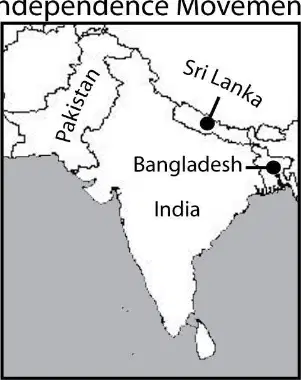
Refer to the map titled 'The Results of the Indian Independence Movement.' Which country is placed incorrectly?
Bangladesh
Sri Lanka
Pakistan
India
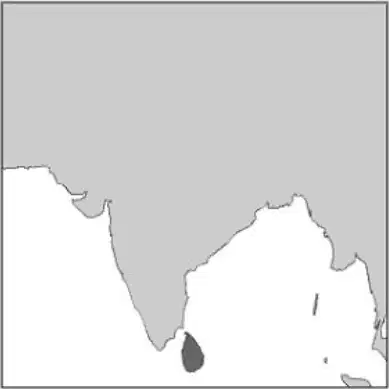
After Indian independence, the darker-shaded region on this map became known as —
Burma
Sri Lanka
Pakistan
Bangladesh
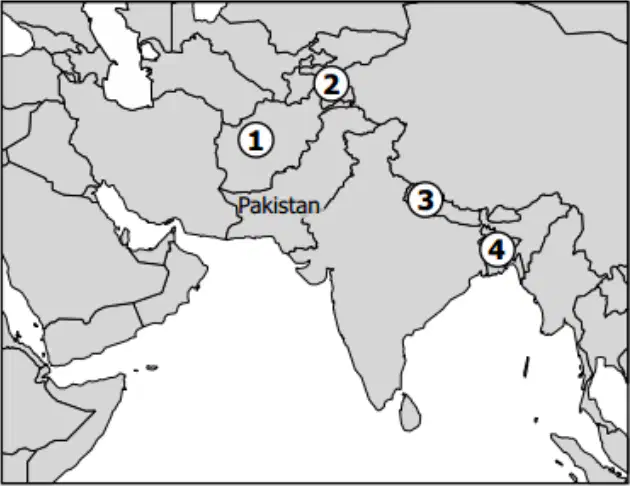
Which country on this map was a part of Pakistan before gaining its independence?
1
2
3
4
The creation of the nation of Pakistan was a result of —
F. religious conflicts within India
G. a mandate by the United Nations
H. economic depression in India
J. a revolt against imperialist France
Feelings of bitterness flourished during the move toward independence in India because the Indian National Congress was dominated by what group?
wealthy traders
Muslims
Hindus
British
What statement describes the federal system that was established in India after it achieved independence?
Many powers are given to the states.
All powers are reserved for the national government.
All powers are given to the state governments.
No powers are given to the states.

Use this list to answer the next question.
Who is described by the characteristics listed?
Indira Gandhi
Jawaharlal Nehru
Morai Desai
Mustafa Kemal
In 1950, one of the goals of the new Indian democratic government was to end what system that encouraged class discrimination?
The caste system
The feudal system
The barter system
The parliamentary system
The conflict over Kashmir highlights what problem that continues to plague India?
economic problems
ethnic and religious differences
struggle to gain independence
lack of powerful leadership
After Indian independence, the darker-shaded region on this map became known as —
Burma
Sri Lanka
Pakistan
Bangladesh
Which country on this map was a part of Pakistan before gaining its independence?
1
2
3
4
Use this list to answer the next question.
Who is described by the characteristics listed?
Indira Gandhi
Jawaharlal Nehru
Morai Desai
Mustafa Kemal
What is the policy of when a stronger/larger nation takes over a smaller/weaker nation?
industrialization
imperialism
alliances
Imperialism started because of which of the following reasons?
Nationalism - Empire Building
Economic - desire for new markets and resources
Western belief in cultural superiority
None of the options are a reason the policy of Imperialism was adopted
Before imperialism, how did China feel about trade with foreign powers?
Enthusiastic
Not interested
Indifferent

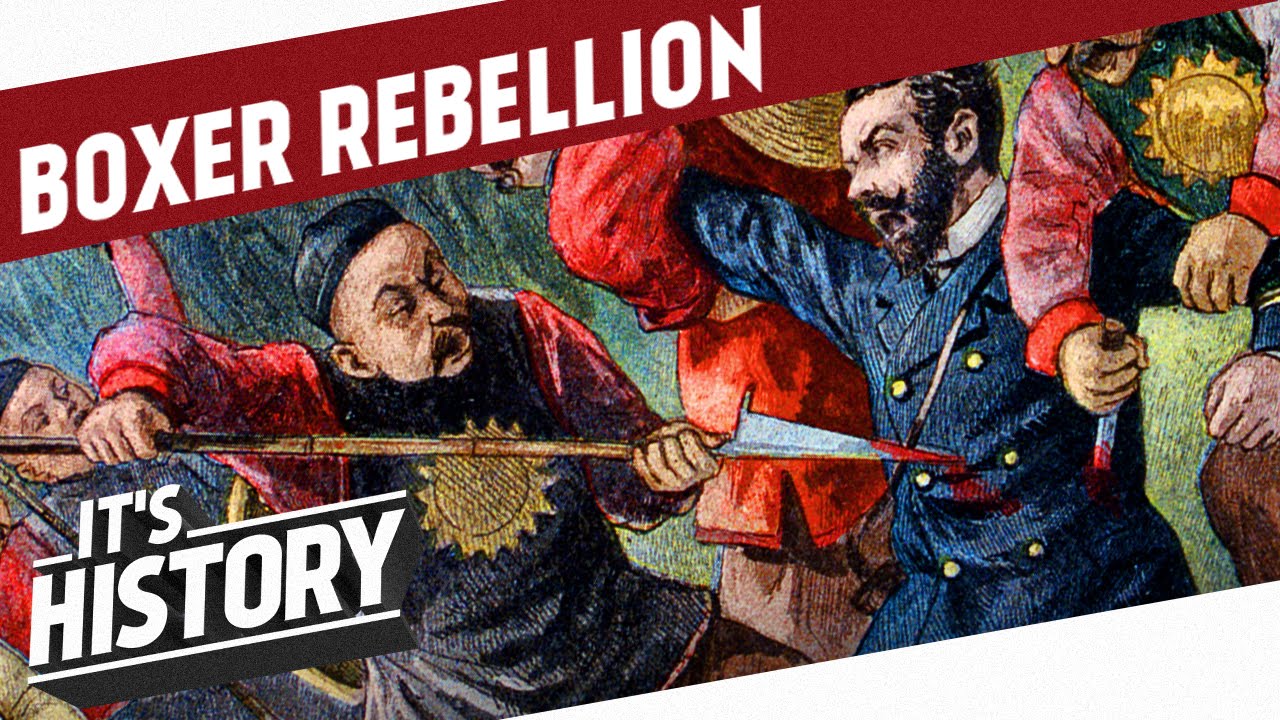
This image most likely depicts the...
Treaty of Nanjing
Boxer Rebellion
Opium Pandemic
Open Door Policy
China never fully came under European control, but rather parts called ___________ were.
boundaries of possession
Realms of Control
Sphere's of Influence
Area's of Control
Who tried to establish a republican form of government after the fall on the Qing dynasty in 1911
Chiang Kai Shek
Sun Yat Sen
Mao Zedong
Deng Xiaoping
Military leader & Cofounder of the CCP
Mao Zedong
Jiang Jieshi
Joseph Stalin
Straun Dsouza
After the Northern Expedition, who tried to purge the communists from the Guomindang?
Sun Yat Sen
Jieng Jieshi
Mao Zedong
Deng Xiaoping
What was the role of the Red Guard during the Cultural Revolution?
Attack and punish those who disagreed with Mao's vision of communism
Reward those who spoke out against corruption in China
Fight against the Soviet Union in China
Fight against the United States in North Korea.
How did China change when Mao Zedong's Communist Party took control?
Businesses and farms came under state ownership
All schools closed
The Red Guard opened special detention camps
Businesses and property were returned to original owners
What was one result of the Great Leap Forward that Mao promoted in China?
Millions of people died of starvation
More farm machinery was purchased to elevate production
Fewer people moved to the countryside for agricultural work
More people moved into cities to work in larger factories
What was the biggest consequence of the Great Leap Forward?
Famine, 20 million people died
The economy was boosted
China became a player in the international setting
Chinese citizens were given more freedoms.
Which happened under the leadership of Deng Xiaoping?
China allowed more freedom of speech
China allowed elements of capitalism
China closed its doors to the West
China lost the Opium War
As a result of trans-Saharan trade, the areas of West Africa converted to —
Christianity
Islam
Judaism
Buddhism
The major products traded between West and East Africa were —
gunpowder and salt
silk and gold
silk and coal
gold and salt

What is the name of the trade route outlined in yellow?
Trans-Saharan Trade Route
Silk Road
Indian Ocean Maritime Trade
South China Sea Trade
What is the name of the trade route outlined in green?
Trans-Saharan Trade Route
Silk Road
Indian Ocean Maritime Trade
South China Sea Trade

What is the name given to the trade route represented by the image?
Trans Saharan Trade Routes
Maritime Indian Ocean Trade ROutes
Silk Road
South China Sea Trade Routes

The shaded area shown was known for trading which good?
Gold
Amber

The holy book of Judaism is the -
Quran
Vedas
Torah
Bible

Buddhism
Islam
Christianity
Hinduism
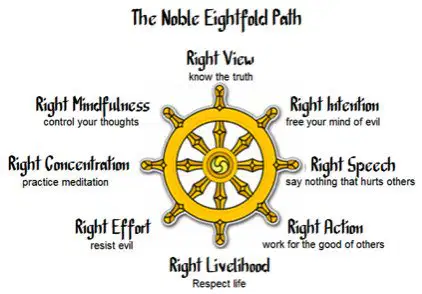
This image is associated with which belief system?
Judaism
Hinduism
Buddhism
Taoism
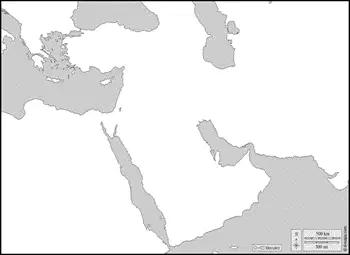
What religion is associated with this region of the world?
Islam
Hinduism
Buddhism
Jainism
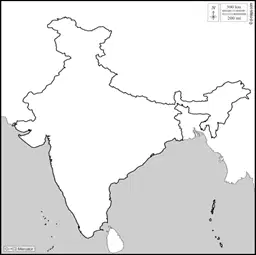
Which religion is associated with this region of the world?
Islam
Judaism
Christianity
Hinduism
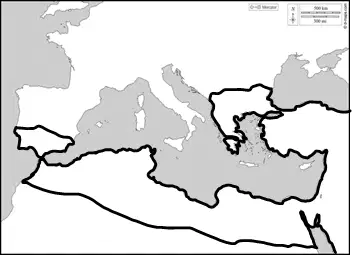
Which religion is associated with this region of the world?
Judaism
Islam
Hinduism
Buddhism
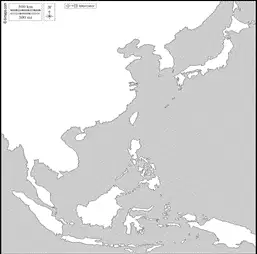
What religion is associated with this region of the world?
Judaism
Christianity
Hinduism
Buddhism

Which best explains the diagram?
knowledge of biology grows
navigational skills improve
use for fossil fuels increases
religious intolerance spreads
Which of the following cities did the Ottomans capture, rename Istanbul, and make their capital?
Athens
Constantinople
Rome
Alexandria
Trade in the Ottoman Empire was mainly centered around −
coffee and ceramics
salt and slaves
gold and diamonds
valuable minerals

In the 1500s, the darker shaded region was ruled by the--
Songhai Empire
Ottoman Empire
Mughal Empire
Ashanti Empire
One reason that the Ottoman Turks were successful in creating a large empire was that they--
taxed visitors who traveled through their empire
conquered the lands of the Mughal Empire
relied on foreign navies to protect their coasts
used the Islamic religion as a unifying force

Use this chart to answer the next question.
After expansion, which empire included all of the territories listed above?
Mughal Empire
Ottoman Empire
Safavid Empire
Songhai Empire
What two European countries agreed to divide the Middle East after WW1?
France
Spain
Germany
Britain
What empire was divided up by the mandate system?
Ottoman
spanish
Portuguese
Dutch
What areas of the middle east came under British control?
Palestine
Syria
Transjordan
Lebanon
Iraq
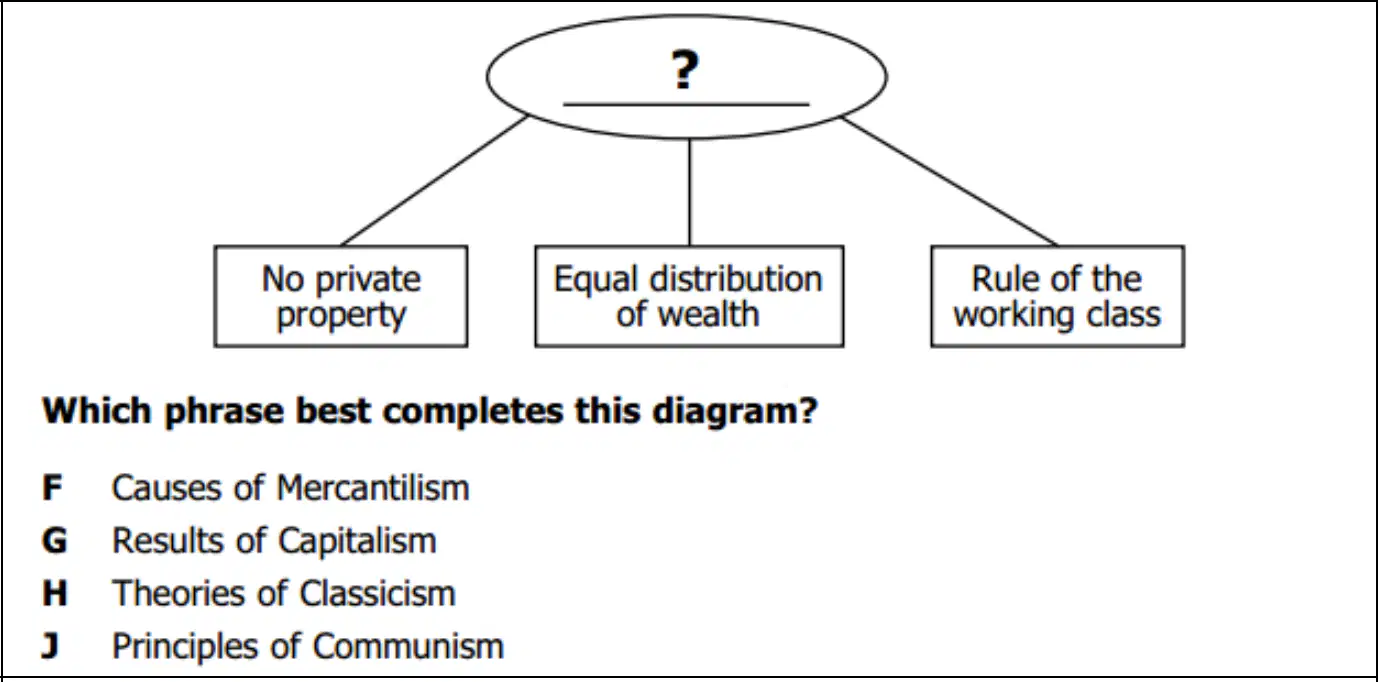

Use this information to answer the next question. Review the information in the chart. Identify which of the following book titles belongs in the chart.
The Wealth of Nations
The Communist Manifesto
Essay on the Principle of Population
On The Principles of Political Economy and Taxation
“The economy will function best if the government stays completely out of the private business sector. Let the free market decide economic questions.” Which author who wrote Wealth of Nations would most likely agree with this comment?
A. Charles Dickens
B. Karl Marx
C. Adam Smith
D. Mary Shelley
What was a criticism of capitalism?
not everyone had jobs
wealth was not evenly distributed
it encouraged government spending
capitalism led to food shortages
"Capitalism is destroying the lives of a huge percentage of workers. It leads to greedy people and an unhealthy society. The government should control all business." Which author might argue something similar to this sentence?
Karl Marx
Adam Smith
Harriet Beecher Stowe
Nathaniel Hawthorne

During the Industrial Revolution, people moved from rural farmlands to the city. This is known as _____________________________.
Workers Migration
Industrial Immigration
Urbanization
Who invented the steam engine?
Ben Franklin
James Watts
Thomas Edison
Henry Ford

The Industrial Revolution began in this country.
The United States
Great Britain
Germany
Russia
Who invented the spinning jenny?
Thomas Edison
James Hargreaves
Henry Bessemer
Isaac Singer

Which invention completes the table above?
Spinning jenny
crop rotation
Bessemer Process
Cotton gin
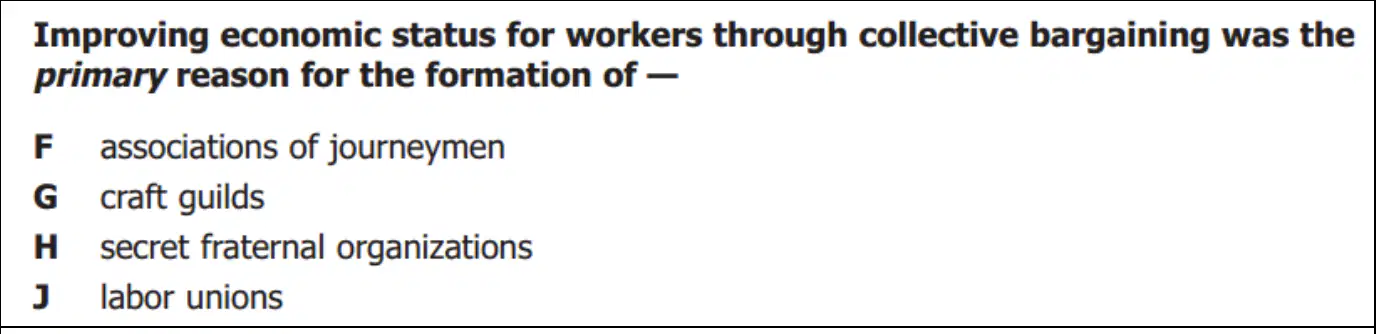
Why did most worker unions organize in the 19th century?
to elect officials friendly to labor
to improve pay and poor working conditions
to return society to a more rural existence

The data in the chart describe −
labor unions
striking forces
collective bargaining
humanitarians
Which scientist of the Industrial Revolution invented a vaccine for smallpox?
Edward Jenner
Louis Pasteur
Eli Whitney
Henry Bessemer
Peter the Great tried to change Russia by –
supporting the Reformation.
eliminating serfdom.
building a strong army.
adopting Western ways.
Which definition explains the concept of divine right?
right to rule comes from God
right to rule comes from the people
right to rule comes through heredity
right to rule comes from within the individual
All of the following are major causes of the Russian Revolution of 1917 except –
A failure of Communism.
B military casualties of World War I.
C defeat in war with Japan in 1905.
D abuse of political power by Czar.
Vladimir Lenin’s promise of "peace, land, and bread" during the Bolshevik Revolution of 1917 was made in an effort to –
end France’s occupation of Russian territory.
restore Czar Nicolas back to the throne.
gain popular support to take control of the government.
resolve conflicts between the farmers and the ruling class.
Which statement best describes the relationship between the Russian Revolution and World War I?
A. World War I helped restore confidence in the Czar to end the Russian Revolution.
B. World War I gave Russia’s army the experience to suppress the revolution.
C. World War I created conditions within Russia that helped lead to a revolution.
D. The Russian Revolution inspired its citizens and allies to win World War I.

Which event is shown above?
Russian Revolution
the fall of the Berlin Wall
rise of the Nazi Party
Austro-Hungarian Civil War
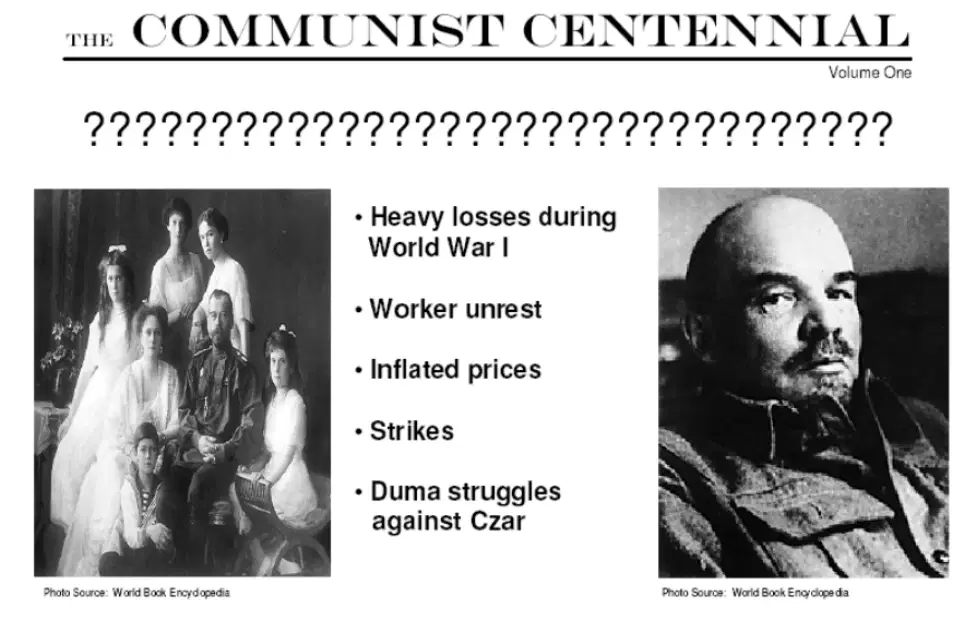
Use this information to answer the next question.
Which of the following would be an accurate headline for the above information?
Czar Nicholas II Confirms Reasons For Declaration of War
Russian Parliament Dissolves Monarchy: Reasons Listed
Study Reveals Major Causes of the Russian Revolution
Supporters of the Czar Reveal Problems of Bolsheviks
The Bolshevik Revolution of 1917 was a major turning
point in history because
Russia became the first nation with a
Communist economic system
it was the last revolution in the 20th century
Russia ceased to be an important force in
world affairs
the royal family was exiled to Mexico
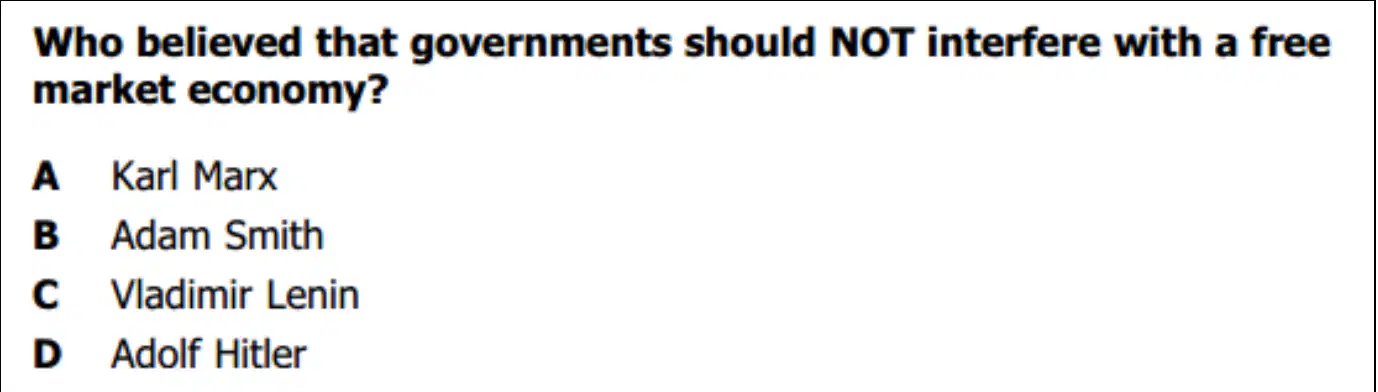
Who believed that governments should NOT interfere with a free market economy?
Karl Marx
Adam Smith
Vladimir Smith
Adolf Hitler
Vladimir Lenin's New Economic Policy differed from Joseph Stalin's Five-Year Plan because the New Economic Policy --
allowed some privately owned businesses
increased regulation of production
eliminated collective farming
imposed production mandates
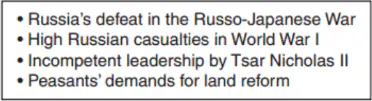
What is the best title for this list?
Causes of the Russian Revolution of 1917
Failures of the League of Nations
Reasons for the Nazi Party's rise to power
Weakness of Russian on the Eve of World War I
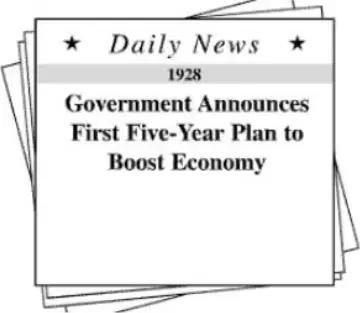
This headline would most likely have appeared in --
Italy
The United States
The Soviet Union
Germany
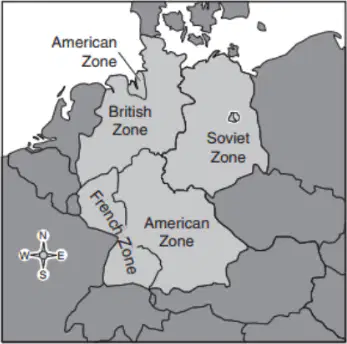
The occupied areas shown in this map became the countries of --
Bosnia and Serbia
East Germany and West Germany
Albany and Yugoslavia
East Pakistan and West Pakistan
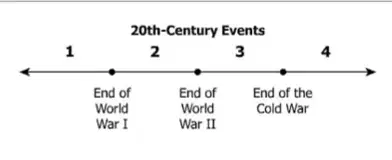
The North Atlantic Treaty organization (NATO) was formed during the period --
1
2
3
4
The ideological basis of the Cold War was conflict between _______ and _______.
absolute monarchy and constitutional monarchy
socialism and fascism
democracy/free enterprise and totalitarianism/communism
democracy and fascism
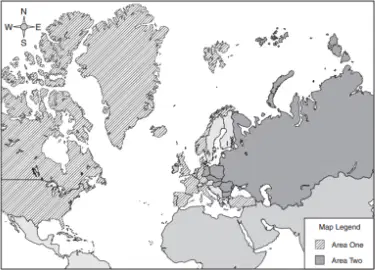
What is represented by the two areas marked on this map?
The Allies and the Axis
The Protestants and the Catholics
The World Trade Organization and the International Monetary Fund
NATO and Warsaw Pact
The United States threatened to use nuclear weapons during the --
Iraqi invasion of Kuwait
Chinese Civil War
Soviet invasion of Afghanistan
Cuban Missile Crisis
Which organization's member states were described as being behind the Iron Curtain after World War II?
United Nations
Axis Powers
European Union
Warsaw Pact
Which leader was most closely associated with stopping the spread of communism?
Harry Truman
Mohandas Gandhi
Joseph Stalin
Kaiser Wilhelm II
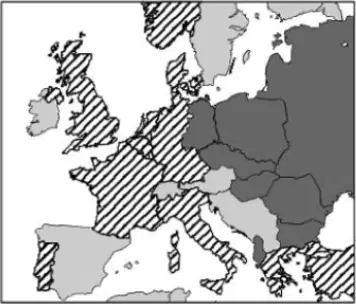
This map represents the political divisions of Europe?
after the Napoleonic Wars
because of the Treaty of Versailles
during the Cold War
after the breakup of the Soviet Union

What is the ideology of this dictator?
Nazi
Fascist
Communist
Militarist

The Soviet Union gained control of German-held territory in eastern Europe as a result of an Allied agreement made where?
The Cold War that followed World War II emerged as a rivalry between--
Germany and the Soviet Union
Italy and Germany
USA and the Soviet Union
Korea and Vietnam

Which U.S. President introduced the policy of containment?
Franklin D. Roosevelt
Harry Truman
Ronald Reagan
John F. Kennedy

The policy of containment was an attempt to contain or stop the spread of --
nuclear weapons
economic problems after World War II
Communism
Continued hostilities from World War II
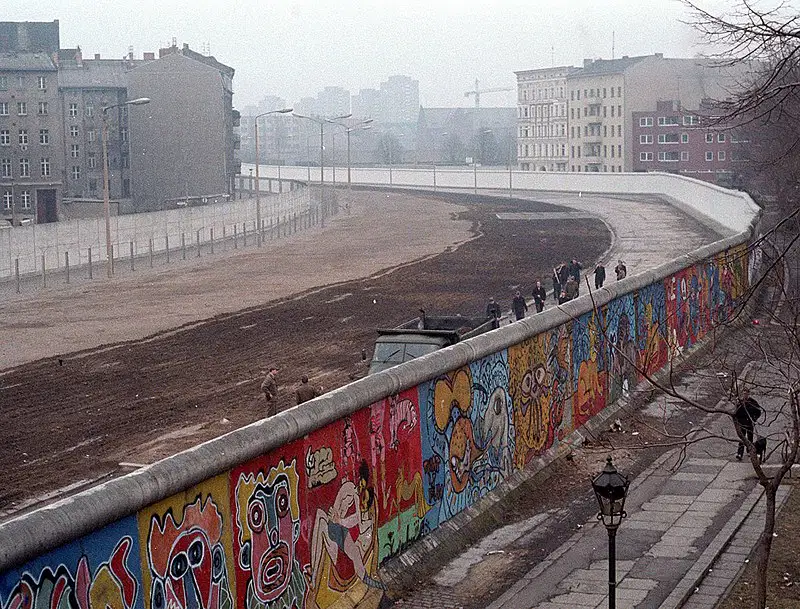
What action became a symbol of the divide between the United States and the Soviet Union?
Formation of the United Nations
Reunification of Germany
Signing of the Nuclear Test-Ban Treaty
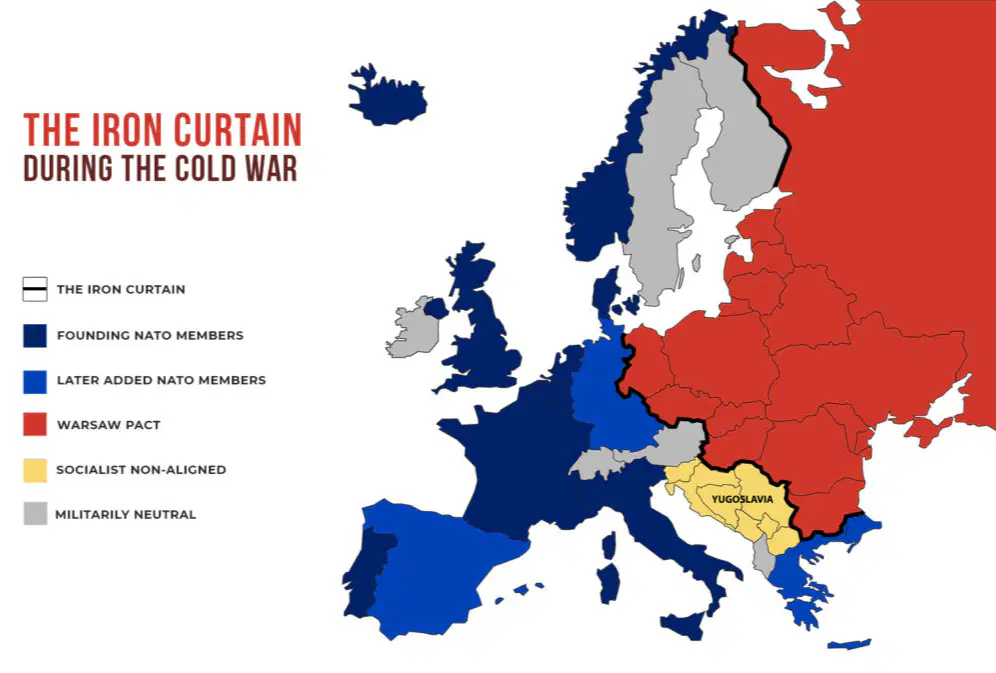
The Iron Curtain --
Prevented Soviet missiles from entering Cuba
Separated Communist from non-Communist nations
provided money to help rebuild Europe after the war
Separated East Berlin from West Berline
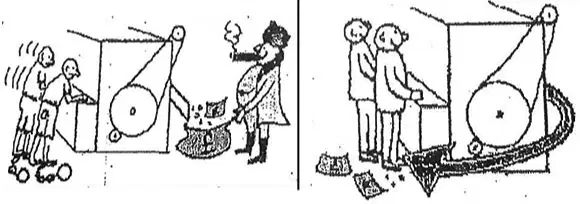
The Cold War can best be described as --
A war fought in cold climates between enemies
an economic war fought between continents.
an ideological war fought through allies and supporting countries
a European rivalry to gain colonial territories

The occupation of Eastern European countries by the Soviet Union contributed to the development of the Cold War by:
bringing about the reunification of Germany.
strengthening the authority of the United Nations.
dividing Europe into Communist and non-Communist spheres.
increasing tensions in the Middle East.
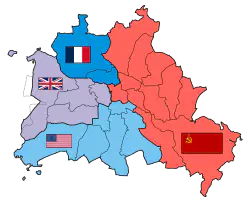
After World War II, Berlin was controlled by
Germany
The United States and the Soviet Union
The Soviet Union, The United States, Britain and France
East Germany and West Germany
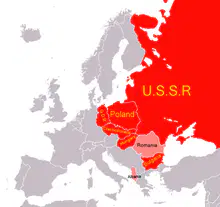
What is the name of the military alliance the Soviet Union made with 7 other nations in 1955?
Allied Pact
Warsaw Pact
Non-Aggression Pact
Stalin Pact
Who was the Cuban Dictator during the Cuban Missile Crisis?
John F. Kennedy
Nikita Khrushchev
Fidel Castro
Dwight Eisenhower

This cartoon represents which topic?
the Space Race
the Arms Race
the bombing of Hiroshima & Nagasaki
the Earth's environmental problems

The US secretly agreed to remove nuclear missiles near the USSR in what two countries?
Latvia & Estonia
Italy and Turkey
Rome & Greece
Cuba and Finland
Ukraine & Czechoslovakia
Who was the Korean War between?
U.S. and South Korea
Russia and North Korea
North Korea and South Korea
North Korea and North Vietnam
Korea was divided along the __________ Parallel after World War II.
35th
36th
37th
38th
Which of the following is the closest the United States has ever come to nuclear war with another country?
the Bay of Pigs Invasion
the Korean War
Vietnam civil war
the Cuban Missile Crisis
What type of economic system did North Korea follow?
Capitalism
Socialism
Liberalism
Communism
If one nation fell to communism then others would eventually fall is known as ....
Containment
Cold War
The Domino Effect Theory
The Warsaw pact
Which of the following best describes the outcome of the Korean War?
Neither side won the war and Korea remains divided today?
The South Koreans won the war and controlled all of Korea
The U.S. and China took over the area
The North Koreans won the war and united Korea under Communism
What kind of government did Ho Chi Minh establish?
Communism
Democracy
Socialism
Monarchy

