
 Worksheets
noop
Total questions: 30
Worksheet time: 15mins
Based on the chart contrasting early political parties, which pairing correctly matches each party to its view of the Constitution?
Federalists: strict construction; Democratic-Republicans: loose construction
Federalists: loose construction; Democratic-Republicans: strict construction
Both parties favored a loose construction to expand federal powers
Both parties favored a strict construction to limit all government powers
Use the information about government preferences in the early republic. Which statement best explains how Federalists and Democratic-Republicans differed in their ideal balance of power?
Federalists emphasized strong state governments to protect local interests, while Democratic-Republicans promoted a strong central government to coordinate national policy.
Both parties preferred a weak central government so long as the courts remained powerful.
Federalists believed in a strong central government, while Democratic-Republicans believed in strong state governments.
Democratic-Republicans wanted equal power between state and national governments, while Federalists favored no national government.
According to the economic preferences shown, which policy choice would most align with Democratic-Republican priorities at the start of the 1800s?
Promoting agriculture and small farmers over urban manufacturing interests
Pursuing closer trade ties with England and expanding manufacturing
Subsidizing northern factories to reduce dependence on farming
Imposing tariffs to protect domestic industry above agricultural exports
The election sometimes called the 'Revolution of 1800' is highlighted for a specific reason. What makes this election revolutionary according to the section?
It replaced the Constitution with the Articles of Confederation.
It marked a peaceful transfer of power between rival political parties from John Adams to Thomas Jefferson.
It abolished political parties in national elections.
It led directly to the Louisiana Purchase before Jefferson took office.
Marbury v. Madison arose after last-minute judicial appointments. Using the context provided, what immediate action by the outgoing Federalists triggered the dispute?
They repealed the Judiciary Act entirely, eliminating federal courts.
They passed the Judiciary Act of 1801 and made 'midnight' appointments to retain power in one branch.
They appointed Jefferson as Chief Justice to resolve party conflicts.
They instructed Madison to deliver all judicial commissions without review.
What was the U.S. Supreme Court’s key ruling in Marbury v. Madison, and why is it significant for American government?
The Court ordered Madison to deliver Marbury’s commission, strengthening executive enforcement.
The Court upheld the midnight judges as constitutional, expanding judicial appointments.
The Court declared part of the appointments unconstitutional and established that the Supreme Court could rule on the constitutionality of laws (judicial review).
The Court refused to hear the case, limiting its own authority to lower courts.
Consider Jefferson’s approach described for his administration. Which action best reflects his stated priorities when entering office?
Expanding military spending to project power abroad
Repealing taxes and limiting federal government power
Increasing tariffs to protect manufacturing
Strengthening federal courts by endorsing midnight judges
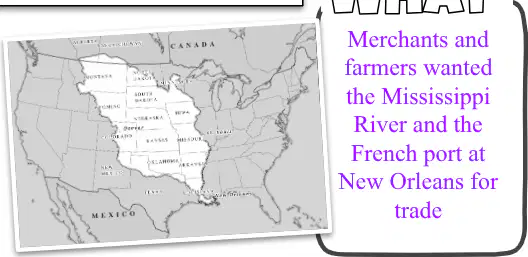
Refer to the summary of the Louisiana Purchase. Which chain of reasons best connects demands in the Mississippi River region to the final U.S. acquisition?
Farmers wanted access to New Orleans; Jefferson negotiated only a military alliance; Napoleon refused any sale due to surplus cash.
Merchants needed the Mississippi and New Orleans for trade; Jefferson negotiated for New Orleans for 10million;becauseNapoleonneededcash,FranceofferedtheentireLouisianaTerritoryfor 15 million.
Planters sought land east of the Appalachians; Congress unilaterally annexed Louisiana; Britain financed the purchase.
Western settlers demanded naval bases on the Pacific; Jefferson purchased Canada; Spain sold Louisiana for $5 million.
Using the excerpt, "Manifest Destiny: Americans are destined by God to spread: Christianity, capitalism, and progress," evaluate which historical development best illustrates how this belief shaped federal policy choices in the early 19th century.
Maintaining strict neutrality in foreign expansion to avoid conflict with Indigenous nations
Passing the Indian Removal Act to open lands for American settlement consistent with a providential mission
Refusing to admit any new states to keep the original balance of the Constitution intact
Eliminating slavery nationwide to unify the nation under a single moral standard
The page lists effects of Westward Expansion, including rising regional tensions, industrial growth in the North, and increased Southern dependence on agriculture and slavery. If Missouri were admitted as a slave state in 1817 when the nation had an equal number of slave and free states, reason through which political consequence the framers of the Missouri Compromise sought to avoid.
A sudden industrial collapse in Northern cities
An imbalance of power in the Senate tipping toward slaveholding interests
Immediate abolition of slavery in newly acquired territories
Loss of federal authority over territorial governance
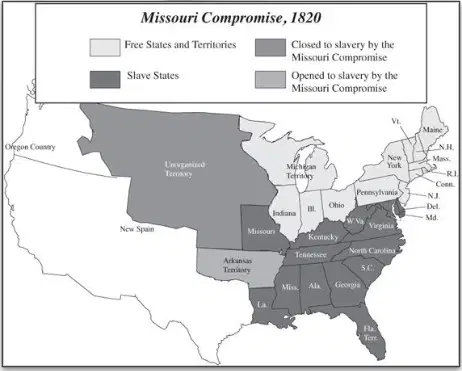
Based on the outlined "Problem" and "Solution" sections, identify the strategic elements of Henry Clay’s Missouri Compromise that addressed the balance-of-power concern while planning for future territorial governance.
Admit Missouri as a free state and permanently ban slavery nationwide
Admit Missouri as a slave state, admit Maine as a free state, and prohibit slavery north of 36°30′ latitude for future territories
Delay Missouri’s admission and expand the number of free states only
Create a new chamber of Congress to offset slave-state representation
The "Corps of Discovery" notes list Lieutenant William Clark, Captain Meriwether Lewis, and Sacagawea. Reason about how this expedition functioned within the broader logic of Manifest Destiny and Westward Expansion effects listed on the page.
It primarily aimed to negotiate European alliances against Britain
It mapped new lands to facilitate settlement and economic development, contributing to regional tensions over slavery and statehood
It enforced immediate federal abolition in western territories
It restricted trade routes to prevent industrialization in the North
The Indian Removal Act (1830) is described as moving tribal nations to Indian Territory and leading to the Trail of Tears. Evaluate which motivation and consequence pairing best aligns with the text.
Motivation: preserve tribal sovereignty; Consequence: stronger self-rule within original homelands
Motivation: settlers wanted to expand their farms onto Native lands; Consequence: forced removal to Indian Territory and the Trail of Tears
Motivation: expand factory labor in the North; Consequence: migration to urban centers by Native peoples
Motivation: protect missions; Consequence: peaceful integration without displacement
In Worcester v. Georgia (1831), Chief Justice John Marshall reasoned that state governments had no authority in tribal affairs, laying the foundation for tribal sovereignty. Which interpretation best applies this ruling to the facts of Worcester’s indictment for residing within Cherokee Nation without a state license?
Georgia’s licensing law is valid because states regulate all residency within their borders
Federal treaties and tribal authority supersede state licensing in Cherokee territory, invalidating Georgia’s prosecution
Tribal sovereignty exists only when approved by a state legislature
Marshall’s opinion limited federal power but affirmed Georgia’s right to tax tribal lands
Drawing on the tone analysis boxes quoting Andrew Jackson’s message to Congress—"benevolent policy... removal of the Indians beyond the white settlements is approaching to a happy consummation"—evaluate how the stated tone contrasts with likely Native American perspectives noted on the page.
Jackson’s tone is sorrowful and condemns removal; Native perspectives are optimistic
Jackson’s tone is happy and pleased about removal; Native perspectives would be greatly saddened and upset
Jackson’s tone is neutral and administrative; Native perspectives are indifferent
Jackson’s tone is apologetic; Native perspectives are supportive of removal
Using the quotation attributed to John Marshall—"The Cherokee nation, then, is a distinct community occupying its own territory in which the laws of Georgia can have no force"—reason which policy outcome most consistently follows from this constitutional view.
States may unilaterally regulate tribal residency and commerce
Federal and tribal law govern within tribal territory, limiting state interference
All tribal lands must be incorporated into surrounding counties
Tribal sovereignty applies only to criminal law, not civil matters
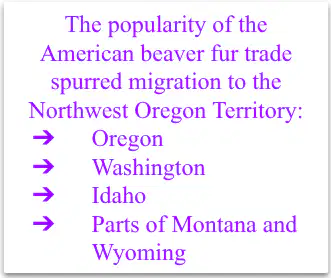
Using the information provided, which combination best explains why the Oregon Territory drew migrants before 1846? Consider both economic pull factors and international agreements that shaped access.
High wages in factory towns and the Monroe Doctrine guaranteeing U.S. control
Profits from the American beaver fur trade and joint British–American control under the Adams–Onís arrangement
Gold discoveries and exclusive U.S. sovereignty after the Louisiana Purchase
Railroad subsidies and open immigration after the Treaty of Guadalupe Hidalgo
A wagon party plans the Oregon Trail journey. Based on typical provisions, which balanced load mirrors historical guidelines listed: select the option that totals the correct types of staples in realistic amounts.
600 lbs. of flour, 120 lbs. of biscuits, 400 lbs. of bacon, 60 lbs. of coffee, plus tea, sugar, lard, and dried foods
300 lbs. of flour, 50 lbs. of biscuits, 100 lbs. of bacon, 20 lbs. of coffee, with spices but no sugar
1,000 lbs. of flour only to save space and time
Mostly fresh vegetables and milk carried for daily use
Which inference best aligns with the note that the Oregon Trail ran 2,000 miles from Missouri to Oregon and typically took six months by wagon?
Migrants relied on rapid rail travel to minimize exposure to weather
Seasonal planning and rationing were critical because the journey spanned multiple climates and seasons
The trip’s brevity allowed frequent returns to resupply along the route
Ocean transport was preferred because the trail was shorter by sea
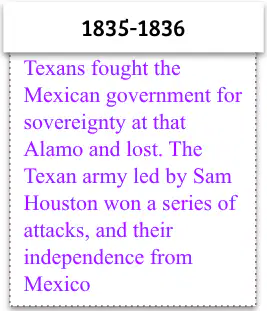
According to the timeline on Texas, which sequence reflects the political progression from local control issues to the national debate known as the “Texas Question”?
Congress first debated annexation, then Texans fought Mexico, then Americans moved to Tejas
Americans moved to Tejas and Mexico lost control; Texans fought for independence; Americans sought U.S. annexation; Congress delayed over adding a slave state
Texans fought for independence; Congress immediately admitted Texas; Americans later moved to Tejas
Mexico annexed Texas to the U.S.; Texans protested; Congress discussed the Texas Question and admitted Texas
Evaluate the statement: “The Alamo was a decisive Texan victory that immediately secured independence.” Using the timeline, choose the most accurate assessment.
Accurate, because the Texan army won at the Alamo and independence followed that day
Partly accurate, because the Alamo was a victory but independence came years later
Inaccurate, because Texans fought at the Alamo and lost, winning independence after subsequent attacks led by Sam Houston
Inaccurate, because the Alamo took place in California during the Bear Flag Revolt
What strategic factor most likely motivated different Westward groups—missionaries, merchants, and Mormons—to settle distinct regions or routes?
All groups sought gold specifically along the California coast
Their aims differed: spreading religious beliefs, establishing trading outposts for profit along trails like Santa Fe, and seeking refuge for communal and polygamous practices in Utah by 1850
Each group was funded by the U.S. Army to occupy forts in Oregon
They were following orders from President Polk to settle only Idaho
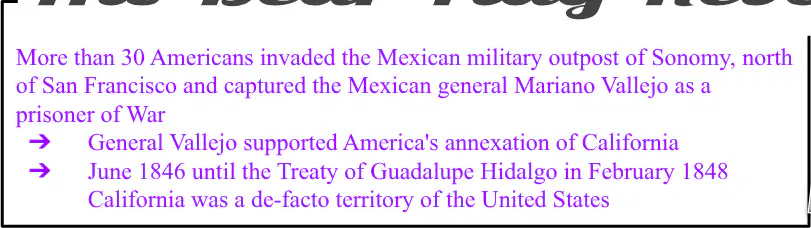
Analyze the Bear Flag Revolt description. Which outcome best captures California’s status between June 1846 and February 1848?
California remained fully under Mexican control without interruption
California became a de facto U.S. territory after a local uprising and stayed so until the Treaty of Guadalupe Hidalgo
California was admitted as a U.S. state immediately after the revolt
California was governed jointly by Britain and the United States
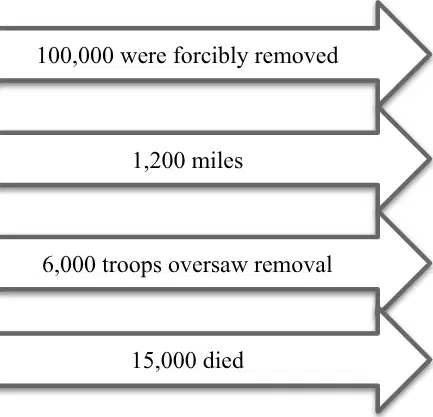
Which interpretation of the Trail of Tears statistics is most supported: 100,000 forcibly removed, 1,200 miles, 6,000 troops oversaw removal, and 15,000 died?
The operation was small-scale and voluntary, with minimal military presence
It was a large, militarized displacement over long distances that resulted in significant loss of life
It was primarily a commercial migration led by merchants seeking profits
It was a brief, peaceful relocation with no fatalities
Using the information provided, evaluate which boundary claim most directly contributed to the outbreak of the Mexican–American War. Which interpretation of the US–Mexico border was asserted by the United States and became a central cause of conflict?
Border along the Nueces River
Border along the Rio Grande River
Border following the Gila River
Border at the Sierra Madre Occidental
President Polk offered Mexico $30 million for disputed territories and sent General Zachary Taylor to camp in Texas. Based on these actions and subsequent events, what strategic rationale best explains how Polk’s approach precipitated war?
It aimed to force Britain to intervene diplomatically on Mexico’s behalf.
It positioned US forces to provoke a Mexican response that could justify a declaration of war.
It prevented US settlers from crossing into Texas and reduced frontier tensions.
It guaranteed immediate Mexican acceptance of the purchase and a peaceful transfer of land.
Abraham Lincoln criticized President Polk, stating Polk gave a long message without showing he had an "even an imaginary conception" of the end. What is the most reasonable inference about Lincoln’s stance toward Polk’s war leadership from this quotation?
Lincoln believed Polk had a clear, achievable plan for victory and reconstruction.
Lincoln viewed Polk as bewildered and lacking a coherent strategy for the war’s objectives.
Lincoln supported Polk’s request for additional troops but opposed new taxes.
Lincoln thought Polk’s main problem was insufficient funding rather than planning.
Sequence the following events to determine which occurred first: US occupation of Mexico City; Treaty of Guadalupe Hidalgo (Mexican Cession) signed; War is declared with Polk’s plan to push Mexican forces from Texas and take California/New Mexico. Which event happened first?
US occupation of Mexico City
Treaty of Guadalupe Hidalgo signed
War is declared and Polk outlines his plan
The Treaty of Guadalupe Hidalgo (February 2, 1848) included multiple outcomes. Which choice best captures the combination of territorial changes and US obligations specified?
Mexico ceded California and Nevada only; the US agreed to pay $30 million and grant immediate citizenship to all Mexicans in America.
Mexico recognized the US annexation of Texas at the Rio Grande and ceded present-day CA, NV, UT, and parts of AZ, NM, CO, WY; the US agreed to pay $15 million and protect Mexicans living in America.
Mexico ceded Texas and Arizona; the US assumed no financial obligations and required all Mexicans to leave within 90 days.
Mexico retained New Mexico but sold California; the US agreed to pay $10 million and annex Cuba to balance territory.
Gold was discovered near Sutter’s Fort along the Sacramento River in January 1848. Considering the immediate and secondary effects described, which outcome best explains why the US Congress faced pressure to annex California by 1849?
Mass migration created boomtowns along the California Trail, intensifying demands for governance and stability.
Gold mining failed to attract migrants, leaving California sparsely populated and politically quiet.
The Mexican army reoccupied California, forcing Congress to annex it for national defense.
British claims to Northern California expanded rapidly, compelling annexation to avoid diplomatic conflict.

