
 Worksheets
Relations and Functions
Total questions: 74
Worksheet time: 37mins
Let A = {1,2,3,4} and B = {3,4,5,6}. Find A × B. Choose the correct complete set of ordered pairs.
{(1,3),(1,4),(1,5),(1,6),(2,3),(2,4),(2,5),(2,6),(3,3),(3,4),(3,5),(3,6),(4,3),(4,4),(4,5),(4,6)}
{(3,1),(3,2),(3,3),(3,4),(4,1),(4,2),(4,3),(4,4),(5,1),(5,2),(5,3),(5,4),(6,1),(6,2),(6,3),(6,4)}
{(1,3),(1,4),(1,5),(2,3),(2,4),(2,5),(3,3),(3,4),(3,5)}
{(1,3),(1,4),(2,3),(2,4),(3,3),(3,4),(4,3),(4,4)}
Let A = {1,2,3,4} and B = {3,4,5,6}. Find B × A. Choose the correct complete set of ordered pairs.
{(1,3),(1,4),(1,5),(1,6),(2,3),(2,4),(2,5),(2,6),(3,3),(3,4),(3,5),(3,6),(4,3),(4,4),(4,5),(4,6)}
{(3,1),(3,2),(3,3),(3,4),(4,1),(4,2),(4,3),(4,4),(5,1),(5,2),(5,3),(5,4),(6,1),(6,2),(6,3),(6,4)}
{(3,1),(3,2),(4,1),(4,2),(5,1),(5,2),(6,1),(6,2)}
{(1,3),(2,3),(3,3),(4,3)}
Let A = {1,2,3,4}, B = {3,4,5,6}, and C = {2,4,6}. Find A × (B ∪ C). Choose the correct complete set of ordered pairs.
{(1,2),(1,3),(1,4),(1,5),(1,6),(2,2),(2,3),(2,4),(2,5),(2,6),(3,2),(3,3),(3,4),(3,5),(3,6),(4,2),(4,3),(4,4),(4,5),(4,6)}
{(1,3),(1,4),(1,5),(1,6),(2,3),(2,4),(2,5),(2,6),(3,3),(3,4),(3,5),(3,6),(4,3),(4,4),(4,5),(4,6)}
{(1,2),(2,2),(3,2),(4,2)}
{(1,2),(1,4),(2,4),(3,4),(4,4)}
Let A = {1,2,3,4}, B = {3,4,5,6}, and C = {2,4,6}. Find (A ∩ B) × C. Choose the correct complete set of ordered pairs.
{(3,2),(3,4),(3,6),(4,2),(4,4),(4,6)}
{(1,2),(1,4),(2,2),(2,4),(2,6)}
{(3,2),(3,4),(4,2),(4,4)}
{(2,2),(2,4),(2,6)}
With A = {1,2,3,4}, B = {3,4,5,6}, and C = {2,4,6}, evaluate (A × B) ∩ (B × C). Choose the correct set.
{(3,4),(3,6),(4,4),(4,6)}
{(1,3),(1,4),(2,3),(2,4)}
{(3,2),(3,4),(4,2),(4,4)}
∅
With A = {1,2,3,4}, B = {3,4,5,6}, and C = {2,4,6}, evaluate (A × B) − (B × C). Choose the correct set.
{(1,3),(1,4),(1,5),(1,6),(2,3),(2,4),(2,5),(2,6),(3,3),(3,5),(4,3),(4,5)}
{(3,4),(3,6),(4,4),(4,6)}
{(1,3),(1,4),(2,3),(2,4),(3,3),(3,4),(4,3),(4,4)}
∅
For any non-empty sets A, B, and C, which of the following product-set identities are valid? Select all that apply.
A × (B ∪ C) = (A × B) ∪ (A × C)
(A ∪ B) × C = (A × C) ∪ (B × C)
A × (B ∩ C) = (A × B) ∩ (A × C)
A × (B ∪ C) = (A × B) ∩ (A × C)
For any non-empty sets A, B, and C, which statements are true? Select all that apply.
(A ∩ B) × C = (A × C) ∩ (B × C)
A × (B − C) = (A × B) − (A × C)
(A ∩ B) × C = (A × B) ∪ (A × C)
A × (B − C) = (A × B) ∪ (A × C)
Suppose A, B, C ⊂ Z × Z with A = {(x,y) | y = 5x − 1}, B = {(x,y) | y = 6x}, and C = {(x,y) | 3x − y = −7}. Find A ∩ B.
{(-1,-6)}
{(4,19)}
∅
Z × Z
Suppose A, B, C ⊂ Z × Z with A = {(x,y) | y = 5x − 1}, B = {(x,y) | y = 6x}, and C = {(x,y) | 3x − y = −7}. Find B ∩ C.
∅
{(-1,-6)}
{(4,19)}
Z × Z
Let the universal set be Z × Z and A, B, C ⊂ Z × Z with A = {(x,y) | y = 5x − 1}, B = {(x,y) | y = 6x}, and C = {(x,y) | 3x − y = −7}. Evaluate A̅ ∪ C̅.
{(4,19)}
∅
Z × Z
{(-1,-6)}
Let the universal set be Z × Z and A, B, C ⊂ Z × Z with A = {(x,y) | y = 5x − 1}, B = {(x,y) | y = 6x}, and C = {(x,y) | 3x − y = −7}. Evaluate B̅ ∪ C̅.
Z × Z
∅
{(4,19)}
{(-1,-6)}
Let A = {1, 2, 3, 4, 6} and R be the relation on A defined by a R b if and only if a is a multiple of b. Choose the correct set of ordered pairs for R.
{(1,1), (2,1), (2,2), (3,1), (3,3), (4,1), (4,2), (4,4), (6,1), (6,2), (6,3), (6,6)}
{(1,1), (2,2), (3,3), (4,4), (6,6)}
{(1,1), (2,1), (3,1), (4,1), (6,1)}
{(1,1), (2,1), (2,2), (3,1), (3,3), (4,1), (4,4), (6,1), (6,3), (6,6)}
Let A and B be finite sets with |B| = 3. If there are 4096 relations from A to B, what is |A|?
3
4
5
6
Let A = {1, 2, 3} and B = {2, 4, 5}. Determine |A × B|.
6
8
9
12
Let A = {1, 2, 3} and B = {2, 4, 5}. Determine the number of relations from A to B.
128
256
512
1024
Let A = {1, 2, 3}. Determine the number of binary relations on A.
64
256
512
729
Let A = {1, 2, 3} and B = {2, 4, 5}. Determine the number of relations from A to B that contain both (1, 2) and (1, 5).
64
96
128
256
Let A = {1, 2, 3} and B = {2, 4, 5}. Determine the number of relations from A to B that contain exactly 5 ordered pairs.
84
120
126
210
Let A = {1, 2, 3}. Determine the number of binary relations on A that contain at least 7 ordered pairs.
36
45
46
55
Let A = {1, 2, 3, 4} and R be the relation on A defined by xRy iff y = 2x. Which set of ordered pairs represents R as a subset of A × A?
{(1, 2), (2, 4)}
{(2, 1), (4, 2)}
{(1, 1), (2, 2), (3, 3), (4, 4)}
{(1, 2), (3, 6)}
Let A = {1, 2, 3, 4} and R be the relation on A defined by xRy iff y = 2x. What are the in-degree and out-degree of vertex 2 in the digraph of R?
in-degree 1, out-degree 1
in-degree 0, out-degree 1
in-degree 1, out-degree 0
in-degree 0, out-degree 0
Let A = {1, 2, 3, 4} and R be the relation on A defined by xRy iff y = 2x. Which adjacency matrix M(R), with rows and columns ordered as 1, 2, 3, 4, is correct?
[ [0,1,0,0], [0,0,0,1], [0,0,0,0], [0,0,0,0] ]
[ [1,0,0,0], [0,1,0,0], [0,0,1,0], [0,0,0,1] ]
[ [0,0,1,0], [0,0,0,0], [0,0,0,1], [0,0,0,0] ]
[ [0,1,0,0], [1,0,0,0], [0,0,0,0], [0,0,1,0] ]
Let A = {1, 2, 3, 4, 6} and R be the relation on A defined by aRb iff a is a multiple of b. Which set of ordered pairs correctly represents R as a subset of A × A?
{(1,1), (2,1), (2,2), (3,1), (3,3), (4,1), (4,2), (4,4), (6,1), (6,2), (6,3), (6,6)}
{(1,1), (1,2), (1,3), (1,4), (1,6)}
{(1,1), (2,2), (3,3), (4,4), (6,6)}
{(2,1), (3,2), (4,3), (6,4)}
For the relation on A = {1, 2, 3, 4, 6} defined by aRb iff a is a multiple of b, what are the in-degree and out-degree of vertex 6 in the digraph of R?
in-degree 4, out-degree 1
in-degree 1, out-degree 4
in-degree 2, out-degree 2
in-degree 3, out-degree 2
For the relation on A = {1, 2, 3, 4, 6} defined by aRb iff a is a multiple of b, which adjacency matrix M(R) with rows/columns ordered 1, 2, 3, 4, 6 is correct?
[ [1,1,0,0,0], [1,1,0,1,0], [1,0,1,0,0], [1,1,0,1,0], [1,1,1,0,1] ]
[ [1,0,0,0,0], [0,1,0,0,0], [0,0,1,0,0], [0,0,0,1,0], [0,0,0,0,1] ]
[ [0,1,0,0,0], [1,0,1,0,0], [0,1,0,1,0], [0,0,1,0,1], [1,0,0,1,0] ]
[ [1,0,1,0,0], [0,1,0,1,0], [1,0,1,0,0], [0,1,0,1,0], [0,0,1,0,1] ]

For A = {a, b, c, d, e, f}, the digraph shown represents a relation on A. Which ordered pair is included in the relation?
(a, a)
(a, c)
(b, e)
(d, f)
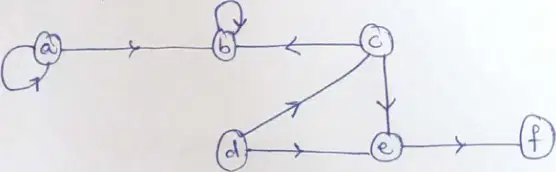
For A = {a, b, c, d, e, f}, based on the digraph shown for the relation on A, which entry of the adjacency matrix M(R) (rows/columns ordered a, b, c, d, e, f) is 1?
Row d, column c
Row a, column f
Row f, column e
Row c, column d
Let A = {1, 2, 3, 4} and R be a relation on A defined by (a, b) ∈ R iff a divides b. Which set of ordered pairs represents R as a subset of A × A?
{(1,1), (1,2), (1,3), (1,4), (2,2), (2,4), (3,3), (4,4)}
{(1,2), (2,3), (3,4)}
{(1,1), (2,2), (3,3), (4,4)}
{(2,1), (3,1), (4,1)}
For the relation on A = {1, 2, 3, 4} defined by a divides b, which statement about powers of the relation is correct?
R is transitive on A, so R2=R and R3=R
R is symmetric on A, so R^2 = R2=identity and R^3 = R3=R
R is antisymmetric on A, so R^2 = empty and R^3 = empty
R is reflexive but not transitive, so
Let A = {1,2,3,4}, B = {w,x,y,z}, and C = {5,6,7}. Relations are defined by R1 from A to B and R2, R3 from B to C as R1 = {(1,x),(2,x),(3,y),(3,z)}, R2 = {(x,6)}, and R3 = {(w,5),(w,6)}. Determine R1 ∘ R2.
{(1,6),(2,6)}
∅
{(1,5),(2,5)}
{(3,7)}
Using A = {1,2,3,4}, B = {w,x,y,z}, C = {5,6,7}, with R1 = {(1,x),(2,x),(3,y),(3,z)} and R3 = {(w,5),(w,6)} defined on B × C, find R1 ∘ R3.
∅
{(1,5),(2,5)}
{(3,6)}
{(1,6),(2,6)}
With A = {1,2,3,4}, B = {w,x,y,z}, C = {5,6,7}, R1 = {(1,x),(2,x),(3,y),(3,z)}, and R2 = {(x,6)}, which matrix equals M(R1 ∘ R2) when rows are ordered 1,2,3,4 and columns are ordered 5,6,7?
Rows 1 and 2 have a 1 in column 6; all other entries are 0
Only row 1 has a 1 in column 5; all other entries are 0
Rows 3 and 4 have a 1 in column 7; all other entries are 0
Every diagonal entry is 1
Based on R1 = {(1,x),(2,x),(3,y),(3,z)} and R2 = {(x,6)} over sets A = {1,2,3,4}, B = {w,x,y,z}, and C = {5,6,7}, does M(R1 ∘ R2) equal the Boolean matrix product M(R1) · M(R2)?
Yes, they are equal
No, M(R1 ∘ R2) has strictly more 1s
No, M(R1 ∘ R2) has strictly fewer 1s
Equality holds only if R3 is used instead of R2
Let A be {1, 2, 3, 4} and R be a relation on A defined by R = {(1,2), (1,3), (2,4), (3,2), (3,3), (3,4)}. Which set equals R composed with R, written R2 ?
{(1,4), (1,2), (1,3), (3,4), (3,2), (3,3)}
{(1,2), (1,3), (2,4), (3,2), (3,3), (3,4)}
{(2,2), (2,3), (3,1), (4,4)}
{(1,1), (2,2), (3,3), (4,4)}
With A = 1,2,3,4 and R = (1,2),(1,3),(2,4),(3,2),(3,3),(3,4) , which set equals R3 (that is, R2 composed with R )?
{(1,4), (1,2), (1,3), (3,4), (3,2), (3,3)}
{(1,2), (2,3), (3,4), (4,1)}
{(1,1), (2,2), (3,3), (4,4)}
{(2,4), (3,2), (3,3), (4,4)}
For A = {1, 2, 3, 4} and R = {(1,2), (1,3), (2,4), (3,2), (3,3), (3,4)}, which 4×4 adjacency matrix M(R) (rows and columns ordered 1,2,3,4) is correct? Give entries row-wise.
Row1: 0 1 1 0; Row2: 0 0 0 1; Row3: 0 1 1 1; Row4: 0 0 0 0
Row1: 1 0 0 0; Row2: 0 1 0 0; Row3: 0 0 1 0; Row4: 0 0 0 1
Row1: 0 1 0 1; Row2: 1 0 0 0; Row3: 0 1 0 1; Row4: 0 0 1 0
Row1: 0 0 1 1; Row2: 0 0 0 1; Row3: 1 0 1 0; Row4: 0 0 0 0
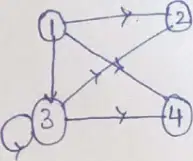
Which 4×4 adjacency matrix M(R^2) (rows and columns ordered 1,2,3,4) matches the digraph of R^2? Give entries row-wise.
Row1: 0 1 1 1; Row2: 0 0 0 0; Row3: 0 1 1 1; Row4: 0 0 0 0
Row1: 0 1 1 0; Row2: 0 0 0 1; Row3: 0 1 1 1; Row4: 0 0 0 0
Row1: 1 0 0 1; Row2: 0 1 0 0; Row3: 0 0 1 0; Row4: 0 0 0 1
Row1: 0 0 0 0; Row2: 0 0 0 0; Row3: 0 0 0 0; Row4: 0 0 0 0
Select all statements that are correct for Boolean matrix multiplication with M(R) corresponding to the relation R on A = {1, 2, 3, 4}.
[M(R)]2 equals M(R2)
[M(R)]3 equals M(R3)
[M(R)]2 equals M(R)
[M(R)]3 equals M(R2)
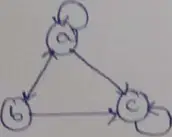
Given the digraphs of relations R and S on the set A={a,b,c} as described: R has edges {(a,a),(a,b),(a,c),(b,c)} and S has edges {(a,c),(b,a),(b,c),(c,c)} . Which set of ordered pairs is R∪S ?
{(a,a),(a,b),(a,c),(b,c)}
{(a,c),(b,a),(b,c),(c,c)}
{(a,a),(a,b),(a,c),(b,a),(b,c),(c,c)}
{(a,a),(a,b),(a,c),(b,a),(b,b),(b,c),(c,c)}

Using the same digraphs of R on A={a,b,c} with edges {(a,a),(a,b),(a,c),(b,c)} , which set of ordered pairs is the complement R taken over A×A ?
{(b,a),(b,b),(c,a),(c,b),(c,c)}
{(a,a),(b,a),(b,b),(c,a),(c,b)}
{(a,b),(a,c),(b,c),(c,c)}
{(a,a),(a,b),(a,c),(b,c),(c,c)}
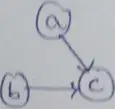
From the digraphs of R and S on A={a,b,c} where R={(a,a),(a,b),(a,c),(b,c)} and S={(a,c),(b,a),(b,c),(c,c)} , which set of ordered pairs is R∩S ?
{(a,c),(b,c)}
{(a,a),(b,a)}
{(a,b),(c,c)}
{(a,a),(a,c),(b,c)}

For relation R={(a,a),(a,b),(a,c),(b,c)} on A={a,b,c} , which set of ordered pairs is the converse (inverse) relation Rc ?
{(a,a),(b,a),(c,a),(c,b)}
{(a,b),(a,c),(b,c),(c,a)}
{(a,a),(a,b),(a,c),(b,c)}
{(b,b),(c,c),(a,c),(b,a)}
Let A={1,2,3} . For the relation R1={(1,2),(2,1),(1,3),(3,1)} on A , select all properties that hold.
Reflexive
Irreflexive
Symmetric
Transitive
Non-transitive
Let A={1,2,3} . For the relation R2={(1,1),(2,2),(3,3),(2,3)} on A , select all properties that hold.
Reflexive
Symmetric
Asymmetric
Transitive
Irreflexive
Let A={1,2,3} . For the relation R3={(1,1),(2,2),(3,3)} on A , select all properties that hold.
Reflexive
Symmetric
Transitive
Equivalence relation
Let A={1,2,3} . For the relation R4={(1,1),(2,2),(3,3),(2,3),(3,2)} on A , select all properties that hold.
Reflexive
Symmetric
Transitive
Equivalence relation
Irreflexive
Let A={1,2,3} . For the relation R5={(1,1),(2,3),(3,3)} on A , select all properties that hold.
Reflexive
Irreflexive
Asymmetric
Symmetric
Transitive
For the relation R6={(2,3),(3,4),(2,4)} , select all properties that hold.
Transitive
Irreflexive
Symmetric
Not symmetric
Let A={1,2,3} . For the relation R7={(1,3),(3,2)} on A , select all properties that hold.
Irreflexive
Non-transitive
Not symmetric
Reflexive
Transitive
Let A={1,2,3,4} . Choose a relation on A that is reflexive and symmetric but not transitive.
{(1,1),(2,2),(3,3),(4,4),(1,2),(2,1),(2,3),(3,2)}
{(1,1),(2,2),(3,3),(4,4),(1,2)}
{(1,2),(2,1),(2,2)}
{(1,1),(2,2),(3,3),(4,4)}
Let A={1,2,3,4} . Choose a relation on A that is reflexive and transitive but not symmetric.
{(1,1),(2,2),(3,3),(4,4),(1,2)}
{(1,1),(2,2),(3,3),(4,4),(1,2),(2,1)}
{(1,2),(2,1),(2,2)}
{(1,1),(2,2),(3,3),(4,4)}
Let A={1,2,3,4} . Choose a relation on A that is symmetric and transitive but not reflexive.
∅
{(1,1),(2,2),(3,3),(4,4)}
{(1,2),(2,1)}
{(1,1),(2,2),(3,3),(4,4),(1,2),(2,1)}
Let A={1,2,3,4} and R={(1,1),(1,2),(2,1),(2,2),(3,3),(3,4),(4,3),(4,4)} be a relation on A . Select all properties that R satisfies.
Reflexive
Symmetric
Transitive
None of these
Let A={1,2,3,4,5,6,7,8,9,10,11,12} . Define a relation R on A by (x,y)∈R if and only if x−y is a multiple of 5 . Select all properties that R satisfies.
Reflexive
Symmetric
Transitive
None of these
Let A=A1∪A2∪A3 , where A1={1,2} , A2={2,3,4} and A3={5} . Define a relation R on A by xRy if and only if x and y are in the same set Ai for i∈{1,2,3} . Select all properties that R satisfies.
Reflexive
Symmetric
Transitive
None of these
For a fixed integer n>1 , let R be the relation on the set of all integers Z defined by aRb if and only if a≡b(modn) . Select all properties that R satisfies.
Reflexive
Symmetric
Transitive
None of these
For the equivalence relation R = {(1,1), (1,2), (2,1), (2,2), (3,4), (4,3), (3,3), (4,4)} defined on the set A={1,2,3,4} , determine the partition of A induced by R.
{{1,2}, {3,4}}
{{1}, {2,3,4}}
{{1,3}, {2,4}}
{{1,2,3,4}}
Find the partition of A induced by R, given A={1,2,3,4,5,6,7,8,9,10,11,12} . The relation R is defined by (x,y)∈R iff x−y is a multiple of 5 .
{{1,6,11}, {2,7,12}, {3,8}, {4,9}, {5,10}}
{{1,2,3,4,5}, {6,7,8,9,10,11,12}}
{{1,6}, {11,2,7,12}, {3,8,4,9}, {5,10}}
{{1,2,3}, {4,5,6}, {7,8,9}, {10,11,12}}
Let A={1,2,3,4,5,6,7} and let R be the equivalence relation on A that induces the partition {{1,2},{3},{4,5,7},{6}} . Identify R from the options below.
R = {(1,1),(2,2),(3,3),(4,4),(5,5),(6,6),(7,7),(1,2),(2,1),(4,5),(5,4),(4,7),(7,4),(5,7),(7,5)}
R = {(1,1),(2,2),(3,3),(4,4),(5,5),(6,6),(7,7),(1,2),(2,1),(3,1),(4,5)}
R = {(1,1),(2,2),(3,3),(4,4),(5,5),(6,6),(7,7),(1,2),(2,1),(4,5),(5,4),(4,7),(7,4)}
R = {(1,1),(2,2),(3,3),(4,4),(5,5),(6,6),(7,7),(1,2),(2,1),(3,2),(4,6),(5,7)}
Let A={1,2,3,4,5} . A relation on A×A is defined by: (x1,y1) is related to (x2,y2) if and only if x1+y1=x2+y2 . Select all properties that this relation satisfies on A×A .
Reflexive on A×A
Symmetric
Transitive
Antisymmetric
Let A={1,2,3,4,5} . The relation on A×A is: (x1,y1) is related to (x2,y2) iff x1+y1=x2+y2 . Which set is the equivalence class of (1,3) ?
{(1,3),(2,2),(3,1)}
{(2,3),(3,2)}
{(1,4),(2,3)}
{(1,3)}
Let A={1,2,3,4,5} . The relation on A×A is: (x1,y1) is related to (x2,y2) iff x1+y1=x2+y2 . Which set is the equivalence class of (2,4) ?
{(1,5),(2,4),(3,3),(4,2),(5,1)}
{(1,5),(2,4)}
{(2,5),(3,4),(4,3),(5,2)}
{(5,5)}
Let A={1,2,3,4,5} . The relation on A×A is: (x1,y1) is related to (x2,y2) iff x1+y1=x2+y2 . Which set is the equivalence class of (1,1) ?
{(1,1)}
{(1,1),(2,0)}
{(1,2),(2,1)}
{(1,1),(2,2)}
Let A={1,2,3,4,5} and a relation on A×A defined by equality of sums: (x1,y1) is related to (x2,y2) iff x1+y1=x2+y2 . Which description correctly gives the partition of A×A induced by this relation?
All equivalence classes consisting of ordered pairs with constant sum x+y=k for k∈{2,3,4,5,6,7,8,9,10}
Subsets grouping ordered pairs by equal product xy
A single class equal to A×A
Classes grouping ordered pairs by equal difference x−y
Find the number of equivalence relations that can be defined on a finite set A with ∣A∣ = 6 .
200
203
205
210
Let A = {1,2,3,4} and R = {(1,1),(1,2),(2,2),(2,4),(1,3),(3,3),(3,4),(1,4),(4,4)} on A. Based on this relation, select all properties that R satisfies on A.
Reflexive
Symmetric
Antisymmetric
Transitive
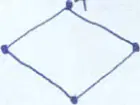
For A = {1,2,3,4} with R as in the previous question, choose the description that matches the Hasse diagram of (A,R).
A chain with 1 below 2 below 3 below 4
A diamond: 1 at the bottom, 2 and 3 above 1, and 4 at the top connected to both 2 and 3
A square: 1 and 2 on the left, 3 and 4 on the right, with horizontal edges only
A star centered at 1 connected directly to 2, 3, and 4 only
Let R be the relation on A = {1,2,3,4} defined by xRy iff x divides y. Select all properties that R satisfies on A.
Reflexive
Symmetric
Antisymmetric
Transitive
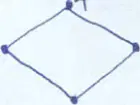
In the Hasse diagram for the divisibility relation on A = {1,2,3,4}, which pair is not a cover relation (i.e., there is an intermediate element between them)?
1 and 2
1 and 3
2 and 4
1 and 4
Let A = {1,2,3,4,6,8,12} and define R by xRy iff x divides y. Select all properties that R satisfies on A.
Reflexive
Symmetric
Antisymmetric
Transitive
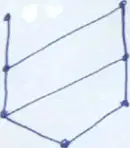
In the Hasse diagram for the divisibility relation on A = {1,2,3,4,6,8,12}, which elements cover 4? Select all that apply.
6
8
12
2
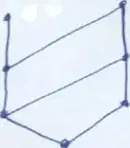
Consider the poset of positive divisors of 36 under divisibility, D36 = {1,2,3,4,6,9,12,18,36}. In its Hasse diagram, which elements cover 6? Select all that apply.
9
12
18
36
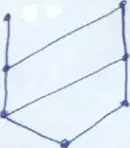
In the Hasse diagram of the poset of positive divisors of 36 under divisibility, how many maximal elements are there?
1
2
3
4

