
 Worksheets
International Trade/exchange rates
Total questions: 68
Worksheet time: 2hrs 33mins
Buying and selling goods across borders
International Trade
Protectionism
Absolute Advantage
Free Trade
Occurs when a country can produce a good utilizing less resources than another country
Absolute Advantage
Comparative Advantage
Free Trade
Balance of Trade
Occurs when a country can produce a good at a lower opportunity cost than another country
Absolute Advantage
Comparative Advantage
Free Trade
Balance of Trade
Government policies that restrict trade
Trade Barriers
Free Trade
Trade surplus
Trade deficit
The policy of imposing duties or quotas on imports in order to protect home industries from overseas competition
Protectionism
Free Trade
Trade Barriers
Trade surplus
What is MOST LIKELY to happen to US imports and exports if the US dollar appreciates relative to other currencies?
imports will decrease, exports will increase
both imports and exports will increase
imports will increase, exports will decrease
both imports and exports will decrease
Goods and services a nation buys from other countries
Imports
Exports
Tariffs
Embargo
Goods and services a nation sells to other countries
Imports
Exports
Tariffs
Embargo
How do tariffs affect domestic consumers over time?
Fewer foreign goods are available and domestic producers will likely increase prices
Domestic goods are more expensive, but foreign goods are cheaper.
The consumers pay lower prices for both foreign and domestic goods.
There is a wider variety of goods available.
Assume the United States has an absolute advantage over Singapore in the production of all goods. Which statement about trade possibilities between the two countries is correct?
The terms of trade will be based on the United States absolute advantage.
They can still arrange a beneficial trade if each one focuses production on a good in which they have a comparative advantage.
Since the United States has an absolute advantage in all goods, it is impossible to reach a trade agreement.
Singapore could benefit from a trade with the United States, but the United States would not benefit.
Taxes on goods coming into a country from another country
Tariff
Embargo
Subsidy
Quota
Standard
Limitation on the quantity of products allowed to be imported into a country
Tariff
Subsidy
Embargo
Quota
Standard
A refusal to trade with a country; imposition of economic sanctions
Tariff
Quota
Embargo
Subsidy
Standard
Guidelines that imports must meet to enter a country
Standards
Tariff
Quota
`Subsidy
Embargo
Payments or other support like tax breaks from governments to businesses
Subsidy
Tariff
Embargo
Standard
Quota
How much the currency of one nation is worth compared to the currency of another nation
Exchange Rate
Standard of Living
Purchasing Power
Standards
Actual amount of goods and services that can be bought with a unit of currency
Purchasing Power
Exchange Rate
Standard of Living
Standards
Which group benefits when the US dollar depreciates (weak dollar)against other currencies?
US citizens traveling in foreign countries
Foreign governments with US Treasury Bonds
Foreign citizens vacationing in the US
US citizens buying foreign goods and services
Using similar resources, Japan can produce 25 cars or 100 computers. The United States can produce 40 cars or 90 computers.
Japan has absolute advantage in the production of cars.
Japan has absolute advantage in the production of computers.
Japan has absolute advantage in the production of both goods
Japan has no absolute advantage in this scenario.
Japan will trade electronic equipment for goods in other countries as long as
other countries have absolute advantage in electronic equipment.
other countries have more desirable exchange rates.
Japans balance of payments is in positive territory.
Japan has comparative advantage in electronic equipment.
Which headline would ASEAN be MOST LIKELY to oppose?
“Philippines considering subsidies to fishing industry”
“Vietnam to remove quotas on Malaysia”
“Germany increasing tariffs on French goods”
“Canada favors trade with Mexico over the US”
The data below shows how much Jessie and Jane can produce given standard baking ingredients. Which statement is true?
Cookies Cakes
Jesse 10 2
Jane 20 5
Jane has comparative advantage in cookies.
Jane has comparative advantage in cakes.
Jessie has comparative advantage in both goods.
Jessie has absolute advantage in both goods.
What is MOST LIKELY to happen US imports and exports if the US dollar appreciates relative to other currencies?
imports will increase, exports will decrease
imports will decrease, exports will increase
both imports and exports will increase
both imports and exports will decrease
In terms of organization and purpose, ASEAN has the MOST in common with
NAFTA
the EU
the FED
FDIC
Having comparative advantage means that a country can produce...
goods at a lower opportunity cost.
more goods than another country.
goods at a higher opportunity cost
In 2019 Nigeria exported $34 billion worth of goods, but imported $46 billion worth of goods. This is called a...
Trade deficit
Trade surplus
Trade balance
Molly is traveling from France to the US. She knows that 1 US dollar is worth 0.80 Euros. How much is 350 Euros worth in US dollars?
$425
$437.50
$280
$375
If 1 US dollar is worth 0.80 Euros, what is the exchange rate for converting Euros to US dollars?
$1.25
$1.50
$.80
$1.10
The producer that can produce the most output OR requires the least amount of inputs (resources)
Comparative Advantage
Trade Offs
Absolute Advantage
Opportunity Cost
The producer with the lowest opportunity cost.
Comparative Advantage
Trade Off
Absolute Advantage
Opportunity Cost

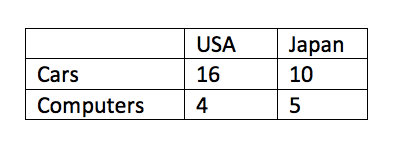
Based on the table provided, which one of the following statements is correct?
Japan has the absolute advantage in producing cars
Japan has the comparative advantage in producing cars
The United States has the absolute advantage in producing both cars and computers
The opportunity cost of producing a car in Japan is 1/2 a computer
Joy gives 2 haircuts and 1 perm. Susie gives 3 haircuts and 2 perms. Who has the absolute advantage for haircuts?
Joy
Susie

Which country has the absolute advantage in producing airplanes?

Who has the comparative advantage in cars?
Peru
neither
U.S.
not enough info

What should the U.S. import?
cars
tools
both
not enough info

What should Peru export?
cars
tools
love
rainbows

The U.S. can produce 10 ipads or 20 phones. China can produce 20 ipads or 30 phones. Who should produce what?
U.S.-ipads
China- phones
U.S. phones
China- ipads
both should produce ipads
they should not specialize
If the United States has inflation rates higher than Mexico, a trade partner, then demand for the US dollar will _____________ (compared to mexico)
Decrease, causing depreciation
increase,causing apprecation
decrease causing appreciation
increase causing depreciation
If the United States has inflation rates higher than Mexico, a trade partner, then demand for the Mexican Peso will _____________ (compared to mexico)
Decrease, causing depreciation
increase,causing apprecation
decrease causing appreciation
increase causing depreciation
If the United States has interest rates higher than Mexico, a trade partner, then demand for the dollar will _____________ (compared to mexico)
Decrease, causing depreciation
increase,causing apprecation
decrease causing appreciation
increase causing depreciation
If interest rates in the United States are lower than in Japan, then the supply of United States currency compared to japan will
increases, causing depreciation
increases causing appreciation
decreases, causing appreciation
decreases, causing depreciation
If the demand for Mexican goods increases from people of the United States, then demand for the ______ will increase and the supply of the ________ will increase
peso, dollar
dollar, peso
If a country's currency appreciates, their net exports _____, shifting AD ____
decreases, left
increases, right
If the United states and canada are trade partners, if American dollar appreciates, then the canadian dollar ________
depriciates
appreciates
If Britain and the United states are trading partners and the United states has higher interest than Britain, the US dollar will ________ the British pound will __________
Appreciate, depreciate
appreciate, appreciate
depreciate, depreciate
depreciate, appreciate
If the United states and japan are trading partners and the inflation rate is 7% in the United States and 5% in japan. The dollar will ________ and the Yen will _____________
depreciate, appreciate
depreciate, depreciate
appreciate, appreciate
appreciate, depreciate
If the United States imposes a tariff on imported steel, what is the most likely immediate effect on the price of steel in the U.S.?
The price will decrease
The price will increase
The price will stay the same
The price will fluctuate randomly
Which of the following best describes an embargo?
A government payment to domestic producers
A complete ban on trade with a specific country
A tax on imported goods
A limit on the quantity of goods imported
If the demand for U.S. goods increases in Europe, what is likely to happen to the value of the U.S. dollar relative to the euro?
The dollar will depreciate
The dollar will appreciate
There will be no change
The euro will appreciate

According to the table, what is the Euro equivalent of 1 USD?
1.32 Euros
0.53 Euros
.76 Euros
1.59 Euros
What is an exchange rate?
The rate at which goods are exchanged between two countries
The price of one nation's currency in terms of another's
How many US dollars you can exchange for RMB at Travelex
The price of goods in terms of a foreign currency
According to the table, what is the Euro equivalent of 1 USD?
1.32 Euros
0.53 Euros
.76 Euros
1.59 Euros

According to the table, what is the USD equivalent of 1 Australian?
0.97 USD
1.32 USD
1.28 USD
1.03 USD
How is an exchange rate determined in the money market?
The forces of supply and demand
Government/the Federal Reserve Bank
Whatever sellers of goods are willing to take
Investors decide the value of the currency they wish to invest
Why do changing exchange rates help one country and hurt the other?
One side loses purchasing power and the other gains it
Takes money away from one side and gives it to the other
Causes war between the two countries
One country's government introduces tariffs to protect local industries
What type of exchange rate system do most countries operate under?
Flexible
Floating
Fictitious
Fixed
What is the difference between a fixed rate exchange system and a floating rate system?
Government sets rate vs market sets rate
Doesn't exist vs does exist
Never changing vs always changing
Currency never appreciates vs can appreciate
If the US $ were to appreciate in relation to the Euro, what effect would this have?
European consumers would have more purchasing power in US
US consumers can buy more European goods and services for fewer $$
US consumers can buy more English goods and services for fewer $$
European tourists to the US will spend more $$
How does inflation rate affect currency value/exchange rate?
Higher inflation leads to depreciating currency & vice versa
Increasing inflation leads to more favourable exchange rates
Higher inflation leads to currency appreciation
Lower inflation leads to more favourable exchange rate
If the Mexican Peso depreciates in relation to the Chinese Yuan, how is Mexico affected?
Mexico has less purchasing power in Chinese currency
Mexico benefits from increased purchasing power
Mexico would have more Chinese investors
They would be invaded by China
What is likely to cause a rise in a country’s foreign exchange rate?
a fall in its exports of goods and services
a fall in its imports of goods and services
a fall in its inflow of income
a rise in its outflow of transfers
A developing country’s two major sources of income from international trade are fishing and tourism. If the country’s exchange rate depreciated, what is likely to happen?
Imported goods would become cheaper for local people.
The country would definitely become poorer.
The price of fish sold as exports would become cheaper.
Tourists to the country would be discouraged by higher prices.
When the US$ exchange rate falls it will usually
help to reduce a US trade deficit.
increase the foreign price of US exports.
reduce the price of US imports.
reduce US inflation

The US currently trades in oil with the UK. The discovery of new oil and gas deposits in the US will mean that its oil imports decrease and its oil exports increase.
From the initial equilibrium point of X, which letter indicates the new equilibrium point for the US exchange rate?
A
B
C
D
68-82.
Answer the questions below after watching the video
What is the official money of a country called?
Stock
Bond
Currency
Commodity
Who usually manages a country's currency?
Local Banks
Central Bank
Private Companies
International Monetary Fund
Which currency is used by many EU member countries?
US Dollar
Euro
Japanese Yen
British Pound
What is the most widely used currency in international transactions?
British Pound
Euro
Japanese Yen
US Dollar
What does an exchange rate refer to?
The value of gold
The rate at which one currency can be exchanged for another
The interest rate of a country
The stock market index
If one US dollar equals 1.05 euros, how many euros can you get for 10 US dollars?
5 euros
15 euros
1.05 euros
10.5 euros
What determines the exchange rate between currencies?
Stock Market
Foreign Exchange Market
Real Estate Market
Commodity Market
What happens to the value of a currency if it is in high demand?
It becomes unstable
It remains the same
It falls
It rises
Which of the following can affect the foreign exchange rate?
Population size
Geographical location
Economic conditions
Weather conditions
What is an example of a digital cryptocurrency?
US Dollar
Euro
Bitcoin
Japanese Yen
How is Bitcoin created and managed?
By private companies
Electronically by a network of computers
By banks
By governments
What determines Bitcoin's value?
Interest rates
Government policies
Market demand
Gold reserves
Why is Bitcoin considered a high-risk investment?
It is issued by governments
Its value can fluctuate widely
Its value is stable
It is supported by tangible assets
What role does currency play in the economy?
It serves as a medium for exchange and a store of value
It determines the population size
It manages geographical locations
It controls the weather
Which of the following is NOT a function of currency?
Determining population size
Store of value
Facilitating trade
Medium for exchange

