
 Worksheets
Kuiz 2 Topic 2
Total questions: 15
Worksheet time: 8mins
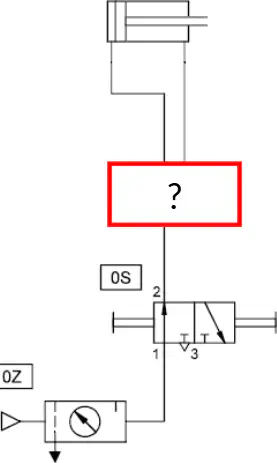
Refer to the direct-control pneumatic sketch showing a push button operating a double-acting cylinder labeled 1A. If the push button is pressed for a very short time and immediately released, what is the most likely cylinder response?
The cylinder fully extends and stays extended until manually reset
The cylinder begins to extend but stops and retracts before reaching full stroke
The cylinder fully retracts and locks mechanically
No movement occurs because short signals are ignored by direct control
Recall: In pneumatic systems, why is indirect control often used for cylinders with a large piston diameter?
Large pistons create a high air requirement that is better handled by actuating a larger control element via a pilot signal
Large pistons are too slow unless controlled directly by a manual lever
Small pistons cannot generate enough pressure for clamping tasks
Indirect control reduces electrical power consumption in the solenoid
A double-acting cylinder is controlled indirectly: it should advance when a push button is operated and retract when the push button is released. Which statement best describes this control behavior?
Direct manual control of the cylinder ports using the push button
Indirect control where the push button actuates a valve that drives the cylinder forward and, on release, causes retraction
Automatic cycling independent of the push button position
Latch control that keeps the cylinder extended after release until a second button is pressed
In an indirect-control circuit for a large double-acting cylinder (250 mm diameter), what is the most likely cylinder response if the push button is pressed for a very short time and then immediately released?
The cylinder will complete a full stroke forward and then retract automatically
The cylinder will begin to advance briefly but may not reach full extension before retracting on release
The cylinder will remain extended due to memory in the valve
The cylinder will not move at all because short signals are ignored by indirect control
When the push button remains actuated at the end position, why does the piston rod not retract until another signal is given in a properly designed memory circuit?
Because exhaust ports are blocked by the cylinder seals
Because the bistable valve keeps the output port pressurized until a reset signal occurs
Because the compressor cannot supply reverse flow while the button is pressed
Because the roller lever valve mechanically locks the rod
If the roller lever valve at mid-stroke triggers a reset on the memory valve, what immediate actuator behavior should be expected?
The cylinder continues extending to the end position
The cylinder holds at mid-stroke until the push button is released
The cylinder changes state and begins retracting
The cylinder momentarily depressurizes both chambers and free-floats
Which placement of a roller lever valve most reliably detects completion of the advance stroke in an indirect control sequence?
Near the cylinder cap end at full extension
At mid-stroke on the piston rod’s path
Near the rod end at full retraction
Immediately upstream of the compressor
In an indirect control circuit, why might engineers prefer a roller lever valve at mid-stroke for certain tasks?
To provide timed delay without any additional components
To add position-based logic for staging operations
To increase supply pressure using mechanical advantage
To reduce leakage by shortening tubing
Which scenario demonstrates the need for a second control signal in a memory-based indirect circuit?
The push button is pressed once and the rod extends and then retracts automatically
The rod extends upon push button actuation and stays extended until a separate retract signal is provided
The rod refuses to move because of insufficient pressure
The rod retracts only when the compressor cycles
Recall: The example labels the lever-operated valve as 1S2. What is its valve type and port configuration?
5/2-way solenoid valve
3/2-way roller lever valve
2/2-way ball valve
4/2-way manual valve
Skill/Concept: For an OR logic pneumatic circuit, which behavior correctly describes the shuttle valve’s output when two inputs are available?
It blocks both inputs until they are equal pressure
It selects the higher pressure input and sends it to the output
It vents the output if either input is pressurized
It requires simultaneous input signals to switch
Recall: What logical behavior is achieved with a dual pressure valve in pneumatic systems?
OR
XOR
AND
NOT
Strategic Thinking: A safety interlock requires two separate operators to press their buttons at the same time to move a cylinder. Which valve arrangement is most appropriate?
Single shuttle valve connecting both buttons to the actuator
Dual pressure valve combining both button signals before the actuator
Pressure regulator feeding each button separately
Check valve placed after each button without combination
Skill/Concept: In the AND-function example, why does the cylinder return to its initial position when either input is released?
The shuttle valve redirects pressure to the exhaust
The dual pressure valve removes output pressure when both inputs are not present
The flow control valve reverses direction automatically
The regulator increases pressure beyond safe limits
Strategic Thinking: When designing a circuit to avoid unintended cylinder movement if one signal sticks on, which logic component helps ensure movement only when a second, independent signal is also present?
Shuttle valve
Dual pressure valve
Check valve
Quick exhaust valve

