
 Worksheets
BSP3153 CHAPTER 6
Total questions: 92
Worksheet time: 5hrs 36mins
Explain how polymers are classified according to thermal response and describe how this classification influences their processing routes. Include the two categories named and a brief note on what each implies for processing.
Outline the two main stages of polymer processing and state what physical state the material is in during each stage.
Describe what happens in the shaping stage when starting from a solid polymer and identify the term used for the liquid phase that results.
In some systems, the starting material is not a solid polymer. Specify two alternative types of starting materials mentioned and comment on their viscosity or molecular characteristics.
Explain where solidification of the polymer melt typically occurs and summarize the different solidification mechanisms for thermoplastics versus thermosets.
Define chemical hardening in the context of thermosets and list the two causes highlighted for this hardening.
Discuss the role of cross‑linking in thermoset processing, including what structural feature it introduces and the consequence for the material’s final form.
Compare the solidification step for thermoplastics and thermosets and explain why the methods differ based on their thermal response.
Provide a concise explanation of what is meant by a polymer melt and indicate when in the processing sequence it appears.
Identify and explain the function of additives in promoting chemical hardening, giving the specific examples cited.
Summarize the distinction between thermoplastics and thermosets as presented, focusing on how each reaches its final permanent form.
Explain why the processing routes for polymers depend on their classification by thermal response, using examples from shaping and solidifying stages.
Consider the following summarized properties: Thermoplastics use melt during shaping, solidify by freezing, the liquid–solid transition is reversible so scrap can be re-used, and they have a ceiling temperature (the temperature at which the material begins to soften again). Thermosets use low molecular weight polymers or low-viscosity resins during shaping, solidify by chemical reaction with cross-linking, the liquid goes irreversibly into a solid so scrap cannot be recovered directly, and they often withstand high temperatures. Explain how processing pathways lead to the different recyclability outcomes of thermoplastics versus thermosets, referring to phase change versus chemical network formation.
Which statement best distinguishes the solidification mechanism of thermoplastics from that of thermosets?
Identify the correct pairing of material class and shaping-stage characteristic.
Discuss how the concept of ceiling temperature applies to thermoplastics and contrast it with the typical high-temperature performance of thermosets.
Explain why the liquid–solid transition is described as reversible for thermoplastics and irreversible for thermosets, and state the implication for scrap handling.
Explain why polymers are typically mixed with additives before being made into a product, and identify the two major overarching purposes for adding these substances.
Differentiate between reinforcing fillers and non‑reinforcing fillers in polymers by describing their primary function and giving representative examples of each.
A polymer part must be stiffer and stronger without excessive creep. Which category of modifying additive should be selected, and why? Include typical materials used.
A manufacturer needs to lower the material cost of a polymer product while keeping properties largely unchanged. What additive category fits this goal, and what is its defining characteristic? Provide examples.
Describe how plasticizers alter the mechanical behavior of a rigid polymer structure, and name a common plasticizer mentioned.
Explain the role of chemical additives such as crosslinkers in polymers and connect this role to chain-level mechanisms.
Identify the purpose of colorants in polymer formulations and explain why this purpose is categorized under modifying rather than protective additives.
Outline the protective additives used to prevent polymer degradation during processing and the types of degradation they target.
A transparent polymer component will be exposed to sunlight and elevated temperatures during processing. Recommend suitable protective additives and justify your choices.
Explain how the classification of additives into 'modifying' and 'protective' helps guide material selection in polymer engineering. Provide an example decision for each class.

Define polymer degradation and explain how the note at the bottom of the visual connects burning to thermal degradation of polymer chains into volatile and flammable products. Provide a concise explanation using the given terminology.
Which additive is primarily intended to help polymers withstand outdoor exposure to ultraviolet radiation?
During polymer processing, what is the purpose of Antistatic Agents, and why is this important for manufacturing safety and quality?
Explain how antioxidants protect polymers at elevated processing temperatures as well as during storage and use.

What role do heat stabilizers play during processing, and how is this distinct from the function of flame retardants?
Describe why lubricants are added to polymer formulations and identify the specific processing behavior they improve.
According to the instructional text, list the TWO uses of an extruder and briefly explain how each use relates to thermoplastics.
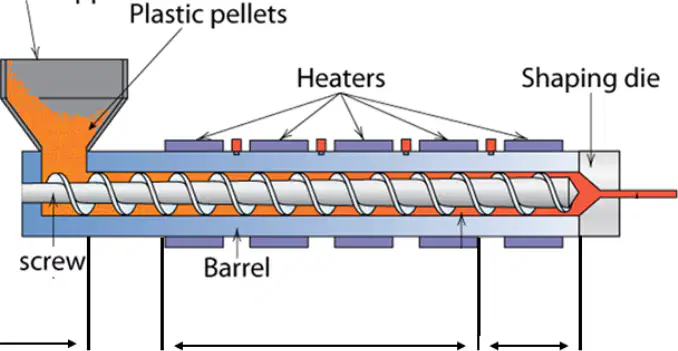
Identify the three main zones labeled in the extruder diagram and explain the role of each zone in moving and transforming the polymer.
From the process description, outline the sequence of setup actions required before adding materials to the hopper.
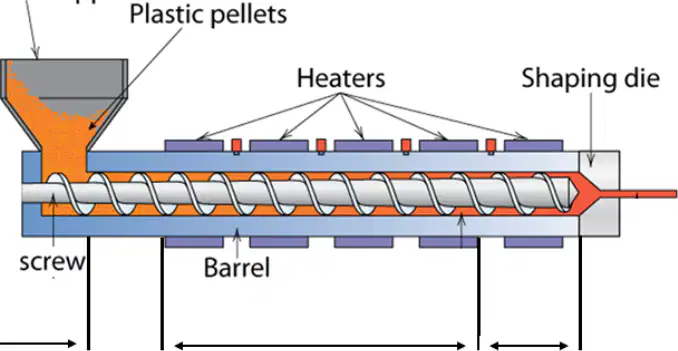
Explain how shape formation occurs in the extruder and name the component responsible for defining the product geometry.
Describe the cooling requirement after the thermoplastic exits the die, including the key temperature criterion and typical cooling methods.
Give examples of thermoplastic products that can be produced by extrusion and categorize them by form.
Summarize what materials may be added during compounding in the extruder, as indicated by the process steps.
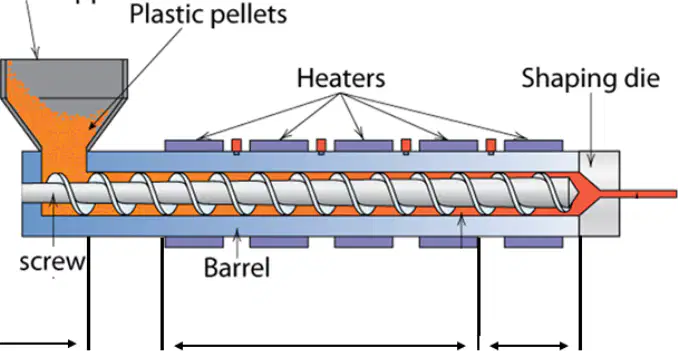
Explain the role of heaters in the extruder barrel as depicted in the diagram and process notes.
State the operational parameter that must be set for the screw and justify why it is important for the process.
Differentiate between extrusion used for compounding and extrusion used for product formation, focusing on the endpoint of each process.
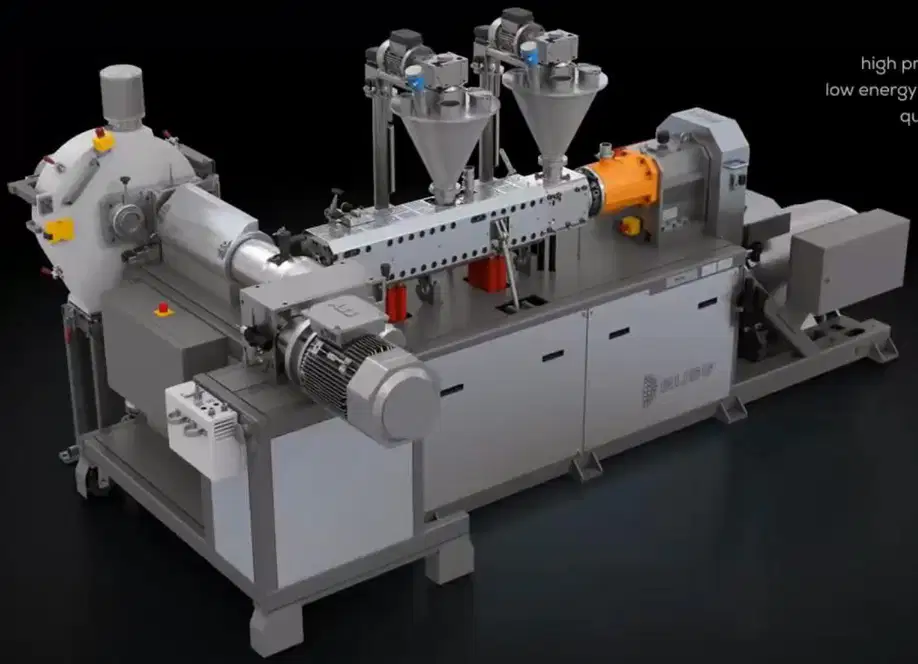
Refer to the diagram of the extrusion line with a horizontal barrel, feed hoppers, drive motors, and a downstream pelletizer. Identify two engineering advantages highlighted for this machine and explain, in one paragraph, how those advantages relate to the thermomechanical processing of polymer melts in extrusion.
Using the labeled cross‑section of an extruder showing Pipe Die, Breaker Plate, Screen Pack, and the screw, explain the function of the breaker plate and the screen pack in maintaining product integrity during extrusion.
From the labeled extruder schematic, describe why a pipe die geometry splits and recombines the melt stream, and relate this to the production of hollow profiles.
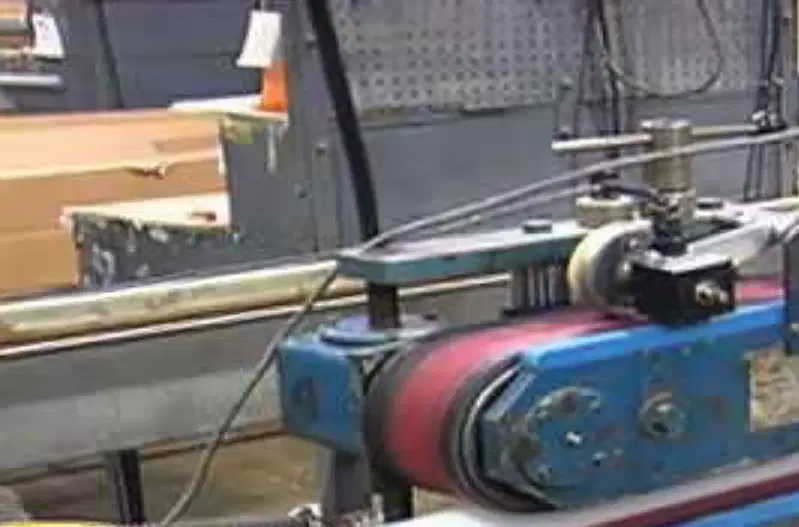
Examine the photo of the downstream extrusion line where a rectangular profile passes through a belt‑type haul‑off. Explain the role of this unit and how its operation affects dimensional stability of the extruded product.
Consider the overall extrusion system illustrated across the images (machine, die components, and product haul‑off). In a short explanation, outline the sequence of material transformation from screw conveying to final profile formation, naming each key component shown.
Define a wood–plastic composite (WPC) and identify its two principal constituent classes mentioned: the lignocellulosic component and the thermoplastic matrix. Explain how combining these classes qualifies WPC as a composite material.
Explain two industrial drivers that motivate XYZ Industries Sdn. Bhd. to pursue a new WPC formulation, and link each driver to the company’s stated constraints or goals.
Given the company’s intention to use recycled PVC, PP, and PE in WPC, analyze two expected benefits and one potential technical challenge that must be addressed in formulation.
Describe how the rules-of-mixture concept can guide the selection and proportioning of wood fibers/flour and thermoplastics in WPC to balance strength and cost.
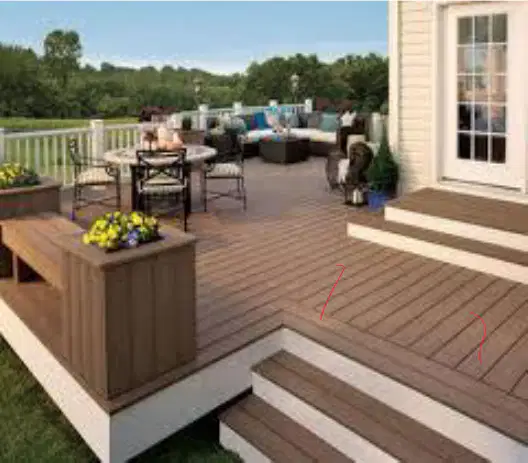
Using the provided description of WPC constituents, discuss why thermoplastics like PE, PP, PVC, and ABS are suitable matrices for outdoor applications shown in the decking visual, and what role wood fibers/flour play.
Critically evaluate the statement that using recycled plastics (PVC, PP, PE) makes WPC ‘stronger, durable and low cost.’ Distinguish between cost and performance claims and propose validation steps.
Formulate an approach for improving WPC techniques and formulations under cost pressure. Include material selection, filler treatment, and processing strategy based on the passage’s constraints.
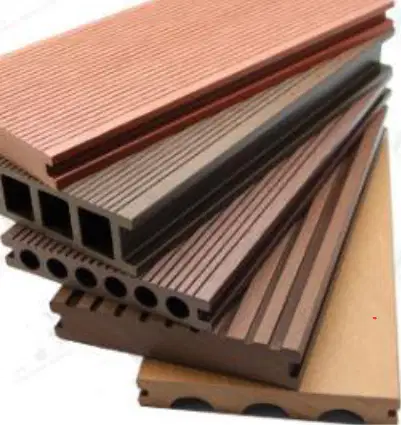
From the WPC description, infer two reasons manufacturers might choose hollow extruded profiles (as shown) for decking systems and relate them to cost and performance.
The slide states three materials to develop the cheapest formulation of Wood Plastic Composites (WPC): recycle plastic to replace virgin plastics (examples: PP, PE, ABS, PVC), wood fibers to replace wood flour/wood (examples: natural fibers such as kenaf, or biomass waste such as oil palm trunk), and mineral fillers to enhance properties (examples: nanoclay, mica, graphite, talc). Explain how each material contributes to cost-effective WPC while maintaining or improving performance, citing the roles and given examples.
Which option best identifies the role of mineral fillers in cost-effective WPC, according to the slide?
Compare recycle plastic and wood fibers in WPC formulation as outlined: What does each replace, and give the specific examples provided for both categories.
Design a low-cost WPC formulation strategy based on the slide: specify the polymer source, the lignocellulosic reinforcement, and the filler family, each using examples given. Briefly justify how this combination reduces cost while sustaining properties.
Injection molding uses a reciprocating screw to melt plastic and inject it into a mold. Explain how the reciprocating screw contributes to producing a more homogeneous melt and why this is important for the quality of injection-molded parts.
Which statement best describes the typical material usage in injection molding?
Some thermosets and elastomers can be injection molded. What precaution must be taken to prevent premature crosslinking before injection?
Identify the two principal components of an injection molding machine and state their primary functions.
The injection unit of an injection molding machine operates much like an extruder. Which pair of functions correctly matches the injection unit?
In the injection molding cycle, what is the role of the clamping unit?
Compare the suitability of thermoplastics versus thermosets for injection molding based on the provided material. Provide one reason injection molding is widely used for thermoplastics and one condition needed when molding thermosets or elastomers.
Which description best captures how the injection molding machine’s components work together during a cycle?
Refer to the injection molding machine diagram. Identify the main purpose of the injection unit and explain how the reciprocating screw contributes to achieving that purpose.
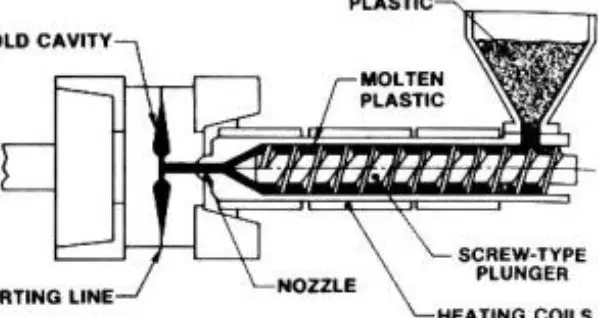
In the labeled machine diagram, what is the function of the feed hopper relative to the barrel and screw, and why might some machines use several hoppers?

Based on the diagram, which component prevents backflow of molten polymer during injection, and where is it located?
Explain why the barrel of the injection unit is made of a heavy steel cylinder and how this design choice relates to operating conditions during melting and injection.
Differentiate between the roles of the stationary platen and movable platen as shown in the machine diagram.
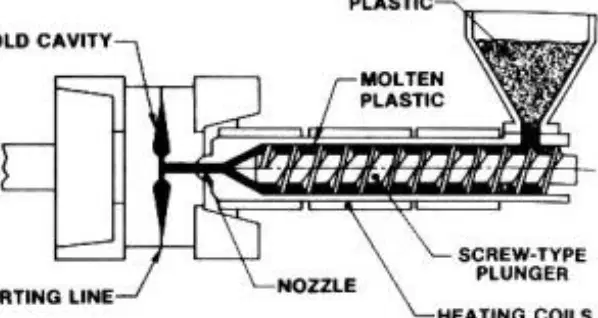
Describe the path of material from solid granules to molded part using the terms: hopper, heaters, barrel, reciprocating screw, nozzle, and mold cavity.
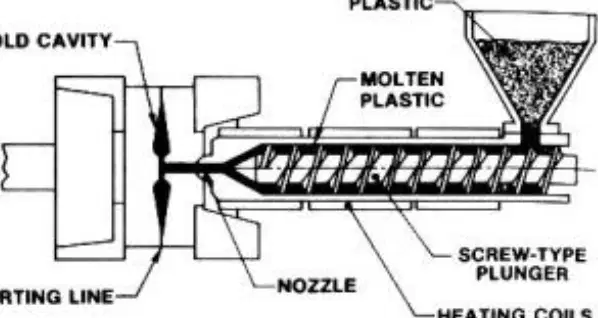
What limitation in mixing capability is noted for injection molding machines, and what design feature causes it?
Identify the two types of systems used in injection molding and briefly characterize the reciprocating screw relative to an extruder.
In the machine diagram, what is the role of the hydraulic clamping cylinder and tie rods during the injection phase?

Explain how heaters and screw rotation interact to melt the resin, and why both mechanisms are needed.
In the reciprocating screw injection molding process, resin is melted by two energy inputs. Explain these inputs and how they act together to melt the resin.
Which statement best describes what happens to the molten resin immediately after melting in the reciprocating screw process?
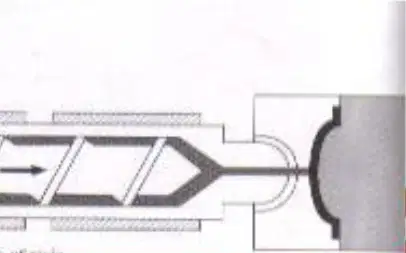
Based on the depicted barrel-and-mold schematic, identify the step when the entire screw moves forward and explain its purpose.
What device is attached to the end of the screw to prevent backflow of resin during injection, and why is it necessary?
Describe the screw position after injection and the condition that triggers its change.
Explain the purpose and effect of screw retraction in the cycle.
Summarize what occurs to the molded part in the cavity after filling and before ejection.
While the part is cooling, what simultaneous action occurs in the barrel, and what is its role in cycle continuity?

Based on the visual titled “The Mold,” explain the role of the mold in injection molding and why molds are replaced between production runs. Your explanation should reference how molds are custom-designed for specific parts.
Which statement best describes a cold‑runner two‑plate mold as presented in the visual?
Compare a cold‑runner three‑plate mold to a hot‑runner mold in terms of runner behavior and part handling. Use information from the visual’s terminology.
Describe what is meant by the mold cavity in the context of injection molding and how clamping force relates to its operation.
From the visual, list the three categories of mold types and justify when a manufacturer might select each, focusing on process outcomes such as scrap and ejection.
Using the visual’s emphasis on customization, outline key design considerations when fabricating a custom mold for a new part.

