
 Worksheets
Prof temmy filtered questions on chemical kinetics
Total questions: 92
Worksheet time: 3hrs 53mins
Which of the following, when dissolved in water, would create a nonelectrolyte?
C2H6O
NH4NO3
NaOH
BaCl2
You begin with a solution of 400 grams of potassium chloride dissolved in 1250 mL of water. If the volume of water is increased by 33%, what is the final molarity of the solution?
3.2 M
4.3 M
5400 M
5.4 M
HNO3
strong electrolyte
weak electrolyte
non - electrolyte
What is defined as an atom or molecule with a net electric charge due to the loss or gain of one or more electrons?
Proton
Conductivity
Ion
Electrolyte
Which of the following will produce ions to conduct electricity when dissolved in water?
CaCl2
NH3
CH4
P2O5
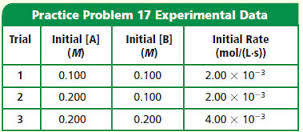
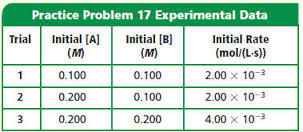


Consider the following data for the reaction:
A+2B → C+D
Deduce the order of reaction with respect to A and with respect to B
A is first order and B is second order.
A is second order and B is first order.
A is first order and B is first order.
A is second order and B is second order.

Consider the following data for the reaction:
A+2B → C+D
Work out a value for the rate constant of this reaction with units.
10 mol-2dm6s-1
10 mol-dm3s-1
5 mol-2dm6s-1
5 mol-dm3s-1

Consider the following data for the reaction:
2X+4Y → Q+2R
Write the rate equation for this reaction.
Rate = k
Rate = k[X]
Rate = k[X][Y]
Rate = k[Y]

Consider the following data for the reaction:
2X+4Y → Q+2R
What are the units of the rate constant?
Moldm-3
Mol-1dm3
Mol-1s-1
Mol-1dm3s-1
A reaction is zero order with respect to P and second order with respect to Q. What would be the effect of doubling the concentration of P and the concentration of Q on the overall rate of reaction?
Constant
The rate of reaction would be Double
The rate of reaction would be Triple
The rate of reaction would be quadrupled

The rate information below was obtained for the following reaction at a constant temperature
2NO2(g) + F2(g) -> 2NO2F(g)
What are the orders of the reaction with respect to N02 and F2?
NO2 is first order and F2 is second order.
N02 is second order and F2 is first order.
NO2is first order and F2 is first order.
NO2 is second order and F2 is zero order.
What order of reaction has a half-life that does not change regardless of the initial concentration?
Zero
First
Second
Third
For second order reaction, the initial concentration of reactant A is 0.24 M. If the rate constant is 8.1 x 10⁻² M-1 s-1, what is the concentration of A after 29 seconds?
0.02 M
0.15 M
0.30 M
0.45 M
Given the following balanced equation :
2NO(g) + Cl2(g) → 2NOCl(g)
If the rate of disappearance of Cl2 is 4.84 x 10⁻² Ms-1, what is the rate of disappearance of NO?
1.45 x 10⁻² Ms-1
2.42 x 10⁻² Ms-1
3.67 x 10⁻² Ms-1
9.68 x 10⁻² Ms-1
In the chemical reaction, the successful formation of products depends on the following factors EXCEPT:
The collisions between reacting molecules must be effective
The colliding molecules must approach each other in the right orientation
The energy of colliding molecules must be equal to or more than activation energy
A collision between molecules must produce sufficient energy to overcome the activation energy
The reaction A + 2B → products was found to have the rate law, k = k[A][B]2. Predict by what factor the rate of reaction will increase when the concentration of B is doubled and the concentration of A remained uncanged
2
4
6
8
The first order rate constant for the decomposition of 0.5 M compound A at 100oC is 0.03 min-1. Calculate the half-life of A.
1.5 min
8.3 min
23.1 min
66.7 min
The rate constant for a second order reaction at 30oC is 2.0 x 10⁻⁶ M-1s-1. The activation energy for this is 108 kJ mol-1. By using Arrhenius equation, determine the collision frequency factor, A for the reaction.
5.0 x 10¹²
6.0 x 10¹²
8.0 x 10¹²
1.0 x 10¹³
Which of the following statements about catalyst is true?
It does not take part in the reaction
It increase the yield of the reaction
It provides an alternative mechanism for the reaction
It increases the number of collisions between reacting molecules per second
What are the sign and units of k in the following rate law equation?
rate=k[A]2
Negative s−1
Positive M−1s−1
Negative M−1s−1
Positive s−1
The Arrhenius law governs what relationship?
temperature and rate constant k
temperature and activation energy
temperature and pH
pH and rate constant
Molecularity of Reactions: Identify the incorrect statement among the following
Molecularity refers to the number of reactant particles involved in an elementary step and can only be an integer value.
The molecularity of a reaction provides direct insight into the reaction mechanism, indicating how reactant molecules come together in the rate-determining step.
For complex reactions, the overall reaction molecularity is the sum of the molecularities of all the elementary steps in the reaction mechanism.
Temperature Dependence of Rate Constants: Identify the incorrect statement among the following
According to the Arrhenius equation, a plot of ln(k) versus 1/T (where T is the temperature in Kelvin) yields a straight line with a slope of -Ea/R.
The Arrhenius equation predicts that the rate constant (k) decreases as the temperature increases, showcasing the temperature's impact on reaction speed.
Activation energy (Ea) and the gas constant (R) are factors in the Arrhenius equation that determine the temperature dependence of the rate constant.
First-Order Reactions: Identify the incorrect statement among the following
A first-order reaction's rate law is given by rate = k[A], where [A] is the concentration of the reactant, and k is the rate constant.
The half-life of a first-order reaction is independent of the initial concentration of the reactants and is a constant for the reaction.
In first-order kinetics, the time it takes for the reactant concentration to reduce to half its initial value is called the reaction's half-life, which varies with concentration.
Order and Molecularity: Identify the incorrect statement among the following
The molecularity of a reaction refers to the number of molecules participating in the rate-determining step and is always an integer.
Reaction order is determined experimentally and can be any fraction, reflecting the reaction rate's dependence on reactant concentration.
Both reaction order and molecularity describe the same aspect of a chemical reaction, specifically how the reaction rate changes with reactant concentration.
Zero-Order Reactions: Identify the incorrect statement among the following
In a zero-order reaction, the rate is dependent on the initial concentration of the reactants and varies over time.
The rate law for a zero-order reaction can be expressed as rate = k, indicating that the reaction rate is directly proportional to the rate constant alone.
Zero-order kinetics imply that the reaction rate changes with variations in temperature but not with changes in reactant concentrations.

Determine the value of rate constant, K based on this table
Rate = K [Q]2
1.0 M-1 s-1
2.0 M-1 s-1
3.0 M-1 s-1
4.0 M-1 s-1
Which of the graph, half life for zero order


The following data were measured for the reaction
BF3(g) + NH3(g) ⟶ F3BNH3(g)
What is the rate law for the reaction?
rate = k[NH3]
rate = k[BF3]2[NH3]
rate = k[BF3][NH3]
rate = k[BF3][NH3]2
Given the following rate law,
rate = k[A]2[B]
if [A] were doubled, what must happen to [B] to keep the rate constant?
[B] must quadruple
[B] must double
[B] must be havled
[B] must be quartered
Which of the following are true of reaction rates?
I. The overall rate law is determined by the fastest step of a reaction
II. The presence of a catalyst will increase the number of molecules entering the transition state
III. An increase in temperature will increase the rate of a reaction
IV. Increasing the concentration of reactants will increase the rate at which products yield
II+III+IV
I+IV
II + III
I+II+III
Units of rate is _______-
M/s
mol/s
m.s
s/M
The quantity of K in rate law expression
Independent of concentration
Is called the Arrhenius constant
Is dimensionless
Is independent of temperature
Consider the reaction:2A→3B. Theaverage rate ofappearance of B is given by [B]/dt. How the average ofappearanceofB related to the average rateofdisappearanceofA?
−2[A])/3t
[A]/t
−[A])/t
−3[A])/2t
Based on the collision model, the atoms in the top of potential energy ‘’hill’’ are called
Top of hill
Activation energy
Transition state
Steric factor
For a certain reaction, the rate=k[NO]2[O2],when the initial concentration of NO is tripled,the initial rate−
Decreases by a factor of nine
Increase by a factor of six
Increase by a factor of nine
Decreases by a factor of six
The half-life period of a first-order process
Depends on reactant concentration raised to the first power
Is inversely proportional to square of reactant concentration
Is inversely proportional to reactant concentration
Is totally independent of reactant concentration
rate = k[A]
The rate constant in the rate law above is 0.5 L/mol·s. If the initial concentration of A is 0.1 M, how long will it take for [A] to drop to 0.025 M?
0.7 s
1.4 s
2.8 s
There is not enough information given.
Rate=[A]2[B]1
Arrhenius equation is
k = AeEa/RT
k = Ae-Ea/RT
k = AeRT/Ea
k = Ae-RT/Ea
The unit of rate and rate constant are same for ______order reaction
zero
one
two
three
The rate law of the reaction 2N2O5 → 2NO2 + O2 is
r = k[N2O5 ]
r = k[N2O5 ]2
r = k[N2O5 ]0
r = k[NO2]4 [O2]
Consider this reaction:
2SO2(g) + O2(g) → 2SO3(g)
The rate of disappearance of SO2 is 1.6 gL-1 min-1. What is the rate of formation of SO3 in molL-1min-1? [Molar mass SO2: 64.0 gmol-1]
0.035
0.025
0.120
0.050
For the reaction, A(g) + B(g) → 2C(g), the rate equation is:
Rate = k[A]2[B]
If the concentration of reactant A is increase by triple at constant temperature, by what factor will the rate of reaction change?
2
6
4
9
The rate constant is doubles on the increasing temperature from 310K to 350K. What is the activation energy (in kJ mol-1) for this reaction?
12.3
15.6
25.8
29.2

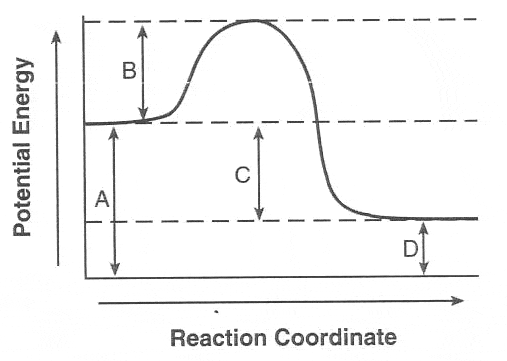
An endothermic reaction with high activation energy for the forward reaction is given by the diagram.
A
B
C
D
X + Y → Z + Q ΔH = +22kj/mol
Which sample of HCl(aq) reacts at the fastest rate with a 1.0-gram sample of iron filings?
10 mL of 1 M HCl(aq) at 10°C
10 mL of 1 M HCl(aq) at 25°C
10 mL of 3 M HCl(aq) at 10°C
10 mL of 3 M HCl(aq) at 25°C
A 5.0-gram sample of zinc and a 50.-milliliter sample of hydrochloric acid are used in a chemical reaction. Which combination of these samples has the fastest reaction rate?
a zinc strip and 1.0 M HCl(aq)
a zinc strip and 3.0 M HCl(aq)
zinc powder and 1.0 M HCl(aq)
zinc powder and 3.0 M HCl(aq)
The rate constant of a reaction is 5.8 × 10 M-1s-1. The order of the reaction is...
0th order
1st order
2nd order
3rd order
What is the half-life (t1/2) of a reactant with a decay constant (λ) of 0.693?
1
2
3
4
rate = k[A]
The rate constant in the rate law above is 0.5 1/s. If the initial concentration of A is 0.1 M, how long will it take for [A] to drop to 0.025 M?
0.7 s
1.4 s
2.8 s
There is not enough information given.

2ClO2(aq) + 2OH-(aq) —> ClO3(aq) + ClO2-(aq) + H2O(l) was studied with the following results:
Calculate the rate constant with proper units.

A → products
The reactant A in the equation above was found to be first order. Which of the following integrated rate laws would correspond to this reaction?
1/[A] = kt + 1/[A]o
ln[A] = -kt + ln[A]o
[A] = -kt + [A]o
For the following reaction
2 N2O5(g) → 4 NO2(g) + O2(g)
If the rate of appearance of O2 is equal to 3.00 mol/min at a particular moment, what is the rate of disappearance of N2O5 at that moment?
0.750 mol/min
1.50 mol/min
6.00 mol/min
12.0 mol/min
For the following reaction
2 N2O5(g) → 4 NO2(g) + O2(g) what is the relationship between the rate of consumption of N2O5 and that of appearance of O2?
1/2 Δ[N2O5]/Δt = Δ[O2]
-1/2 Δ[N2O5]/Δt = Δ[O2]
-Δ[N2O5]/Δt = 1/2 Δ[O2]
-Δ[N2O5]/Dt = Δ[O2]
Write the solubility product constant expression for:
AgCl
(a)

Which salt is least soluble?

Which salt is most soluble?
What is the solubility in moles/liter of AgBr if the Ksp = 5.0 x 10⁻¹³?
(a)
If the solubility of Li₂CO₃ = 0.15 moles/liter, what is its Ksp at this temperature?
(a)
The solubility product of silver chromate (VI) at room temperature is 2.4 x 10⁻¹². Calculate the molar solubility of Ag+(aq) and CrO42-(aq) ions in a saturated solution of silver chromate (VI) at room temperature.
Ag+ = 1.68 x 10⁴ M and CrO42- = 8.4 x 10⁻⁵ M
Ag+ = 1.68 x 10⁴ M and CrO42- = 8.4 x 10⁵ M
Ag+ = 1.68 x 10⁻⁴ M and CrO42- = 8.4 x 10⁵ M
Ag+ = 1.68 x 10⁻⁴ M and CrO42- = 8.4 x 10⁻⁵ M
The Ksp value for PbF2 is 4 x 10⁻⁸. Calculate the molar solubility of solid PbF2 in a 0.5M NaF solution.
8 x 10⁸
1.6 x 10⁷
8 x 10⁻⁸
1.6 x 10⁻⁷

