

wayground logo

Free Printable Worksheets

Font size

S
M
L
XL
Worksheets

C.2 Unit 2 - Lightning - Unit Assessment

Total questions: 35

Worksheet time: 19mins
Name
Class
Date
1.

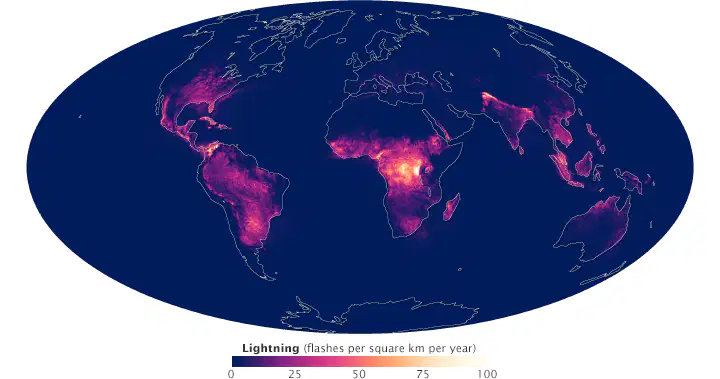
Based on the figure below, which location has the LEAST lightning flashes per year?

a)
Northern Europe
b)
Central Africa
c)
Australia
d)

United States of America

2.
In class, we learned that lightning strikes are most common during the summer months in the U.S. Which of the following factors are necessary for lightning to occur? Select all that apply.
a)
Warmer temperatures
b)
Increased hours of daylight
c)
Increased humidity/moisture in the air
d)
More people are outdoors
3.
Based on our investigations in class and the data that we analyzed, which of the following best describes the relationship between rainfall and lightning strikes.
a)
There is no relationship between rainfall and lightning.
b)
Rainfall causes lightning strikes.
c)
Lightning strikes cause rainfall.
d)
There is a correlation between rainfall and lightning.
4.

Which best explains what will occur if two particles, with like charges, are brought close to each other.

a)
The particles will repel each other.
b)
The particles will be attracted to each other.
c)
There will be no interaction between the particles.
5.
Where does the electrostatic force come from that causes a balloon charged with static to be attracted to another surface, like your hair or a fuzzy sweater?
a)
The charge on the protons in the atoms that make up your hair or sweater
b)
The friction between the balloon and surface makes it stick
c)
The electric field generated by the charge on the balloon
6.

Which particle in the model below is meant to represent protons?

a)
Yellow Circles
b)
Red Circles (+)
c)
Blue Circles (-)
d)
Electrons are not shown in the model
7.
For static charge to build on an object, which subatomic particle must be transferred?
a)
Electrons
b)
Protons
c)
Quarks
d)
Neutrons
8.

An ion gains 2 electrons when it becomes ionized. After losing electrons, what net charge will the ion have?

a)
-2
b)
0
c)
+2
d)
+1
9.
The number of which subatomic particle determines the identity of an element? No two elements have the same number of these:
a)
Neutrons
b)
Protons
c)
Nuclei
d)
Electrons
10.
What is the primary cause of a lightning strike?
a)
The collision of ice crystal and water molecules in a cloud
b)
The rapid build up of static electricity in the atmosphere
c)
The sudden release of energy stored in the electric field between the cloud and the ground
d)
The ionization of air molecules by cosmic rays
11.
Why does a massive buildup of charge occur in a thundercloud?
a)
The rapid movement of air masses creates friction, generating static electricity.
b)
The collision of ice crystals and water droplets separates charges, leading to a charge imbalance.
c)
The Earth's magnetic field induces a charge in the atmosphere.
d)
The Sun emits charged particles that accumulate in the atmosphere.
12.

What is the relationship between the magnitude of charge two charged particles and the electrostatic force between them?

a)

The greater the charge, the greater the force

b)

The charge has no effect on the electrostatic force.

c)

As the charge increases, the force decreases.

d)
The relationship is complex and depends on other factors.
13.
How does polarization of the ground contribute to the formation of lightning?
a)
It weakens the electric field between the cloud and the ground.
b)
It prevents the formation of ionized channels in the air.
c)
It increases the resistance of air to electrical conduction.
d)
It strengthens the electric field between the cloud and the ground, attracting the negative charges from the cloud.
14.
Where is energy stored in a charged object?
a)
In the electric field surrounding the object.
b)
In the nucleus of its atoms.
c)
In the bonds between its atoms.
d)
In the kinetic energy of its electrons.
15.
How does energy transfer during a lightning strike?
a)
Kinetic energy of the air molecules is converted into electrical potential energy.
b)
Chemical energy is converted into light and heat energy.
c)
Nuclear energy is released in the form of radiation.
d)
Electrical potential energy is converted into kinetic energy of the electrons.
16.
Why are metals good conductors of electricity?
a)
They have a strong crystal lattice structure.
b)
They are easily oxidized.
c)
They have a high density of free electrons.
d)
They have a low melting point.
17.
Wood is made of cellulose which is an insulator. Why is an enclosed wooden structure not as safe as a grounded metal structure during a lightning storm?
a)
If it is raining, the wood will absorb water and become more conductive than the metal which increases the chance for electric shock.
b)
The air inside the wooden structure can ionize which will allow the current to jump from wiring to any people in the building.
c)
Because wood has a high resistance to electrical current, it will catch of fire when struck by lightning.
18.
How do ionic compounds like sodium chloride conduct electricity when dissolved in water?
a)
The water molecules break down the ionic bonds, releasing free electrons.
b)
The ions in solution can move freely and carry electric charge.
c)
The dissolved salt molecules form a conductive network.
d)
The water molecules themselves become charged and conduct electricity.
19.
How does the polarity of water molecules contribute to their ability to dissolve ionic compounds?
a)
The positive end of the water molecule attracts the negative ions of the ionic compound.
b)
The negative end of the water molecule attracts the positive ions of the ionic compound.
c)
The polarity of water molecules allows them to surround and separate the ions of the ionic compound.
d)
All of the above.
20.

You are conducting an investigation on the conductivity of liquids. Based on what you have learned, which of the following liquids would have the LOWEST conductivity?

a)
Distilled Water (0% Salt)
b)

0.1% Salt Solution

c)

2% Salt Solution

d)

10% Salt Solution

21.
Which material would be the best conductor of electrical current?
a)
Wood
b)
Copper wire
c)
Plastic
d)
Fiberglass
22.

How can understanding the principles of electricity and electrostatics help us protect ourselves during a thunderstorm? (More than one answer choice may be correct.)
a)
By understanding these principles, we can design lightning rods to protect buildings.
b)
By understanding these principles, we can develop early warning systems for thunderstorms.
c)
By understanding these principles, we can avoid activities that increase our risk of lightning strike.
23.
In a static interaction, Object A becomes negatively charged after being rubbed with Object B. What must have happened at the atomic level?
a)
Protons moved from Object A to Object B.
b)
Neutrons were exchanged between the two.
c)
The nuclei of both objects were altered.
d)
Electrons moved from Object B to Object A.
24.
What does the electric field around a charged object represent?
a)
The total number of electrons in the object.
b)
The speed at which the charge moves.
c)
The region where the object exerts force on other charges.
d)
The amount of light energy emitted.
25.
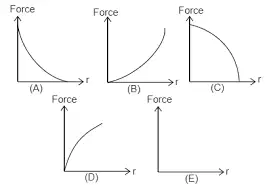
Which graph below best shows the relationship between force and distance as oppositely charged particles are moved farther apart?
a)
A
b)
B
c)
C
d)
D
e)
E
26.
A scientist compares two materials to test conductivity. One contains tightly held electrons; the other has free-moving electrons. Which conclusion is correct?
a)
Neither material conducts electricity.
b)
Both materials are conductors.
c)

The material with tightly held electrons is the better insulator.

d)

The material with free electrons is the better insulator.

27.
Why do ions conduct electricity in salt water but not in solid salt?
a)
In solution, ions move freely; in solids, they are fixed in place.
b)
Solids contain only neutral atoms.
c)
Solids have more resistance to air.
d)
Dissolved ions lose their charges.
28.
What is the relationship between electric potential energy and electric field strength?
a)
Electric field strength and potential energy are unrelated.
b)
Stronger electric fields store more potential energy between charges.
c)
Weak fields store more potential energy.
d)
Electric fields only store kinetic energy.
29.
Which description best fits an insulator?
a)
Substance that easily transfers electrons.
b)
Object with no electrical properties.
c)
Material that resists the flow of electric charge.
d)
Metal with high conductivity.
30.
A neutral metal sphere is brought near a negatively charged glass rod. What happens?
a)
The protons in the sphere move toward the rod.
b)
The rod loses its negative charge.
c)
No movement occurs because the sphere is neutral.
d)
The electrons in the sphere move away from the rod.
31.
What is the best reason to avoid swimming during a lightning storm?
a)
Water contains dissolved ions that conduct electricity.
b)
Lightning cannot reach underwater.
c)
The air above water is an insulator.
d)
The water molecules block electricity.
32.
Which statement best explains how a lightning rod protects a building?
a)
It stops lightning from forming in the cloud.
b)
It neutralizes the storm’s electric field.
c)
It prevents electrons from moving through the air.
d)
It provides a safe conductive path to the ground for electric charge.
33.
A fifth grade class constructed this circuit.  Which of these objects most likely made the light glow when connected to points X and Y?
a)
plastic straw
b)
cotton string
c)
aluminum foil
d)
rubber eraser
34.
Jill finds that all of the electric cords in her school are covered in plastic. Why is it important to cover the electric cords with plastic?
a)
Plastic is an insulator.
b)
Plastic is a conductor.
c)
Plastic is strong.
d)
Plastic will melt.
35.

Jay uses various objects to complete a circuit. He compares how bright a bulb glows using each object. His results are shown here.

Which object is the BEST electrical conductor?

a)

nail

b)

eraser

c)

crayon

d)

pencil lead
