
 Worksheets
Rules for Pronouncing Meem and Noon Mushaddad
Total questions: 73
Worksheet time: 37mins
What is the rule for pronouncing a Meem or Noon Mushaddad?
It must be pronounced with a Ghunnah (Nasal sound) of 2 beats.
It must be pronounced without any nasal sound.
It must be pronounced with a Ghunnah of 4 beats.
It must be pronounced with a silent tone.
What should a reader do if they stop on a word ending with Noon or Meem Mushaddad?
Apply the Ghunnah for the Meem or Noon Mushaddad.
Skip the Ghunnah and continue reading.
Pronounce the word without any nasal sound.
Repeat the word twice.
What does the term "Mushaddad" indicate in the context of Noon and Meem?
It indicates the presence of a Shaddah sign on the letter.
It indicates the absence of a Shaddah sign on the letter.
It indicates a silent letter.
It indicates a vowel sound.
What is the meaning of Qalqalah in Tajweed?
The vibration of sound at the end of the pronunciation of a letter
The elongation of a vowel sound
The merging of two letters into one
The stopping of sound at the end of a word
When is Qalqalah pronounced?
When the letter is Saakin (has a Sukoon sign or is assigned Sukoon due to stopping)
When the letter is Mutaharrik (has movement)
When the letter is at the beginning of a word
When the letter is followed by a vowel
Which of the following is NOT a letter of Qalqalah?
ق
ط
ب
م
What is the state of Qalqalah described as?
A state between a Saakin and Mutaharrik letter
A state of complete silence
A state of elongation of vowels
A state of merging two letters
Which of the following words contains a letter of Qalqalah?
الصمد
الم
الرحمن
الرحيم
What are the two main types of Arabic letters based on their heaviness and lightness?
Heavy letters and temporary heavy letters
Heavy letters and light letters
Light letters and temporary light letters
Heavy letters and exalted letters
Which letter is considered heavy in the name of Allah?
Alif
Laam
Madd
Ghunnah
What determines whether the Alif Madd should be pronounced heavy or light?
The following letter
The preceding letter
The position of the letter in the word
The type of word
What happens to the Ghunnah for Ikhfaa if the following letter is heavy?
Ghunnah should be pronounced light
Ghunnah should be pronounced heavy
Ghunnah should be skipped
Ghunnah should be elongated
What is the quality of heavy letters in Tajweed?
Rising high (Isti’laa)
Falling down (Istifaal)
Neutral sound
Whispering sound
Which phrase contains the heavy letters in Tajweed?
[خص ضغط قظ]
[أبجد هوز]
[كلمن سعف]
[طغ ص ض خ]
How are light letters pronounced in Tajweed?
By lowering the tongue (Istifaal)
By raising the tongue (Isti’laa)
By pressing the lips together
By vibrating the vocal cords
What determines whether Alif Madd is heavy or light in Tajweed?
The letter preceding Alif Madd
The position of the tongue
The length of the sound
The type of vowel used
What happens to the Laam in the word "Allah" if there is a Fatha or Dhamma before it?
The Laam becomes light.
The Laam becomes heavy.
The Laam is omitted.
The Laam changes pronunciation.
What happens to the Laam in the word "Allah" if there is a Kasrah before it?
The Laam becomes heavy.
The Laam becomes light.
The Laam is omitted.
The Laam changes pronunciation.
If the reader starts reading with the name of Allah, what happens to the Laam in "Allah"?
The Laam becomes light.
The Laam becomes heavy.
The Laam is omitted.
The Laam changes pronunciation.
What is Noon Saakinah?
A Noon with no Harakah or with a Sukoon sign on it.
A Noon that comes at the end of nouns.
A Noon that is always written but not pronounced.
A Noon that only occurs in verbs.
What is Tanween?
A Noon Saakinah that comes at the end of nouns, pronounced but not written.
A Noon with no Harakah or Sukoon sign on it.
A Noon that occurs in the middle of a word.
A Noon that is always written and pronounced.
Where does Tanween occur?
At the end of nouns (except for two verbs).
Anywhere in a word, including the middle.
Only in verbs.
At the beginning of nouns.
What is the difference between Noon Saakinah and Tanween in terms of their occurrence?
Noon Saakinah may occur anywhere in a word, while Tanween only occurs at the end of nouns.
Noon Saakinah only occurs at the end of nouns, while Tanween occurs anywhere in a word.
Both Noon Saakinah and Tanween occur only at the end of nouns.
Noon Saakinah occurs in verbs, while Tanween occurs in nouns.
Which of the following is NOT a rule of Noon Saakinah and Tanween?
Izhar Halqi
Idgham
Iqlaab
Tajweed
What does "Izhaar" mean?
Hidden
Clear
Loud
Silent
Which of the following are Izhaar letters?
ب، ت، ث، ج، د، ذ
ع، ه، ح، خ، غ، ء
س، ش، ص، ض، ط، ظ
ف، ق، ك، ل، م، ن
What happens when a Noon Saakin or Tanween is followed by any of the six throat letters?
It is pronounced with Ghunna.
It is pronounced clearly without Ghunna.
It is skipped entirely.
It is pronounced with elongation.
Which of the following is an example of Noon Saakin?
يُؤْمِنُ خَشِيَةً
مِنْ أَهْلِ
كَذِبَةٍ خَاطِئَةٍ
طَعَامٍ إِلَّا
What does the term "Iqlaab" mean in Tajweed?
To turn over
To elongate
To stop
To join
Which letter is associated with the rule of Iqlaab in Tajweed?
ب
ن
م
ت
What happens when Noon Saakin or Tanween is followed by the letter "ب" in Tajweed?
It is converted into a hidden Meem with separation between lips.
It is pronounced as a silent letter.
It is elongated for 4 beats.
It is skipped entirely.
How many beats of Ghunnah should be made during the application of Iqlaab?
2 beats
4 beats
1 beat
3 beats
What does the term "Idghaam" mean?
To separate one thing from another
To mix or put one thing into another
To skip a letter entirely
To pronounce a letter for 2 beats
How many letters are included in the Idghaam letters, and what word are they collected in?
Four letters, collected in the word "يمون"
Six letters, collected in the word "يرملون"
Five letters, collected in the word "يرمل"
Seven letters, collected in the word "يرملون"
What happens if the Noon Saakin or Tanween and the Idghaam letter are in the same word?
The reader should perform Idghaam with Ghunnah
The reader should skip the Noon Saakin or Tanween
The reader is not supposed to do Idghaam, and it becomes Izhaar Motlaq
The reader should pronounce the letter for 2 beats
Which letters are used for Idghaam with Ghunnah?
"ي", "ن", "م", "و"
"ر", "ل", "م", "ن"
"ي", "ر", "ل", "و"
"ن", "م", "ل", "ر"
What is the correct way to pronounce Idghaam with Ghunnah?
Skip the Noon Saakin or Tanween and pronounce Ghunnah with the following letter for 2 beats
Pronounce the Noon Saakin or Tanween for 2 beats
Skip the Ghunnah and pronounce the Noon Saakin or Tanween for 2 beats
Pronounce both the Noon Saakin and Ghunnah together for 2 beats
What are the letters for Idghaam without Ghunnah?
ل and ر
م and ن
ب and ت
س and ش
What happens if Noon Saakin or Tanween is followed by the letters ل or ر?
Ghunnah is applied.
The Noon or Tanween is skipped, and ل or ر is pronounced without Ghunnah.
The Noon or Tanween is pronounced with emphasis.
The letters ل or ر are skipped entirely.

Which of the following is an example of Idghaam without Ghunnah?
عن ربهم
جزاء من
قلوب يومئذ
برءا ولا
What is the correct way of pronunciation for Idghaam without Ghunnah?
Skip the Noon or Tanween and pronounce ل or ر without Ghunnah.
Pronounce the Noon or Tanween with Ghunnah.
Emphasize the Noon or Tanween before ل or ر.
Skip the letters ل or ر entirely.
What does "Ikhfaa" mean in Tajweed?
To pronounce Noon Saakin or Tanween clearly
To hide the pronunciation of Noon Saakin or Tanween between Idghaam and Izhaar
To merge Noon Saakin or Tanween with the following letter
To emphasize the sound of Noon Saakin or Tanween
Which letters are considered "Letters of Ikhfaa"?
Letters of Idghaam
Letters of Izhaar
Letters of Iqlaab
Any letter other than the letters of Izhaar, Iqlaab, or Idghaam
What is required when pronouncing Ikhfaa?
Merge the Noon Saakin or Tanween with the following letter
Pronounce the Noon Saakin or Tanween clearly
Hide the Noon Saakin or Tanween and make Ghunnah for two beats
Skip the Noon Saakin or Tanween entirely
Which of the following is an example of Noon Saakin with Heavy Ghunnah?
يَنظُرُ
مَنْ طَغَى
عَذَابًا قَرِيبًا
كَتَبَ قَيِّمَةً
Which of the following is an example of Tanween with Heavy Ghunnah?
يَنظُرُ
مَنْ طَغَى
عَذَابًا قَرِيبًا
كَتَبَ قَيِّمَةً
What is the rule for the sound of Ghunnah when Noon Saakin or Tanween is followed by a light letter?
The sound of Ghunnah should be heavy.
The sound of Ghunnah should be light.
The sound of Ghunnah should be silent.
The sound of Ghunnah should be elongated.
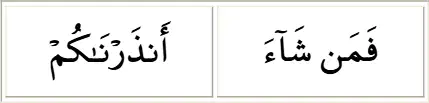
Which of the following is an example of Noon Saakin with a light Ghunnah sound?
فَمَنْ شَاءَ
يُوْمَئِذٍ شَانٍ
وَكَأْسًا دِهَاقًا
أَنْدَرْتَكُمْ

Which of the following is an example of Tanween with a light Ghunnah sound?
فَمَنْ شَاءَ
يُوْمَئِذٍ شَانٍ
أَنْدَرْتَكُمْ
وَكَأْسًا دِهَاقًا
What is the primary focus of the Light Ghunnah rule in Tajweed?
To ensure the sound of Ghunnah is heavy.
To ensure the sound of Ghunnah is light when followed by a light letter.
To eliminate the sound of Ghunnah completely.
To elongate the sound of Ghunnah.

What is the rule applied when the letter following Noon Saakinah or Tanween is one of the letters in "ي ن م و"?
Idgham with Ghunna
Idgham without Ghunna
Ikhfa Haqiqi
Izhar Halqi
What is the rule applied when the letter following Noon Saakinah or Tanween is one of the letters in "ت ث د ذ ز س ش ص ض ط ظ ف ق ك"?
Ikhfa Haqiqi
Idgham with Ghunna
Izhar Halqi
Idgham without Ghunna

What is the rule applied when the letter following Noon Saakinah or Tanween is one of the letters in "ء ه ع ح غ خ"?
Izhar Halqi
Ikhfa Haqiqi
Idgham with Ghunna
Idgham without Ghunna

What is the rule applied when Noon Saakinah or Tanween is followed by "ب"?
Ikhfa Haqiqi
Idgham with Ghunna
Izhar Halqi
Iqlaab
What is the rule for pronouncing Noon Saakin in Izhaar Halqi?
Skip the Noon and add a nasal sound to the next letter
Pronounce the Noon clearly without merging it with the next letter
Merge the Noon with the next letter completely
Add a shaddah to the next letter and skip the Noon
What is the correct pronunciation rule for Tanween in Idgham with Ghunnah?
Skip the Tanween and pronounce the next letter with a nasal sound
Change the Tanween into a Noon sound and add a nasal sound to the next letter
Pronounce the Tanween clearly without merging it with the next letter
Merge the Tanween completely with the next letter
What does the term "Ghunnah" refer to in Tajweed rules?
A clear pronunciation of letters without merging
A nasal sound added to the pronunciation of certain letters
A complete merging of two letters
A skipping of letters during pronunciation
In Idgham with Ghunnah, what happens to the Noon Saakin when followed by certain letters?
It is pronounced clearly without merging
It is skipped, and a nasal sound is added to the next letter
It is merged completely with the next letter
It is pronounced with a shaddah
Which of the following is an example of Izhaar Halqi for Tanween?
نازٍ حامية
عدنٍ إذا
كاذبين خاطئة
من أهل
What does "Idgham without Ghunnah" require for Noon Saakin?
Skip the Noon (ن)
Pronounce the Noon (ن) with a nasal sound
Change Noon (ن) to a hidden Noon (ن)
Add a heavy Ghunnah sound
What is the correct pronunciation rule for "Ikhfaa Haqiqi" when dealing with Noon Saakin?
Skip the Noon (ن)
Change Noon (ن) to a hidden Noon (ن) with a nasal sound (2 beats)
Pronounce Noon (ن) with a heavy Ghunnah sound
Change Noon (ن) to Tanween

What is the difference between Light Ghunnah and Heavy Ghunnah in "Ikhfaa Haqiqi"?
Light Ghunnah is pronounced with a nasal sound, while Heavy Ghunnah is not
Light Ghunnah applies to Noon Saakin, while Heavy Ghunnah applies to Tanween
Light Ghunnah is used for lighter letters, while Heavy Ghunnah is used for heavier letters
Light Ghunnah is skipped, while Heavy Ghunnah is pronounced

What happens to Tanween in "Ikhfaa Haqiqi"?
It is skipped entirely
It is pronounced as a hidden Noon (ن) with a nasal sound (2 beats)
It is replaced with a heavy Ghunnah sound
It is pronounced without any changes
In "Idgham without Ghunnah," what happens to Tanween?
It is skipped entirely
It is changed to a hidden Noon (ن)
It is pronounced as a heavy Ghunnah sound
It is merged with the following letter

What is the difference between Light Ghunnah and Heavy Ghunnah in Tajweed?
Light Ghunnah is pronounced with a heavier nasal sound than Heavy Ghunnah.
Light Ghunnah is used for إطعام في, while Heavy Ghunnah is used for صِفَا صَفَا.
Heavy Ghunnah is pronounced with a lighter nasal sound than Light Ghunnah.
Light Ghunnah and Heavy Ghunnah are pronounced the same way.
What happens to Noon Saakin during Iqlaab in Tajweed?
Noon Saakin is replaced with a heavy Ghunnah sound.
Noon Saakin is pronounced as a hidden م with nasal sound (2 beats).
Noon Saakin is pronounced without any nasal sound.
Noon Saakin remains unchanged.
What is the rule for Tanween during Iqlaab in Tajweed?
Tanween is pronounced as a heavy Ghunnah sound.
Tanween is pronounced as a hidden م with nasal sound (2 beats).
Tanween is pronounced without any nasal sound.
Tanween remains unchanged.
How is the word كَرَامٍ بَرَرَةٌ pronounced during Iqlaab?
كَرَامٍ بَرَرَةٌ is pronounced without any nasal sound.
كَرَامٍ بَرَرَةٌ is pronounced with a heavy Ghunnah sound.
كَرَامٍ بَرَرَةٌ is pronounced with hidden م and nasal sound (2 beats).
كَرَامٍ بَرَرَةٌ remains unchanged.
What is Meem Saakin?
A Meem with no Harakah or a Meem with a Sukoon sign
A Meem with a Harakah
A Meem with a Sukoon sign only
A Meem with a Shaddah
What happens to words ending with Tanween Fathah when stopping at the end of the word?
Changed into Fathah on the last letter
Changed into Sukoon on the last letter
No change occurs
Changed into Kasrah on the last letter

When stopping at the end of a word, what happens to words ending with Madd?
Changed into Sukoon on the last letter
No change occurs
Changed into Fathah on the last letter
Changed into Kasrah on the last letter
What is the rule for stopping at the end of a word with a Mushaddad letter?
Stop with Sukoon on the Mushaddad letter
Stop with Fathah on the Mushaddad letter
Stop with Kasrah on the Mushaddad letter
No change occurs

What happens to words ending with Taa Marboothah when stopping at the end of the word?
Changed into Sukoon on the last letter
Changed into Fathah on the last letter
Changed into Kasrah on the last letter
No change occurs

