
 Worksheets
Leaks and Leak Checking Introduction
Total questions: 35
Worksheet time: 18mins
According to the lesson, what is the most accurate statement about sealed systems in construction and HVAC?
Properly built sealed systems never leak if maintained
All sealed systems leak because microscopic flaws exist at joints and seams
Sealed systems leak only when a major crack forms
Sealed systems leak only under extreme pressure far beyond normal operation
Where are initial flaws most likely to exist in a sealed system? Select all that apply.
At joint fittings
Within perfectly solid, unworked base material far from connections
At seams
At welds
Which combination of factors best explains why tiny flaws become detectable leaks over time?
Time, vibration, temperature changes, and environmental stress
Only high pressure during startup
Factory testing errors and paperwork mistakes
Operator handling and labeling
A system shows no leaks during initial testing but develops a refrigerant leak months later. Based on the lesson, which is the most likely cause?
The system was never sealed at all
Microscopic flaws at fittings or seams expanded due to vibration and temperature cycling
Refrigerant chemically disappears in normal operation
Only human error during charging can create leaks
In the context of leak checking, why is routine leak detection necessary even for new installations?
Because leaks are rare and detection is optional
Because all sealed systems have microscopic flaws that can grow into detectable leaks
Because leak detectors are required only for old equipment
Because leaks occur only after catastrophic failure

Refer to the micrograph labeled (A). What does the visual primarily illustrate about sealed systems?
Perfectly smooth, flaw-free joint surfaces
Microscopic irregularities and voids that can become leak paths
Large fractures visible without magnification
Surface coatings that permanently seal joints

Which statement best connects the visuals (A) and (B) to practical leak checking?
Visuals show that only visible cracks cause leaks, so microscopes are required on job sites
Visuals confirm that microscopic flaws are present, so technicians must monitor systems over time for leak development
Visuals prove that seams and welds are flawless, reducing the need for inspections
Visuals indicate leaks occur only during manufacturing, not during service
A technician is preparing to use a leak detector on refrigeration piping. According to best practice, which material must be removed from the leak site to avoid contaminating the detection tips?
Pipe insulation, oil, and grease
Tight-fitting pipe clamps
Dry cloth tape only
Water deposits only
Which statement best explains why the leak site should be cleaned before detection?
Cleaning prevents vapor from flowing under layers that could hide the leak
Cleaning increases system pressure to reveal pressure-dependent leaks
Cleaning cools the pipe so temperature-dependent leaks appear
Cleaning seals minor leaks without further repair
When exposing the leak site, which items are specifically listed as materials to remove during cleaning? Select all that apply.
Loose paint
Slag
Flux
Rust
Soldered joints
Standing leaks are characterized by which condition?
Detected while the unit is at rest or off
Detected only when ambient temperature rises
Detected only as system pressure increases
Detected only during defrost cycles
Which leak type is most common in refrigeration and air conditioning systems?
Standing leaks
Pressure-dependent leaks
Temperature-dependent leaks
Vacuum-induced leaks
Pressure-dependent leaks are typically detected under which circumstance?
As the system pressure increases
When the unit is off and at rest
During rapid cooling of components
Only when the refrigerant is fully evacuated
Temperature-dependent leaks are associated with which phenomenon?
Heat of expansion
Decrease in ambient humidity
Electrical load changes
Vibration from compressors
Which actions together best describe proper preparation of a leak site before using a detector?
Remove layers like paint, slag, flux, or rust
Strip away pipe insulation where necessary
Wipe off oil and grease from the area
Increase system pressure to force leaks open
Cool the components to reduce heat expansion
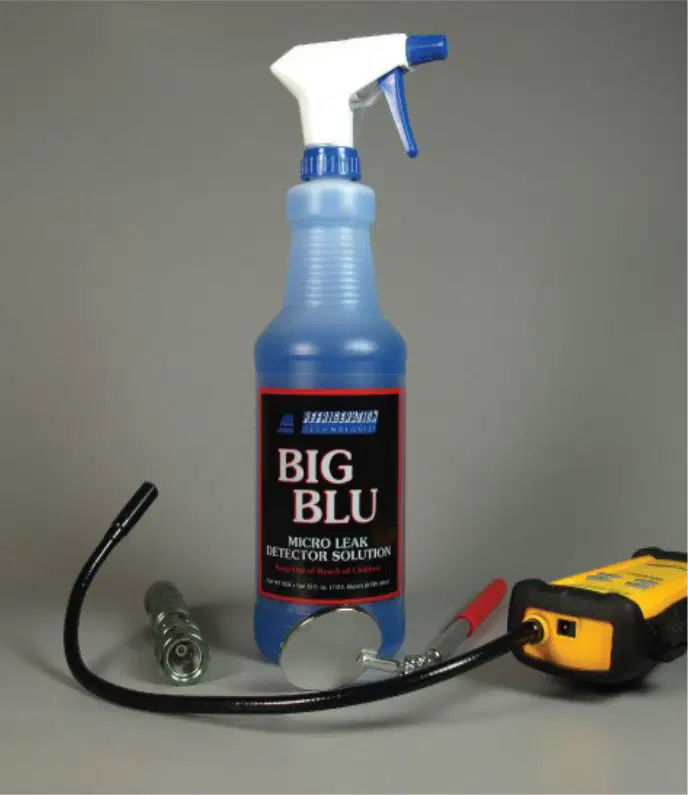
Refer to the left image showing a spray bottle labeled “BIG BLU Micro Leak Detector Solution” alongside inspection tools. What is the primary purpose of this solution in refrigeration and air conditioning work?
To lubricate threaded fittings during assembly
To chemically seal small leaks without repair
To visually reveal leaks by forming bubbles on escaping gas
To clean oxidation from copper tubing
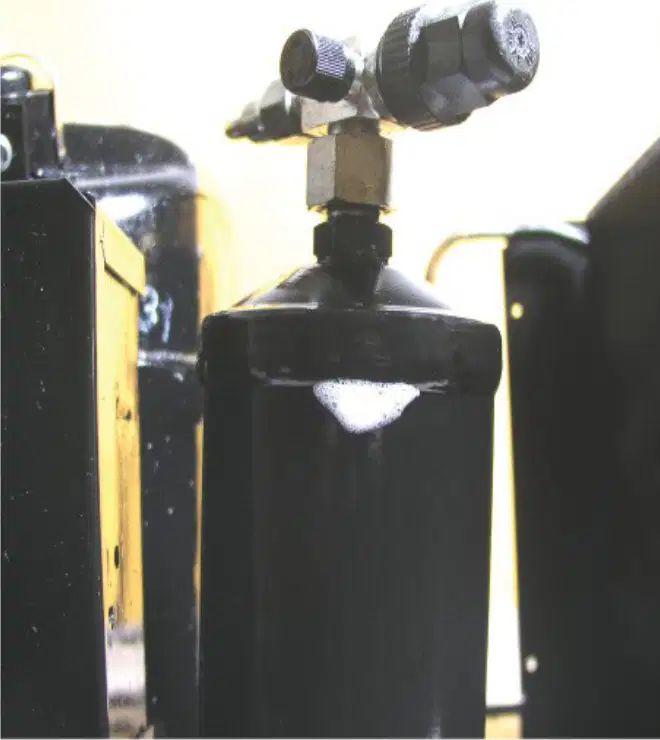
In the right image, a white cluster of bubbles appears at a fitting on a black component. What does the presence of these bubble formations indicate?
Properly tightened joint with no leak
Active leak where the solution traps escaping gas
Condensation forming due to low surface temperature
Residual flux from a recent braze
Which statement best describes a vibration-dependent leak in refrigeration and air conditioning systems?
It occurs only when the system is shut down and pressure equalizes.
It occurs during unit operation when movement causes joints or components to open.
It requires two or more environmental conditions to happen simultaneously.
It is a collection of many microleaks too small for standard tools to detect.
What defines a combination-dependent leak?
A leak that appears as soon as the compressor starts vibrating.
A leak that needs two or more conditions at the same time to leak.
A leak that is visible due to refrigerant oil residue.
A leak consisting of numerous microleaks that add up over time.
Which option accurately explains cumulative microleaks?
They are large leaks that are easy to detect with standard tools.
They are single leaks that occur only during unit operation.
They are the sum of many small leaks that are too tiny for standard detection methods.
They are leaks that require two or more conditions to appear.
Select all characteristics that correctly match the leak type.
Vibration-dependent: occurs during unit operation
Combination-dependent: requires two or more conditions to leak
Cumulative microleaks: detectable with standard tools
Combination-dependent: appears only while the unit is off
Which basic method is used to identify standing refrigerant leaks?
Pressurizing the system with nitrogen only.
Spotting refrigerant oil residue around connections and components.
Measuring compressor amperage draw during startup.
Checking thermostat setpoint changes over time.
Where should a technician focus when testing for evaporator section leaks according to the basic methods listed?
On the condensing section components only.
On the evaporator section components and connections.
On the suction and liquid lines exclusively.
On electrical wiring harnesses and control boards.
Which areas are specifically mentioned for basic leak testing besides the evaporator section?
Condensing section
Suction line
Liquid line
Ductwork plenums
A system shows no leaks with electronic tools, but performance declines slowly. Based on the section’s concepts, which explanation is most likely?
A single large vibration-dependent leak that only occurs at shutdown.
Cumulative microleaks that are individually too small to detect with standard tools.
A combination-dependent leak triggered by oil residue.
An evaporator leak that is always visible without testing.
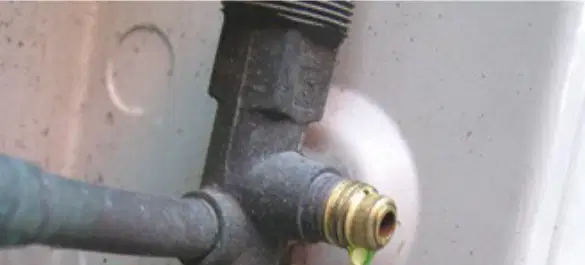
Refer to the left image showing a service port and a small greenish residue near the fitting. What does the presence of oily residue around refrigerant connections most commonly indicate during a system inspection?
Normal condensation from ambient humidity
A refrigerant leak carrying oil out of the system
Corrosion that requires painting the line set
Recent cleaning with solvent
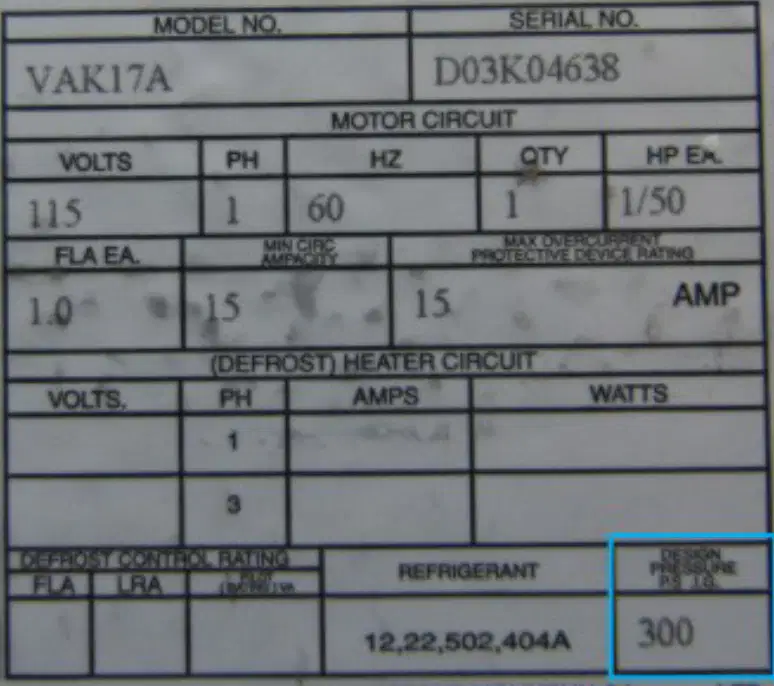
Using information shown on the equipment nameplate, which statement best describes why checking the refrigerant type is essential before using an electronic leak detector?
Detectors only measure airflow and do not sense refrigerant gases
Different refrigerants may require detector sensitivity settings or sensors matched to the specific gas
The nameplate lists the installer’s contact details used by the detector
Leak detectors operate only on systems above 600 V

Which items on the nameplate are most relevant for confirming safe leak-testing conditions on a refrigeration system? Select all that apply.
Design pressure rating (e.g., 300 psig)
Refrigerant types used in the unit
Motor horsepower of the evaporator fan
Manufacturer’s city and state

Which advanced leak detection approach targets leaks that occur only when system pressure increases or decreases from normal operating levels?
Temperature-dependent testing
Vibration-dependent testing
Pressure-dependent testing
Combination-dependent testing

In advanced leak detection, which method is most appropriate for leaks that appear only when components heat up or cool down significantly?
Pressure-dependent testing
Temperature-dependent testing
Vibration-dependent testing
Combination-dependent testing

A technician suspects a joint leaks only when a compressor starts and induces mechanical movement. Which testing type best targets this scenario?
Temperature-dependent testing
Vibration-dependent testing
Pressure-dependent testing
Combination-dependent testing

Which statement best describes combination-dependent leak testing in refrigeration and air conditioning systems?
It isolates leaks triggered solely by pressure changes.
It identifies leaks caused by simultaneous factors such as pressure, temperature, or vibration.
It focuses on leaks that occur only at low ambient temperatures.
It finds leaks exclusively during mechanical start-up vibration.
Which component monitors the test pressure of approximately 250 psig in the standing pressure test setup?
Sight glass on the liquid line
Thermostatic expansion valve
Gauge manifold connected to the system
Compressor discharge temperature sensor
Why is nitrogen used for pressurizing the system during a standing pressure test instead of refrigerant?
Nitrogen is inert and suitable for pressure testing without introducing moisture
Nitrogen instantly cools the evaporator during the test
Refrigerant cannot pass through a regulator
Nitrogen prevents oil from returning to the compressor
During the standing pressure test shown, what should be the technician’s focus while the system is pressurized?
Monitoring the gauge manifold for stable pressure indicating no leaks
Adding oil to raise the oil level in the compressor
Opening the service valves to equalize pressures
Running the compressor to circulate nitrogen

