
Font size
 Worksheets
PS Bonding Test
Total questions: 38
Worksheet time: 24mins
The chemical bond formed when two atoms share electrons is called a(n)
Covalent bond
Ionic bond
Metallic bond
Electron bond
Which pair of atoms will combine with each other and form an ionic bond?
C and O
C and H
Ca and Mg
Ca and Br
What is the oxidation number of oxygen in most compounds?
6
-2
8
0
Which formula represents a substance that contains covalent bonds?
LiCl
CaCl₂
K₂O
CO₂
How does an atom of aluminum become an ion?
It gains 3 electrons
It gains 3 protons
It loses 3 electrons
It loses 3 neutrons
How many electrons are shared within a single bond?
0
1
2
4
Which atoms are most likely to form covalent bonds?
metal atoms that share electrons
metal atoms that share protons
nonmetal atoms that share electrons
nonmetal atoms that share protons
The electrons that are lost, gained, or shared in chemical bonds are called ____________.
valence electrons
chemical electrons
Lewis electrons
none of the above
Which of the following is NOT an example of covalent bonding?
H₂O
NaF
NH₃
O₂
How many electrons are needed in the outer energy levels of most atoms for the atom to be chemically stable?
2
4
6
8
How many electrons are being shared in a triple bond?
3
6
8
12
Cations are ions with a ______ charge that are formed when an atom ______ electrons. Which option best completes the sentence?
positive, loses
negative, gains
positive, gains
negative, loses
Anions are ions with a _______ charge that are formed when an atom _______ electrons. Which option best completes the sentence?
negative, gains
positive, loses
neutral, shares
negative, loses
Ionic compounds are made of a _______ and a _________. Covalent molecules are made of a ___________ and a _____________.
metals / nonmetals;
nonmetals / nonmetals
nonmetals / nonmetals; metals / nonmetals
metals / metals; nonmetals / metals
nonmetals / nonmetals; metals / metals
Noble gases rarely form compounds because:
they have a complete or full valence electron shell.
they are highly reactive.
they have unstable electron configurations.
they easily lose electrons.
Which of the following compounds are usually the strongest?
Ionic
Covalent
Metallic
Molecular

Which process is taking place in the diagram to the left? Mark all that apply.
electron transfer
electron sharing
ionic bonding
covalent bonding
If an atom (a) electrons, it will become negative.
If an atom (b) electrons, it will become positive.
Match the following
Ionic
electrons are transfered
Covalent
Electrons are shared
Compound
Two or more chemically combined elements
Molecule
Two or more covalently bonded atoms.
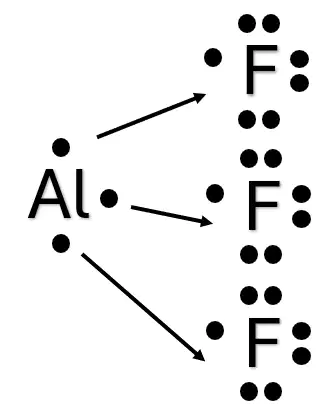
The image at the left shows the Lewis Dot Diagram for a (a) bond. When this compound forms, the aluminum becomes a (b) and the fluorine atoms become (c) ions. The name of this compound is (d) and it's formula is (e) .
Match the following cation/anion with how many valence electrons it lost/gained (its oxidation number).
Fe3+
lost three valence electrons
O2−
gained 2 valence electrons
I−
gained one valence electron
Ca2+
lost two valence electrons
Cs+
lost one valence electron
Indicate whether the compound below is ionic or covalent.
Na2O
H2O
AgNO3
CBr4
NH4Cl
B2Si
Phosphorous triiodide
Trisulfur hexafluoride
Ammonium sulfide
N20
Sodium carbonate
Manganese (III) bromide
Which is the correct formula for Sodium sulfide?
Na2S
NaS2
Na2S2
NaS
Which is the correct formula for Beryllium acetate?
Be2(C2H3O2)2
Be(C2H3O2)2
Be2(C2H3O2)
Be(C2H3O2)
Which is the correct formula for Triboron heptahydride?
Br3H7
B3OH
B3H7
B3OH7
Which is the correct formula for Tetracarbon decahydride?
CH
C3H9
C4(OH)10
C4H10
Which is the correct formula for Ammonium fluoride?
NHF4
Nh4F
NH4F
(NHF)4
Which is the correct formula for Iron (II) chloride?
Fe2Cl
FeCl2
Fe2Cl2
FeCl
Which is the correct formula for Manganese (III) oxide?
Mn3O
Mn2O3
Mn3O2
MnO
Which is the correct formula for Magnesium sulfate?
MgSO4
Mg2SO2
MgS2O
MgSO
What is the correct name for the following formula?
N2S
nitrogen sulfate
sulfate nitride
nitrogen sulfide
dinitrogen monosulfide
What is the correct name for the following formula?
CF4
carbonate tetrafluoride
carbon tetrafluoride
fluorine carbide
monocarbon tetrafluoride
What is the correct name for the following formula?
CO
oxygen monocarbide
carbonate oxide
carbon monoxide
carbon oxide
What is the correct name for the following formula?
P4O6
oxygen phosphate
phosphate oxide
phosphorous oxide
tetraphosphorous hexaoxide
What is the correct name for the following formula?
NH4I
iodine ammonide
ammonium iodide
nitrogen hydriodide
nitrogen tetrahydrogen iodide
What is the correct name for the following formula?
PbCO3
lead carbonide
lead (III) carbonate
lead (II) carbonate
lead tricarbonide
What is the correct name for the following formula?
Be3P2
berylliate phosphide
beryllium phosphate
beryllium phosphide
triberyllium diphosphide
What is the correct name for the following formula?
MgO
magnesium oxide
magnesium monoxide
monomagnesium monoxide
oxygen magneside

