
Font size
 Worksheets
Chapter 7 Strategic Options Framework
Total questions: 35
Worksheet time: 42mins
Linatex plc has completed a corporate appraisal and identified that its brand is the most recognised in the industry. Under SWOT, this would be classified as a:
Threat
Opportunity
Strength
Weakness

Match each issue to ONE analysis tool:
1.Value chain
2. PESTEL
3.Five Forces
4.SWOT
A3, B1, C2, D4
A2, B4, C1, D3
A3, B4, C2, D1
A1, B3, C4, D2
A food manufacturer, HarvestCo, has discovered that its production line is running at only 45% efficiency compared to competitors who operate at 70–80%. Within the SWOT this is classified as a:
Threat
Weakness
Opportunity
Strength
Which of the following is an intangible value driver?
A new fully automated production plant
A sophisticated international logistics network
A strong reputation among existing customers
A prime retail property location
NebuCar Ltd attributes its competitive advantage to its ability to design unique electric engines and maintain long-term supply contracts with cobalt mines. Which TWO are intangible drivers?
Engine design expertise
Cobalt supply contract
Manufacturing robots
Warehouse technology
In gap analysis, after accounting for efficiency improvements and expansion strategies, the remaining unclosed gap is referred to as the ________ gap.
Capacity
Productivity
Diversification
Structural
Tyrenet aims for sales of $200m in five years. Forecasts show:
• Current strategy delivers $150m
• Efficiency improvements raise this to $160m
• New product development raises it to $175m
What type of gap remains?
Efficiency gap
Expansion gap
Diversification gap
No gap
An airline uses regression to predict fuel consumption based on number of passengers. A limitation is
Regression cannot handle historical data
It assumes perfect correlation between variables
It assumes past relationships continue into the future
It cannot be used on numerical variables
Time series forecasting is most useful for organisations where:
No historic data is available
Demand is stable and unaffected by cycles
Seasonal patterns strongly affect demand
Qualitative judgement is more important than quantitative analysis
SilverMint Jewellery uses time series analysis to forecast gold prices but finds predictions unreliable during volatile political periods. This illustrates:
Time series models struggle with sudden external shocks
Derived demand analysis is more accurate
Regression should always replace time series
Forecasting eliminates uncertainty
A company assembles a panel of experts who never meet in person and are interrogated by successive questionnaires. This describes:
Think tank
Delphi method
Scenario planning
Brainstorming
A key feature of brainstorming is:
Only experts may contribute ideas
All ideas are evaluated immediately
Criticism of ideas is encouraged
Ideas are listed without judgement
Demand for lithium used in phone batteries is an example of
Primary demand
Forecast demand
Derived demand
Latent demand
Foresight primarily involves:
Predicting exact future events
not only predicting the future but developing an understanding of all the potential changes, which if managed properly could produce many new opportunities.
Replacing forecasting systems
Eliminating uncertainty entirely
Which of the following is NOT one of the 5Cs of foresight?
Consensus
Concentration
Creativity
Commitment
Which step in scenario planning involves identifying high-impact, high-uncertainty factors?
Constructing learning scenarios
Mapping stakeholders
Identifying driving forces
Developing action plans
TruFit Gym is unsure how AI-based fitness technology will evolve. Management wants to explore several plausible futures, including optimistic and pessimistic outcomes. They are using:
Brainstorming
Scenario planning
Delphi method
Derived demand
A key benefit of scenario planning is:
Eliminates uncertainty
Guarantees prediction accuracy
Encourages long-term strategic thinking
Avoids the need for data analysis
Which is a disadvantage of scenario planning?
Encourages creativity
High cost and complexity
Identifies sources of uncertainty
Supports communication among managers
Game theory is most useful in markets wher
Firms operate independently
There is no competition
Competitor actions significantly influence firm outcomes
Demand is perfectly predictable
In the prisoner’s dilemma applied to marketing spend, the equilibrium outcome is most likely:
Both firms spend less
Both firms spend heavily
One spends more, one spends less
Firms avoid spending entirely
Two telecom companies consider entering a new market. If both enter, profits fall. If one enters alone, they profit. Based on game theory, the dominant strategy for each is likely to:
Avoid entering
Enter the market
Collude secretly
Delay decisions indefinitely
A clause that allows a company to stop a project if costs escalate is an option to:
Follow on
Delay
Abandon
Contract
The value of a real option increases when
Duration decreases
Project uncertainty decreases
Duration increases and uncertainty increases
Duration decreases and uncertainty increases
A housebuilder has permission to build any time in the next eight years and delays construction until market prices rise. This demonstrates:
Option to abandon
Option to delay
Option to follow on
Option to hedge
A tech company invests in a low-profit smartphone line because it enables it to later sell profitable accessories. This is an example of:
Option to follow on
Option to delay
Option to abandon
Option to abandon
Which SWOT pairing requires the organisation to assess whether internal capability allows pursuit?
Threat on weakness
Opportunity on strength
Opportunity on weakness
Threat on strength
After developing three major scenarios, an organisation compares real-world events to determine which scenario is unfolding. This step is:
Constructing initial scenarios
Monitoring reality
Mapping drivers
Conducting stakeholder analysis
SolarPanelCo is a large manufacturer of rooftop solar panels. The market is mature with four main competitors of similar size. A startup, SunCore, has developed a new ultra‑efficient photovoltaic cell that doubles energy output per panel. SunCore will license the cell to any manufacturer for a fixed annual fee over 12 years and refuses exclusivity. SolarPanelCo’s strategist estimates: if SolarPanelCo is the only firm to license the cell it will gain an extra $6m profit per year; if one rival also licenses it SolarPanelCo’s profit falls by $1m per year; if two or more rivals license it SolarPanelCo will lose $4m per year. Collusion is illegal in this market.
Which ONE option is most appropriate for SolarPanelCo?
Attempt to reverse‑engineer the cell to avoid paying the license fee.
Negotiate with rivals to agree a coordinated approach when dealing with SunCore.
Offer SunCore a premium to secure an exclusive licence.
License the cell quickly and invest in rapid roll‑out, hoping rivals delay entry.
MediTech makes diagnostic scanners in a market with three similar competitors. A university spin‑out, BioSense, has patented a sensor that halves scanning time and greatly improves patient throughput. BioSense will license to any firm for a fixed annual fee over 10 years and will not grant exclusivity. MediTech’s analysis: if MediTech alone licenses the sensor it will earn an extra $4m per year; if one rival also licenses it MediTech’s net benefit falls to $0.5m; if two rivals license it MediTech will lose $3m per year. Strict anti‑collusion rules apply.
Which ONE option is most appropriate for MediTech?
Try to acquire BioSense to secure exclusive access.
Coordinate with rivals to present a joint bid to BioSense.
Invest in licensing and complementary services to strengthen differentiation.
Ignore the technology and focus on cost reduction in current products.
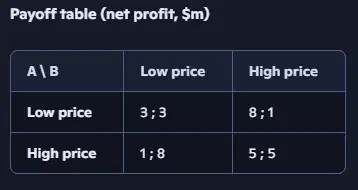
Two rival supermarket chains, A and B, sell identical staple goods. Each can choose a Low price (aggressive) or High price (status quo). If one cuts price while the other keeps prices high, the cutter gains market share and higher profit; if both cut, margins fall and both earn less than if both kept high prices.
Which statement is correct?
Both firms have a dominant strategy to choose High price.
Both firms have a dominant strategy to choose Low price.
The Nash equilibrium is (High price, High price).
The Nash equilibrium is (Low price, Low price).
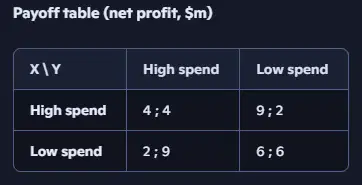
Two equally sized smartphone makers, X and Y, decide whether to run an expensive global advertising campaign (High spend) or keep current modest marketing (Low spend). If one advertises heavily while the other does not, the advertiser gains significant sales; if both advertise heavily, both suffer reduced ROI.
Which option best describes the strategic situation?
Each firm prefers to match the rival’s choice; there is no dominant strategy.
Each firm has a dominant strategy to choose Low spend.
Each firm has a dominant strategy to choose High spend.
(High spend, High spend) is Pareto efficient and stable.
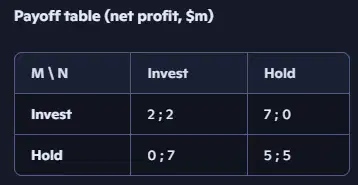
Two airline firms, M and N, consider investing in extra fleet capacity (Invest) or maintaining current capacity (Hold). If one invests while the other holds, the investor captures more routes and profit; if both invest, overcapacity reduces yields and both earn less than if both had held.
Which conclusion follows from this payoff structure?
Both firms will choose Hold because it maximises joint profit.
Both firms have a dominant strategy to Invest, producing a suboptimal equilibrium.
There is no Nash equilibrium in pure strategies.
The best unilateral action for each firm depends on the other’s choice.
TRT is a large company that manufactures light bulbs. The light bulb market has been mature for many years, with little innovation and TRT has only three other rivals in the market — all of roughly equal size to TRT. The markets that TRT operate in have strict legislation restricting collusion between competing companies. A new type of lightbulb has recently been developed by an entrepreneur, Mr B, which provides the same light as a current lightbulb, but which uses a fraction of the electricity of traditional bulbs and which (in theory) will never need to be replaced. Mr B has stated that he is absolutely unwilling to sell this patented new product exclusively to just one supplier.
Instead, he wishes to license the technology to any company who is willing to pay a fixed annual fee for a pre-set 15 year period. TRT’s strategic management accountant has calculated that if TRT is the only company that decides to license the new lightbulb, it will earn around $5m each year for the foreseeable future. It will make a loss of around $2m each year if one of its rivals also licenses the product and this loss will widen the more of its rivals decide to enter the market.
Which ONE of the following options is the most appropriate for TRT to take in order to deal with this situation?
Attempt to copy the technology behind the new lightbulbs, avoiding having to pay a license fee to Mr B
Negotiate with rival companies and agree a mutually beneficial strategy when negotiating with Mr B
Attempt to negotiate an exclusive deal with Mr B
Invest in the new lightbulbs as quickly as possible in the hope that rival companies will avoid investing
UPP is an organisation that sells custom-made accountancy software to large or complex organisations. It has recently been approached by the government of country L, which wishes to employ UPP to create an accountancy software solution for country L’s national health service, which runs the hospitals and doctors surgeries throughout the country. UPP is concerned that the government demands a fixed fee contract. It is aware that costs on software development are often hard to accurately estimate and this could lead to UPP making significant losses if the contract becomes more complex than originally anticipated. It is therefore negotiating with the government a clause in the contract that will allow UPP to exit the contract if costs rise above a certain level. Under real option theory, the clause UPP is negotiating is referred to an option to........................................
Option to Abandon
Option to Follow
Option to Delay
Option to Refuse

