
 Worksheets
Muscles of the Upper Extremity
Total questions: 29
Worksheet time: 15mins
Which muscle primarily elevates the mandible during chewing?
Frontalis
Temporalis
Sternocleidomastoid
Orbicularis Oris
Select all muscles whose primary actions involve the eyes or eyelids.
Orbicularis Oculi
Frontalis
Orbicularis Oris
Temporalis
Which muscle is located on the forehead and is responsible for moving the eyebrows upward?
Frontalis
Masseter
Sternocleidomastoid
Temporalis
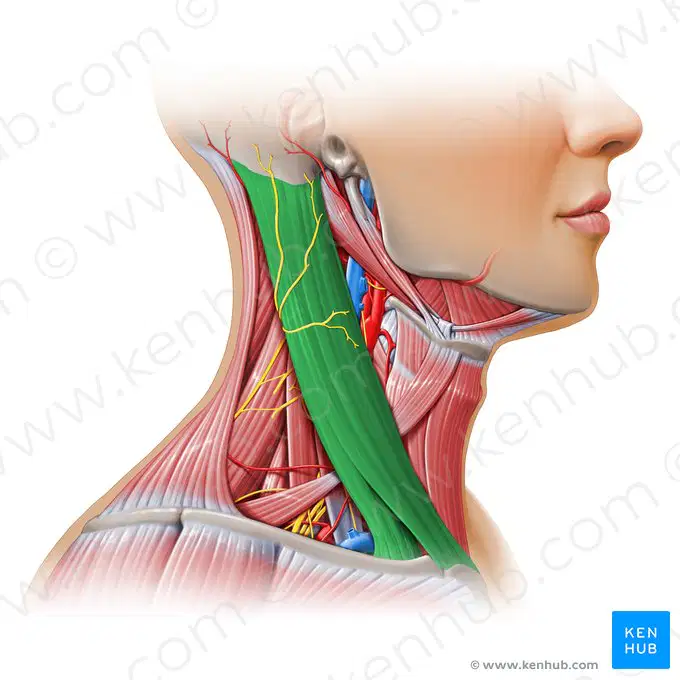
Identify the muscle highlighted in green; it is responsible for neck rotation.
Masseter
Sternocleidomastoid
Frontalis
Orbicularis Oculi
Which muscle acts directly on the lips to control movements such as closing and shaping them?
Orbicularis Oris
Orbicularis Oculi
Temporalis
Sternocleidomastoid
Which statement best describes the role of the Masseter?
It rotates the neck to the opposite side.
It elevates the lower jaw as a chewing muscle.
It lifts the eyebrows and wrinkles the forehead.
It closes the eyelids during blinking.
Multi-select: Which muscles are directly involved in facial expressions rather than neck movement or mastication?
Frontalis
Orbicularis Oculi
Sternocleidomastoid
Temporalis
Orbicularis Oris
Which action is primarily performed by the Pectoralis Major?
Shoulder abduction and external rotation
Shoulder adduction and internal rotation
Elbow flexion and supination
Trunk flexion
According to the instructional text, which group is broadly responsible for trunk flexion?
Pectoral muscles
Abdominal muscles
Back extensors
Hip abductors
Which statement best describes the Rectus Abdominis?
A deep stabilizer located under other abdominal muscles
The front abdominal muscle often associated with the “6 pack”
A muscle primarily responsible for trunk rotation
A chest muscle that moves the shoulder
Select all muscles that contribute mainly to trunk rotation.
External Oblique
Internal Oblique
Transverse Abdominis
Rectus Abdominis
Which muscle is identified as a deep stabilizer engaged during laughing and coughing?
Transverse Abdominis
Rectus Abdominis
External Oblique
Pectoralis Major
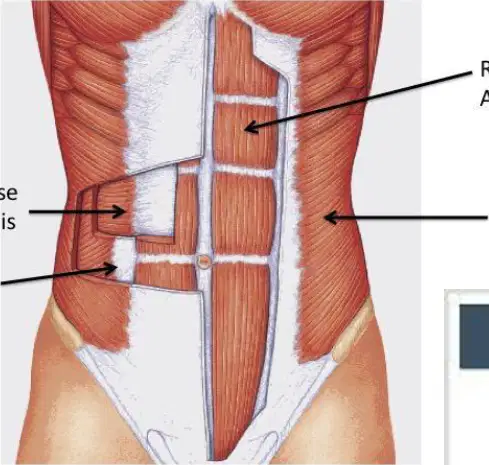
In the labeled abdominal diagram, which muscle is shown on the anterior midline as segmented blocks?
Transverse Abdominis
External Obliques
Rectus Abdominis
Internal Obliques
Select all statements that accurately describe the Transverse Abdominis.
It is a deep muscle located under the other abdominal muscles.
It primarily causes trunk flexion.
It contributes to trunk stabilization.
It is typically referred to as the “6 pack.”
Which muscle is primarily responsible for shoulder elevation?
Trapezius
Latissimus dorsi
Deltoid
Pectoralis major
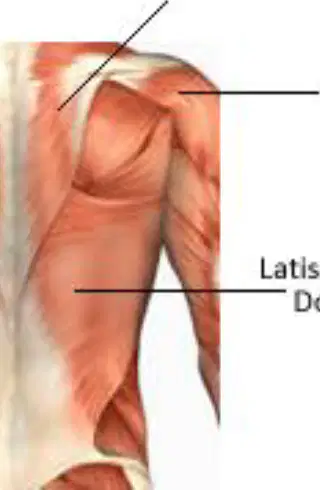
According to the description of posterior trunk muscles, which action is most associated with the Latissimus dorsi?
Shoulder elevation
Shoulder depression
Elbow flexion
Neck extension
Multi-select: Which statements correctly match each muscle with its primary action? Select all that apply.
Trapezius — shoulder elevation
Latissimus dorsi — shoulder depression
Deltoid — shoulder elevation
Trapezius — shoulder depression
Which muscle primarily produces shoulder abduction?
Deltoid
Biceps brachii
Triceps brachii
Subscapularis
Identify the action most associated with the biceps brachii.
Elbow flexion
Elbow extension
Shoulder abduction
Shoulder external rotation
Which statement best describes the deltoid based on the text?
A triangle-shaped muscle forming the cap of the shoulder
A fusiform muscle on the anterior arm that extends the elbow
A flat muscle deep to the scapula that internally rotates the shoulder
A slender muscle of the forearm that abducts the wrist
Select the muscle that primarily performs elbow extension.
Triceps brachii
Biceps brachii
Supraspinatus
Infraspinatus
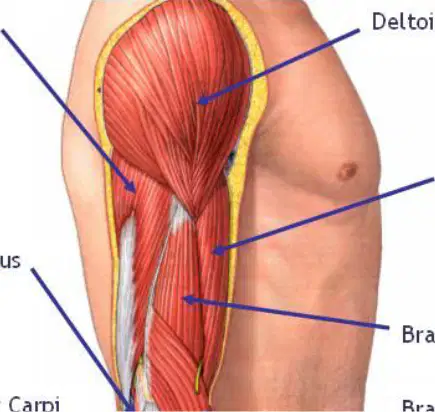
According to the diagram of the lateral arm, which labeled structure sits superficially over the shoulder joint?
Deltoid
Brachialis
Anconeus
Biceps brachii
Which rotator cuff muscle initiates shoulder abduction?
Supraspinatus
Infraspinatus
Teres Minor
Subscapularis
Choose the rotator cuff muscles responsible for shoulder external rotation. Select all that apply.
Infraspinatus
Teres Minor
Subscapularis
Supraspinatus
Which rotator cuff muscle performs shoulder internal rotation?
Subscapularis
Infraspinatus
Supraspinatus
Teres Minor
Match each muscle to its primary action.
Deltoid—shoulder abduction
Biceps brachii—elbow flexion
Triceps brachii—elbow extension
Infraspinatus—shoulder external rotation
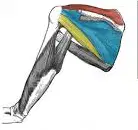
In the rotator cuff illustration, what is the muscle highlighted in blue that contributes to external rotation?
Infraspinatus
Subscapularis
Supraspinatus
Pectoralis major
Which pair correctly matches a muscle to shoulder internal rotation?
Subscapularis—internal rotation
Infraspinatus—internal rotation
Supraspinatus—internal rotation
Teres Minor—internal rotation of the elbow
Which set lists only rotator cuff muscles?
Supraspinatus, Infraspinatus, Teres Minor, Subscapularis
Deltoid, Biceps brachii, Triceps brachii, Supraspinatus
Biceps brachii, Triceps brachii, Brachialis, Subscapularis
Teres Minor, Deltoid, Infraspinatus, Biceps brachii

