
 Worksheets
APHG Unit 2 Test Review
Total questions: 16
Worksheet time: 8mins
Name
Class
Date
1.
1. Thomas Malthus predicted that
a)
technology will alter population growth
b)
how resources are distributed would always be a problem
c)
food production can not keep up with population growth
d)
the environment will be damaged and not produce more food
e)
a revolution would slow population growth and food production
2.
2. The Antarctica and the Sahara Desert all represent which concept in demography?
a)
Demographic Momentum
b)
Greying Population
c)
Non-Ecumene
d)
Demographic Transition
e)
Sustainability
3.
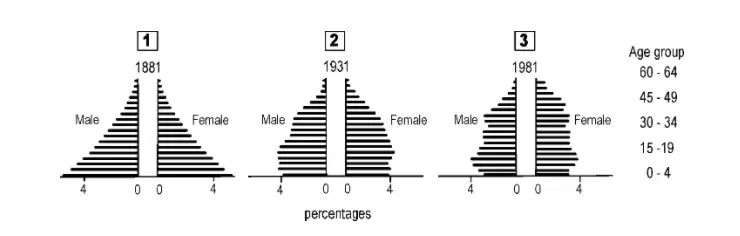
3. In the graphic, population pyramid 1 best represents a country in what stage of Demographic Transition?
a)
1
b)
2
c)
3
d)
4
e)
5
4.
4. Which of the following arguments would be most likely offered by a Neo-Malthusian?
a)
Recent declines in agricultural yield will lead to crisis
b)
Agricultural technology will reduce the chances of a crisis
c)
Population growth will stabilize before reaching a crisis
d)
Scarce resources, such as oil, and environmental harm will lead to a crisis
e)
Limiting the number of children born will do nothing to help solve the food sortage
5.
5. Forced-sterilization, distribution of birth control, and high fines for large families are all examples of strategies used by countries with what type of population policies?
a)
Pro-natalist
b)
Expansionist
c)
Eugenic
d)
Anti-natalist
e)
Ecumene
6.
6. In which stage of the Demographic Transition Model do countries have high and steady birth rates combined with falling death rates?
a)
1
b)
2
c)
3
d)
4
e)
5
7.
7. Urban diseases (such as Cholera) and poor industrial conditions account for a significant portion of deaths in which stage of the Epidemiological Transition Model?
a)
1
b)
2
c)
3
d)
4
e)
5
8.
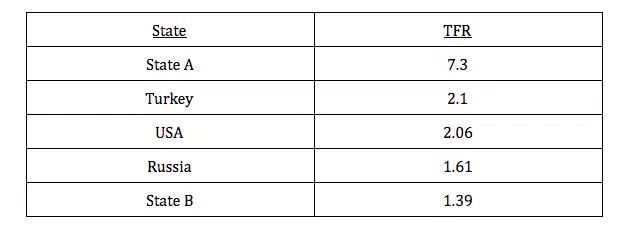
8. Based on the chart, which of the following could be State B?
a)
Syria
b)
Japan
c)
Vietnam
d)
Liberia
e)
Somalia
9.
9. Unlike arithmetic population density, physiological density:
a)
Cannot be a negative number
b)
Does not consider the carrying capacity of a particular area
c)
Is the preferred method of calculating density among geographers
d)
Only considers units of arable land in its calculation
e)
Cannot be calculated using modern demographic statistics
10.
10. Population density and distribution can cause strain in a community if the resource base of that environment cannot support the population. This best describes surpassing an environment’s
a)
Infant mortality rate
b)
Ecumene
c)
Rate of natural increase
d)
Carrying capacity
e)
Crude death rate
11.
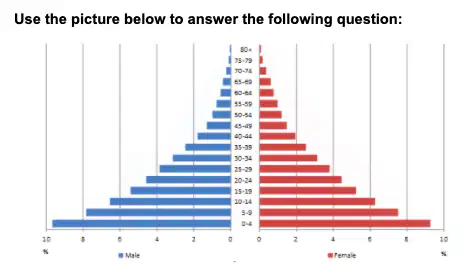
11. According to the above population pyramid, the represented country
a)
Is experiencing rapid population growth due to high birth rates
b)
Belong to a country in the fourth stage of demographic transition
c)
Has constant, equally sized cohorts from ages 0 to 39
d)
Sees sharp declines due to abnormally high death rates
e)
May experience population decline due to greying populations
12.
12. A declining birth rate and a stationary death rate characterize the fifth state of Demographic Transition. Which of the following countries best represents this demographic pattern?
a)
Japan
b)
Mexico
c)
Pakistan
d)
South Africa
e)
Argentina
13.
13. Which of the following descriptions best matches the Epidemiological Transition Model?
a)
Patterns of migration change based on the development of a country
b)
Trade between cities can be calculated using population and distance
c)
Causes of mortality shift as countries increase in development
d)
Crude birth rates and crude death rates can classify countries in demographic clusters
e)
Human actions are capable of overcoming, although not fully controlling, the physical environment
14.
14. According to Malthus, which of the following best summarizes the causes of the “point of crisis?”
a)
While resources, such as food, increase in a linear fashion, they will be outpaced by exponentially growing populations
b)
Agricultural output can be expanded based on technological advances, limiting issues of population
c)
Carrying capacity decreases as population increases, causing mass starvation and pestilence
d)
Although the population grows in a linear fashion, the resource base expands geometrically, creating scarcity.
e)
Overpopulation does not post a serious threat to humanity due to unlimited resources
15.
Bonus Review Question: The area served by a United States Post Office is best described as what type of region?
a)
Formal
b)
Functional
c)
Vernacular
d)
Uniform
e)
Nodal
16.
Bonus Review Question: Which of the following is the primary assumption of environmental determinism?
a)
Human destiny is controlled by the cultural environment .
b)
The physical environment has little influence on humans .
c)
Humans have complete control over the physical environment .
d)
Many human adaptations are possible within a specific physical environment .
e)
The physical environment controls human culture .
100 %

