
NEW
Font size
 Worksheets
Latin American Independence and The Industrial Revolution
Total questions: 56
Worksheet time: 29mins
Which feature of England most directly supported the start of the Industrial Revolution by protecting property and contracts so investors felt confident to build factories?
A stable government with reliable laws and courts
Frequent changes in rulers that disrupted policy
High tariffs that blocked domestic trade
A royal monopoly that controlled all industry
According to ideas linked with Adam Smith, which statement best describes a laissez‑faire, free‑market economy during the early Industrial Revolution?
Prices and production are guided by supply and demand with limited government interference
Government planners set prices to guarantee equal profits for all businesses
The king grants exclusive charters to determine what goods are produced
Workers’ wages are fixed by law so they do not change with market conditions
Which two natural resources were especially abundant in England/Britain and helped power the Industrial Revolution by generating energy and providing infrastructure materials?
Cotton and timber
Coal and iron
Gold and silver
Oil and natural gas
Which statement best explains how the Agricultural Revolution contributed to the start of the Industrial Revolution in England/Britain?
It ended overseas trade, forcing factories to close and workers to return to farms.
It changed how people lived and worked in England/Britain, increasing food supply and a labor force for factories.
It made government control of the economy stricter, limiting entrepreneurs’ ability to invest.
It reduced the middle class, weakening the demand for manufactured goods.
Which development most directly gave rise to the factory system in the early Industrial Revolution?
New inventions/technology that led to production in one location
Government bans on cottage industries and home spinning
Declining population that forced mechanization to save labor
Religious reforms that encouraged communal workshops
Which term best describes the rapid movement of people from rural villages to growing factory towns during the Industrial Revolution?
Urbanization
Privatization
Decolonization
Globalization

Based on the conditions shown in the political cartoon, which public health threat would most likely spread quickly, and why?
Cholera, because contaminated water in crowded areas facilitates transmission
Smallpox, because smoke particles directly cause viral infections
Rickets, because tenement air pollution transmits the disease person-to-person
Scurvy, because factory soot prevents access to any vitamin C sources
Which reform best addressed excessive working hours for women and young people in textile mills during the Industrial Revolution?
The Mines Act of 1842
The Ten Hours Act of 1847
The Factory Act of 1833
The Public Health Act of 1848
Which parliamentary act first set limits on child labor in textile factories by restricting the working hours of children and establishing factory inspections?
Factory Act of 1833
Mines Act of 1842
Public Health Act of 1848
Reform Act of 1832
Which invention by John Kay increased the speed of weaving by allowing cloth to be woven faster, creating higher demand for thread?
Spinning Jenny
Flying Shuttle
Power Loom
Water Frame
James Hargreaves is best associated with which early textile invention used to quickly spin thread?
Spinning Jenny
Power Loom
Steam Engine
Cotton Gin
Richard Arkwright’s Water Frame was significant because it used what power source to spin thread much faster?
Wind power from mills
Animal power from horses
Water power from rivers
Manual power from foot treadles
Edmund Cartwright created which fully mechanized machine that changed the way of making cloth?
Power Loom
Flying Shuttle
Spinning Mule
Jacquard Loom
Which innovation had the most significant effect on the factory system by allowing factories to be built away from rivers?
Water Frame
Power Loom
Steam Engine improved by James Watt
Cotton Gin
According to the text, the Industrial Revolution in England began primarily as a revolution in which industry?
Iron smelting
Textiles
Shipbuilding
Agriculture
Which statement best explains why the factory system could expand beyond rivers in England?
Power looms required less water for cooling.
Steam-powered machines no longer depended on running water.
Coal mines supplied free electricity.
Windmills were replaced by gas engines.
The text notes that the textile revolution had both social and economic impacts. Which outcome is most directly linked to these changes?
Decline of urban populations due to rural resettlement
Growth of industrial cities with associated problems
Abolition of coal mining because textiles required less energy
Immediate elimination of child labor
What key reason made coal increasingly important as steel became more widely used?
Coal could be woven into fabric as a reinforcing fiber.
Coal was required to heat iron to the high temperatures needed to create steel.
Coal prevented rust on finished steel.
Coal replaced steel in most construction.
Which statement best describes how communism, as practiced historically, differed from Marx’s theory according to the text?
It produced truly classless societies led entirely by workers.
It resulted in societies with an upper class of ruling elites rather than a classless structure.
It abolished government ownership of production in favor of private firms.
It encouraged intense market competition to spur profit motives.
In the described communist economies, who owned and controlled the means of production and set prices and output levels?
Private entrepreneurs under strict competition
Worker cooperatives with free-market pricing
The government in a command economy
Foreign corporations via concessions
According to the section on property and income, how would pay be determined in Marx’s theory?
Based on the ability and skill level of each worker
According to needs rather than abilities, eliminating private ownership
By market demand under competitive capitalism
By seniority within private firms
Which concept is directly tied to the lack of competition described in communist economies?
Increased profit motive leading to innovation
No profit motive, reducing incentives to work
Flexible prices determined by supply and demand
Rapid growth of private property
Which statement accurately reflects the intended social structure under Marx’s vision as stated in the text?
A society with a permanent aristocracy and peasantry
A classless society where workers collectively own property
A merit-based hierarchy determined by test scores
A military-led state allocating resources to elites

Who invented the steam engine?
Henry Bessemer
Thomas Edison
Henry Ford
James Watt

What is Urbanization?
Growth of Cities
The Growth of Inventions
The challenge of immigration
The growth of farms
What impact did the Industrial Revolution have on the class structure?
It eliminated the class system
It created a large middle class
It made the rich poorer
It had no impact on the class structure
How did the Industrial Revolution affect economic changes in society?
It led to a decrease in global trade
It resulted in the decline of capitalism
It increased the production and availability of goods
It caused a reduction in industrial output
What was a major consequence of technological innovations during the Industrial Revolution?
Decrease in production efficiency
Increase in manual labor
Mass production of goods
Reduction in global trade
Which leader is most closely associated with the independence movement in northern South America, including present-day Venezuela, Colombia, and Ecuador?
Simón Bolívar
José de San Martín
Dom Pedro I
Father Miguel Hidalgo
What was a major social effect of the Latin American independence movements in the early 19th century?
The immediate abolition of slavery throughout Latin America
The unification of all Latin American countries into a single nation
The restoration of Spanish royal authority
The rise of creole elites to political power
Which event directly inspired many Latin American colonies to seek independence from European rule?
The signing of the Magna Carta
The invention of the steam engine
The American and French Revolutions
The Industrial Revolution in England
One way in which Toussaint L’Ouverture, Simón Bolívar, and José de San Martín are similar is that they
supported the Reconquista
led independence movements
fought for Native American suffrage
defended the encomienda system
Led Revolution movement of "Grand Columbia) and it included Equador, Columbia, Bolivia, and Venezuala
Jose de San Martin
Bilbo O' Higgins
Toussaint Loverture
Simon Bolivar
What event in 19th century Europe precipitated the movements for independence in Latin America?
The forced abdication of the royal family of Spain during the Napoleonic wars
The conquest of the Mughal empire by the Portuguese
Spain's loss of colonial territories to the British during the War of Jenkin's Ear
The Seven Years War and its aftermath


What was a major influence on the struggles for political independence in Latin America?
poor conditions in urban centers in Latin America
the American and French revolutions
the desire of the Roman Catholic Church in Latin America to escape European control
demands by Latin American workers to own their own factories
During the Latin American colonial period, political and economic power in most colonies under Spanish rule was held primarily by
parties representing workers and peasants
people who were born in Spain and their descendants
Indian tribal leaders
people of mixed Indian and Spanish ancestry
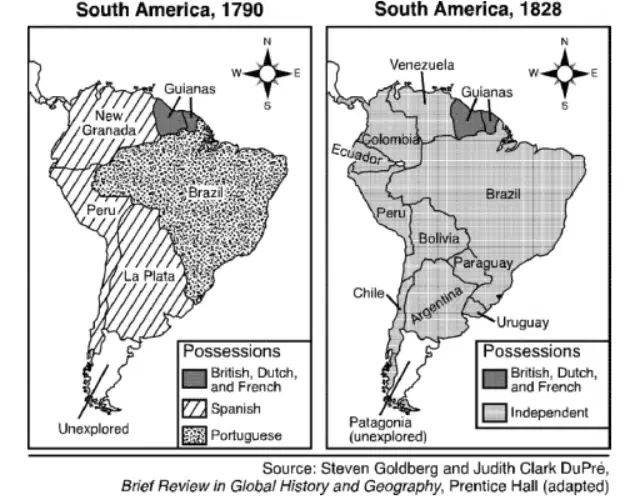
Between 1790 and 1828, which situation helped cause the change reflected on these maps of South America?
The Aztecs regained control of many areas of South America.
South American voters removed Spanish and Portuguese rulers from power.
Spain sent conquistadors to South America.
Enlightenment and revolutionary ideas spread from Europe and the United States to South America.
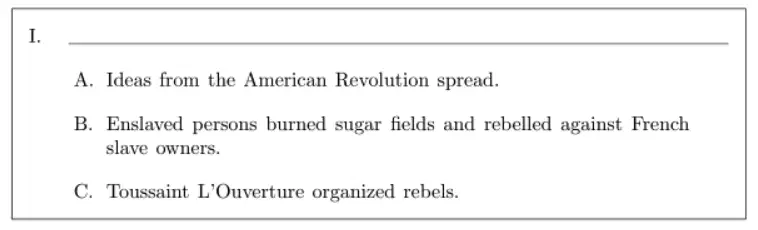
Which title best completes this partial outline?
Causes for Bismarck's Rise to Power
Factors of the Haitian Revolution
Results of the Congress of Vienna
Situations Contributing to the Zionist Movement
Which country is responsible for the extensive colonial use of the encomienda labor system in Latin America?
England
the Netherlands
France
Spain
Which of these situations was the direct result of the other three?
Nations of Latin America won independence.
Revolutions occurred in North America and France.
The Napoleonic wars weakened Spain's power.
Creoles and mestizos became discontented with Spanish rule.
-Toussaint L'Ouverture
-Bernardo O'Higgins
-Jose de San Martin
These individuals had their greatest impact on the
unification of Italy
Zionist movement
independence movements in Latin America
Catholic Counter Reformation

What is the correct chronological order of these events?
A, B, D, C
C, B, A, D
A, D, C, B
D, C, B, A
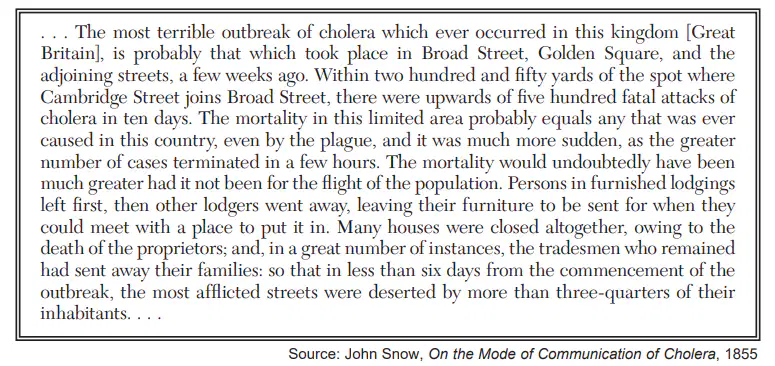
Which claim is best supported by this passage?
City officials took steps to address the epidemic.
People stayed home and waited for the disease to end.
Economic growth would not be affected by this epidemic.
The spread of disease can impact both the victims and the survivors.
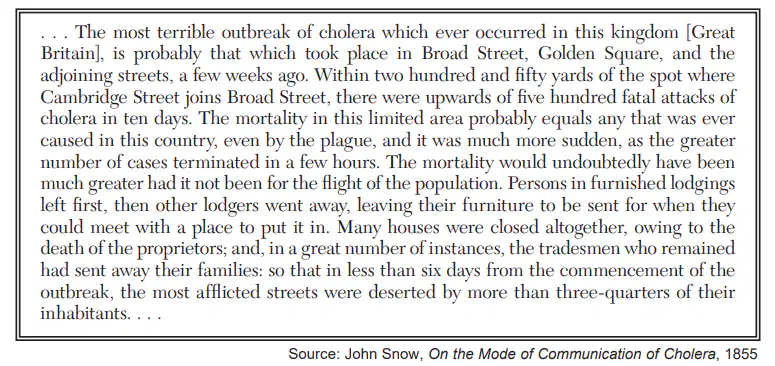
This passage could best be used to study which topic?
political complaints which led to the French Revolution
the impact of the Age of Imperialism on colonized peoples
living conditions for workers during the Industrial Revolution
the impact of the Agricultural Revolution on food production
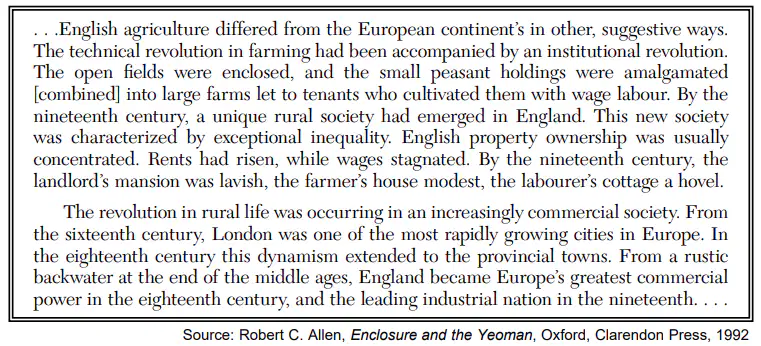
According to this passage, what was one impact of the agricultural changes in England?
Social class distinctions were eliminated.
Wage labor led to a growing gap between the rich and poor.
Rural populations increased and urban populations declined.
Property ownership was equally dispersed among the social classes.
How did Enlightenment principles shape José de San Martín's approach to leadership during the independence movements?
He promoted equality, liberty, and the rights of citizens
He sought to establish a theocracy
He supported the continuation of Spanish royal authority
He rejected all European ideas in favor of traditional colonial rule
Which statement best explains the impact of Enlightenment thinkers like Rousseau and Montesquieu on Latin American revolutionaries such as Bolívar and San Martín?
They convinced the revolutionaries to support colonial mercantilism
They inspired the revolutionaries to fight for representative government and individual freedoms
They encouraged the revolutionaries to maintain strict social hierarchies
They promoted the idea of returning power to the Spanish crown
Which of the following leaders is most closely associated with the liberation of northern South America from Spanish rule?
Jose de San Martin
Dom Pedro I
Simon Bolivar
Father Miguel Hidalgo
What was a common goal shared by Simon Bolivar, Jose de San Martin, and Father Miguel Hidalgo during the early 19th century?
To promote independence and nationalism in Latin America
To restore Spanish colonial authority
To expand Portuguese influence in South America
To establish monarchies in their respective countries
Which event is most directly linked to Father Miguel Hidalgo's call for Mexican independence?
The Congress of Vienna
The Haitian Revolution
The Battle of Ayacucho
The Grito de Dolores
Which social class did Simón Bolívar and José de San Martín belong to, and why did this class play a key role in the Latin American revolutions?
Indigenous peoples; they wanted to restore pre-colonial empires
Peninsulares; they wanted to maintain Spanish control
Creoles; they felt politically and economically marginalized by European-born elites
Mestizos; they sought to abolish all social classes
What was a major grievance of the Creole class in Latin America that contributed to the outbreak of independence movements?
They were required to pay no taxes
They were denied high-ranking government positions by the Peninsulares
They were forced to convert to Protestantism
They controlled all trade with Europe
How did the Creole class's position in colonial society influence their leadership in the Latin American revolutions?
They were recent immigrants from Europe with no ties to the colonies
They were the ruling class and wanted to maintain the status quo
They were wealthy and educated but lacked political power, motivating them to seek independence
They had no education and little wealth, so they relied on foreign support

