
 Worksheets
OCD Treatment Practice Questions
Total questions: 66
Worksheet time: 33mins
Which criterion best describes a necessary feature for participants to be included in Lovell’s study on OCD?
Adults diagnosed with obsessive-compulsive disorder using standardized clinical criteria
Children with generalized anxiety but no compulsions
Volunteers without any mental health diagnosis
Individuals currently in long-term inpatient care for psychosis
In clinical psychology, what does ERP stand for in the context of treating OCD?
Exposure and Response Prevention
Extended Relapse Protection
Emotional Regulation Practice
Evidence-based Recovery Protocol
What was the primary aim of Lovell et al.’s study regarding OCD treatment?
To evaluate the effectiveness of a specific OCD treatment approach
To map the global prevalence of OCD across cultures
To compare the genetic basis of OCD with anxiety disorders
To design a new diagnostic test for OCD
Which pair lists two appropriate outcome measures that could be used in Lovell’s study of OCD treatment?
Standardized OCD symptom severity scale and patient-reported anxiety ratings
Blood glucose levels and resting heart rate
Visual acuity test and hearing threshold
Time to complete a maze and number of puzzles solved
Which treatment is more directly linked to the nature perspective in psychology, and why?
SSRI, because it acts biologically on serotonin systems
ERP, because it changes learned environmental triggers
CBT, because it focuses on thought patterns shaped by experience
Family therapy, because it modifies social environments
What is the main process emphasized in Cognitive Behavioral Therapy (CBT) for OCD?
Identifying and restructuring irrational thoughts and behaviors
Administering sedatives to reduce acute anxiety
Practicing free association to uncover unconscious conflicts
Using hypnosis to access suppressed memories
How does negative reinforcement help explain the maintenance of OCD behaviors?
Compulsions are performed to remove or reduce anxiety, which strengthens the behavior
Compulsions provide social approval from others, increasing the behavior
Punishments reduce the frequency of compulsions over time
Positive rewards for avoiding rituals decrease anxiety
In Lehmkuhl’s case study of “Jason,” how was the procedure adapted to accommodate his needs?
Tailored ERP steps were individualized to Jason’s specific obsessions and compulsions
A standardized protocol was applied without any modifications
Only pharmacotherapy was used with no behavioral component
The study avoided any exposure-based tasks entirely
Which statement highlights evidence supporting SSRIs as an explanation or treatment for OCD?
Clinical studies report symptom reduction when serotonin reuptake is inhibited
OCD symptoms worsen when patients practice ERP
Serotonin levels remain unchanged after SSRI treatment
CBT shows no effect on OCD compared to waitlist controls

According to the lesson goals, which task involves recalling basic information about OCD interventions?
Understanding the different types of treatments used for OCD
Planning a new clinical trial for OCD
Designing a hospital ward for OCD patients
Predicting long-term societal impacts of OCD

Which objective best reflects applying knowledge of research methods rather than simple recall?
Memorizing the acronym OCD
Describing the key features of the named studies
Listing common OCD symptoms
Recalling the year OCD was added to diagnostic manuals

A student is asked to judge whether a specific OCD therapy is effective by weighing evidence from named studies. Which listed learning objective does this align with most directly?
To understand the different types of treatments used for OCD
To be able to describe the key features of the named studies
To evaluate the treatments used for OCD
To memorize all OCD diagnostic criteria
Which statement best defines SSRIs in the context of treating OCD?
Serotonin Suppression and Release Inhibitors
Selective Serotonin Reuptake Inhibitors
Systemic Serotonin Redistribution Interventions
Sequential Serotonin Response Inducers
According to the material, how do SSRIs improve OCD symptoms?
By increasing serotonin production in the liver
By blocking serotonin reabsorption so levels remain higher in the brain
By converting dopamine into serotonin in muscle tissue
By decreasing neuronal communication across synapses
What is the immediate clinical effect described when serotonin levels remain higher due to SSRIs?
Increase in compulsive rituals to relieve stress
Decrease in anxiety, reducing the need to engage in OCD behaviours
Onset of tolerance within one week leading to relapse
Increase in Y-BOCS scores indicating symptom severity
Soomro et al.'s meta-analysis reported which outcome regarding SSRIs?
SSRIs were less effective than placebo and increased Y-BOCS scores
SSRIs were more effective than placebo and reduced Y-BOCS scores
SSRIs had no difference from placebo and did not affect Y-BOCS scores
SSRIs were only effective in adults over 50 years old
Which detail characterizes the Rapoport case study of Charles?
Charles was a 14-year-old with extensive washing rituals; serotonin-targeting antidepressants relieved symptoms but tolerance developed after a year and he relapsed
Charles was a 10-year-old with checking compulsions; antipsychotics eliminated symptoms permanently
Charles was a 14-year-old with hoarding behaviours; therapy alone reduced symptoms with no relapse
Charles was a 20-year-old with contamination fears; SSRIs had immediate, lifelong effects
Which mechanism-of-action description aligns with SSRIs as presented?
They enhance serotonin reabsorption after transmission between neurons
They block serotonin from being reabsorbed after a message passes, keeping synaptic serotonin higher
They increase norepinephrine availability by inhibiting MAO
They stimulate dopamine release to counteract anxiety
Based on the evidence provided, which inference is most supported about SSRIs for OCD?
They reduce anxiety and OCD behaviours, with research showing superiority over placebo, though individual tolerance can lead to relapse
They increase anxiety while reducing compulsions, with placebo outperforming SSRIs
They only work by lowering Y-BOCS scores without affecting patient behaviour
They guarantee permanent symptom relief with no risk of tolerance
Which statement best defines ERP in the context of OCD treatment?
A medication protocol to reduce intrusive thoughts
A form of CBT that combines facing feared triggers with resisting compulsions
A relaxation-only technique focused on deep breathing exercises
A psychoanalytic method emphasizing dream analysis
In ERP, what does the exposure component specifically involve?
Avoiding all contact with feared objects to lower anxiety
Gradually confronting situations that trigger obsessive thoughts or anxiety
Immediately performing compulsions to reduce distress
Rehearsing alternative thoughts without real-world practice
According to the material, which outcome is expected over time when a person refrains from compulsions during ERP?
Anxiety permanently increases with each exposure
Anxiety stays the same and requires medication to change
Anxiety decreases on its own due to habituation
Anxiety disappears only if compulsions are allowed
Which example illustrates response prevention in ERP?
Touching a 'contaminated' door handle
Washing hands immediately after touching a doorknob
Not checking the oven even when anxious about whether it is off
Avoiding supermarkets to reduce anxiety
Which statement captures the key idea of ERP presented in the text?
People confirm their feared outcomes through repeated checking
People learn that feared outcomes don’t actually happen and they can tolerate anxiety without compulsions
People must eliminate all anxiety before confronting fears
People rely on relaxation to remove obsessions

Based on the cycle diagram described, what typically follows an obsession such as repeated thoughts about the oven being left on?
Immediate relief without action
A compulsion like repeatedly checking the oven
A reduction in anxiety due to ignoring the thought
An improvement in memory that prevents future obsessions

In the cycle explanation, why is the relief after a compulsion problematic?
It eliminates anxiety permanently
It strengthens the obsessive response for the future
It proves the feared outcome was real
It prevents habituation during exposure
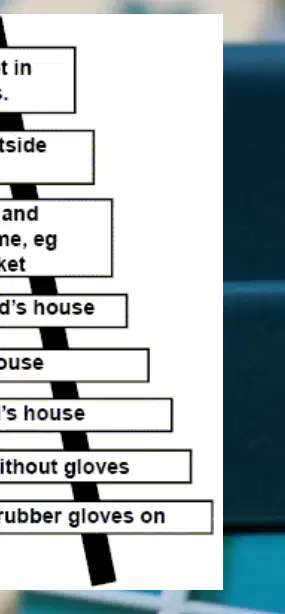
What is the purpose of a fear thermometer in ERP?
To measure physiological temperature changes during anxiety
To rank feared situations and build exposure gradually so the compulsion does not occur
To time how long compulsions are delayed
To select which relaxation technique to use
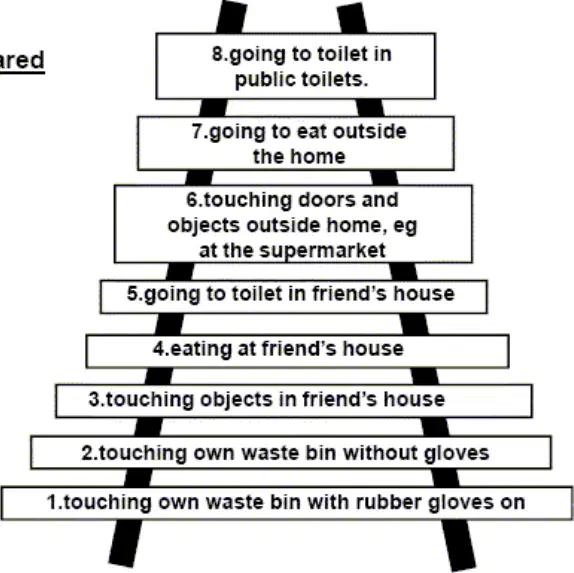
Which step would likely be near the bottom of a fear hierarchy for contamination concerns, based on the example?
Going to toilet in public toilets
Touching doors and objects outside home at the supermarket
Touching own waste bin with rubber gloves on
Going to eat outside the home
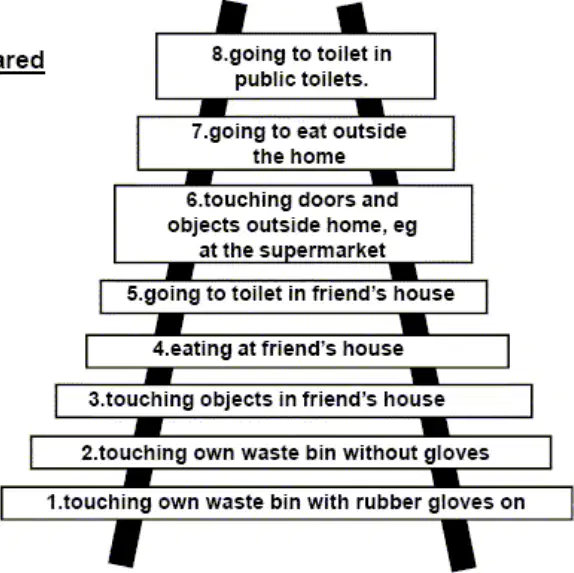
A client with OCD worries about germs. Which ERP plan aligns with the hierarchy approach described?
Start with public toilets, then move to home tasks
Begin by touching their own waste bin with gloves, then without gloves, and progress to public spaces
Avoid all waste bins until anxiety disappears
Perform handwashing after each step to feel safe
Which combination best represents the two core elements of ERP?
Exposure to triggers and allowance of compulsions
Exposure to triggers and prevention of the compulsive response
Relaxation training and mindfulness only
Medication management and psychoeducation only
According to the case study, what was the primary aim of Lehmkuhl et al. (2008)?
To compare medication versus therapy for adult OCD
To test how well ERP works in treating OCD in a child with Autism Spectrum Disorder
To evaluate school-based programs for social skills in ASD
To develop a new diagnostic scale for OCD severity
Which description best matches the participant in the case study?
A 12-year-old boy with high-functioning autism and OCD
An 8-year-old girl with generalized anxiety disorder
A 16-year-old adolescent with depression and ASD
A 12-year-old boy with ADHD and social anxiety
Which of Jason’s symptoms were specifically noted at the start of treatment?
Paranoia and hallucinations
Contamination fears and excessive handwashing
Sleep paralysis and nightmares
Phobias of heights and flying
What key adaptation was made to ERP to suit Jason’s autism?
Using only group therapy settings
Excluding imaginary exposure exercises because pretend situations were difficult
Increasing session length to 90 minutes
Replacing exposure with mindfulness only
In the adapted procedure, which coping strategy did Jason learn to use during anxiety?
Catastrophizing statements like “Something bad will happen”
Coping statements such as “I know that nothing bad will happen”
Silence and avoidance of triggers
Immediate reassurance seeking from parents
Which examples were used for step-by-step exposure during Jason’s ERP?
Public speaking and crowded concerts
Elevator buttons and door handles
Heights and roller coasters
Dogs and spiders
What was the structure of Jason’s therapy schedule?
10 sessions of 50 minutes over 16 weeks
8 sessions of 30 minutes over 8 weeks
12 sessions of 60 minutes over 12 weeks
6 sessions of 45 minutes over 6 weeks
Which statement best describes Jason’s Y-BOCS score change following treatment?
Increased from 3 (normal range) to 18 (severe)
Dropped from 18 (severe) to 3 (normal range)
Remained at 18 (severe) with no change
Fluctuated between 10 and 15 with mild improvements
What outcome was reported three months after treatment?
Symptoms returned to severe levels with frequent rituals
Symptoms remained low, with improved daily functioning and better participation in school and social activities
No change in symptoms, but improved sleep only
Complete relapse requiring hospitalization
Which conclusion did the case study support about ERP?
ERP is ineffective for patients with comorbid ASD
ERP can be highly effective for OCD and can be adapted to individual needs
ERP works only when combined with medication
ERP is suitable only for adults with OCD
During Sessions 3–8, which tasks were emphasized as part of the procedure?
Learning relaxation only and stopping exposure
Filling reports on distress and using coping statements during distress for response prevention
Practicing imaginary exposure exclusively
Engaging in competitive games to distract from anxiety
Which statement reflects Jason’s learning about his anxiety responses as therapy progressed?
His anxiety increased in duration after each session
They reduced quickly within a few minutes as therapy progressed
They stayed constant regardless of exposure
They disappeared only during imaginary exercises
Recall: According to the overview, what core process does CBT use to create positive changes in emotional and behavioural responses?
Teaching relaxation without addressing thoughts
Challenging irrational thoughts after understanding them
Avoiding stressful situations to reduce exposure
Strengthening only behavioural habits without cognition
Skill/Concept: Which statement best describes imaginal desensitization as presented in the overview?
A technique where patients repeatedly confront real-life stressors without guidance
A method that trains patients to suppress emotions when stressed
A process where patients visualise stress-inducing images and practise relaxation techniques
A behavioural drill that focuses solely on changing habits through rewards
Recall: In this overview, what does ERP most likely refer to as a component within CBT?
Emotion Regulation Practice
Exposure and Response Prevention
Enhanced Relaxation Procedure
Expressive Reframing Protocol
Strategic Thinking: A client believes, "If I make one mistake, I will fail at everything." Using CBT’s described mechanism, which initial therapist action aligns best with the approach?
Ignore the thought and teach the client time management
Identify and then challenge the irrational belief to promote adaptive responses
Encourage the client to avoid tasks that trigger the belief
Provide rewards for perfect performance to reinforce accuracy
Skill/Concept: Which sequence reflects the CBT flow implied by the overview?
Behavioural change first, then identify emotions, then list rational thoughts
Understand the individual's thoughts, challenge irrational beliefs, then aim for positive emotional and behavioural change
Visualise stressors, avoid them, and wait for emotions to subside
Begin with ERP, skip cognitive work, and focus on habit formation
According to the context provided, what is a noted advantage of CBT in relation to OCD?
CBT is primarily used for phobias, not OCD
CBT is very effective for treating OCD
CBT is only effective when delivered in group settings
CBT has limited evidence for mental health conditions
Face-to-face CBT sessions for OCD are typically described as which of the following?
10–15 minutes, twice daily for one week
45–60 minutes, once a week for several weeks
90 minutes, once a month for one year
30 minutes, only as a single session
Which challenge associated with traditional face-to-face CBT is highlighted in the context?
It is inexpensive and quick to deliver
It often has long waiting lists
It eliminates the need for therapist training
It is only available via computerised platforms
Which rationale is given for offering shorter telephone CBT sessions?
They increase pressure on services and reduce accessibility
They reduce waiting lists and make services more accessible
They require longer travel times for patients
They are less acceptable to patients with family/work commitments
Which accessibility factor is specifically mentioned as improved by telephone CBT?
Access to specialized inpatient wards
Support for transport, family/work commitments, and anxiety about travel
Availability of home visits by therapists
Guaranteed same-day appointments
What was the stated aim of Lovell et al. (2006) regarding CBT for OCD?
To replace all face-to-face therapy with computerised self-help
To compare the effectiveness of telephone-based CBT to face-to-face when treating OCD
To prove that ERP is ineffective for OCD
To analyze long-term outcomes of pharmacological treatments for OCD
Identify the hypothesis tested by Lovell et al. (2006).
ERP by phone will have worse outcomes than face-to-face
ERP by phone will have similar outcomes to face-to-face
ERP by phone will outperform all other therapies
ERP by phone will only benefit mild cases of OCD
Which experimental design features characterize Lovell et al. (2006)?
Matched pairs and quasi-experimental
Independent groups and randomized control trial
Cross-sectional survey and case study
Longitudinal cohort without randomization
In Lovell et al. (2006), what were the two independent variable conditions compared? Choose the best answer.
Face-to-face ERP therapy versus ERP therapy via telephone
Group CBT versus individual CBT
Medication management versus placebo
Inpatient intensive ERP versus outpatient supportive counseling

Which age range best describes the participants recruited in Lovell et al. (2006)?
12–25 years
16–65 years
18–80 years
21–40 years

According to the study, participants needed a baseline Y-BOCS score of at least what value to be included?
8 or more
12 or more
16 or more
20 or more

Which measure, alongside Y-BOCS, was completed by participants to assess mood?
HAM-A
BDI
GAD-7
PANSS

Which of the following was an exclusion criterion in Lovell et al. (2006)?
Mild depression without suicidal intent
Organic brain disease
Prior CBT experience
Being older than 50
Which statement accurately describes the randomization in Lovell et al. (2006)?
Participants self-selected into treatment
Participants were randomly assigned to telephone or face-to-face ERP
Clinicians assigned patients based on symptom severity
Assignment alternated every other patient without randomization
At which time points were Y-BOCS and BDI repeated after the initial treatment completion, according to the procedure?
At 2, 4, and 8 weeks
At 1, 3, and 6 months
At 6 and 12 months only
Weekly for 12 weeks
What step occurred four weeks after the initial pre-treatment assessments?
Client satisfaction questionnaire only
Y-BOCS and BDI were completed again
Random assignment to treatment conditions
Therapist supervision session
Which safeguard enhanced internal validity by reducing assessor bias in Lovell et al. (2006)?
Open-label assessment by treating therapist
Blinding: the researchers did not know which condition participants were assigned to
Video-recorded sessions for later review
Double-entry of questionnaire data
Which paired set correctly identifies the primary outcome and the satisfaction measure used in Lovell et al. (2006)?
Primary outcome: PANSS; Satisfaction: CSQ-8
Primary outcome: Y-BOCS; Satisfaction: client satisfaction questionnaire
Primary outcome: GAD-7; Satisfaction: therapist rating scale
Primary outcome: HDRS; Satisfaction: exit interview only

Reasoning task: Given the exclusion of severe depression with suicidal intent and substance misuse, which threat to validity was the study attempting to minimize?
Testing effect increasing scores over time
Confounding from comorbid conditions influencing outcomes
Selection bias from random assignment
Placebo effects due to therapist expectations

