
 Worksheets
Introduction to Space and Important Terms
Total questions: 68
Worksheet time: 36mins
Which statement best defines absolute zero?
The highest temperature achievable in a vacuum
The point at which all molecules stop moving and energy is minimal
The average temperature of interplanetary space
The temperature at which water freezes in cislunar space
What is cislunar space?
The region beyond the orbit of the outermost planet
The space located within a solar system
The space between the Earth and the Moon
The space between galaxies
Which term describes an enormous collection of stars arranged in a particular shape?
Universe
Galaxy
Interstellar space
Van Allen belts
Which option correctly defines microgravity?
A condition of small gravity levels or low gravity, producing a floating condition
A complete absence of molecules and energy
Radiation belts around Earth filled with charged particles
The region in space from one solar system to another
What does the term universe refer to according to the vocabulary bank?
Only the planets and the Sun
Everything, including planets, galaxies, animals, plants, and humans
Only stars and galaxies
The empty space between solar systems
Match each space-related term to its correct definition.
Interplanetary space
Space within a solar system, measured from the Sun to the orbit of its outermost planet
Interstellar space
Region in space from one solar system to another
Vacuum
Space that is empty or void of molecules
Van Allen belts
Radiation belts around Earth filled with charged particles
Which items are characteristics or regions of space rather than measurement units? Select all that apply.
Kelvin
Vacuum
Interstellar space
Microgravity
Which statement best distinguishes interplanetary space from interstellar space?
Interplanetary space lies within a solar system; interstellar space spans from one solar system to another
Interplanetary space is between galaxies; interstellar space is within a galaxy
Interplanetary space is only around Earth; interstellar space is only around the Sun
Interplanetary space contains radiation belts; interstellar space contains microgravity
Which learning outcome focuses on comparing two regions of space?
Define cislunar space
Describe the location of space
Distinguish between interplanetary and interstellar space
Define universe
Which term is defined as the unit of measurement based on absolute zero and commonly used by scientists to measure temperature?
Celsius
Kelvin
Vacuum
Galaxy
According to the section, which statement best defines space in relation to Earth?
Space is the air directly above Earth where weather occurs.
Space is a part of the universe beyond the immediate influence of Earth and its atmosphere.
Space is any region with total darkness and no stars.
Space is the layer of clouds that surrounds Earth.
Several agencies use altitudes to mark where space begins. Which altitude is most widely accepted as the boundary where space begins, according to the text?
50 miles (80.5 km), as defined by the Air Force and NASA
62 miles (100 km), commonly accepted as the boundary
80 miles (129 km), the minimum to achieve orbit
90 miles (145 km), where the atmosphere completely ends
Which statements about space as a vacuum are correct? Select all that apply.
Space is described as a void or vacuum because molecules become widely spaced.
No place in the universe is truly empty; interactions can still occur at extremely low densities.
The vacuum of space means there is absolutely no atoms anywhere.
Space becomes a vacuum abruptly at a single altitude above Earth.
Match each altitude or condition to its description from the text.
50 miles (80.5 km)
Altitude at which the Air Force and NASA award astronaut wings
62 miles (100 km)
Commonly accepted height where space begins
80–90 miles (129–145 km)
Approximate altitudes needed to stay in orbit when circling Earth
Which statement accurately describes the universe as introduced in the section?
The universe includes everything: stars, planets, galaxies, animals, plants, and humans.
The universe is only the stars visible from Earth on a clear night.
The universe is limited to our solar system and nearby planets.
The universe excludes living things because it refers only to celestial objects.
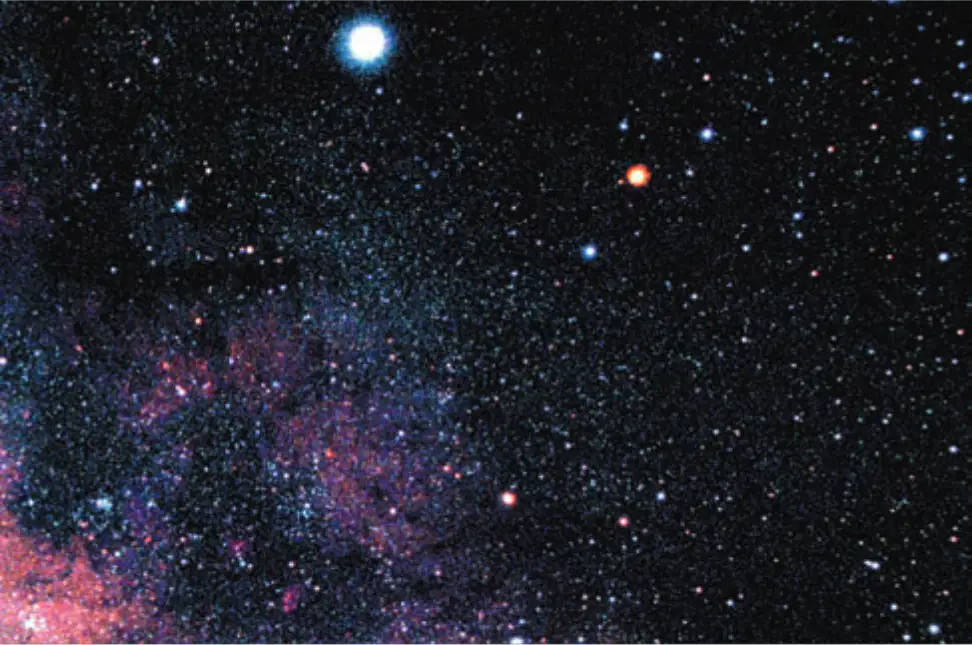
Refer to the starfield image. What does the image emphasize about the concept of space discussed in the section?
Space is a solid surface surrounding Earth.
Space contains numerous stars and objects within the broader universe.
Space is completely empty without any light or matter.
Space begins at the cloud layer near Earth.
Which statement best explains why outer space is often described as a vacuum?
It contains no stars or planets.
It has no, or virtually no, molecules because gravity from large bodies prevents them from floating around.
It is completely empty with absolutely no particles anywhere.
It has high pressure that pushes molecules away.
What is the main reason humans need an oxygen supply when traveling in space?
Spacecraft engines consume all available oxygen.
Space is characterized by a lack of oxygen, making it impossible to breathe without an external supply.
Oxygen freezes in space and must be warmed before use.
Oxygen levels in space fluctuate too rapidly for human lungs.
According to NASA’s description of spacewalking, what would happen to an unprotected human due to the near-zero pressure of space? Select all that apply.
Air inside the lungs would rush out.
Skin would contract tightly, reducing body volume.
Bubbles would form in the bloodstream, impairing oxygen transport.
External pressure would keep body fluids stable.
Deprivation of oxygen to the brain could cause unconsciousness in less than 15 seconds.
Match each temperature scale to a key reference point described in the material.
Fahrenheit
Water boils at 212° on this scale
Celsius
Water freezes at 0° on this scale
Kelvin
Absolute zero is 0 on this scale
Which description best defines absolute zero as presented in the section?
The temperature at which water freezes in Kelvin.
The point at which all molecules stop moving or have the least amount of energy, written as 0 K (-273° C or -459° F).
The average temperature of outer space near the Sun.
The lowest temperature measured on the Fahrenheit scale, 0° F.
Why do scientists commonly use the Kelvin (K) scale for measuring temperature in space contexts?
It starts at the temperature of liquid water.
It is based on absolute zero, making it useful for very low temperatures.
It uses larger degree sizes than Celsius.
It avoids negative numbers for temperatures above freezing only.
Which statement about the temperature of outer space in darkness is most accurate based on the text?
It is exactly absolute zero everywhere.
It is generally near absolute zero because of minimal molecular motion, though cosmic microwave background radiation still exists.
It is generally near room temperature due to starlight.
It cannot be measured because instruments fail in a vacuum.
In the context of space, what does the term microgravity most accurately describe?
A region where gravity is exactly zero.
A condition where gravity is much smaller than on Earth, producing a feeling of weightlessness.
A state caused only by being far beyond the Moon.
A situation that happens only outside Earth’s atmosphere.
Which scenario is used to model how microgravity can be created on Earth?
Riding in an elevator that suddenly begins to accelerate upward.
Riding in an elevator whose cables break at the top, causing the car and you to fall together.
Standing on a scale in a stationary elevator at ground level.
Jumping on a trampoline in a gym.
Select all statements that correctly describe free fall and microgravity in low Earth orbit.
Astronauts experience microgravity because they are constantly falling around Earth.
Free fall means objects accelerate together under gravity alone.
Weightlessness in orbit occurs because gravity is absent.
Orbiting at about 17,500 miles per hour helps the spacecraft keep going around Earth while falling.
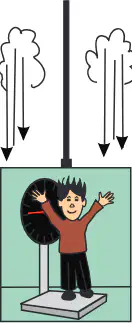
Match each elevator scenario (A–D) to the weight reading shown on the scale in the diagram. Use the illustration that labels A: Normal weight, B: Heavier than normal, C: Lighter than normal, D: No measured weight.
A: Normal weight
Scale reads normal weight while stationary.
B: Heavier than normal
Scale reads higher than normal during upward acceleration.
C: Lighter than normal
Scale reads lower than normal during downward acceleration but not falling freely.
D: No measured weight
Scale reads zero when the car and person are in free fall together.
What misconception about gravity in space is directly addressed in the material?
Space has stronger gravity than Earth’s surface.
There is no gravity in space, so everything floats.
Gravity only exists near planets larger than Earth.
Astronauts stop feeling gravity after traveling 17 times farther than the Moon.
Why has no human traveled beyond the Moon yet been able to experience microgravity?
Microgravity requires traveling beyond the Moon to escape gravity.
Microgravity happens only in deep space, far from planets.
Microgravity occurs during orbital free fall around Earth, not only at great distances.
Microgravity can be felt only inside special spacesuits.
Which description best defines cislunar space according to the instructional text?
The region between the Sun and its outermost planet
The space between Earth and the Moon, including parts of Earth’s magnetosphere
The distance from one solar system to another
The area beyond the Solar System containing galaxies
Select all components found in cislunar space as described in the text.
Protons, electrons, and magnetic lines of force
Meteoroids, asteroids, and comets
Eight known planets and dwarf planets
Radiation storms emitting from the Sun
According to the astronaut quote included, how does the sky appear from cislunar space?
Bright blue with a faint Moon
Pitch black with the Moon appearing quite light and a vivid dark line between sky and Moon
Grey with scattered clouds
Glowing white due to solar wind
Which statement about Earth’s magnetosphere in cislunar space is accurate?
It is absent in cislunar space because that region is a vacuum
It contains charged particles and magnetic lines of force found partly within cislunar space
It only exists beyond the outermost planet of the Solar System
It is composed solely of neutral atoms with no radiation
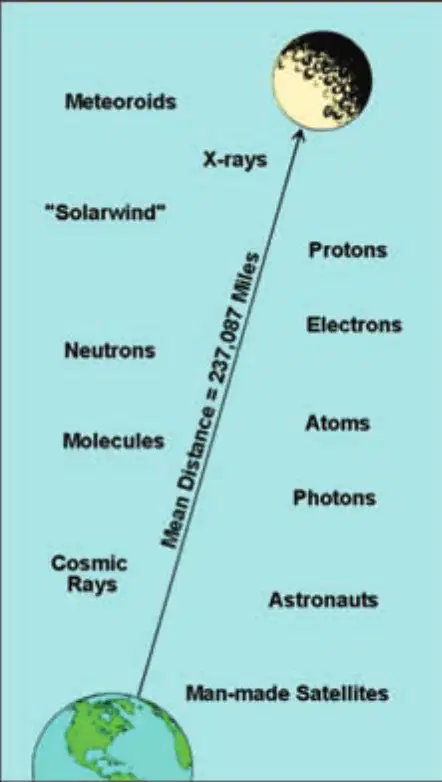
Refer to the diagram titled “Dimensions and occupants of cislunar space.” Which occupant is human-made within cislunar space?
Meteoroids
Neutrons
Man-made satellites
Cosmic rays
What is the best definition of a galaxy as used in astronomy?
A small cluster of planets orbiting a single star
An enormous collection of stars arranged in a particular shape
A cloud of gas surrounding Earth’s atmosphere
A group of comets traveling together through space
Which list correctly names the three main shapes of galaxies described in the text?
Spiral, elliptical, irregular
Round, oval, swirling
Disk, sphere, cluster
Barred, ringed, spiral
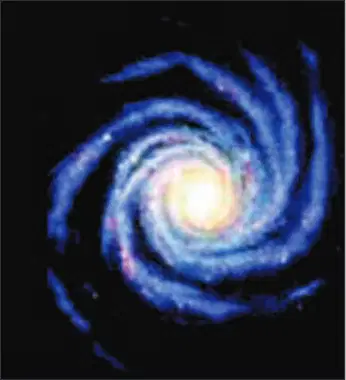
Identify the statement that accurately describes a spiral galaxy based on the material provided.
It has no particular shape and appears uneven
It is oval-shaped with a smooth, rounded appearance
It has arms spiraling outward from a central bulge
It consists only of red and yellow stars without blue stars
According to the passage, what distinguishes the center and arms of the Milky Way Galaxy?
The center has hot, young, blue stars; the arms contain older red and yellow stars
The center contains older red and yellow stars; the arms have mostly hot, younger, blue stars
Both the center and arms have the same mix of stars
Only the center contains stars; the arms are empty
Which statement about the size and contents of galaxies is supported by the text?
There are millions of galaxies in the universe
The smallest galaxies have about 100,000 stars
The largest galaxies have about 3,000 billion (3 trillion) stars
Our Sun is the center of the Milky Way Galaxy
Choose the statement that best reflects the text’s description of the universe.
The universe is small enough to map completely
The universe is continually expanding and almost incomprehensibly vast
The universe has a fixed size and number of galaxies
The universe is composed only of the Milky Way
Match each galaxy shape to its description.
Elliptical
Oval-shaped
Spiral
Arms spiraling outward from a center
Irregular
No particular shape
Which estimate do scientists make about the Milky Way according to the passage?
It contains exactly one billion stars
It probably contains about 100 billion other solar systems and stars
It has no central bulge
It is the smallest galaxy in the universe
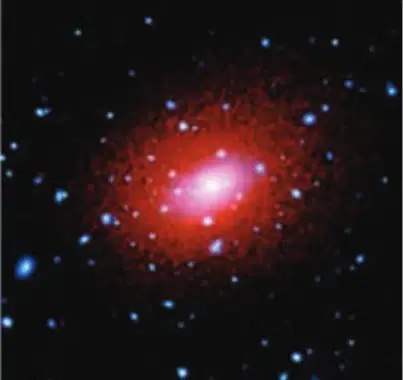
Refer to the image labeled 'Elliptical galaxy.' Which characteristic aligns with an elliptical galaxy?
A dense central bulge with obvious spiral arms
An oval-shaped distribution of stars without distinct arms
An uneven shape with no particular form
A ring of hot, young, blue stars only
Which statement best describes Earth’s magnetic field as presented in the lesson?
It is a perfect sphere that ends at the atmosphere.
It resembles a toy magnet’s field with lines and a long tail stretching millions of miles.
It is a short, stubby field confined to the equator.
It only exists on the day side facing the Sun.
Why are the trapped charged particles around Earth called the Van Allen Radiation Belts?
They were first observed by astronauts on the Moon.
They were named after James Van Allen, who helped discover them using early NASA satellites in 1958.
They were discovered by Galileo with a telescope.
They are formed only during volcanic eruptions.
In the context of space science, what does the term “radiation” refer to?
Only visible light produced by the Sun
Any energy or matter moving through space, including electromagnetic radiation and fast-moving particles
Heat produced by friction in Earth’s atmosphere
Sound waves traveling through space
Match each radiation belt with its typical particle composition and energy range described in the lesson.
Inner Belt
High-energy protons (~100 million volts) and electrons (~1–3 million volts)
Outer Belt
Mostly electrons with energies of ~5–20 million volts
Hazard emphasis for astronauts
Inner Belt more hazardous to astronauts; Outer Belt more hazardous to satellite electronics
Which belt is specifically noted as a serious hazard to astronauts working in space?
Inner Belt (blue) containing high-energy protons and electrons
Outer Belt (purple) dominated by lower-energy electrons
Neither belt affects humans
Both belts affect only ground-based equipment
Which belt poses a greater hazard to communication satellites’ sensitive circuits due to fast-moving electrons?
Inner Belt
Outer Belt
Neither belt
Only temporary belts during solar eclipses
Which two leading ideas explain where the particles in the Van Allen Belts may come from, according to the lesson?
From the Sun as a powerful source of particles
From cosmic rays outside the solar system trapped by Earth’s magnetic field
From Earth’s oceans evaporating into space
From volcanic ash launched into orbit
Why are satellite operators concerned about radiation belts during space operations?
Radiation belts increase Earth’s gravity.
High-energy particles can penetrate a satellite’s skin and damage sensitive circuitry, causing loss of lock or temporary failure.
Radiation makes satellites invisible to telescopes.
Belts prevent solar power generation completely.
What is meant by “space radiation effects” on satellites and astronauts?
Minor weather patterns on Earth
All the ways changes in fast-moving particles and X-rays can significantly affect satellite operation or astronaut health, especially during severe events
Only the slowing of satellites due to air resistance
A decorative term for auroras
Which scenario illustrates how a single high-energy particle can disrupt a satellite, as described in the lesson?
A raindrop hits the satellite, causing corrosion.
A particle is absorbed by microscopic components, flipping a switch from on to off or corrupting a memory bit, leading the satellite to veer out of control until corrected.
Sunlight melts the satellite’s exterior, changing its color.
Moonlight confuses the star-tracking camera by dimming stars.
During severe solar storms, what change in Earth’s upper atmosphere can affect satellites’ orbits?
It cools and contracts, reducing drag.
It heats and expands, increasing air density and friction that slows satellites and alters their orbits.
It becomes ion-free, eliminating radio communication.
It forms solid ice layers that satellites bounce off.
According to the lesson, what is the main concern for astronauts regarding space radiation?
Noise interfering with radios
Amount of radiation (often X-rays) penetrating spacecraft walls and the astronaut’s body, with potential biological effects
Bright light causing eye strain
Cold temperatures lowering body heat
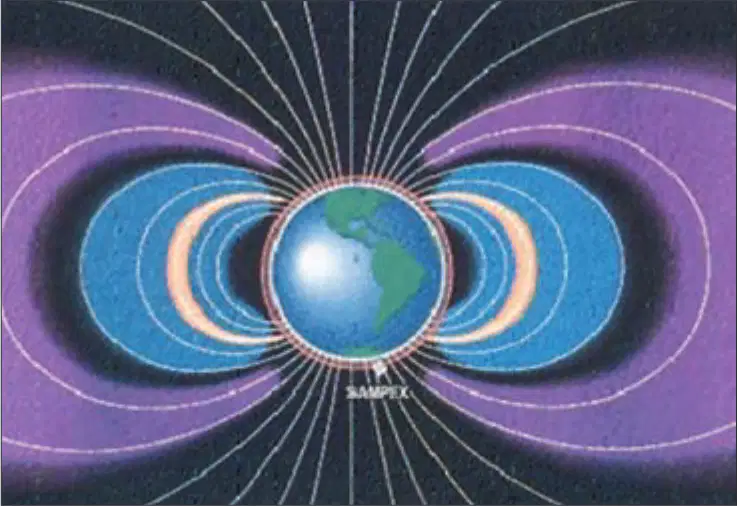
Refer to the diagram showing Earth’s magnetic field lines and donut-shaped belts around Earth. Which feature is illustrated by the long tail of field lines?
A short loop confined to the equator
An invisible tail of magnetism stretching millions of miles beyond the Moon on the opposite side of the Sun
A series of mountains on Earth
A halo of visible light around the planet
Which statement best defines the Earth's magnetosphere for grade 8 students?
A region of electrically charged layers in the upper atmosphere
A magnetic field of force that surrounds Earth and extends into interplanetary space
A layer of ozone that protects Earth from ultraviolet radiation
A belt of clouds that forms around the equator
Solar wind interacts with Earth’s magnetosphere. What is one direct effect described in the material?
It creates a calm region with no magnetic activity
It forms a bow shock wave that distorts the magnetosphere
It removes oxygen from the atmosphere
It causes earthquakes along plate boundaries
Where is Earth’s magnetic force strongest and weakest?
Strongest at the equator; weakest at the poles
Strongest at the poles; weakest at the equator
Equal strength everywhere
Strongest over oceans; weakest over land
Aurora borealis and aurora australis are associated with which atmospheric zone and at what general heights?
The troposphere at 0–30 miles
The stratosphere at 30–60 miles
The ionosphere at 60–600 miles
The exosphere at 600–6,000 miles
Which statements about the ionosphere are accurate? Select all that apply.
It is divided by its electrical activity and contains ionized gas particles.
It was discovered when radio waves were found to be transmitted and reflected in the atmosphere.
It is a thin surface layer of liquid water above the oceans.
It reflects radio waves because ions gain or lose electrons and carry charge.
Match each term to its description.
Solar wind
Stream from the Sun that strikes the magnetosphere
Bow shock wave
Resulting wave that distorts the magnetosphere
Ionosphere
Electrically charged layer region in the upper atmosphere
Aurora borealis/australis
Brilliant sky display linked to the ionosphere
What causes the ionosphere to be filled with ions, according to the material?
Heating by surface temperatures
Powerful ultraviolet radiation from the Sun and ultra high frequency cosmic rays
Evaporation from oceans
Volcanic ash in the stratosphere
According to the chapter summary, which list best represents components that are part of the universe?
Space, stars, planets, galaxies, plants, animals, and humans
Only stars and planets, because galaxies are separate from the universe
Space and galaxies, but not living things like plants and animals
Stars and magnetic fields, but not planets or humans
Select all conditions that the chapter summary states can vary in different places within the universe.
Temperature
Atmosphere
Gravity
Magnetic fields
The types of atoms
What common feature do all galaxies share, based on the summary?
They are made entirely of planets without stars
They are arrangements of huge masses of glowing objects called stars
They contain only one star surrounded by empty space
They are defined by having identical temperatures throughout

The suns massive (a) is what keeps all the planets and other objects in the solar system from drifting away.

Match the statement to the correct arrow.
The force of gravity keeps the moon in its orbit around Earth.
A
The property of inertia keeps the moon moving in a straight line until acted upon by another force.
B
The combination of the two keeps the Moon moving around the Earth
A and B

