
Font size
 Worksheets
Medical Terminology EXAM 4 Study Guide
Total questions: 167
Worksheet time: 2hrs 54mins
________ anemia refers to the failure of blood cell production in the bone marrow:
Hemolytic
Sickle cell
Aplastic
Iron deficiency
________ anemia is the reduction in red blood cells due to excessive destruction:
Hemorrhagic
Sickle cell
Hemolytic
Aplastic
Polycythemia vera:
Inherited disorder of abnormal hemoglobin production
Excessive bleeding due to hereditary lack of factors VIII or IX
Reduction in red cells due to excessive destruction
General increase in red blood cells
Mechanical separation or removal of white blood cells from the rest of the blood:
Leukapheresis
Leukocytosis
Leukophilia
Plasmapheresis
Neutrophil:
White blood cell with granules that stain blue; associated with the release of histamine and heparin.
Immature bone marrow cell that gives rise to granulocytes.
White blood cell with granules that do not stain intensely but show a pale color; phagocytic tissue-fighting cell.
White blood cell with granules that stain red; associated with allergic reactions.
________ is the deficiency of clotting cells; ________ is the deficiency of neutrophils:
Thrombocytopenia, neutropenia
Neutropenia, thrombocytopenia
Cellpenia, neutrophilpenia
Classic penia
Prothrombin time tests:
Number of erythrocytes per cubic millimeter of blood
Speed at which erythrocytes settle out of plasma
Total amount of hemoglobin in a sample of peripheral blood
Ability of the blood to clot
Hemochromatosis:
Excess calcium deposits throughout the body
General increase in red blood cells
Reduction in red cells due to excessive destruction
Excess iron deposits throughout the body
Hemolysis:
Anticoagulant found in blood and tissues
Breakdown or destruction of red blood cells
Blood clotting
Plasma protein
Antigen:
Specific protein produced by lymphocytes in response to bacteria or viruses.
Foreign substance or toxin that stimulates the production of an antibody.
Enzyme that converts fibrinogen to fibrin.
Anticoagulant found in blood and tissue cells.
________ is excessive bleeding caused by a hereditary lack of one of the protein factors necessary for blood clotting.
Granulocytosis
Hemochromatosis
Hemophilia
Polycythemia vera
Bilirubin:
Plasma protein.
Major protein in blood that maintains the proper amount of water.
Orange-yellow pigment in bile formed by the breakdown of hemoglobin when RBCs are destroyed.
Protein that forms the basis of a blood clot.
Hematopoietic stem cell:
Cell in the bone marrow that gives rise to all types of blood cells.
Immature red blood cell.
Mononuclear leukocyte that produces antibodies to fight disease.
Hormone secreted by the kidneys to stimulate RBC formation.
Thrombin:
Platelet
Enzyme that converts fibrinogen to fibrin during coagulation
Response of the immune system to foreign invasion
Protein that forms the basis of a clot
A basophil is a WBC that has granules that stain blue and are associated with the release of histamine and heparin
True
False
Electrophoresis:
Removing red blood cells with electric shock
Removal of plasma from withdrawn blood
Method of separating serum proteins by electrical charge and size
An immunoglobulin is an anticoagulant found in blood and tissue cells:
True
False
ESR test:
Test that finds the percentage of erythrocytes in a volume of blood.
Determines the speed at which erythrocytes settle out of plasma.
Test for the presence of antibodies that coat and damage erythrocytes.
Determines the percentages of different leukocytes in the blood.
WBC differential:
Determines the total amount of hemoglobin in a sample of peripheral blood.
Microscopic examination of stained blood smear to determine shape of individual red blood cells.
Determines the percentages of different types of leukocytes in the blood
Determines the number of leukocytes per cubic millimeter of blood.
Test that determines the percentage of erythrocytes in a volume of blood:
Red blood cell morphology
Hematocrit
CT scan
Complete blood count
Albumin is a protein that forms the basis of a blood clot.
True
False
Apheresis:
Whole blood or cells are taken from a donor and infused into a patient.
Microscopic examination of a core of bone marrow removed with a needle.
Procedure that can remove toxic substances or autoantibodies from the blood and can collect blood cells.
Peripheral stem cells from a compatible donor are administered to a recipient.
Blood has all of the following functions except to:
Transport carbon dioxide and wastes from the cells for elimination from the body
Maintain a constant environment for other living tissues
Regulate respiration
Transport nutrients and oxygen to the cells
Not enough iron to produce hemoglobins; most common type of anemia:
Iron deficiency anemia
Aplastic anemia
Hemorrhagic anemia
Hemolytic anemia
________tion is the process of blood clotting.
Coagula
Granula
Forma
Differentia
Fibrin:
Plasma protein that is converted to fibrin in the clotting process.
Enzyme that converts fibrinogen to fibrin during coagulation.
Anticoagulant found in blood and tissue cells.
Protein that forms the basis of a clot.
A(n) _______phil is a white blood cell with granules that are neutral or do not stain intensely:
Granulo
Neutro
Eosino
Leuko
The enzyme that converts fibrinogen to fibrin during coagulation is called:
Prothrombin
Thrombin
Thromboplastin
Thrombocyte
A protein that maintains proper proportion and concentration of water in blood is (a) ; the protein converted to fibrin in the clotting process is (b) .
The hormone secreted by the kidneys to stimulate the bone marrow to make RBCs is:
Heparin
Erythropoietin
Erythroblasts
Antibodies
Protein with antibody activity; IgG, IgM, IgA, IgE and IgD:
Albumins
Immunoglobulins
Myeloblasts
Fibrinogens
Acute lymphoid leukemia (ALL):
Both mature and immature granulocytes are present in large numbers in the marrow and blood.
Immature lymphocytes predominate with a sudden onset that is usually seen in children and adolescents.
Immature granulocytes predominate and platelets and erythrocytes are diminished.
Abnormal numbers of relatively mature lymphocytes that predominate in the marrow, lymph nodes and spleen.
ELISA
Measurement of the amount of AIDS virus (HIV) in the bloodstream
Screening test to detect anti-HIV antibodies in the bloodstream
Measures the number of CD4+ T cells in the bloodstream of patients with AIDS
Test that separates the immunoglobulins
Acts directly on antigens to destroy them or produce chemicals (cytokines) that are toxic to antigens (Examples include helper, cytotoxic and suppressor cells):
B cells
Dendrite cells
T cells
Plasma cells
Herpes simplex:
Viral infection causing blisters on skin of the lips, nose or genitals
Bacterial disease involving the lungs, brain and other organs
Parasitic infection of the GI tract, brain and spinal cord
Bacterial disease with fever, malaise, night sweats, anorexia, diarrhea, weight loss and lung/blood infections
__________ is an exaggerated, life-threatening hypersensitivity to a previously encountered foreign protein or other substance.
Anaphylaxis
Atopy
Opportunistic function
Histoplasmosis
A malignant tumor of lymph tissue in the spleen and lymph nodes is called __________ disease, or lymphoma.
Waldenström
Kaposi
Hodgkin
Thymoma
A __________ infection is associated with AIDS, involving the brain, lungs and blood; pathogen is found in pigeon droppings and nesting areas, air, water and soil:
Cryptococcal
Tuberculosis
Cryptosporidiosis
Histoplasmosis
________ sarcoma is a malignant condition associated with AIDS that arises from the lining of capillaries; it appears as dark purplish skin nodules.
Kaposi
Ewing
Osteogenic
Rhabdomyosarcoma
A person who is prone to allergies can be described as being:
Anaphylactic
Intolerant
Indisposed
Atopic
A condition of interstitial fluid collecting within the spaces between cells as a result of obstruction of lymphatic vessels and nodes:
Hypersensitivity reaction
Lymphedema
Lymphadenitis
Lymphadenopathy
Cell-mediated immunity:
B cells produce antibodies after exposure to specific antigens
Any disease of the lymph nodes
Protection an individual is born with
T cells respond to antigens and destroy them
The virus that causes AIDS:
H1N1
MRSA
Ebola
HIV
Vaccination:
Ability of T lymphocytes to recognize and accept the body's own antigens as "self" or friendly.
Body's ability to resist foreign organisms and toxins that damage tissues and organs.
Exposure of an individual to a foreign protein (antigen) with an injection that provokes an immune response that destroys any cell that possesses the antigen on its surface and will protect against future infection.
Ability of T cells to recognize and accept the body's own antigens as friendly
Lymphocytopenia is a(n):
Disease of lymph glands
Deficiency of lymphocytes
Inflammation of lymph nodes
14. Lymphopoiesis:
increase in lymph
formation of lymphocytes
deficiency of lymphocytes
Adenoids:
Masses of lymphatic tissue in the back of the oropharynx (mouth)
Organ that destroys worn out red blood cells
Mass of lymphatic tissue in the nasopharynx
Drains lymph from the lower and left side of the body
Humoral immunity:
T cells respond to antigens and destroy them
B cells produce antibodies after exposure to specific antigens
Protection that an individual is born with to fight infection
Interleukins:
Proteins that stimulate the growth of B and T lymphocytes
Antibodies secreted by plasma cells in response to an antigen
Proteins secreted by T cells to aid and regulate the immune response
B cell:
Directly kills antigens
Shows T and B cells where to attack
Phagocytic cell found in the lymph nodes
Matures into a plasma cell to secrete antibodies
Toxoplasmosis:
Virus that causes enteritis and retinitis
Parasitic infection involving CNS with fever, chills, visual disturbances, confusion, hemiparesis and seizures.
Yeast-like fungus in the mouth, skin, intestines and vagina.
Bacterial disease with fever, cough, weight loss, anorexia and blood in sputum.
Pneumocystis pneumonia:
Bacterial disease involving the lungs, brain and other organs with fever, cough, weight loss, anorexia and blood in sputum.
Fungal infection caused by inhalation of dust contaminated with Histoplasma capsulatum.
Lung infection with fever, cough and chest pain.
Virus that causes enteritis and retinitis.
X-ray imaging produces cross-sectional and other view of abnormalities of lymphoid organs; lymph nodes, spleen and thymus gland:
CT scan
Immunoelectrophoresis
Electrocardiogram
MRI
Lymphocyte that directly kills antigens:
B cell
Cytotoxic T cell
Dendritic cell
The thymus gland is an organ in the LUQ that destroys worn out RBCs, activates lymphocytes and stores blood.
True
False
Substances capable of inducing an immune response are:
Antibodies
Cytokines
Antigens
Which of the following is not a lymphoid organ of the immune system?
Lymph nodes
Spleen
Thymus
Liver
The ability of the body to resist foreign microorganisms, such as bacteria, parasites, and viruses, is known as:
Vaccination
Antitoxicity
Phagocytosis
Immunity
Collection of stationary solid lymphatic tissue along lymph vessels; contains cells that fight infection:
Macrophages
Antibodies
Cytokines
Lymph nodes
Protection that an individual is born with to fight infection; it is not antigen specific and does not elicit memory:
Humoral
Immunotherapy
Cell-medidated
Natural immunity
Proteins produced by B cells to destroy antigens are:
Interleukins
Antibodies
Lymph
Antigens
The collection of stationary lymph tissue in the armpits is comprised of:
Mediastinal nodes
Paraaortic nodes
Axillary nodes
Inguinal nodes
Fluid in the spaces between the cells is:
Cerebrospinal fluid
Interstitial fluid
Amniotic fluid
Visceral fluid
The collection of stationary lymph tissue in the groin region is comprised of:
Mesenteric nodes
Inguinal nodes
Cervical nodes
Retroperitoneal nodes
The tiniest lymphatic vessels are the:
Lymph vessels
Lymph capillaries
Axillary vessels
Interstitial capillaries
Antigen-presenting cells that show T and B cells what to attack are:
Cytotoxic T cells
Plasma cells
Macrophages
Dendritic cells
T cells that serve a regulatory function for specific immune responses by stopping the immune response when an antigen has been destroyed are:
Helper T cells
Cytotoxic T cells
Suppressor T cells
Interleukins
Interferons and interleukins are examples of:
Antigens
Cytokines
Vaccines
B cells
Yeast-like fungus that causes lung, brain and blood infections:
Toxoplasmosis
Pneumocytosis pneumonia
Histoplasmosis
Cryptococcal infection
Hypersensitive or allergic state involving an inherited predisposition:
Atopy
Allergen
Anaphylaxis
Lymphoma
With a _______ fracture a bone is broken but there is no open wound in the skin:
Compound (open)
Compression
Simple (closed)
Colles
A _______ fracture is when the bone is broken and a fragment of bone protrudes through an open wound in the skin:
Comminuted
Simple (closed)
Compound (open)
Greenstick
The physician ordered NSAIDs and PT/OT for Ms. Chang to reduce her inflammation and pain from degenerative joint disease, or osteo________.
Malacia
Arthritis
Perosis
Listhesis
Fascia:
Sac of fluid near a joint
Fibrous tissue that envelops and separates muscles
Any type of joint
Muscle connected to internal organs
Gouty arthritis:
Inflammation and painful swelling around a joint caused by excessive uric acid crystal accumulation
Chronic, progressive arthritis with stiffening of joints
Chronic joint condition with inflammation and pain caused by an autoimmune reaction
Arthroplasty:
Muscle pain due to chronic inflammation
Surgical repair of a joint
Removal of a joint
Muscle atrophy due to degeneration of nerves
The softening of bone is osteo______, the inflammation of bone and marrow is osteo_______:
Poirosis, myelitis
Blasts, clasts
Malacia, myelitis
Cells
Spondylolisthesis:
Narrowing of the spine
Formation of a vertebra
Degeneration of the vertebrae
Forward slipping or subluxation of a vertebra over a lower vertebra
Congenital abnormality of the hindfoot (involving the talus):
Exostosis
Polymyotosis
Kyphosis
Talipes
Laminectomy:
Incision of lamina
Removal of lamina
Inflammation of lamina
Opening to lamina
Bursa:
Freely movable joint
Sac or fluid near a joint
Smooth white tissue that covers the ends of bones
Immovable joint
The medical condition caused by the median nerve being compressed by a wrist ligament as it passes between that ligament and the bones and tendons of the wrist:
Carpal tunnel syndrome
Tendonitis
Synovitis
Transverse fracture
Origin:
Turning the palm upward
Connection or attachment of muscle to the bone that moves
The point of attachment of the muscle to a stationary bone
Connective tissue band that connect muscles to bones
Insertion:
Connection or attachment of muscle to the bone that moves
Movement toward the midline of the body
Decreasing the angle between two bones
The _____ are the ends of a long bone and the ______ is the shaft or middle region of a long bone.
Acetablum, ischium
Epiphysis, diaphysis
Foramen magnum, tendon
Condyle, epicondyle
Ewing sarcoma:
Traumatic breaking of a bone
Malignant tumor arising from osteoblasts
Bony, benign growth arising from the surface of bone
Rare malignant tumor arising in bone
Atrophy:
No record
Increase in size of an organ or tissue
Lack of strength
Wasting away or decrease in size of an organ or tissue
Osteoporosis:
Humpback
Softening of bone
Decrease in bone density
Inflammation of bone and bone marrow
Arthrocentesis is the surgical repair or replacement of a joint.
True
False
Scoliosis is when the spinal column is bent abnormally to the side.
True
False
Movement away from the midline of the body is __________ and movement toward the midline of the body is ____________.
Supination, pronation
Abduction, adduction
All of the following are cranial bones except:
Sphenoid
Ethmoid
Zygomatic
Occipital
Round elevation where tendons and muscles attach:
Condyle
Tubercle
What does TKA/TKR stand for?
Total Knee Arthroplasty/Total Knee Replacement
Total Knee Adjustment/Total Knee Realignment
Tibial Knee Arthroscopy/Tibial Knee Reconstruction
Transitional Knee Application/Transitional Knee Repair
TKA/TKR:
The knee is replaced with a prosthesis
The shoulder is replaced with a prosthesis
The leg is amputated below the knee
The hip is replaced with a prosthesis
Electromyography
Uptake of a radioactive substances is measured in bone
X-ray beam and computer show cross-sectional and other images of bone and musculoskeletal problems
Recording the electrical activity of muscle tissue
X-ray exam of cervical or lumbar intervertebral disc after injection on contrast
Smooth muscle makes up the voluntary or skeletal muscles that move all bones, facial expressions and eye movements.
True
False
The motion that extends the foot downward toward the ground as when pointing the toes is ______ flexion.
Dorsi
Ante
Plantar
Retro
This type of muscle moves all bones and controls facial expressions and eye movements:
Striated
Fibrils
Smooth
Visceral
A bone head, tuberosity, and condyle are examples of:
Fossa
Sinuses
Bone processes
Bone depositions
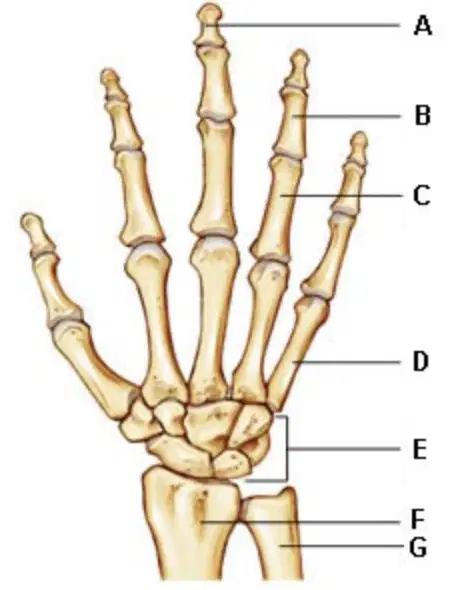
In the image below, which part of the musculoskeletal system is indicated by label E?
humerus
carpal bones
metacarpal bones
radius
In the image below, which part of the musculoskeletal system is indicated by label F?
humerus
xiphoid process
ulna
radius
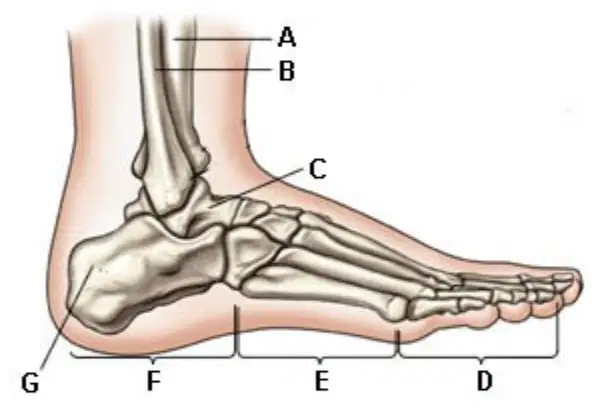
In the image below, which part of the foot is indicated by label D?
Metatarsals
Calcaneus
Phalanges
Talus
Straightening a limb is called:
Flexion
Extension
Abduction
The act of turning the palm up when the elbow is bent:
Dorsiflexion
Supination
Rotation
Extension
The lacrimal, mandible, maxillae, nasal, vomer and zygomatic are all types of
Cranial bones
Vertebrae bones
Facial bones
Leg bones
The round depression in the hip joint that forms the socket for the head of the femur to complete the hip joint is called the
Acetabelum
Foramen
Pubis
Ischium
The bone of the upper arm is known as the:
Ulna
Humerus
Radius
Scapula
Tinea:
Acute allergic reaction in which red, round wheals develop on the skin
Infection of the skin caused by a fungus; ringworm, athlete's foot
Thickened rough lesion of the epidermis; associated with aging or skin damage
Loss of pigment in areas of the skin
An inherited deficiency or absence of pigment in the skin, hair, and eyes caused by an abnormality in melanin production is:
Albinism
Vitiligo
Scleroderma
Albini's nodules
Keratosis:
White, thickened patches on numerous membrane tissue of tongue and cheek
Excess hypertrophied, thickened scar developing after trauma or surgical incision
Thickened and rough lesion of the epidermis; associated with aging and skin damage
Pigmented lesion of the skin
___________________ is a cancerous growth composed of melanocytes or pigmented skin cells
Malignant cytomelanoma
Malignant melanoma
Malignant melnoma
Malignant melanocytoma
Death of tissue associated with disruption/loss of blood supply is:
Hemotinea
Gangrene
Impetigo
Exanthematous viral disease
Chronic progressive disease of the skin and internal organs with hardening and shrinking of connective tissue
Scabies
Varicella
Scleroderma
Eczema
________________is an acute allergic skin reaction in which red, round wheals develop.
Tinea
Urticaria
Purpura
Acne
A __________ is a hypertrophied, thickened scar that develops after trauma to the skin, such as a surgical incision
Nevus
Verruca
Wheel
Keloid
Subcutaneous layer
Band of epidermis at the base and sides of the nail plate
Innermost layer of the skin containing fat tissue
Outermost layer of the epidermis, which consists of flattened, keratinized cells
Deepest region of the epidermis
An epidermal growth caused by a virus is called a wart, or _______
Verruca
Keloid
A malignant tumor of cells in the epidermis that can also be found in the mouth, larynx, bladder, esophagus and lungs is called:
Squamous cell carcinoma (SCC)
Basal cell carcinoma (BCC)
Keratin:
Flat, scale-like cells composing the epidermis
Hard protein material found in the epidermis, hair and nails
Structural protein found in the skin and connective tissue
Oily substance secreted by sebaceous glands
Chronic, recurrent dermatosis marked by itchy, scaly red plaques covered by silvery gray scales:
Psoriasis
Vitiligo
Keratosis
Leukoplakia
Pruritis:
Itching
Open point
Small, pinpoint hemorrhage
Nevus:
Pigmented lesion of the skin
Papule containing pus
Wearing away or loss of dermis
Mohs surgery
Substances are injected intradermally or applied to the skin
Use of subfreezing temperature to destroy tissue
Thin layers of malignant tissue are removed and each slice is examined microscopically
Tissue is destroyed by burning with an electric spark
Basal layer
Middle layer of the skin
Innermost layer of the skin, containing fat tissue
Deepest region of the epidermis
Flat, scale-like cells composing the epidermis
The dermis is the middle layer of the skin
True
False
Flat, scale-like cells composing the epidermis; functions as a barrier against outside elements
Collagen
Paronchyia
Stratum corneum
Squamous epithelium
A wheal is a smooth, edematous papule or plaque that is centrally redder than the surrounding skin
True
False
Subungual is the combination of the hair follicle and attached sebaceous gland.
True
False
The function of the dermis is to:
Anchor the epidermis to bone and muscle
Produce melanocytes
Produce adipocytes
House and support a system of nerves, vessels, and glands
The skin functions to do all of the following except
Protect deeper tissue against pathogenic invasion
Receive sensory messages from the environment
Aid in maintaining body temperature
Absorb oxygen for respiration
The structural protein material found in the dermal layer of the skin and connective tissue is called
Corneum
Lunula
Keratin
Collagen
What is the oily substance secreted by sebaceous glands?
Paronchyium
Lunula
Sebum
Stratum
The soft tissue surrounding the nail border is called:
Keratin
Paronchyium
Cuticle
Lunula
This type of sweat gland is large and embedded in the dermal layer of the skin under the arms and near the genitals
Apocrine
Adrenal
Eccrine
Sebaceous
Adipocytes are ___ cells
Fat
Flat
Protein
Nerve
___________ ulcers (bedsores) are caused by pressure that results from lying down or being in one position for an extended period of time
Gastric
Peptic
Crusty
Decubitus
The combination of the hair follicle and the attached sebaceous gland is called:
Pilosebaceous unit
Strata
Hair shaft
Eccrine gland
Match the description with the correct combining forms (1)
Fat
Adip/o
White
Albin/o
Stiff
Ankyl/o
Joint
Arthr/o, articul/o
Base
Bas/o
Match the description with the correct combining forms (2)
Bursa
Burs/o
Calcium
Calc/o, calci/o
Burn, burning
Caus/o
Heat, burn
Cauter/o
Cartilage
Chrond/o
Match the description with the correct combining forms (3)
Color
Chrom/o
Clotting
Coagul/o
Skin
Cutane/o
Cell
Cyt/o
Skin
Derm/o, dermat/o
Match the description with the correct combining forms (4)
Profuse sweating
Diaphor/o
Red, dawn, rosy
Eosin/o
Red
Erythr/o
Redness
Erythem/o, erythemat/o
Fascia
Fasci/o
Match the description with the correct combining forms (5)
Fibrous connective tissue
Fibr/o
Granules
Granul/o
Blood
Hem/o, hemat/o
Hemoglobin
Hemoglobin/o
Sweat
Hidr/o
Match the description with the correct combining forms (6)
Protection
Immun/o
Same, equal
Is/o
Dry, scaly
Ichthy/o
Nucleus
Kary/o
Hard
Kerat/o
Match the description with the correct combining forms (7)
Humpback, hunchback
Kyph/o
Lamina
Lamin/o
Smooth muscle that lines walls of internal organs
Leiomy/o
White
Leuk/o
Ligment
Ligament/o
Match the description with the correct combining forms (8)
Fat
Lip/o
Curve, swayback
Lord/o
Loins, lower back
Lumb/o
Lymph
Lymph/o
Lymph node
Lymphaden/o
Match the description with the correct combining forms (9)
One, single
Mon/o
Shape, form
Morph/o
Muscle
My/o, myos/o
Fungus
Myc/o
Heart muscle
Myocardi/o
Match the description with the correct combining forms (10)
Bone marrow
Myel/o
Neutral
Neutr/o
Nucleus
Nucleu/o
Nail
Onchy/o
Straight
Orth/o
Match the description with the correct combining forms (11)
Bone
Oste/o
Eat, swallow
Phag/o
Plant
Phyt/o
Hair
Pil/o
Sole of the foot
Plant/o
Match the description with the correct combining forms (12)
Varied, irregular
Poikil/o
Pus
Py/o
Skeletal muscle connected to bones
Rhabdomy/o
Watery flow
Rheumat/o
Wrinkle
Rhytid/o
Match the description with the correct combining forms (13)
Muscle and flesh
Sarc/o
Crooked, bent
Scoli/o
Sebum
Seh/o
Iron
Sider/o
Globe, round
Spher/o
Match the description with the correct combining forms (14)
Vertebra
Spondyl/o
Spleen
Splen/o
Scale-like
Squam/o
Synovial membrane
Synovo/o
Tendon
Ten/o, tendin/o
Match the description with the correct combining forms (15)
Clot
Thromb/o
Thymus gland
Thym/o
Hair
Trich/o
Poison
Tox/o
Nail
Ungu/o
Match the description with the correct combining forms (16)
Vertebra
Vertebr/o
Yellow
Xanth/o
Dry
Xer/o
Match the description with the correct prefix (1)
Away from
Ab-
Toward
Ad-
Again, anew
Ana-
Match the description with the correct prefix (1)
Back
Dorsi-
Between
Inter-
Many, much
Poly-
Match the description with the correct suffix (1)
Removal, carrying away
-aphresis
Lack of strength
-asthenia
Immature or embryonic cell
-blast
To break
-clast
Abnormal condition of cells
-cytosis
Match the description with the correct suffix (2)
To bind, tie together
-desis
Blood condition
-emia
Giving rise to producing
-gen
Protein
-globin, -globulin
Slipping
-listhesis
Match the description with the correct suffix (3)
Pertaining to destruction
-lytic
Softening
-malacia
Derived, related to, originating from
-oid
Abnormal condition
-osis
Deficiency
-penia
Match the description with the correct suffix (4)
Eat, swallow
-phage
Attraction for
-philia
Carrying, transmission
-phoresis
To grow
-physis
Formation
-poiesis
Match the description with the correct suffix (5)
Pore, passage
-porosis
Stop, control
-stasis
Narrowing
-stenosis
Development, nourishment
-trophy
Instrument to cut
-tome
Match the description to the correct combining form related to specific bones (1)
Hip socket
Acetabul/o
Heel
Calcane/o
Wrist bones
Carp/o
Collarbone
Clavicul/o
Ribs (true, false and floating ribs)
Cost/o
Match the description to the correct combining form related to specific bones (2)
Skull
Crani/o
Thigh bone
Femor/o
Smaller lower leg bone
Fibul/o
Upper arm bone
Humer/o
Upper part of pelvis
Ili/o
Match the description to the correct combining form related to specific bones (3)
Posterior part of pelvis
Ischi/o
Process on each side of ankle
Malleol/o
Lower jawbone
Mandibul/o
Upper jawbone
Maxill/o
Hand bones
Metacarp/o
Match the description to the correct combining form related to specific bones (4)
Foot bones
Metatars/o
Elbow
Olecran/o
Patella
Patell/o
Pelvis
Pelv/o
Finger/toe bones
Phalang/o
Match the description to the correct combining form related to specific bones (5)
Anterior part of the pelvic bone
Pub/o
Forearm bone-thumb side
Radi/o
Shoulder blade
Scapul/o
Breastbone
Stern/o
Match the description to the correct combining form related to specific bones (6)
Bones of mid and hindfoot
Tars/o
Shinbone
Tibi/o
Forearm bone-little finger side
Uln/o

