
 Worksheets
Moments CFU
Total questions: 12
Worksheet time: 6mins
According to the definition shown, what does the moment of a force measure?
The tendency of the force to translate the body in a straight line
The tendency of the force to rotate the body upon which it acts
The total energy stored in the body due to the force
The maximum speed the body can reach when pushed
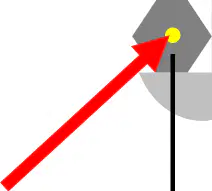
In the diagram, what is the lever arm specifically measuring?
The parallel distance from the force line to the edge of the wrench
The perpendicular distance from the pivot point (fulcrum) to the line of action of the force
The angle between the wrench and the applied force
The total length of the wrench handle regardless of force direction
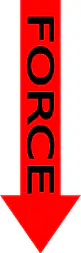
Which statement correctly describes the requirement for the distance used in moments calculations?
The distance must be parallel to the applied force for accuracy
Any convenient distance along the handle can be used
The distance must be perpendicular to the force
The distance equals the radius of the wrench head
Using the formula provided, what is the moment M when the perpendicular distance d is 0.25 m and the applied force F is 80 N?
20 N·m
80 N·m
0.25 N·m
32 N·m
Refer to the Units for Moments table shown. Which set correctly pairs the SI base units for a moment?
Newton (N) and foot (ft) to give N·ft
Pound-force (lbf) and meter (m) to give lbf·m
Newton (N) and meter (m) to give N·m
Pound-force (lbf) and inch (in) to give lbf·in
According to the stated sign convention for moments, which statement is correct?
Clockwise (CW) moments are positive and counterclockwise (CCW) moments are negative.
Clockwise (CW) moments are negative and counterclockwise (CCW) moments are positive.
Both clockwise (CW) and counterclockwise (CCW) moments are positive.
Both clockwise (CW) and counterclockwise (CCW) moments are negative.
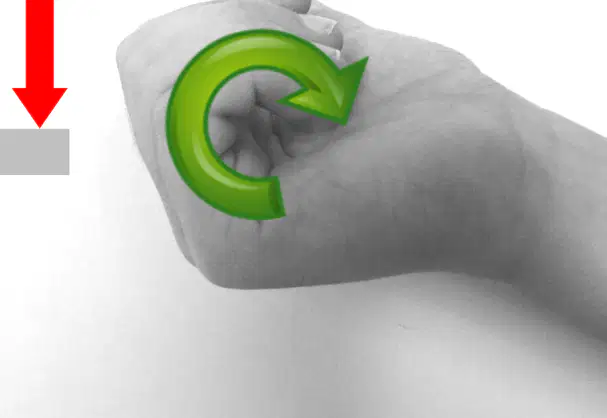
Interpret the visual: In the shown scenario the wrench rotates clockwise under a downward force. Using your right hand, how should the thumb point and what is the sign of the moment?
Thumb points toward you; moment is positive
Thumb points away from you; moment is negative
Thumb points up; moment is positive
Thumb points down; moment is negative
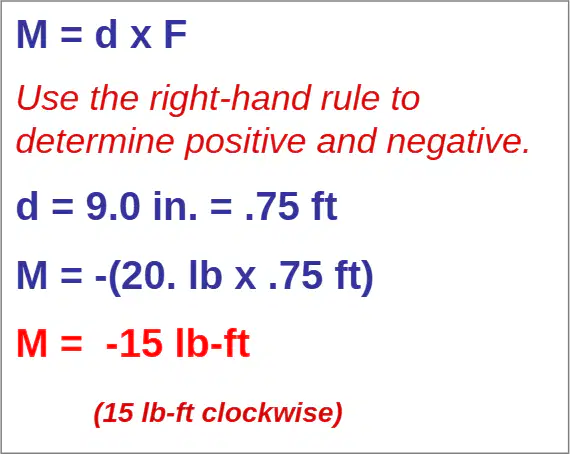
Which statement best explains why unit conversion is necessary in these moment calculations?
Forces must be converted from pounds to newtons to use M = d × F.
Moments require consistent units; using inches for distance and pounds for force would produce lb-in instead of lb-ft.
Angles must be converted from degrees to radians before multiplying d × F.
Converting length units changes the sign of the moment according to the right-hand rule.
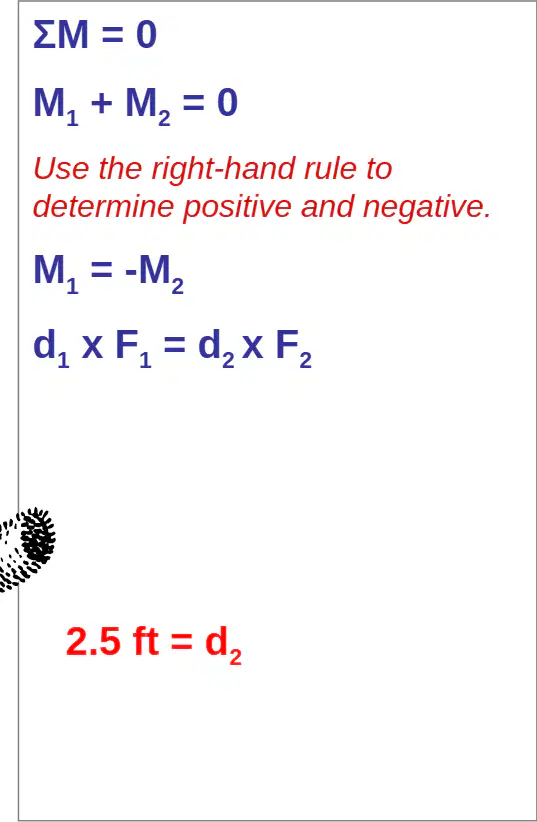
In the see-saw example, using the right-hand rule, the sum of moments at equilibrium is ΣM = 0. What does this imply about M1 and M2?
M1 = −M2
M1 = M2
M1 = 0 and M2 = 0 separately
M1 = 2M2
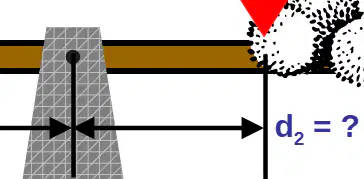
On the see-saw, if the heavier teddy applies F2 = 40 lb at 2.5 ft from the pivot, what is the moment magnitude from that side?
100 lb·ft
160 lb·ft
62.5 lb·ft
10 lb·ft
The vertical (up and down) part of a force vector.
x-component
y-component
magnitude
sense

Is the moment positive or negative?
Positive
Negative

