
 Worksheets
SET 2: REVISION FOR FE MATERIAL SCIENCE & ENGINEERING
Total questions: 15
Worksheet time: 8mins
Which term describes the process where a material is stretched and does not return to its original shape?
Elasticity
Plasticity
Resilience
Toughness
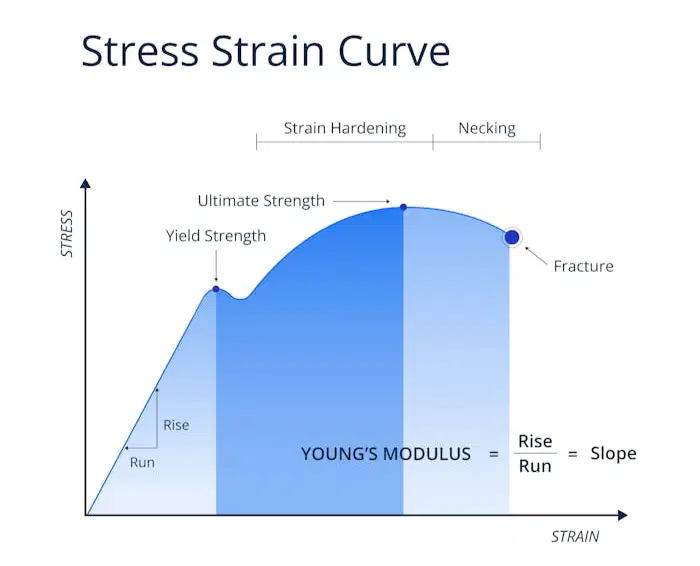
In the stress-strain diagram, the point corresponding to the maximum stress the material can withstand before fracture is typically called:
Yield Strength
Fracture Point
Ultimate Tensile Strength
Proportional Limit
What is the chemical formula for Cementite, a hard and brittle constituent in the Iron-Carbon system?
FeO
Fe3C
Fe2C
FeC3
Alpha Ferrite is a solid solution of carbon in iron with a Body-Centered Cubic (BCC) structure that exists at:
High temperatures
Temperatures between 912^C to 1394^C
Low temperatures (e.g., room temperature)
Any temperature above 1500^C
Materials like Aluminum and Copper are typically classified as:
Ferrous Metals
Non-Ferrous Alloys
Ceramics
Polimers
Metalworking performed above the recrystallization temperature is known as:
Cold Working
Hot Working
Deep Drawing
Annealing
A key advantage of Hot Working is:
Better surface finish
High dimensional accuracy
Elimination of porosity and refinement of grain structure
Increased strength without heat treatment
Which casting process is often called 'lost-wax casting' and is known for producing complex, high-precision components?
Sand Casting
Die Casting
Investment Casting
Continuous Casting
Which metal forming process involves forcing a material through a die opening to create a product with a continuous cross-section (like a rod or tube)?
Rolling
Forging
Wire Drawing
Extrusion
Pitting corrosion is best described as a form of corrosion that:
Affects the entire surface uniformly.
Causes the cracking of the material under stress.
Occurs between dissimilar metals.
Creates small, localized holes or cavities on the metal surface.
To prevent corrosion in a pipe, adding a chemical substance to the fluid flowing through the pipe to slow down the reaction is using:
Coating
An Inhibitor
Cathodic Protection
Galvanizing
The corrosion that occurs when two dissimilar metals are in contact with each other in the presence of an electrolyte is called:
Pitting Corrosion
Crevice Corrosion
Galvanic Corrosion
Stress Corrosion Cracking
Which material testing method is typically used to detect internal defects or flaws in metallic materials using sound waves?
Ultrasonic Testing (UT)
Magnetic Particle Inspection (MPI)
Eddy Current Testing (ECT)
Liquid Penetrant Testing (LPT)
Which statement is a key advantage of Non-Destructive Testing (NDT) over Destructive Testing (DT)?
It is much faster and cheaper.
The tested part remains usable after the inspection
It provides a measure of ultimate strength.
It can only find internal flaws.
What two material properties are compared in the Brinell and Vickers hardness tests?
Ductility and Brittleness
Tensile Strength and Yield Strength
Modulus of Elasticity and Toughness
Resistance to permanent indentation and load applied

