
NEW
Font size
 Worksheets
7th Grade SS Unit 2 SW Asia Post-Test 25-26
Total questions: 33
Worksheet time: 17mins
Of the choices, which of these is the MAIN source of conflict in the Middle East between Israel and the Palestinians?
slavery.
religion.
communism.
oil rights.
Land, labor, capital, and entrepreneurship are
the basis of employment.
the results of production.
factors of production.
results of supply and demand.
The stated purposes of the war in Iraq that began in 2003 involve all of the following EXCEPT
foster democracy in Iraq.
restoring self-rule to Kuwait.
The primary cause of the first Gulf War (1990-1991) was
the Iraqi army's sudden invasion of Kuwait.
Iraqi possession of weapons of mass destruction.
repeated attacks by the Iraqi navy on civilian targets within Israel.
Iraq’s testing of a nuclear device as part of a test of its weapons program.
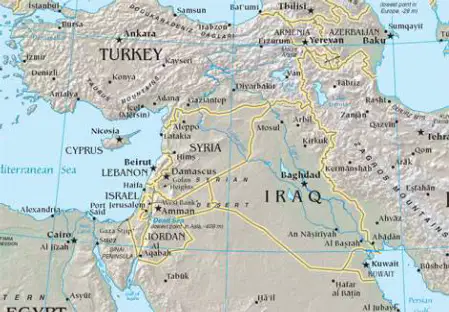
This region is unique in World History because it
housed a major world empire.
is home to more than one desert.
lies at the intersection of two continents.
is where the world's major monotheistic faiths began.
was the site of major and economically vital trading routes.
Following the end of the "Mandate System" the Middle East
returned to colonial rule after World War II.
withdrew from the newly-created United Nations.
fell into violence along political and religious lines.
saw an end to religious conflict among nations in the region.
The cities of Mecca and Medina were vital to the foundation of what religion?
Buddhism
Hinduism
Islam
Judaism
Christianity
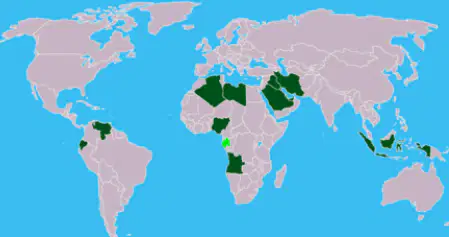
This map is depicting which international economic organization?
CAFTA
EU
NAFTA
OAS
OPEC
What is the MAIN difference between Sunni and Shia Muslims?
The Sunni believe in the idea of Monotheism.
The Shia pray towards Mecca five times every day.
The Shia wanted a family member of Muhammad to succeed him.
The Sunni fast from sunrise to sunset during the month of Ramadan.
What is the most pressing challenge facing the Middle East in terms of its water supply?
general scarcity
pollution from farming
pollution from industry
bacterial contamination
The water supply in the Middle East is being threatened by climate changes, shrinking aquifers, and overpopulation. What is MOST LIKELY the biggest challenge in finding a way for the nations there to cooperate to solve these problems?
The nations involved have a history of solving conflict through warfare.
The urban and rural areas of the region can not reach a compromise about water rights.
The United Nations has refused to oversee projects to ensure the equal distribution of water.
The nations involved do not have the money needed to finance pipelines to solve the problems.
In this type of economic system, the government controls all aspects of the economy and makes all decisions about what goods will be produced, who will produce them, and how they will be produced.
command
market
mixed
traditional
In this type of economic system, the production of goods and services is controlled solely by the concept of supply and demand, businesses are operated for profit, and the government is not involved.
command
communism
market
mixed
The movement which worked for the establishment of this national home was commonly known by what name?
Zionist Movement
Civil Rights Movement
Suffragette Movement
Green Movement
Question 17: 36305 Select the correct answer.
Autonomism
Diaspora
Resettlement
Zionism
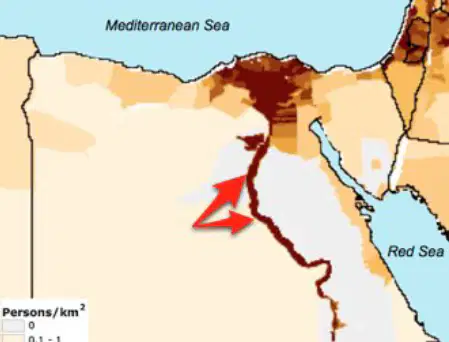
Which of these might explain the reason for the population density in the areas indicated by the red arrows?
man-made canals
coastal flooding
gold and coal mining
abundant access to water
international trade routes
Countries which border the Persian Gulf such as Kuwait have very limited fresh water supplies. Many are forced to search for water from other sources such as
refining petroleum oil into drinking water.
desalinization of salt water from the Persian Gulf.
importing water using the same ships that transport oil.
pumping water from the Black Sea through an overland pipeline.
When determining standard of living in a country, which indicator will be the most practical and reliable?
GDP
CPI
per capita GDP
unemployment rate
unemployment rate per capita
Which Middle Eastern country would you expect to have an economy that is more market-based than command-based?
Iran
Japan
Israel
Saudi Arabia
Which of these is a belief common to Judaism, Christianity, and Islam?
They are all centered in Africa.
They are all monotheistic faiths.
They all were founded in the same century.
They all believe the Jesus Christ was the Messiah.
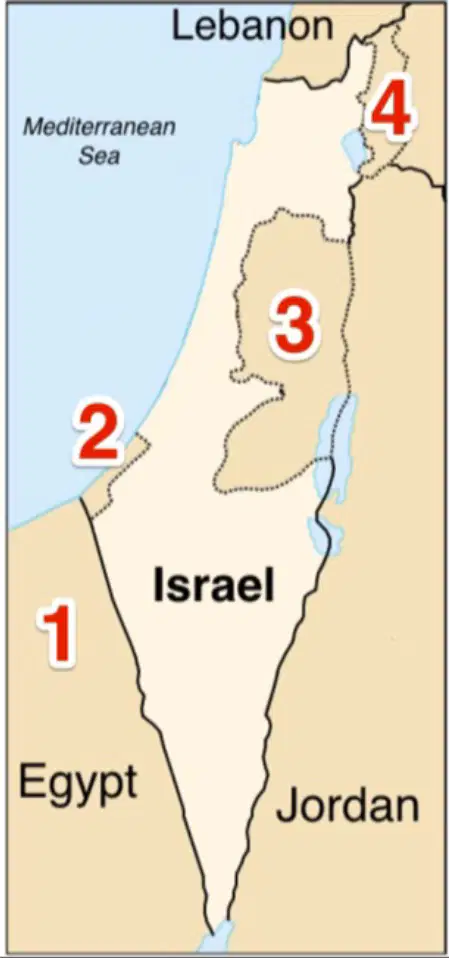
Refer to the map of Israel and surrounding countries. Which number is CLOSEST to the area known as the Gaza Strip?
A. 1
B. 2
C. 3
D. 4
Choose the THREE rivers that are found in the Middle East/Southwest Asia.
Tigris, Euphrates, Jordan
Amazon, Nile, Yangtze
Mississippi, Danube, Thames
Ganges, Mekong, Volga
Which of the following is the Euphrates River?
Volga River
Tigris River
Jordan River
Yangtze River
Euphrates River
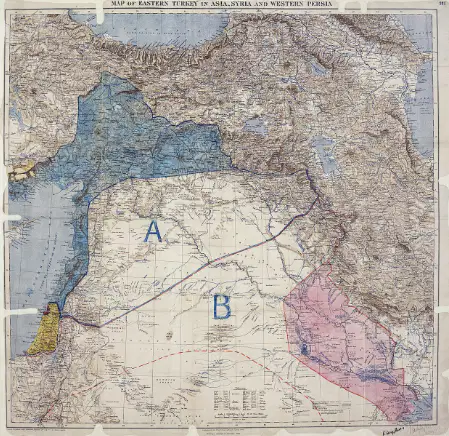
How did the Sykes-Picot Agreement affect the Ottoman Empire?
The Sykes-Picot Agreement unified the Ottoman Empire.
The Sykes-Picot Agreement partitioned the Ottoman Empire.
The Sykes-Picot Agreement negotiated the terms of the end of the war.
The Sykes-Picot Agreement strengthened the Ottoman Empire allowing them to fight the Triple Entente.
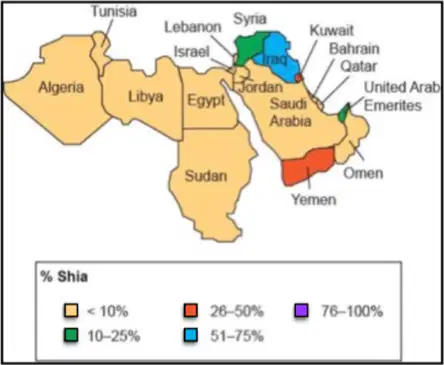
Based on the map, which of these appears to be MOST true?
Shia Muslims outnumber Sunni Muslims 2 to 1 globally.
Shia Muslims are found predominantly in North Africa.
Only the country of Syria has a majority of Shia Muslims.
Shia Muslims appear to be the minority group within Islam.
Which of these best explains the split between Sunni and Shia Muslims?
The total number of Imams that should be allowed within the religion
Whether or not the Quran is the most sacred text in the Islamic faith
Disagreement over who was the rightful successor to Muhammad
The location of the holiest city in Islam

Based on the map, what was the main goal of the League of Nations in the division of the Middle East?
They were seeking trade routes to Africa.
They wanted to create spheres of influence in that region.
They wanted to settle religious differences in the region.
They wanted to dissolve the Assyrian Empire who joined forces with Germany during WWI.

Why did the division into British and French mandated territory cause Middle Eastern conflict today?
The border conflicts with indigenous groups gave rise to Apartheid laws.
The borders were drawn without cultural consideration leading to terrorism in the region.
The borders created Christian dominated territories with Muslim minorities desiring independence today.
The borders divided Hindus and Muslims peacefully, but the constant fight over natural resources still exist.
What was the first public statement in support of the creation of a Jewish state?
The Treaty of Versailles in 1919.
The Conference of Berlin in 1884-85.
The Potsdam Declaration issued in 1945.
The issuance of the Balfour Declaration in 1917.
What were the causes for President Truman's recognition of the state of Israel?
He desired a base of operations for attacking the Soviets.
He was remorseful for the nuclear attacks on Hiroshima and Nagasaki.
He sought to punish Muslims for their direct role in causing World War II.
He supported Zionism based on the antisemitism and suffering during the Holocaust.
Which terrorist group was responsible for the pictured attack on New York City on September 11, 2001?
ISIS
Al-Qaeda
Hezbollah
Boko Haram
Which statement best represents the US response to the September 11 attack?
The US launched military operations in Afghanistan to target terrorist groups.
The US withdrew its military presence from the Middle East.
The US increased diplomatic relations with terrorist organizations.
The US reduced security measures at airports and borders.
Which U.S. presidential administration is correctly matched with its major foreign policy action?
The Bush administration launched Operation Enduring Freedom in Afghanistan and the War in Iraq to remove Saddam Hussein.
The Clinton administration launched the Global War on Terror to remove the various terrorist organizations.
The Obama administration signed the Joint Comprehensive Plan of Action to limit Iran's nuclear programs.
The Trump administration loosened trade restrictions on North Korea to foster political relations.

