
Font size
 Worksheets
GB1 Cell Types and Structures
Total questions: 30
Worksheet time: 18mins

What structure is this? (Red arrow)
Nucleus
Chloroplast
Central Vacuole
Mitochondrion

During a biology lab, Ethan is examining a microscopic image of a cell. He notices a structure highlighted by a green arrow in the image. What structure is this? (Green arrow)
Mitochondrion
SER
Golgi Body
Plasma Membrane

What structure is this? (Green arrow)
Nucelus
Cell Wall
Nucelolus
Mitochondrion

What type of cell is this?
Prokaryotic
Eukaryotic Animal
Eukaryotic Plant
Eukaryotic Uni-cellular
If a cell's lysosomes become damaged, which of the following would MOST LIKELY occur?
The cell would produce excessive proteins
The cell would be less able to break down molecules within the cell
The would slow down the process of photosynthesis
The cell would be less able to regulate the amount of fluid in its cytoplasm
During a hot summer day, Mason noticed that the fruit trees in his backyard were filled with ripe fruits. He wondered which cell organelle in the leaves of these trees would be very active during the summer, to produce enough sugars to fill the fruit's cells?
Lysosomes
Ribosomes
Mitochondria
Chloroplasts

During a biology class, Luna is presented with four different types of cells under a microscope. She needs to identify which cell is MOST LIKELY an animal cell.
Cell W
Cell X
Cell Y
Cell Z
Both euglena and cyanobacteria are photosynthetic unicellular organisms found in pond water. Euglena, however, is eukaryotic while cyanobacteria are prokaryotic. What feature distinguishes euglena from cyanobacteria?
The ability to reproduce asexually
The presence of ribosomes in the cells
The ability to maintain homeostasis
The presence of a nuclear membrane

What is the function of A?
movement through watery environment
store genetic instructions
stick to host cells
store genes for antibiotic resistance

Type of cell shown?
Eukaryotic
Prokaryotic
Bacterial
Plant

Tay Sachs results from a build-up of fats due to an error in which organelle that is responsible for digesting macromolecules?
Rough ER
Smooth ER
Lysosome
Golgi Bodies
A student identifies the following parts of a cell.
1. cell wall
2.RNA
3.mitochondrion
4.ribosome
The presence of which structure allows the student to conclude that this is a eukaryotic cell?
Structure 1
Structure 2
Structure 3
Structure 4
The nuclear lamina is an array of filaments on the inner side of the nuclear membrane. If a method were found that could cause the lamina to fall into disarray, what would you expect to be the most likely consequence?
the inability of the nucleus to divide during cell division
a change in the shape of the nucleus
the loss of all nuclear function
inability of the nucleus to keep out destructive chemicals

In a botanical garden, Aiden observes how plant cells communicate and share nutrients through tiny channels called plasmodesmata. He wonders which structures in animal cells serve a similar purpose in facilitating communication between cells. Which of the following structures in animal cells is most similar in function to plasmodesmata?
tight junctions
gap junctions
desmosomes
extracellular matrix
In a botanical research lab, scientists are studying various components that contribute to the structure of plant cells. They have identified several elements that play crucial roles in maintaining this structure. However, they need to determine which of the following components is distinct from the others in terms of its composition.
plant cell walls
microtubules
intermediate filaments
nuclear lamina
An organism was described as being made up of a single cell containing a membrane-bound nucleus and membrane-bound organelles.
Which of the following correctly identifies the organism being described?
A unicellular eukaryote
A unicellular prokaryote
A multicellular eukaryote
A multicellular prokaryote
Organelles such as the endoplasmic reticulum, mitochondria, Golgi body, chloroplasts are similar in that their structure is made up of flat membranes containing many folds.
The main reason that they all contain these flat, folded structures is that:
this provides the organelles with a distinctive pattern for identification.
this increases the surface area available for the organelle to carry out its function.
all of these organelles carry out the same function.
it allows the substances within the organelle to move more freely.
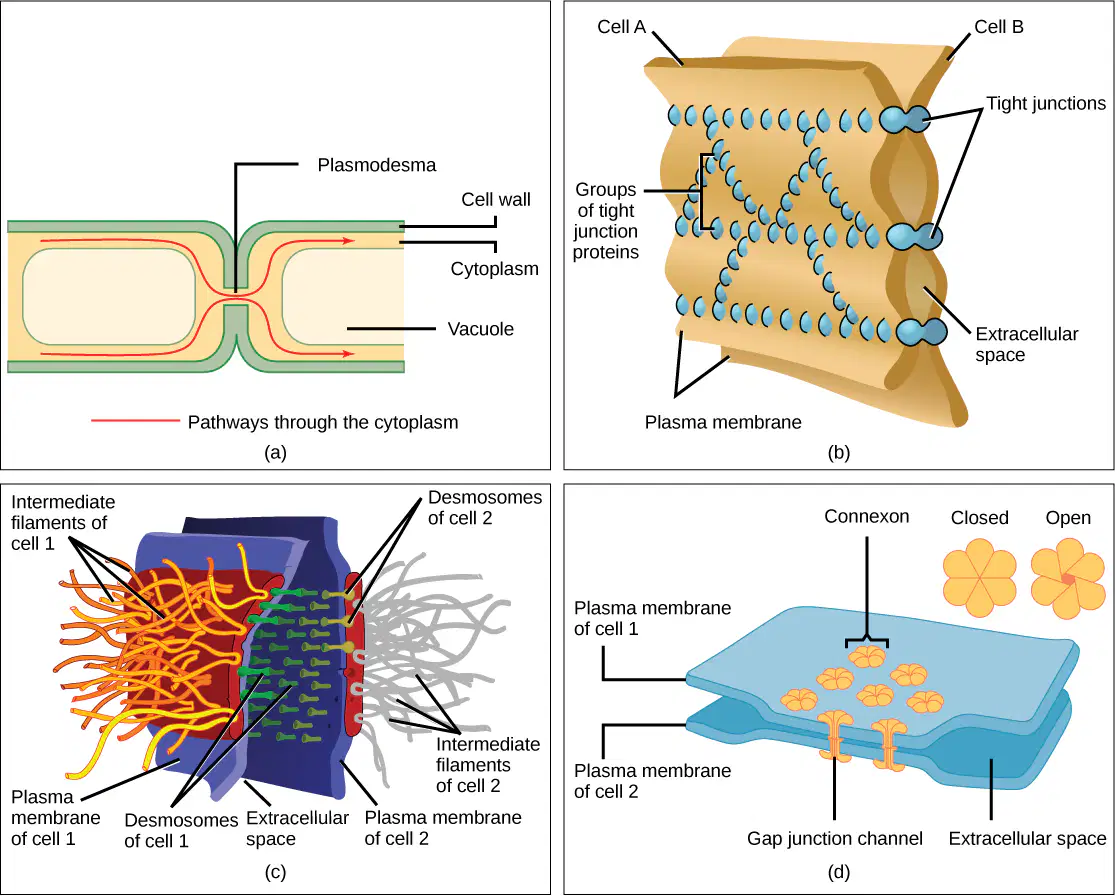
In a biological research lab, scientists are studying how ions communicate between animal cells. They discover that ions can travel directly from the cytoplasm of one animal cell to the cytoplasm of an adjacent cell through _______
intermediate filaments.
tight junctions.
desmosomes.
gap junctions.
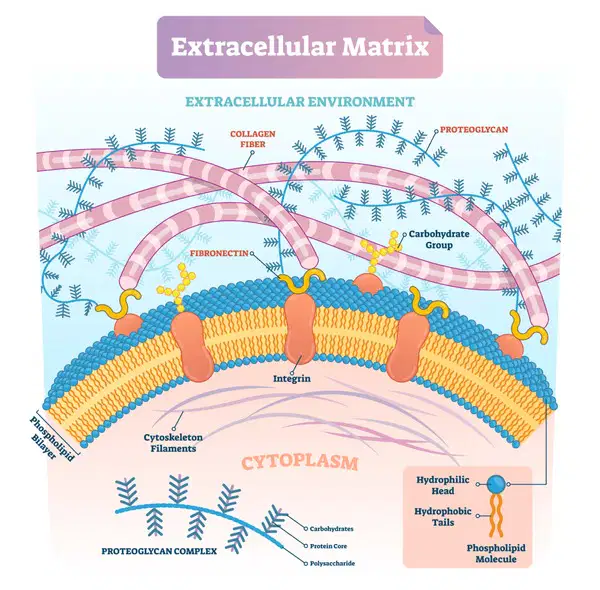
The cell walls of bacteria, fungi, and plant cells and the extracellular matrix of animal cells are all external to the plasma membrane. Which of the following is a characteristic of all of these extracellular structures?
They must block water and small molecules in order to regulate the exchange of matter and energy with their environment.
They must permit information transfer between the cell's cytoplasm and the nucleus.
They must provide a rigid structure that maintains an appropriate ratio of cell surface area to volume.
They are constructed of materials that are largely synthesized in the cytoplasm and then transported out of the cell.
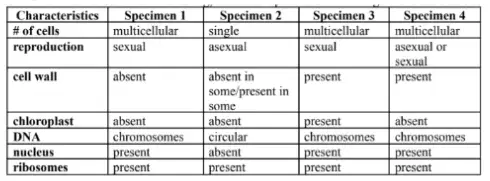
A student was given four specimens and was asked to describe each. The student made the table below. According to the information, which specimen is prokaryotic?
Specimen 1 is prokaryotic because it contains a nucleus.
Specimen 2 is prokaryotic because it lacks a nucleus.
Specimen 3 is prokaryotic because it contains chloroplasts.
Specimen 4 is prokaryotic because it lacks chloroplasts.
Which of the following best summarizes an advantage for eukaryotic cells in having internal membranes?
Eukaryotic cells are able to reproduce faster because of the presence of organelles.
Some organelles, such as mitochondria and chloroplasts, are similar to prokaryotic cells in structure.
Internal membranes allow cells to separate specific reactions, increasing their efficiency.
Compartmentalization leads to a higher mutation rate in DNA, which leads to more new species.
Arrange the following events that happens in the endomembrane system:
I. The mRNA is being transcribed in the ribosomes attached in the Rough ER to produce proteins.
II. The Golgi Bodies finalizes and modifies the protein, and transport it out of the endomembrane system
III. The proteins are transported through vesicles from Rough ER to Golgi Bodies.
IV. Nucleus contains the DNA that codes for mRNA.
III-IV-II-I
IV-I-III-II
II-I-III-IV
IV-I-II-III
During a laboratory experiment, you are provided with two microscope slides, one containing a prokaryotic cell and the other containing a eukaryotic cell. You need to identify which is which. Which of the following observations would help you correctly differentiate between the prokaryotic and eukaryotic cells?
Observation 1: The cell on slide A has a well-defined cell wall made of peptidoglycan.
Observation 2: The cell on slide B lacks a nucleus and other membrane-bound organelles.
Observation 3: The cell on slide A has ribosomes scattered in the cytoplasm.
Observation 4: The cell on slide A has a undergoes mitosis.
In a microscopic sample, you identify a cell with a highly complex structure. The cell possesses membrane-bound organelles, including mitochondria and a well-defined nucleus with a nucleolus. It also exhibits cilia on its surface for movement. Which of the following is NOT true about the cell sample.
The sample is a eukaryotic cell.
The sample is a plant cell.
The sample is an animal cell.
The sample cell is locomotive (can move)
Which of the following pairs INCORRECTLY matches a cell structure with its function?
cell membrane: protein synthesis
nucleus: information (DNA)
storage vacuole: storage
chloroplast: energy conversion

In a garden, Mason notices that the plants are thriving and appear healthy. He learns that the vacuoles in the plant cells play a crucial role in maintaining their health. What is the primary function of vacuoles in plants?
To maintain water pressure inside of the cell.
To remove waste from inside of the cell.
To store nutrients inside of the cell.
To synthesize new membranes for the cell.
Why are lysosomes known as “the cleaners” of cell waste?
It has hydrolytic enzymes for cellular digestion.
They engulf and destroy pathogens that enter the cell
Its work is like a recycling facility which digest dead cells.
All of the above
EVERY cell (prokaryotic and eukaryotic) has this/these structure/s:
(select all that are true)
ribosomes
cytoplasm
cell membrane
cell wall
DNA
Which of these can also be considered the 'cell's shapeshifter'?
Centrosome
Lysosome
Cytoplasm
Cytoskeleton
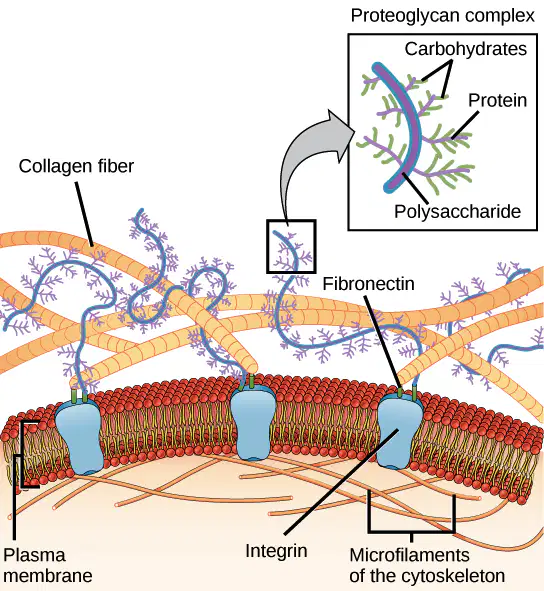
Receptor proteins embedded in the cell membrane that transmit signals between the Extracellular Matrix and the cytoplasm are called...
Collagens
Glycoproteins
Integrins
Peripheral Proteins

