
 Worksheets
ECON2105_Final_Exam_Prep
Total questions: 100
Worksheet time: 56mins
How is the trade balance calculated?
Imports minus exports
Exports minus imports
Total exports divided by total imports
Total imports divided by total exports
If a country's exports are 500 billion and imports are 600 billion, what is the trade balance?
$1.1 trillion deficit
$1.1 trillion surplus
$100 billion deficit
$100 billion surplus
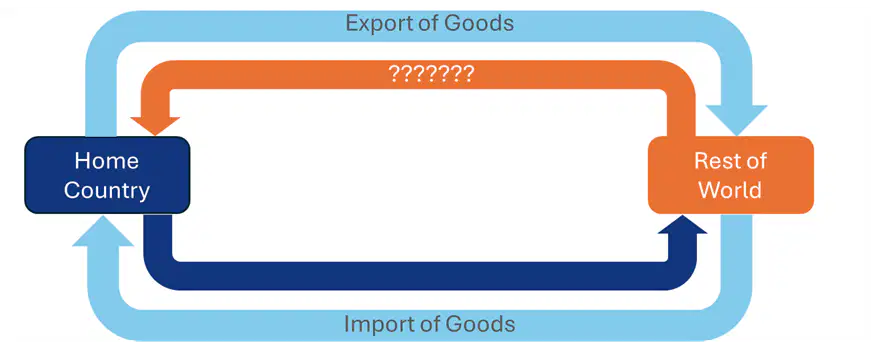
In the circular diagram above, what does the orange arrow represent?
Imports from Rest of World
Payments from Home Country to Rest of World
Payments from Rest of World to Home Country
Exports to Rest of World
Which is not a component of the current account balance?
Trade in Goods and Services
Income Receipts and Payments
Unilateral Payments
Business Investment
If Country A can produce 10 tons of steel or 20 tons of wheat with one unit of labor, and Country B can produce 5 tons of steel or 15 tons of wheat with one unit of labor, which country has a comparative advantage in steel production?
Country A
Country B
Both countries
Neither country
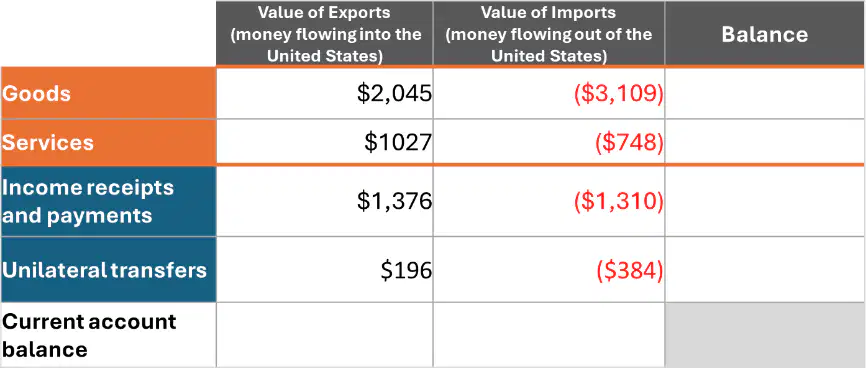
Given the data in the table, what is the value of net exports?
-$1,064
-$907
-$785
-$3,109
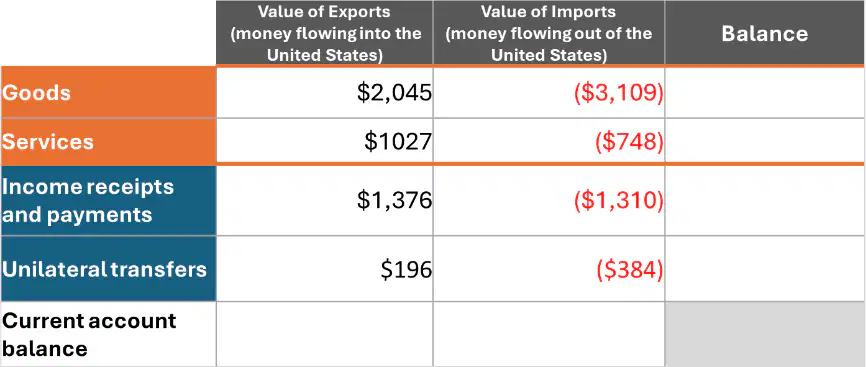
Given the data in the table, what is the total value of capital flowing into the United States?
$1,376
$196
If private savings in a country are 500 billion, public savings are 200 billion, and net exports are -$100 billion, what is the total national saving?
$800 billion
$600 billion
$500 billion
$200 billion
If a country has private savings of 700 billion government savings of 100 billion, and net exports of -$50 billion, what is the total investment?
$750 billion
$800 billion
$650 billion
$850 billion
What is a trade surplus?
When a country's exports exceed its imports
When a country's imports exceed its exports
When a country's exports equal its imports
When a country has no trade activity
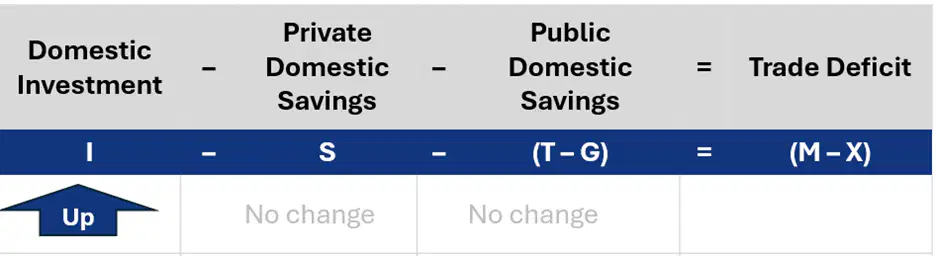
Let’s analyze how a country’s trade deficit is impacted by changes to other components of the National Savings and Investment Identity. If domestic investment increases, with no change to Private or Public savings, what must happen to the trade deficit?
Nothing. The trade deficit is independent.
It must increase
It must decrease
Not enough information
Which type of exchange rate system allows a currency's value to fluctuate according to the foreign exchange market?
Fixed exchange rate system
Pegged exchange rate system
Floating exchange rate system
Managed exchange rate system
What is the primary function of the foreign exchange market?
To trade stocks and bonds
To facilitate international currency exchange
To regulate interest rates
To manage government debt
How does an increase in interest rates in a country generally affect its currency value?
It tends to decrease the currency's value
It tends to increase the currency's value
It has no effect on the currency's value
It causes immediate inflation
What impact does high inflation have on a country's currency value in the foreign exchange market?
It typically leads to an appreciation of the currency
It causes the currency value to stabilize
It has no impact on the currency value
It typically leads to a depreciation of the currency
If the exchange rate is 1.5 USD/EUR and a product costs 300 EUR, how much does it cost in USD?
450 USD
200 USD
300 USD
500 USD
A U.S. investor wants to buy British stocks. If the exchange rate is 1.3 USD/GBP and the stocks cost 500 GBP, how much will the investor pay in USD?
500 USD
385 USD
650 USD
750 USD
If a country's currency depreciates by 10% and the price elasticity of demand for its exports is -0.5, what happens to the quantity of exports?
Decreases by 5%
Increases by 5%
Decreases by 10%
Increases by 10%
When a country's currency appreciates, what impact does it have on its exports?
Exports increase
Exports decrease
No impact on exports
Exports become negative
Suppose the British pound (GBP) appreciates against the US dollar (USD) by 10%. If the initial exchange rate was 1 GBP = 1.40 USD, what is the new exchange rate?
1 GBP = 1.26 USD
1 GBP = 1.54 USD
1 GBP = 1.30 USD
1 GDP = 1.50 USD
Assume the nominal exchange rate is 1.3 CAD/USD. If Canadian inflation is 2% and U.S. inflation is 4%, what is the expected change in the real exchange rate?
CAD depreciates
CAD appreciates
No change
USD depreciates
Ferrari sells a sports car in the UAE for AED 1,200,000. Each car costs €200,000 to produce. At an exchange rate of €0.25 EUR/AED, what is their profit per car?
€100,000
€150,000
€200,000
€250,000
Sony sells their TV in the US for $2,000. Each TV costs ¥250,000 to produce. At an exchange rate of ¥120 JPY / USD what is their profit per TV?
-¥50,000
¥50,000
-¥10,000
¥10,000
Which economic measure is commonly used to compare the standard of living across countries?
Gross Domestic Product (GDP)
Unemployment Rate
Consumer Price Index (CPI)
Gross Domestic Product per capita
Which of the following factors is most likely to contribute to economic growth in developing countries?
Increased reliance on subsistence agriculture
Reduction in foreign investment
Improvements in education and infrastructure
Decrease in population growth
How does income distribution typically differ between high-income and low-income countries?
High-income countries always have more equal income distribution
Low-income countries often experience higher levels of income inequality
Income distribution is similar across all countries
Low-income countries always have more equal income distribution
If Country A has a GDP of $500 billion and a population of 50 million, with an 80% labor participation rate what is its GDP per capita?
$5,000
$10,000
$12,500
$15,000
If Country D's population increases from 10 million to 10.5 million while its GDP remains constant at $200 billion, what happens to its GDP per capita?
Decreases by 4.76%
Decreases by 10%
Increases by 4.76%
Remains the same
What role does education play in enhancing a country's standard of living?
It only benefits individuals who pursue higher education
It increases human capital, leading to higher productivity and economic growth
It has no direct impact on economic outcomes
It primarily affects social cohesion rather than economic growth
What is absolute advantage?
The ability to produce more of a good than another country
The ability to produce a good at a lower opportunity cost than another country
The ability to produce more goods than any other country
The ability to restrict imports to protect domestic industries
Which of the following statements best describes the benefit of comparative advantage and international trade?
It allows countries to consume beyond their production possibilities frontier
It ensures all countries have equal trade balances
It guarantees that all countries produce everything they need
It restricts countries from engaging in trade
If Country A can produce 10 tons of steel or 5 tons of wheat with one unit of resources, and Country B can produce 8 tons of steel or 4 tons of wheat with one unit of resources, which country has the absolute advantage in steel production?
Country A
Country B
Both have the same absolute advantage
Neither has an advantage
If Country A can produce 10 tons of steel or 5 tons of wheat with one unit of resources, and Country B can produce 8 tons of steel or 4 tons of wheat with one unit of resources, which country has the comparative advantage in steel production?
Country A
Country B
Both have the same absolute advantage
Neither has an advantage. The opportunity cost is the same
How does opportunity cost relate to comparative advantage?
Comparative advantage is determined by the absolute cost of production
Comparative advantage is determined by the lower opportunity cost of production
Opportunity cost does not affect comparative advantage
Opportunity cost increases when comparative advantage is maximized
Country X can produce 20 units of good A or 40 units of good B. Country Y can produce 30 units of good A or 60 units of good B. What is the opportunity cost of producing one unit of good A in Country X?
0.5 units of good B
1 unit of good B
2 units of good B
3 units of good B
Country A can produce 15 cars or 45 computers. What is the opportunity cost of producing one car in terms of computers?
3 computers
2 computers
1/5 computer
5 computers
Which country should specialize in producing a good, according to the theory of comparative advantage?
The country with the higher production capacity
The country with the more advanced technology
The country with the higher population
The country with the lower opportunity cost for that good
Which country should specialize in the production of a good?
The country with the higher output
The country with the lower cost
The country with the higher population
The country with the lower opportunity cost for that good

Which country has the comparative advantage in oil production?
A. Canada
B. Venezuela
C. Both
D. Neither

Which country has the comparative advantage in lumber production?
A. Canada
B. Venezuela
C. Both
Suppose a country imposes a 25% tariff on imported computers, increasing the average price from 1,000to 1,250. The previous equilibrium quantity demanded was 60,000 units. If the price elasticity of demand is -0.8, what will be the new equilibrium quantity demanded?
45,000
48,000
50,000
54,000
What is protectionism in the context of international trade?
A. A policy of reducing tariffs and trade barriers
B. A strategy to increase consumer spending
C. A policy to restrict imports to protect domestic industries
D. A strategy to promote foreign direct investment
Which of the following is a potential negative impact of protectionism?
Increased domestic employment
Reduced consumer choice and higher prices
Enhanced innovation and competition
Lower production costs for domestic industries
Why might a government implement protectionist policies?
To increase trade deficits
To promote foreign investment
To decrease domestic investment
To protect emerging industries from international competition
How can protectionism impact domestic innovation?
By reducing the incentive to innovate due to lack of competition
By increasing research and development funding
By encouraging foreign partnerships
By lowering production costs
How do regional trade agreements benefit member countries?
By imposing higher tariffs on inter-regional trade
By ensuring identical economic policies
By increasing restrictions on exports to other countries
By reducing trade barriers between member countries
What is a potential disadvantage of trade liberalization?
Reduced consumer choice
Job losses in industries unable to compete with foreign imports
Increased domestic employment

Assume two countries, Thailand (T) and Japan (J), have one good: cameras. The demand (d) and supply (s) for cameras in Thailand and Japan is described by the function in the image. P is the price measured in a common currency used in both countries, such as the Thai Baht. Compute the equilibrium price (P) and quantities (Q) in Thailand without trade.
67.69 Bahts; 25.33 units
67.69 Bahts; 12.31 units
74.67 Bahts; 25.33 units
74.67 Bahts; 12.31 units

Assume two countries, Thailand (T) and Japan (J), have one good: cameras. The demand (d) and supply (s) for cameras in Thailand and Japan is described by the functions in the image. P is the price measured in a common currency used in both countries, such as the Thai Baht. Assume that free trade occurs. What is the new equilibrium price?
67.69 Bahts
70.00 Bahts
74.67 Bahts
71.42 Bahts

In a world without trade, what is the equilibrium price and quantity in Mando?
A. 900, 600
B. 800, 330
C. 700, 300
D. 900, 300

What is the total quantity demanded and supplied in the market for the two countries with free trade at a price of $700?
A. Qd = 930, Qs = 795
B. Qd = 990, Qs = 735
C. Qd = 300, Qs = 30
D. Qd = 645, Qs = 495

Assuming free trade opens up, what is the new equilibrium price and quantity across the two markets?
900, 600
800, 540
700, 300
800, 870
If the price of a good increases, what happens to the quantity demanded, according to the law of demand?
It increases
It decreases
It remains unchanged
It fluctuates unpredictably
Assume the demand for a product is given by Qd = 150 - 3P and the supply is given by Qs = 5P - 10. What is the equilibrium price?
5
10
12
When the government sets a price floor above the equilibrium price, what is the likely outcome?
Surplus
Shortage
Equilibrium
Decreased Supply
Suppose a technological advancement reduces the cost of production for good X. What happens to the supply curve of good X?
It shifts to the left
It shifts to the right
it remains unchanged
It becomes vertical
If X and Y are substitute goods and the price of X increases, what happens to the demand for good Y?
Quantity demanded for good Y increases along the demand curve
Quantity for good Y decreases along the demand curve
The demand curve for good Y shifts right
The demand curve for good Y shifts left

Using the above demand and supply schedules, if the market is at D1 and S1, what is the equilibrium quantity?
500
400
600
550

Using the above demand and supply schedules, if the market starts at D1 and S1, and demand shifts to D2 the equilibrium price has shifted from ________ to ________.
$5.00; $3.00
$3.00; $5.00
$7.00; $5.00
$5.00; $7.00
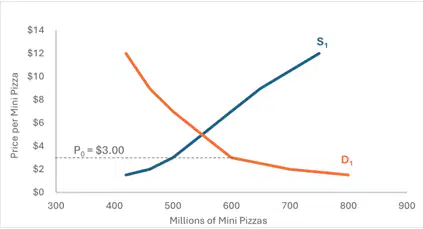
Given the above demand and supply curves, if the current price is $3.00, then the market____________
has a shortage
is in equilibrium
has a surplus
price is too high
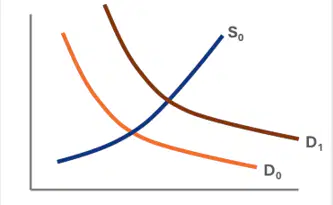
If our demand curve shifts from D0 to D1 this is called a ______________.
Increase in the quantity demanded
Decrease in the quantity demanded
Increase in Demand
Decrease in demand
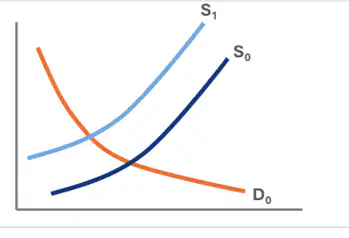
If our supply curve shifts from S0 to S1 this is called a ______________.
Increase in the quantity supplied
Decrease in the quantity supplied
Increase in supply
Decrease in supply
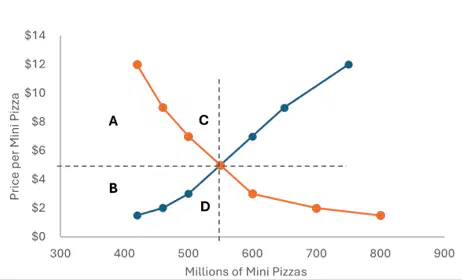
Given the graph, identify the area associated with consumer surplus.
A
B
C
D
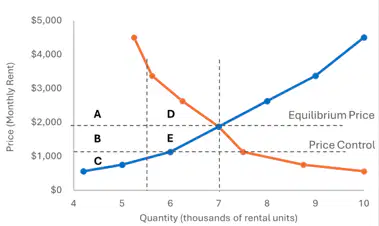
The chart displays the local market for housing rentals. At the equilibrium price, consumer surplus is represented by area(s) ___________.
A
B
D
A + B
A + D
Price elasticity of demand is calculated as:
Percentage change in quantity demanded / Percentage change in price
Percentage change in price / Percentage change in quantity demanded
Change in quantity demanded / Change in price
Change in price / Change in quantity demanded
If the price elasticity of demand for a product is -2.5 and the price increases by 10%, by what percentage will the quantity demanded decrease?
10%
20%
25%
30%
The price of a good increases from $5 to $6, and the quantity demanded decreases from 100 units to 80 units. What is the price elasticity of demand?
1
1.2
1.5
2
Which of the following is true if a product has perfectly inelastic demand?
The quantity demanded changes by the same percentage as the price.
The quantity demanded does not change when the price changes
The quantity demanded changes infinitely when the price changes.
The price does not change when the quantity demanded changes
If the price of a good decreases from $20 to $15 and the quantity supplied decreases from 500 units to 400 units, what is the price elasticity of supply?
0.8
1.0
1.2
1.4
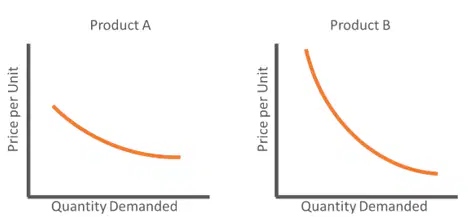
Given the two demand curves which one will experience a greater change in quantity demanded for a given price change?
A
B
We need more information
Neither, they change the same amount
If the demand for a good is elastic, what happens to total revenue when the price decreases?
Total revenue decreases
Total revenue increases
Total revenue remains the same
Total revenue becomes zero
Assume the cross-price elasticity of demand between two goods is -1.2. What can be inferred about the relationship between these two goods?
They are substitutes
They are complements
They are unrelated
They are inferior goods
Gross Domestic Product (GDP) is best defined as:
The total value of all goods and services produced in a country in a year
The total value of all goods and services consumed in a country in a year
The total value of all exports and imports of a country in a year
The total value of all investments made by a country in a year
Which of the following is not included in the calculation of GDP?
Educational services
Sale of new shoes
Honda ATVs made in South Carolina
Ford trucks made at a Mexican plant
If the GDP deflator is 130 and the nominal GDP is $800 billion, what is the real GDP?
$725 billion
$615 billion
$480 billion
$753 billion
If consumption is $500 billion, investment is $150 billion, government spending is $200 billion, exports are $100 billion, and imports are $50 billion, what is the GDP?
$900 billion
$1000 billion
$850 billion
$950 billion
The GDP per capita is calculated by dividing:
GDP by the working-age population
GDP by the number of households
GDP by the total population
GDP by the number of employed individuals
The value of all goods and services produced by US based companies regardless of where they are in the world represents the:
Gross Domestic Product
National Income
Gross National Product
Net National Product
Gross Domestic Product equals $28 trillion. If consumption equals $19 trillion, investment equals $5 trillion, and government spending equals $5 trillion, then:
exports exceed imports by $100 billion
imports exceed exports by $100 billion
imports exceed exports by $1 trillion
exports exceed imports by $1 trillion

Given the data in the table, Gross Domestic Product (GDP) equals:
$20,000
$44,500
$31,500
$47,200
What is the primary purpose of adjusting nominal values to real values?
To account for changes in population
To account for inflation
To account for changes in technology
To account for government spending
If Country A's GDP per capita was $10,000 in 2000 and it grew at an average annual rate of 2%, what was its GDP per capita in 2020?
$13,578
$15,981
$12,362
$14,859
If Country B's GDP was $500 billion in 1990 and grew to $2 trillion by 2020, what was the average annual growth rate over this period?
4.73%
6.12%
7.18%
8.20%
If the population of Country C grew at an average annual rate of 1.5% while its GDP grew at an average annual rate of 4%, what was the average annual growth rate of GDP per capita?
3%
2%
5.5%
2.5%
You own a bakery. Current technology allows 1 worker to make 5 dozen loaves of bread per 8 hour day. Each loaf sells for $4. What is the worker’s productivity per hour?
$2.50
$20
$30
$25
You own a lawn care service. With a push mower, 1 worker can mow 8 yards per day. If each yard pays $30, what is the worker’s productivity per hour?
$2.50
$20
$30
$25
How does education contribute to economic growth?
By increasing the number of jobs
By improving the quality and productivity of the labor force
By reducing capital stock
By decreasing wage rates
How is the unemployment rate defined?
The percentage of people who are unemployed out of the total population
The percentage of people who are unemployed out of the labor force
The percentage of people who are unemployed out of the working-age population
The percentage of people who are unemployed out of the total number of workers
If the number of people employed is 152 million and the number of unemployed is 8 million, what is the unemployment rate?
4.9%
5.3%
6.1%
5.0%
If the number of employed people is 152 million and the number of unemployed is 8 million, what is the labor force participation rate if the working-age population is 200 million?
75%
80%
76%
85%
If the labor force participation rate is 70% and the working-age population is 250 million, what is the size of the labor force?
150 million
170 million
175 million
165 million
Sierra looked for work for six months but could not find a job to her liking. She decided to enroll in school full time and stopped looking for a job. For the purposes of tracking unemployment, Sierra is considered:
unemployed
employed in the underground economy
out of the labor force
underemployed
If the natural rate of unemployment is 5% and the current unemployment rate is 8%, what is the cyclical unemployment rate?
2%
3%
5%
8%
A decrease in aggregate demand will likely lead to:
Lower unemployment rates
Higher inflation rates
An increase in the natural rate of unemployment
Higher unemployment rates in the short run
Which index is commonly used to measure inflation in the United States?
Producer Price Index (PPI)
Gross Domestic Product (GDP) Deflator
Consumer Price Index (CPI)
Employment Cost Index (ECI)
If the CPI in Year 1 is 150 and in Year 2 it is 165, what is the inflation rate between these two years?
12%
15%
5%
10%
How is the inflation rate calculated?
(CPI in the current year - CPI in the base year) / CPI in the base year x 100
(CPI in the current year - CPI in the previous year) / CPI in the previous year x 100
(CPI in the base year - CPI in the current year) / CPI in the current year x 100
(CPI in the base year - CPI in the previous year) / CPI in the previous year x 100
Why might the CPI overstate the cost of living?
Because it fails to account for changes in consumption patterns
Because it only measures goods, not services
Because it does not include imported goods
Because it includes the prices of used goods
What does "indexing" refer to in the context of inflation’s impact on payments like social security?
Adjusting interest rates for inflation
Adjusting nominal values to maintain purchasing power
Adjusting GDP for inflation
Adjusting unemployment rates for seasonal variations
When Mando first signed up for StreamFlix in 2011 the monthly fee was $8 per month. His subscription price increased to $10 in 2015, $12 in 2019 and $16 in 2023. What is the overall rate of inflation (2011 to 2023) for Mando’s streaming service?
25%
200%
100%
50%

