
 Worksheets
Chapter 9, Lesson 1 Science Test
Total questions: 50
Worksheet time: 25mins
Physical properties can be used to distinguish between pure substances and mixtures by:
Identifying differences in melting and boiling points
Ignoring color and texture
Assuming all substances are mixtures
Using only chemical reactions
Fill in the blank: ______ is anything that has mass and takes up space.
Matter
Energy
Light
Sound
Fill in the blank: A ______ is matter with a composition that is always the same.
Pure Substance
Mixture
Solution
Element
Fill in the blank: A ______ is two or more substances that are physically blended but do not combine chemically.
Mixture
Compound
Element
Solution
Fill in the blank: A ______ is a characteristic of matter that can be observed or measured without changing the identity of the matter.
Physical Property
Chemical Reaction
Mixture
Element
Fill in the blank: A ______ is a mixture in which two or more pure substances are not evenly mixed.
Heterogeneous Mixture
Homogeneous Mixture
Solution
Compound
Fill in the blank: A ______ is a mixture in which two or more pure substances are evenly mixed but not bonded together.
Homogeneous Mixture
Heterogeneous Mixture
Compound
Element
Fill in the blank: A ______ is another name for a homogeneous mixture.
Solution
Suspension
Colloid
Emulsion
Fill in the blank: To ______ means to form a solution by mixing evenly.
Dissolve
Evaporate
Condense
Freeze
Which of the following is NOT matter?
Sound
Light
Heat
Gravity and magnetism
All of the above
Which of the following is matter?
Pencils
Rocks
Clouds
Air
All of the above
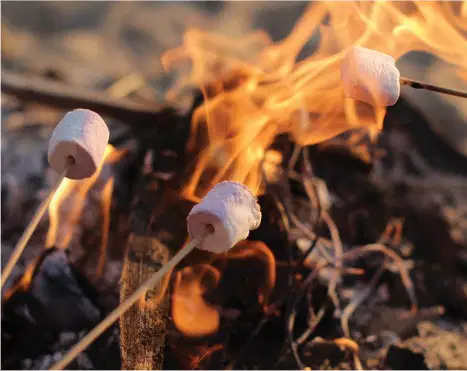
Is the marshmallow in the image an example of matter?
True
False
Examine the image above. What are two examples of matter in this campfire?
Wood and smoke
Heat and light
Energy and air
Flame and heat
What are the two main types of matter?
Pure substances and mixtures
Atoms and molecules
Solids and liquids
Energy and forces
What do copper and water have in common?
They are both pure substances.
They are both metals.
They are both gases.
They are both mixtures.
What is a pure substance?
Matter that is always the same
Matter that is always different
Matter made of different atoms
Matter that takes up space
Fill in the blank: Copper is a pure substance because it only has ______ atoms.
copper
iron
oxygen
hydrogen
Fill in the blank: Pure water is a pure substance because it always has ______ and ______ atoms combined the same way.
hydrogen and oxygen
carbon and oxygen
hydrogen and nitrogen
carbon and nitrogen
How do scientists show atoms in models?
Atoms look like colored spheres
Atoms look like cubes
Atoms look like triangles
Atoms look like lines
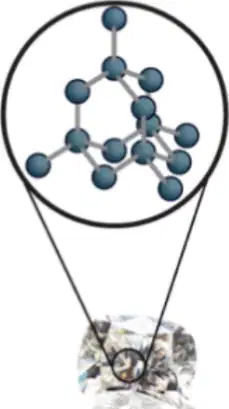
Analyze the atomic models for diamond, pyrite, and quartz. Circle the pure substances that are made up of a combination of atoms.
Diamond
Pyrite
Quartz
What is a mixture? Fill in the blank: A mixture is when two or more things are ______ together but not stuck together.
mixed
glued
melted
fused
A physical property is something you can ______ or measure without changing what it is.
see
eat
hear
break
Mixtures can be: - All the same state (like air, which is all gases). - Or different states (like soda, which has gas, liquid, and solid sugar). Which of the following is an example of a mixture with different states?
Air
Soda
Diamond
Pyrite
Mixtures are made of pure substances.
True
False
The properties of a mixture depend on the parts inside it.
True
False
Fill in the blank: Salt water with 5 grams of salt or 10 grams of salt is still ______.
salt water
fresh water
sugar water
distilled water
Characteristics of Mixtures: - Adding more of one part doesn’t change what the mixture is. True or False: Adding more of one part changes what the mixture is.
True
False
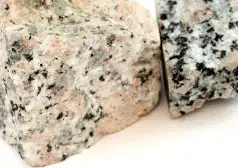
Examine the two samples of granite. Which evidence supports this claim?
Both samples have similar mineral composition.
The samples are different colors.
One sample is larger than the other.
The samples are from different locations.
Fill in the blank: An example of a homogeneous mixture is _____
Air
Sand and water
Oil and water
Iron filings and sulfur
Fill in the blank: An example of a homogeneous mixture is _____
Steel
Salad
Sand and iron filings
Oil and water
Fill in the blank: An example of a homogeneous mixture is _____
Seawater
Sand and iron filings
Oil and water
Granite
What is another name for a homogeneous mixture?
Solution
Compound
Element
Suspension
When you make lemonade, you mix sugar and water. What happens to the sugar in the solution?
It disappears completely
It dissolves and you can still taste it
It turns into gas
It changes color
In a homogeneous mixture, everything is mixed evenly.
True
False
If you take two cups of seawater from the same place, will they have the same amount of salt and water?
Yes
No, the amount of salt will be different
No, the amount of water will be different
No, both salt and water amounts will be different
Why do we sometimes separate mixtures?
To get something valuable or to remove things we don’t want.
To make the mixture more colorful.
To increase the temperature of the mixture.
To make the mixture heavier.
What happens when substances mix?
They keep their own properties, like color, shape, or sweetness.
They always form a new substance with different properties.
They disappear completely.
They turn into a gas.
Which of the following is NOT a property that substances keep when they mix?
A) Color
B) Shape
C) Sweetness
D) They lose all their properties
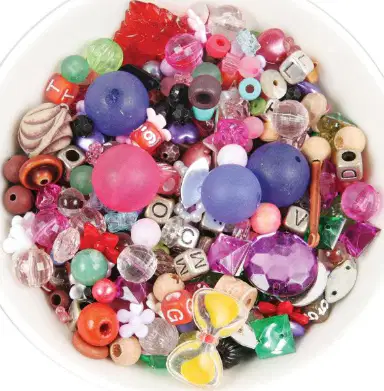
Which of the following are properties that substances keep when they mix?
Color, shape, and size
Color, taste, and texture
Weight, volume, and temperature
Density, boiling point, and melting point
One physical property that could be used to separate this bowl of beads is:
Color
Taste
Sound
Flexibility
Sieving is:
a process of separating particles of different sizes using a sieve.
a method of mixing liquids.
a technique for dissolving solids in liquids.
a way to measure temperature.
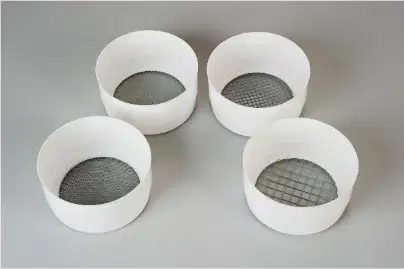
Sieving means using a mesh or strainer to separate things based on _______.
size
color
shape
weight
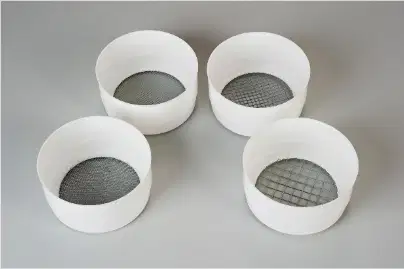
When you shake the mixture on the mesh during sieving: Which statement is correct?
Small pieces fall through the holes.
Big pieces stay on top.
Sedimentation happens because heavy things have more _______ than water.
density
color
temperature
volume
When a mixture has water and solids (like sand or rocks), the heavier parts sink to the _______.
bottom
top
middle
surface
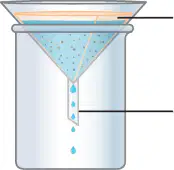
Filtration separates solids from liquids using _______.
size
color
temperature
pressure
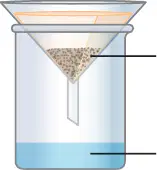
In filtration, what happens when you pour the mixture through filter paper?
Liquid goes through.
Solids stay on the paper.
Both A and B
None of the above
The size of the spaces compared to the size of the sand particles is:
larger than the sand particles
smaller than the sand particles
the same as the sand particles
not related to the sand particles
Which process is used to separate a solid dissolved in a liquid by turning the liquid into gas and leaving the solid behind?
Filtration
Evaporation
Distillation
Condensation
Fill in the blank: Distillation is a way to separate a mixture by _________?
boiling point
color
density
magnetism

