
 Worksheets
pretest mikro 2.3
Total questions: 10
Worksheet time: 5mins
In the human eye area there is a microbiota—microorganisms that colonize body sites without causing infection in healthy individuals. Which microorganism is NOT part of the normal microbiota of the healthy eye?
Streptococcus viridans
Propionibacterium sp.
Corynebacterium sp.
Neisseria gonorrhoeae
Staphylococcus epidermidis
Ocular infections are anatomically divided into external ocular infections and internal ocular infections. Which grouping belongs to external ocular infections?
Dacryoadenitis, Conjunctivitis, Keratitis, Endophthalmitis
Blepharitis, Conjunctivitis, Dacryoadenitis, Orbital cellulitis
Dacryoadenitis, Blepharitis, Keratoconjunctivitis, Uveitis
Conjunctivitis, Keratitis, Orbital abscess, Panophthalmitis
Blepharitis, Uveitis, Chalazion, Canaliculitis
Conjunctivitis, often called “pink eye,” is inflammation of the conjunctiva and may be caused by bacterial, viral, fungal, or parasitic infection. Which microorganism most often causes conjunctivitis?
Varicella–Zoster virus
Adenovirus
Staphylococcus aureus
Herpes simplex virus
Neisseria gonorrhoeae
Epidemic keratoconjunctivitis (EKC) is a clinical manifestation of viral eye infection. Which statement about EKC is most accurate?
It is the most common clinical manifestation of adenoviral conjunctivitis.
It is caused by Herpes simplex virus and represents a combination of conjunctivitis and keratitis.
It is the most severe clinical manifestation of adenoviral conjunctivitis, presenting as conjunctivitis accompanied by keratitis.
It is acute follicular conjunctivitis associated with upper respiratory tract infection and is caused by Varicella–Zoster virus.
It is caused by Cytomegalovirus and represents a combination of conjunctivitis and keratitis.
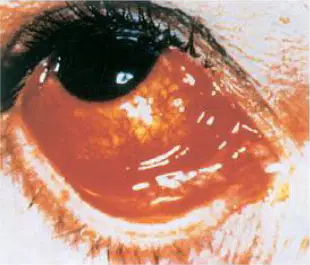
A 60‑year‑old man presents with sudden onset of a right eye that looks red like bleeding, watery, painful, and with a foreign‑body sensation. He reports that vision in the affected eye remains normal. One day earlier he visited a friend who had eye illness. What is the most likely diagnosis?
Acute follicular conjunctivitis
Epidemic keratoconjunctivitis
Acute bacterial conjunctivitis
Hyperacute bacterial conjunctivitis
Acute hemorrhagic conjunctivitis (AHC)
In acute bacterial conjunctivitis, which bacteria are most commonly the causes?
Staphylococcus aureus, Streptococcus pneumoniae, and Haemophilus influenzae
Staphylococcus aureus, Streptococcus pneumoniae, and Neisseria gonorrhoeae
Streptococcus pneumoniae, Haemophilus influenzae, and Escherichia coli
Haemophilus influenzae, Corynebacterium spp., and Pseudomonas aeruginosa
Streptococcus pneumoniae, Neisseria gonorrhoeae, and Pseudomonas aeruginosa
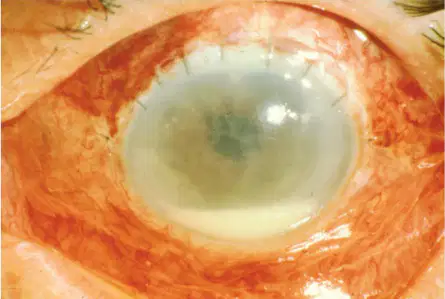
A 65‑year‑old woman presents with a left eye that has become red and painful since yesterday. Two days earlier she underwent cataract surgery on the left eye. Vision started to worsen as the redness and pain developed. What is the most likely diagnosis?
Post‑injection endophthalmitis
Acute post‑cataract endophthalmitis
Endogenous bacterial endophthalmitis
Uveitis
Bacterial keratitis
A 10‑day‑old infant is brought to a health center because the eyes have been red for the past 2 days. The mother notices mucoid secretion at the corner of the eye and continuous tearing. The baby was born at full term via vaginal delivery. What is the most appropriate diagnosis?
Acute bacterial conjunctivitis
Allergic conjunctivitis
Neonatal conjunctivitis (ophthalmia neonatorum)
Nasolacrimal duct obstruction
Chemical conjunctivitis in adults
What is the primary role of toxins or specific adhesins of bacteria in the pathogenesis of bacterial conjunctivitis?
Decrease the conjunctival inflammatory response
Inhibit tear production
Enable bacterial penetration through an otherwise intact epithelium
Increase mucus production by the conjunctiva
Inhibit epithelial regeneration
Not every eye infection requires microbiological testing; definitive diagnosis relies on history and physical examination, supported by microbiology and other laboratory tests when appropriate. Which statement about specimen collection for microbiology in eye infections is most accurate?
For conjunctivitis cases, conjunctival swab and any pus on the conjunctiva can be collected by a general practitioner.
For bacterial keratitis cases, a corneal swab can be collected by a general practitioner.
For bacterial keratitis cases, a corneal swab can be collected by an ophthalmologist.
For bacterial endophthalmitis cases, conjunctival swab and any pus on the conjunctiva can be collected by an ophthalmologist.
For bacterial endophthalmitis cases, vitreous aspiration can be collected by a general practitioner.

