
 Worksheets
rate of reaction
Total questions: 24
Worksheet time: 32mins
What is the meaning of the rate of reaction?
Decrease in amount of product
Decrease in amount of product against time
Increase in amount of products against time
Increase in amount of reactants against time
Which unit is correct for the rate of reaction?
g mol-1
g min-1
mol dm-3
kJ mol-1
Which of the following has the lowest rate of reaction?
Combustion of ethanol
Fermentation of glucose
Oxidation of magnesium
Precipitation of silver chloride
Which reactions has the highest rate of reaction?
Rusting of water pipe
Photosynthesis in green plant
Burning of a small piece of charcoal in the air
Formation of stalactites and stalagmites
Which process has the highest rate of reaction?
Rusting
Respiration
Combustion
Photosynthesis
The following equation represents a chemical equation.
CaCO3 + 2HCl --> CaCl2 + CO2 + H2O
Which graph shows the correct change in mass of reactant used in excess against time?
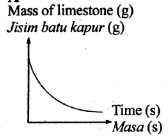
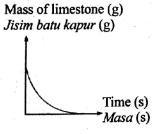
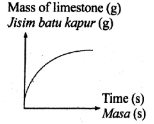
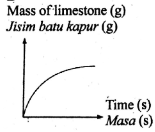
The rate of reaction for the decomposition of hydrogen peroxide decreases with time because
product of reaction decreases
temperature of hydrogen peroxide decreases
volume of hydrogen peroxide decreases
concentration of hydrogen peroxide decreases
In which of the chemical reactions can the rate be determined by measuring the change in the gas volume?
Acidified potassium manganate (VII) solution with iron (II) sulphate solution
Sodium hydroxide solution with dilute hydrochloric acid
Silver nitrate solution with sodium chloride solution
Calcium carbonate with dilute hydrochloric acid
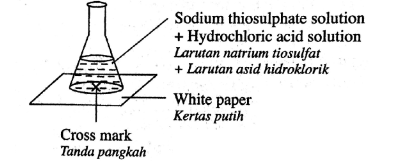
Diagram shows the apparatus set up for an experiment to determine the rate of reaction.
Which of the following techniques is the most suitable to determine the rate of reaction?
Record the time as soon as precipitate is formed
Record the time taken to obtain the maximum temperature
Record the times as soon as the cross mark cannot be seen
Record the times taken for the change of the pH value until a fixed pH value is obtained
The reaction between zinc, Zn and hydrochloric acid, HCl is represented by the following equation.
Zn + 2HCl --> ZnCl2 + H2
A student wants to determine the rate of reaction in a school laboratory. Which of the following methods is the most suitable?
Determine the change in temperature of the solution with time
Determine the change in the concentration of zinc chloride with time
Determine the volume of hydrogen gas given off with time
Determine the change in the concentration of hydrochloric acid with time
The reaction between zinc, Zn and hydrochloric acid, HCl is represented by the following equation.
Zn + 2HCl --> ZnCl2 + H2
A student wants to determine the rate of reaction in a school laboratory. Which of the following methods is the most suitable?
Determine the change in temperature of the solution with time
Determine the change in the concentration of zinc chloride with time
Determine the volume of hydrogen gas given off with time
Determine the change in the concentration of hydrochloric acid with time
The following equation represents the reaction between calcium carbonate, CaCO3 and hydrochloric acid, HCl.
CaCO3 + 2HCl --> CaCl2 + CO2 + H2O
Which changes can be used to determine the rate of reaction?
I : mass of calcium carbonate per unit time
II : Volume of carbon dioxide released per unit time
III : Colour of solution per unit time
IV : Mass of precipitate produced per unit time
I and II
I and III
II and IV
III and IV
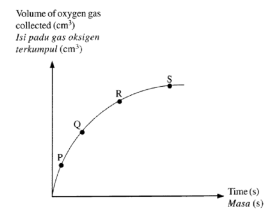
Diagram shows a graph of volume of oxygen gas collected against time in the decomposition reaction of hydrogen peroxide when using manganese dioxide as catalyst.
Which point shows the highest rate of reaction?
P
Q
R
S
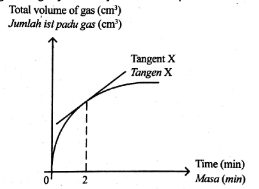
Diagram shows a graph to study the effect of total surface area on the rate of reaction.
What is represented by gradient tangent X?
Average rate of reaction in the first 2 minutes
Average rate of reaction in the 2nd minute
Overall average rate of reaction
Rate of reaction at the 2nd minute
Choose the correct answer for the fast reaction
fermentation of glucose solution
photosynthesis
iron rusting
combustion
What is the best answer for slow reaction
reaction between acid and alkali
Iron rusting
combustion
double decomposition
the rate of reaction can be expressed
amount of reactant used up over time taken
time taken over the amount of reactant used up
rate of reaction is inversely proportional to concentration
the reaction is slow if it takes a short time
Reaction between calcium carbonate and hydrochloric acid will produce what type of gas?
CO2 gas
H2 gas
O2 gas
Cl2 gas
Which factors affect the rate of a reaction?
temperature
concentration
size
pressure
catalyst
Increase in temperature causes the particles to
slow down
move faster
stay apart from each other
move in the correct order
Catalyst helps to
increase the amount of product obtained
to lower the activation energy
provide an alternative reaction route
decrease the frequency of collision
As the frequency of ________________ collision increases, the rate of reaction increases.
time
speed
effective
efficient
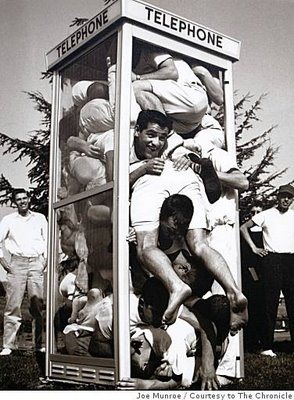
You make a space much smaller by increasing the ________________ hoping to increase the reaction rates.
temperature
concentration
catalyst
pressure

