
 Worksheets
Module A305 P04 Quiz
Total questions: 50
Worksheet time: 25mins
Why might general entry and exit procedures be important in a laboratory setting?
To ensure safety and prevent contamination
To speed up experiments
To reduce paperwork
To increase the number of experiments performed
Which of the following is a required characteristic of the materials used for walls, floors, and ceilings in a clean room?
Smooth
Rough
Porous
Textured
Why must wall and floor junctions in a clean room be covered?
To allow for easy cleaning
To improve insulation
To enhance soundproofing
To increase friction
Which of the following statements best explains why furnishings in a clean room must not release significant quantities of particles?
To maintain air purity and prevent contamination
To reduce noise levels
To improve comfort for workers
To save on maintenance costs

A clean room is being designed. Which combination of features would best ensure compliance with clean room standards?
Smooth, seamless surfaces that do not shed particles and are easily cleaned
Carpeted floors and textured walls for comfort
Open shelving and wooden furniture for accessibility
Painted brick walls and tiled floors for durability
Which of the following is a characteristic of a clean room?
Tight windows to prevent airborne contamination
Open windows for ventilation
Carpeted floors for comfort
Curtains on all windows
Why should door and window opening frames in a clean room be flushed with walls?
To improve the aesthetic appearance
To prevent accumulation of dust and contamination
To allow easy installation of curtains
To increase air flow from outside
What is the purpose of sealing all known wall openings for utilities in a clean room?
To prevent utility access
To block the release of particles and contamination
To reduce noise levels
To improve lighting
Operators in a clean room are required to wear non-shedding garments. What is the main reason for this requirement?
To keep operators warm
To block the release of particles from the body and underclothing
To make operators easily identifiable
To comply with fashion standards
Imagine you are designing a clean room for a pharmaceutical company. Which combination of features would best minimize contamination risk? (Select the most appropriate answer.)
Tight windows, sealed wall openings, and non-shedding garments for operators
Open windows, carpeted floors, and regular clothing for operators
Curtains on windows, unsealed wall openings, and air fresheners
Large open doors, tiled floors, and no special clothing requirements
Which of the following is a type of airlock?
Cascade airlock
Pressure airlock
Vacuum airlock
Rotary airlock
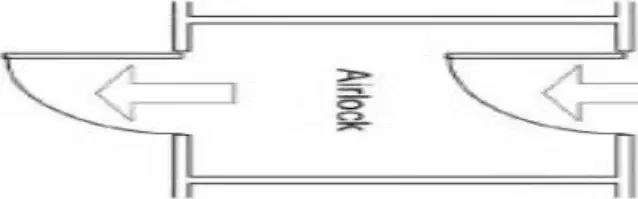
Which type of airlock has high pressure on one side and low pressure on the other side?
Cascade airlock
Bubble airlock
Sink airlock
Double airlock
What is the pressure condition inside a bubble airlock?
High pressure inside, low pressure on both outer sides
Low pressure inside, high pressure on both outer sides
High pressure on one side, low pressure on the other side
Equal pressure on all sides
In which airlock type is the pressure inside the airlock lower than the pressure on both outer sides?
Cascade airlock
Bubble airlock
Sink airlock
Tunnel airlock
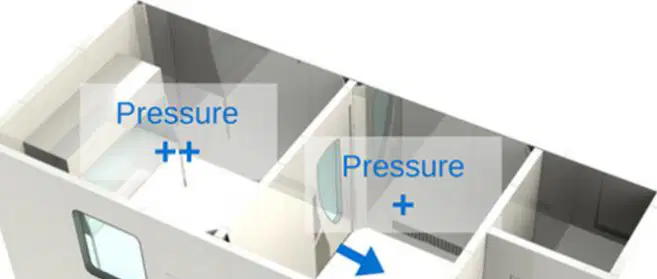
What is the main design aim of room-to-room pressurization in cleanrooms?
To ensure contaminated air does not enter the cleanroom from adjacent dirtier areas
To allow air to move freely between all rooms
To equalize pressure in all rooms
To reduce the temperature in cleanrooms
According to cleanroom pressurization principles, in which direction should air always move?
From clean room to less clean adjacent areas
From less clean areas to clean rooms
From outside to inside the cleanroom
From the cleanroom to the outside environment
What is the typical differential pressure maintained between two cleanrooms?
10Pa
5Pa
15Pa
20Pa
Why are cleaner areas in a cleanroom facility more positively pressurized than less-clean adjacent areas?
To ensure air moves from cleaner to less clean areas, preventing contamination
To reduce energy consumption
To increase humidity in the cleanroom
To allow for easier maintenance
If the differential pressure between a cleanroom and an unclassified area is 15Pa, what does this help achieve?
It prevents contaminated air from entering the cleanroom
It increases the temperature in the cleanroom
It allows for faster air exchange
It reduces the need for air filtration
Given a cleanroom with a pressure of ++, an adjacent room with a pressure of +, and an unclassified area with a pressure of 0, explain the strategic importance of this pressure gradient in maintaining cleanroom integrity.
The pressure gradient ensures that air flows from the cleanest area to the least clean, minimizing contamination risk.
The pressure gradient allows contaminants to move freely between rooms.
The pressure gradient is used to balance temperature across rooms.
The pressure gradient is irrelevant to cleanroom integrity.
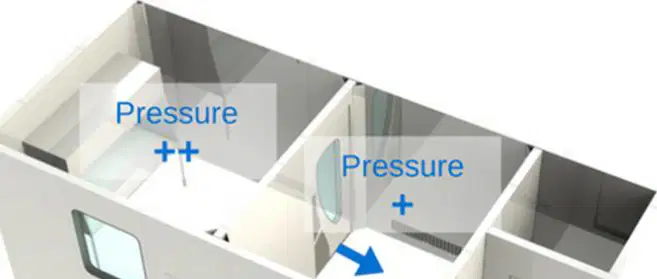
Which area normally has the highest pressure in a room-to-room pressurization system?
Production area
Storage area
Entry corridor
Office space
Which of the following is an extra cost associated with room-to-room pressurization?
Extra energy costs
Increased water usage
Higher maintenance costs
Additional cleaning supplies
Why might opening or closing doors be difficult in a pressurized room system?
Due to pressure differences
Because of faulty hinges
Because of heavy doors
Due to lack of lubrication
Which phenomenon can occur due to air movement through cracks in pressurized rooms?
Whistling through the cracks
Condensation on windows
Dust accumulation
Temperature drop
Which device is used to filter extracted air before it is discharged into the external environment?
HEPA filter
Carbon filter
UV filter
Water filter
Negative pressure is important in a containment room for processes involving toxic chemicals or dangerous bacteria because:
It ensures contaminated air does not escape into other areas
It increases the temperature for chemical reactions
It allows more light into the room
It reduces the need for cleaning
The role of a HEPA filter in the air extraction process from containment rooms is to:
Remove harmful particles before air is discharged
Add fragrance to the air
Increase air pressure in the room
Cool the air before discharge
If a containment room fails to maintain negative pressure, what could be the potential consequences for the surrounding environment?
Toxic chemicals or dangerous bacteria could escape and contaminate other areas
The room would become quieter
The lighting system would fail
The room would become colder
Which strategy ensures that air extracted from a containment room does not pose a risk to the external environment?
Discharge air directly outside without filtration
Use HEPA filters and safety cabinets for air extraction
Increase the temperature of the extracted air
Use scented air fresheners
The usage of gowns in a cleanroom helps prevent contamination by:
Making the room colder
Preventing the addition of extra particulates from the human body
Increasing the number of microbes
Allowing more skin flakes to shed
Which of the following is a reason for wearing protective gowns in a laboratory environment?
To prevent contamination from hair, skin, and respiratory droplets
To keep warm in cold rooms
To look professional
To avoid getting chemicals on shoes
Why is it important to cover your hair when working in a sterile environment?
To prevent microorganisms from contaminating samples
To avoid hair getting caught in equipment
To keep hair clean
To reduce noise in the lab
What is the relationship between the loudness of talking and the amount of contaminants released?
The louder one talks, the more contaminants are released.
The louder one talks, the fewer contaminants are released.
Loudness does not affect contaminant release.
Only whispering releases contaminants.
Why is it important not to come to work in the cleanroom if you are sick?
Because you might feel tired
Because you could contaminate the cleanroom environment
Because you will not be productive
Because you might get bored
Which of the following is recommended for maintaining hygiene and behavior in a cleanroom?
Frequent bathing and shampooing
Using hair sprays in the cleanroom
Smoking inside the cleanroom
Wearing high-lint clothing
Which of the following is NOT a recommended practice for cleanroom hygiene?
Avoiding cosmetics such as face powder and perfumes
Avoiding getting sunburned
Smoking inside the cleanroom
Wearing clothing that is low-lint
Humans are considered a source of contamination in cleanrooms. Which of the following best explains why, and suggests two ways to minimize this risk?
Humans carry contaminants and shed particles; minimizing risk by frequent bathing and wearing low-lint clothing
Humans do not shed particles; minimizing risk by smoking and using aftershave
Humans only contaminate when sunburned; minimizing risk by avoiding sun exposure
Humans are always clean; minimizing risk by using more cosmetics and perfumes
What is the primary use of isopropyl alcohol in a cleanroom?
A powerful disinfectant and antiseptic
A food preservative
A water softener
A fragrance additive
Which of the following best describes the mode of action of isopropyl alcohol?
Denatures proteins, dissolves lipids, and can lead to cell membrane disintegration
Increases cell wall thickness
Promotes cell growth
Binds to DNA and prevents replication
Isopropyl alcohol is effective against which types of microorganisms?
Bacteria and fungi
Viruses only
Protozoa only
Algae and molds only
A cleanroom technician needs to ensure that surfaces are free from bacteria and fungi. Which cleaning agent should they use based on its effectiveness?
Isopropyl alcohol
Distilled water
Table salt
Vegetable oil
Which of the following is a limitation of phenolic cleaning agents used in cleanrooms?
They are sporicidal
They leave residues
They are only effective against viruses
They are only available in neutral formulas
Phenolic cleaning agents are effective against which of the following?
Only gram positive organisms
Only gram negative organisms
A broad spectrum of microorganisms, including gram positive and gram negative organisms, certain fungi, and certain viruses
Only spores
What is meant by "rotating" in the context of phenolic cleaning agents?
Using only one type of formula
Alternating between alkaline and acidic formulas
Spinning the cleaning agent before use
Mixing with water before application
Phenolic cleaning agents may not be suitable for all cleanroom applications due to which of the following limitations?
They are not sporicidal and can leave residues
They are always acidic
They are only effective against bacteria
They are too expensive
Which cleaning agent blend is mentioned as being used in a cleanroom for fast, broad spectrum, sporicidal activity?
H2O2/Peracetic acid blends
Sodium hypochlorite
Ethanol
Quaternary ammonium compounds
What is one advantage of H2O2/Peracetic acid blends compared to other effective oxidizers?
They are less corrosive
They are more expensive
They require no pre-cleaning
They have no odor
Why might personnel prefer H2O2/Peracetic acid blends over other cleaning agents in a cleanroom?
They are safer for personnel
They are more toxic
They are less effective
They are more expensive
A cleanroom technician notices a strong vinegar-like smell after cleaning. Which cleaning agent blend is most likely responsible?
H2O2/Peracetic acid blends
Sodium hypochlorite
Isopropyl alcohol
Phenolic disinfectants
If a cleanroom contains equipment made of soft metals, what should be considered before using H2O2/Peracetic acid blends?
The cleaning agent is corrosive to soft metals
The cleaning agent is non-corrosive
The cleaning agent is odorless
The cleaning agent is not effective against spores

