Wayground logo

Free Printable Worksheets

Font size

S
M
L
XL
Worksheets

Maintenance extra questions

Total questions: 33

Worksheet time: 18mins

Name
Class
Date
1.
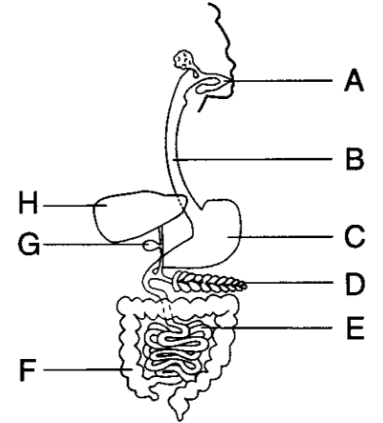
The diagram represents human digestive system. From which structure are glucose and amino acids normally absorbed into the circulatory system?
a)
F - Large Intestine
b)
H - Liver
c)
C - Stomach
d)
E - Small Intestine
2.
Look at the diagram. In which structure does the initial digestion of carbohydrates occur?
a)
A - Mouth
b)
E - Small Intestine
c)
C - Stomach
d)
D - Pancreas
3.
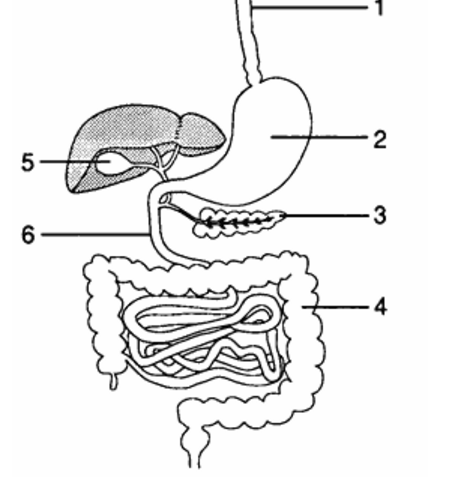
A painful condition results from erosion of the surface of this organ by gastric juices. Select the organ, from the diagram, that most closely relates to that malfunction.
a)
1-Mouth
b)
3-Pancreas
c)
2-Stomach
d)
4-Large Intestine
4.
In the image what is the name of part #3?
a)
1-Mouth
b)
3-Pancreas
c)
2-Stomach
d)
4-Large Intestine
5.
In the image what numbers are a part of the digestive tract?
a)
1, 2, 3, 5
b)
2, 3, 5
c)
1, 2, 6, 4
6.
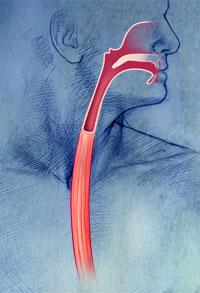
This is an image of the
a)
stomach
b)
small intestine
c)
esophagus
d)
large intestine
7.
Accumulations of hardened cholesterol deposits form gallstones in this organ.
a)
1
b)
3
c)
4
d)
5
8.
What very important job do kidneys have?
a)
The filter urine
b)
To filter waste and excess fluid out of the blood
c)
To filter waste out of urine
d)
None of the above 
9.
Where does digestion begin?
a)
in the mouth
b)
in the esophagus
c)
in the stomach
d)
in the intestines
10.
There are two kidneys, two ureters, one urinary bladder, and one urethra.
a)
True
b)
False
11.
The major organs of the urinary system is the
a)
Lungs
b)
Ureters
c)
Kidneys
d)
Nephrons
12.
Where does mechanical digestion take place?
a)
mouth only
b)
mouth and large intestine 
c)
stomach only
d)
mouth and stomach
13.
__________ is a digestive juice that starts breaking down some materials in the food in the mouth.
a)
saliva
b)
teeth
c)
tongue
d)
esolphagus
14.
Urine exits the bladder and the body through a tube called the:
a)
Ureter
b)
Kidney
c)
Urethra
d)
Bladder
15.
The digestive system .....
a)
removes waste products from the blood
b)
Breaks down food to be absorbed. Removes solid wastes.  
c)
Site of gas exchange
d)
Directs the body's activities.
16.

Our mouth is involved in what type(s) of digestion?

a)

Mechanical

b)

Chemical

c)

BOTH mechanical and chemical

d)

None of these

17.

Connects the mouth to the esophagus

a)

Stomach

b)

Pharynx

c)

Larynx

d)

Pancreas

18.

Which of the following do the muscles of the stomach NOT do?

a)

crush food that has entered the stomach cavity

b)

release digestive enzymes to break down food

c)

release wastes directly from the body

d)

act as a storage tank for food

19.

Reorder the following. Put these in order that food follows as it passes through the digestive system.

a)

mouth

b)

oesophagus

c)

stomach

d)

small intestine

e)

large intestine

1)
2)
3)
4)
5)
20.
a)
esophagus
b)
liver
c)
stomach
d)
pancreas
21.
a)
stomach
b)
pancreas
c)
large intestine
d)
small intestine
22.
Gastric juices in the stomach digest food into a thick liquid.  This is...
a)
Mechanical digestion
b)
Chemical digestion
23.
What is the definition for digestion?
a)
Breaking down food into smaller nutrients
b)
Getting rid of waste products
c)
Getting food into our bodies
d)
Getting nutrients into our bloodstream, so that our cells can use them
24.
The muscular tube that moves food from the mouth to the stomach?
a)
esophagus
b)
small intestine
c)
stomach
d)
mouth
25.
Enzymes and acids are examples of 
a)
mechanical digestion
b)
chemical digestion
26.
Chewing, grinding, and churning are examples of...
a)
mechanical digestion
b)
chemical digestion
27.
What do the villi do?
a)
Digests food in the mouth.
b)
Digests food in the stomach
c)
Protects the stomach from digesting iteself
d)
Absorbs nutrients from food so the body has energy.
28.

Which parts of the diagram is the small and large intestine?

a)

A~ small intestine

E~ large intestine

b)

D~ small intestine

E~ large intestine

c)

C~ large intestine

B~ small intestine

d)

A~ large intestine

C~ small intestine

e)

E~ small intestine

D~ large intestine

29.

Which is the esophagus?

a)

A

b)

B

c)

C

d)

D

e)

E

30.

What does the small intestine do?

a)

reabsorbs the water after the process of the system.

b)

Absorbs most of the end of the nutrients and minerals from where the food takes place.

c)

keeps the stomach in balance for when the system starts.

d)

Absorbs most of the food that's left from the process.

31.

Which organ absorbs nutrients from the food we eat?

a)

Gallbladder

b)

Small intestine

c)

Stomach

d)

Esophagus

32.

What does the large intestine absorb?

a)

Nutrients

b)

Bile

c)

Proteins and sugars

d)

Water and salts

33.

What kind of digestion happens with saliva?

a)

Mechanical

b)

Chemical

c)

Accidental

d)

Hydraulic