
 Worksheets
Exponential F.S. + GIBBS + Parseval's
Total questions: 11
Worksheet time: 6mins
Defining Cn=2AnejΘn for n > 0 leads to the synthesis equation x(t)=n=−∞∑∞Cnejnw0t . What is the role of Cn in this representation?
Complex Fourier coefficients capturing magnitude and phase
Real-valued amplitudes scaling cosine harmonics only
Time-domain weights varying with t for each harmonic
Indices marking harmonic order without numerical value
Which conclusion about energy distribution can be inferred from the 1/n magnitude decay of Cn?
Higher harmonics dominate energy
Lower harmonics dominate energy
Energy is concentrated at even indices
Energy is uniform across harmonics
Which property makes the rectified sine wave periodic with T = π rather than 2π?
It repeats every half sine due to rectification
Its amplitude doubles every half period
Its phase resets only after 2π
It contains only odd symmetry
From x(t)=π2A+π2An=−∞∑∞(1−4n2ej2nt) , what does the term π2A represent?
DC component of the signal
Fundamental cosine term
Quadrature sine term
Spectral leakage term
Why do the Fourier coefficients Cn form a discrete spectrum?
Coefficients exist only for discrete n
Coefficients depend on nonperiodic time
Coefficients vary continuously in frequency
Coefficients exist only for continuous ω
For a complex spectrum of Cn, which spectra are typically plotted?
Magnitude and phase spectra
Time and frequency spectra
Energy and power spectra
Real and imaginary spectra
Using Euler’s identity, ejnw0t equals which trigonometric combination?
cos(nw0t)+jsin(nw0t)
cos(nw0t)−jsin(nw0t)
sin(nw0t)+jcos(nw0t)
sin(nw0t)−jcos(nw0t)
Which formula correctly converts the DC term between forms?
C0 equals a0
C0 equals b0
a0 equals jC0
a0 equals 2C0
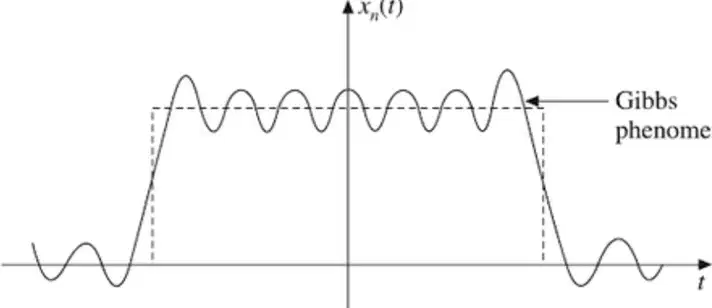
In the diagram, the oscillatory ripples near the vertical dashed line are labeled as the Gibbs phenomenon. What feature of the signal causes these ripples to appear during Fourier series reconstruction?
Smooth slope transitions in the waveform
Finite energy of the periodic signal components
Discontinuities producing abrupt amplitude jumps
Low-frequency content dominating the spectrum
As more harmonics are added to a truncated Fourier series of a square-like wave, what change is observed near the edges?
Overshoots broaden with larger amplitude
Overshoots get sharper with reduced adjoining amplitude
Overshoots disappear completely at high harmonics
Edges blur due to increased low-frequency content
What is the primary physical interpretation of Parseval’s identity for periodic signals?
Energy conservation between time and frequency domains
Phase synchronization of harmonics across cycles
Amplitude normalization of the fundamental component
Noise suppression by complex conjugation

