
 Worksheets
Introduction to Bone Biomechanics
Total questions: 15
Worksheet time: 8mins
Which statement best describes the mineral portion of normal human bone ?
Primarily calcium and phosphate forming small crystals
Mostly collagen fibers called ossein and osteocytes
Mainly water content accounting for eighty percent
Predominantly elastic cartilage enabling joint movement
Which component primarily gives bone its hardness and accounts for roughly 65–70% of bone dry weight?
Type I collagen and minor collagens
Hydroxyapatite mineral crystals
Non‑collagenous matrix proteins
Bound water within bone matrix
In bone tissue, which cell type primarily resorbs mineralized matrix during remodeling?
Osteoblasts forming new bone surfaces
Osteoclasts breaking down bone matrix
Osteocytes sensing mechanical loads
Chondrocytes producing cartilage matrix
Which feature best distinguishes a long bone from other types?
A shaft much longer than width
Thin curved layers of compact bone
Cube-shaped with thin compact coating
Embedded within a tendon near joints
Which statement best distinguishes compact bone from trabecular bone?
Compact bone forms the hard outer layer with minimal gaps
Trabecular bone forms the hard outer layer with minimal gaps
Compact bone is an open-cell porous network with rods and plates
Trabecular bone accounts for 80 percent of adult bone mass
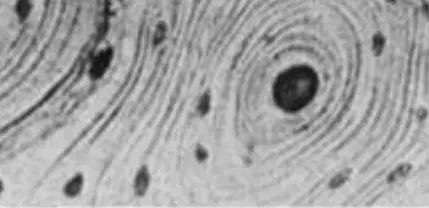
In the diagram showing osteons, which structure forms the central channel carrying blood vessels and nerves within compact bone?
Volkmann’s canal connecting adjacent osteons
Haversian canal within the osteon core
Canaliculi radiating from lacunae
Trabeculae spanning spongy bone spaces
Bone shows different mechanical properties in different directions. This property is called:
Cancellous bone is best designed to resist:
The stress–strain curve of bone initially shows:
The ability of bone to deform slowly under a constant load is known as:
According to Wolff’s law, bone adapts to:
Greenstick fractures are more common in children due to:
High cortical thickness
Low viscoelasticity
Higher collagen content
Reduced bone porosity
Compressive trabeculae in the femoral neck are aligned:
Vertically
Horizontally
Obliquely
Randomly
The yield point on the stress–strain curve represents:
Viscoelastic materials show:
No time-dependent behavior
Same response to fast and slow loading
Different response depending on loading rate
Instant failure

