
 Worksheets
Social Studies Revision
Total questions: 92
Worksheet time: 46mins
What are the three main types of government?
A) Autocracy, Democracy, Oligarchy
B) Dictatorship, Monarchy, Plutocracy
C) Democracy, Theocracy, Plutocracy
D) Autocracy, Monarchy, Democracy
In an autocracy, who has total power over everyone else?
The people
A small group
One person
Religious leaders
Fill in the blank: In a dictatorship, a ruler makes all the decisions without following any laws or constitution. Examples include ________, Muammar al-Gaddafi, Adolf Hitler.
Idi Amin
Nelson Mandela
Mahatma Gandhi
Abraham Lincoln
Which type of autocracy is described as power staying in a royal family, with the king or queen having complete control?
Dictatorship
Absolute Monarchy
Theocracy
Plutocracy
Fill in the blank: In a democracy, the people have the power to choose their leaders through ________.
elections
appointments
inheritance
lottery
Which of the following is an example of a representative democracy?
Vatican City
USA
Old Japan
Saudi Arabia
What is an oligarchy?
A government ruled by one person
A government where the people have the power
A government ruled by a small group of powerful people
A government ruled by religious leaders
Plutocracy is a government ruled by the ________. Example: Old Japan.
rich
poor
military
priests
What is the definition of 'Aristocracy'?
Government ruled by the people
Government ruled by the best or noble people (called aristocrats)
Government ruled by a single person
Government ruled by the military
What is a political party?
A political party is a group of people who share similar ideas about how a country should be governed. They choose candidates to represent them in elections. When their candidates win, the party’s ideas (called an agenda) are carried out.
A political party is a group of people who organize sports events for the community.
A political party is a company that sells products to the government.
A political party is a group of people who only focus on environmental issues and do not participate in elections.
How many active political parties does Nigeria officially have today?
18 active political parties
36 active political parties
25 active political parties
12 active political parties
In 2020, how many political parties were deregistered by the electoral body (INEC) in Nigeria?
74 parties
50 parties
100 parties
30 parties
Which party is the current ruling party in Nigeria?
Peoples Democratic Party (PDP)
Labour Party (LP)
All Progressives Congress (APC)
New Nigeria Peoples Party (NNPP)
Which party is the main opposition party in Nigeria?
All Progressives Congress (APC)
Peoples Democratic Party (PDP)
Labour Party (LP)
New Nigeria Peoples Party (NNPP)
Which party is described as a fast-rising party that gained strong support in recent elections?
All Progressives Congress (APC)
Peoples Democratic Party (PDP)
Labour Party (LP)
New Nigeria Peoples Party (NNPP)
Name one other political party in Nigeria apart from APC, PDP, LP, and NNPP.
All Progressive Grand Alliance (APGA)
United States Democratic Party (USDP)
British Conservative Party (BCP)
Canadian Liberal Party (CLP)
What is a civil war?
A war fought between different groups of people within the same country.
A war fought between different countries.
A war fought for independence.
A war fought for resources.
The Nigerian Civil War, also called the ______ War, began in 1967.
Biafran
Zulu
Mau Mau
Ashanti
In which year did the Nigerian Civil War begin?
1967
1970
1956
1983
Who led the Nigerian Government during the Nigerian Civil War?
Sir Abubakar Tafawa Balewa
General Yakubu Gowon
Lt. Colonel Odumegwu Ojukwu
Major Chukwuma Kaduna Nzeogwu
Who led the Republic of Biafra during the Nigerian Civil War?
Sir Abubakar Tafawa Balewa
General Yakubu Gowon
Lt. Colonel Odumegwu Ojukwu
Major Chukwuma Kaduna Nzeogwu
The Nigerian Civil War lasted for ______ months and ended in January 1970.
30
24
18
36
In 1966, who was assassinated during a coup led by Major Chukwuma Kaduna Nzeogwu?
Sir Abubakar Tafawa Balewa
General Yakubu Gowon
Lt. Colonel Odumegwu Ojukwu
None of the above
The killings of many Igbo people in 1966 became known as the ______.
Massacre of 1966
Civil War of 1967
Biafra Uprising
Nigerian Coup
How many states was Nigeria divided into to calm the crisis?
6
12
24
36
In May 1967, which region declared itself the Republic of Biafra?
Eastern Region
Western Region
Northern Region
Mid-Western Region
Which countries supported Nigeria during the Civil War?
France and Israel
United Kingdom and Soviet Union
United States and China
None of the above
Which countries supported Biafra during the Civil War?
France, Israel, and some other nations
United Kingdom and Soviet Union
United States and China
None of the above
Many Igbo people suffered severe ______ during the war.
starvation
prosperity
celebration
migration
On what date did Biafra surrender, officially ending the war?
14 January 1970
1 May 1967
12 June 1966
30 January 1970
Which of the following was NOT a cause of the Nigerian Civil War?
A) Military coup
B) Counter-coup
C) Ethno-religious violence
D) Economic boom
One cause of the Nigerian Civil War was:
Religious differences
Economic rivalry between regions
Dispute over oil resources
Colonial boundary disputes
Effects of the War: Millions of people were ______.
displaced
celebrated
enriched
promoted
Effects of the War: Over ______ civilians died, many from starvation.
2 million
200,000
500,000
5 million
Effects of the War: About ______ soldiers were killed.
45,000
10,000
100,000
5,000
Effects of the War: Nigeria suffered an ______ crisis.
economic
political
cultural
technological
Effects of the War: ______ tension grew stronger.
Ethno-religious
Economic
Political
Geographical
World War I: The war started in ______ when Archduke Franz Ferdinand, heir to the Austrian throne, was assassinated by a Serbian.
July 1914
June 1912
August 1915
May 1913
World War I: Who declared war on Serbia?
Austria
Germany
France
Russia
World War I: ______ supported Serbia, while ______ supported Austria.
Russia, Germany
France, Britain
Italy, Russia
Britain, France
World War I: Germany invaded ______, and Britain declared war on Germany to defend it.
Belgium
France
Russia
Italy
World War I: The war is also called the ______ or the ______.
Great War, War to End All Wars
Cold War, Nuclear Conflict
Civil War, Revolution
Modern War, Global Conflict
Which countries were part of the Central Powers during World War I?
A) Britain, France, Russia
B) Austria-Hungary, Germany, Ottoman Empire
C) USA, Italy, Japan
D) Germany, Britain, France
Which countries were part of the Allied Powers during World War I?
A) Austria-Hungary, Germany, Ottoman Empire
B) Britain, France, Russia (later joined by the USA and others)
C) Germany, Britain, France
D) USA, Italy, Japan
Name one new weapon used by Germany during World War I.
Poison gas, flamethrowers, or submarines called U-boats
Longbows
Catapults
Chariots
Which country introduced tanks as a new weapon in World War I?
Germany
Britain
France
Russia
About __ million people died and over __ million were wounded during World War I.
10 million; 20 million
15 million; 25 million
8 million; 15 million
20 million; 30 million
The war spread even to Africa, causing heavy losses.
True
False
In which year were the Central Powers defeated in World War I?
1914
1919
1925
1939
What was the name of the treaty Germany signed after World War I?
Treaty of Paris
Treaty of Versailles
Treaty of London
Treaty of Berlin
After World War I, Germany's army was reduced to how many soldiers?
100,000 soldiers
50,000 soldiers
250,000 soldiers
500,000 soldiers
What organization was created to prevent future wars after World War I?
United Nations
League of Nations
European Union
NATO
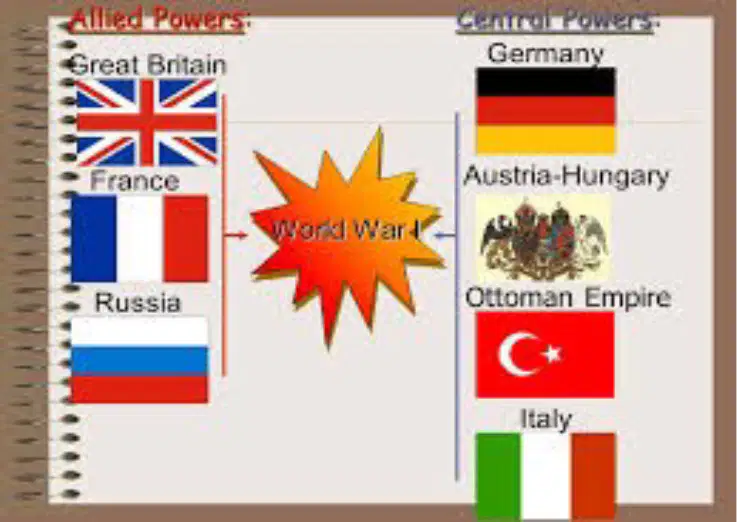
Which of the following countries was a member of the Allied Powers during World War I?
Germany
Great Britain
Austria-Hungary
Ottoman Empire
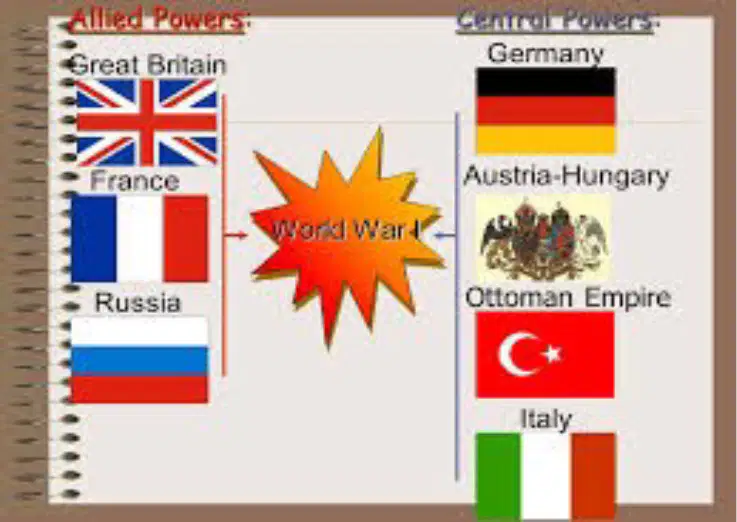
Which of the following countries was a member of the Central Powers during World War I?
France
Russia
Italy
Great Britain
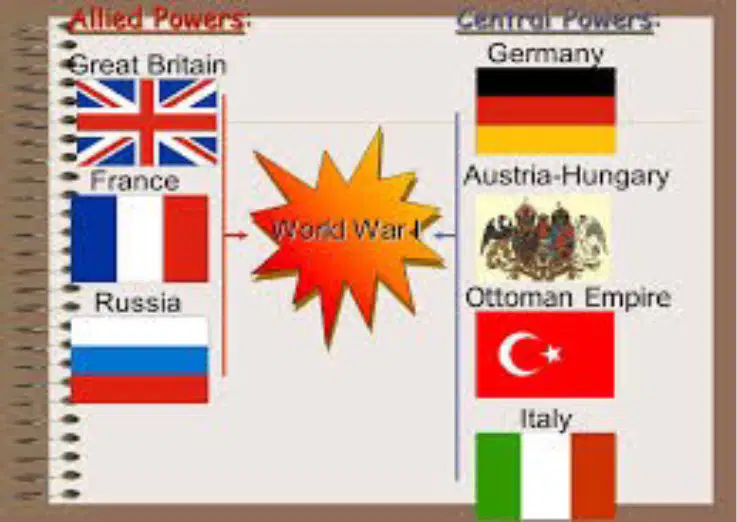
Fill in the blank: ______ was a member of the Allied Powers during World War I.
France
Germany
Ottoman Empire
Austria-Hungary
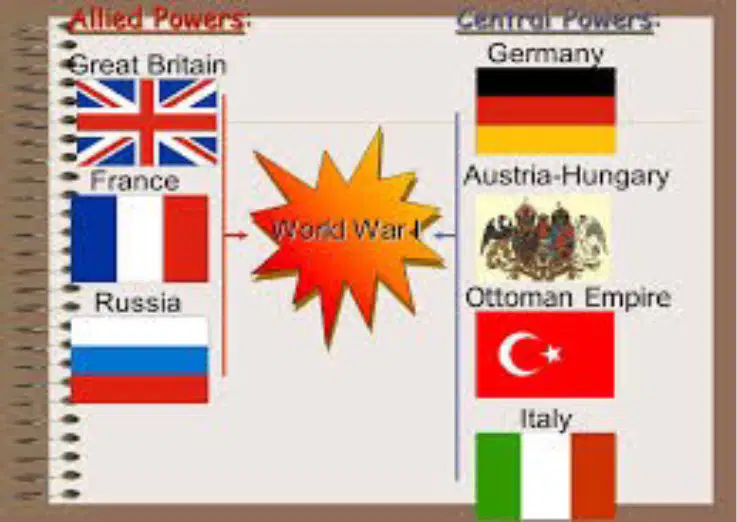
Fill in the blank: ______ was a member of the Central Powers during World War I.
Germany
France
United States
United Kingdom
What does the 'M' in the M.A.I.N. causes of World War I stand for?
Militarism
Monarchy
Migration
Mercantilism
What does the 'A' in the M.A.I.N. causes of World War I stand for?
Alliances
Armistice
Appeasement
Aggression
What does the 'I' in the M.A.I.N. causes of World War I stand for?
Imperialism
Isolationism
Industrialization
Individualism
What does the 'N' in the M.A.I.N. causes of World War I stand for?
Nationalism
Neutrality
Negotiation
Nuclear power
Which of the following is NOT a weapon used in World War I?
Machine Gun
Bayonet
Laser Gun
Flame Thrower
After World War I, Germany suffered from which of the following?
Wealth and prosperity
Poverty, inflation, and unemployment
Peace and stability
Rapid industrialization
Who rose to power as leader of the Nazi Party after World War I?
Adolf Hitler
Joseph Stalin
Winston Churchill
Benito Mussolini
What symbol is associated with the Nazi Party?
Swastika
Hammer and Sickle
Eagle and Snake
Rising Sun
Hitler discriminated against Jews by removing their rights, jobs, and even their lives.
True
False
On what date did Germany invade Poland, starting World War II?
1 September 1939
1 September 1945
7 December 1941
6 June 1944
Which countries declared war on Germany in response to its invasion of Poland?
Britain, France, Australia, and New Zealand
USA, USSR, Canada, and France
Italy, Japan, and Germany
Britain, USA, and Canada
Who were the Axis Powers in World War II?
Germany, Italy, Japan
Britain, USA, France
USSR, Canada, France
Germany, USA, Japan
Who were the Allied Powers in World War II?
A) Britain, USA, France, Canada, USSR, and others
B) Germany, Italy, Japan
C) USA, Germany, Japan
D) Britain, Italy, Japan
In which year did Japan attack Pearl Harbor, leading the USA to join World War II?
1941
1939
1945
1943
The USA dropped atomic bombs on which two Japanese cities, forcing Japan to surrender?
Tokyo and Osaka
Hiroshima and Nagasaki
Kyoto and Sapporo
Hiroshima and Tokyo
In what year did Hitler commit suicide and Germany surrender?
1941
1945
1939
1944
About how many people died worldwide during World War II?
60 million
10 million
25 million
100 million
Over how many Jews and others were killed in Nazi camps during the Holocaust?
1 million
6 million
10 million
60 million
The war ended in ______ with the defeat of the Axis Powers.
1945
1939
1942
1950
What organization was formed in 1945 to promote peace and prevent future wars?
League of Nations
United Nations (UN)
European Union
NATO
Which of the following countries was part of the Axis Powers during World War II?
Great Britain
Japan
Soviet Union
United States
Which country joined the Allied Powers in June 1941?
France
Soviet Union
United States
Germany
Fill in the blank: The United States joined the Allied Powers in _________.
December 1941
June 1940
September 1939
May 1942
Which of the following is NOT an Allied Power listed in the chart?
Great Britain
France
Italy
United States
What does ECOWAS stand for?
Economic Community of West African States
European Council of Overseas Welfare and Security
Eastern Coalition of World Agricultural Societies
Environmental Committee of West Asian States
What does EU stand for?
European Union
Eastern Union
Economic Unity
Euro University
What does WTO stand for?
World Trade Organization
World Tourism Organization
World Technology Organization
World Transport Organization
What does UNESCO stand for?
United Nations Educational, Scientific and Cultural Organization
United Nations Economic, Social and Cultural Organization
United Nations Environmental, Scientific and Cultural Organization
United Nations Educational, Social and Cultural Organization
What is the full form of UNICEF?
United Nations Children's Fund
United Nations Children's Foundation
United Nations Child Fund
United Nations Child Foundation
WHO stands for _________
World Health Organization
World Humanitarian Organization
World Health Office
World Heritage Organization
When was the United Nations formed?
24th October 1945
24th October 1950
24th October 1940
24th October 1939
How many member countries does the United Nations have today?
50
100
193
200
Which of the following is NOT an organ of the United Nations?
General Assembly
Security Council
Economic and Social Council
International Court of Justice
Which UN agency helps children around the world?
WHO
UNICEF
UNESCO
ECOSOC
Which UN agency promotes health worldwide?
WHO
UNICEF
UNESCO
Security Council
The UN works to solve global problems like hunger, poverty, health, and war.
True
False

