
Font size
 Worksheets
Psych Consciousness
Total questions: 48
Worksheet time: 24mins
Resistance to division
Divided attention; integrating sensory experiences. . .
Unity
Selectivity
Transience
Dichotic listening
If you are asked to do two different things at the same time, like sing a song out loud while you’re doing some math problems then you will be able to complete both of those things, but you won’t be able to do so efficiently-> Resistance to divison
Unity
Selectivity
Cocktail party phenomenon
Transience
include some objects, not others:
Dichotic listening: two things at once; REA, LEA
Cocktail party phenomenon: tune in one message while they filter out others nearby
Selectivity
Unity
Transience
Consciousness
means that we are able to fully process some aspects of our environment while at the same time ignoring other aspects of the environment. . .
Selectivity
Unity
Transience
an experimental paradigm that a researcher can use to test for selectivity. In this task, a participant is asked to listen to auditory information presented through headphones. Each ear receives a different piece of auditory information, and participants are more likely to immediately hear and process pieces of information that are important to them. . .
The dichotic listening task is an experimental paradigm that a researcher can use to test for ______. In this task, a participant is asked to listen to auditory information presented through headphones. Each ear receives a different piece of auditory information, and participants are more likely to immediately hear and process pieces of information that are important to them
selectivity
if both earphones present a news story, but only one of those news stories has the name of the participant embedded into the news story, then they are more likely to pay attention to that story and ignore the other.
Dichotic listening task (selectivity)
Transience
Unity
This is a situation wherein there is a lot of activity going on in the background, but you are able to tune all of that out in order to have a conversation (like, for instance, while you’re at a party) until you hear something amongst the background clamor that is relevant to you. If you’re talking to one person, then everything else being said around you just becomes muffled words that you’re not actually processing in any meaningful way. Despite this, however, if someone suddenly said your name then you would pay attention to that immediately.
Tendency to change, mind wanders. . .
Selectivity
Transience
Unity
Intentionality
it’s the opposite of unity, but it actually can be beneficial. When our brains can take a short break from all of the extreme heavy lifting it does for you and everything you have to process, then it will. If you’re driving home from work, and you’ve driven that same route 1,000 times before, then your brain doesn’t really have to be highly tuned in the entire time. Rather, it can wander a bit and think about other things that require fewer resources to process.
Selectivity
Intentionality
Unity
Transience
Low-level kind of sensory awareness and responsiveness.
Occurs when the mind inputs sensations and may output behavior (mind can wander)
Minimal consciousness
Consciousness in which you know and are able to report your mental state
Full consciousness
Attention is drawn to the self as an object
-Self-recognition
Self-consciousness
Becoming _________ is a major developmental milestone that truly separates us from the majority of other animal species. When we look in the mirror, we know that we are looking at ourselves (after about 18 months of age) but when a dog looks in the mirror they will not be fully aware that they are seeing themselves. Rather, they are likely to think they are seeing another, separate, dog.
where the harder you try to push something out of your conscious thought processing, the more likely it is to stay in your thoughts, and very frustrating and counterproductive problem that many grapple with on a regular basis. . .
rebound effect
conscious avoidance of a thought
like the gas you get at the dentist or what you might get to knock you out before surgery, then your ability to fully process what’s going on around you will be impacted to a marked degree.
Anesthetic gas alters conscious
But changes in conscious processing can occur even with _____ anesthesia, like what you might get via an injection in your skin prior to getting stitches. Without the anesthesia, you would feel each and every stitch that goes into your skin. But with the anesthesia you can watch the process and see that a needle is going into your skin without the accompanying sensory processing from the skin that you would expect.
is our most common and most needed altered state of consciousness. . .
Theory that states we need sleep simply to restore our resources
Restorative Theory
Your brain is working hard for you every single second of everyday, and every time your brain does something it burns through resources like glucose, oxygen, water, and ATP. The more you force it to do, the more depleted it gets. This supports what theory about sleep?
The theory that states the length of sleep that we need to get is based on evolutionary drives
Adaptive hypothesis
Amount depends on the availability of food & safety considerations . . .What hypothesis matches this?
Adaptive hypothesis
-Predators (lions), animals that hide (bats) sleep a lot
-Vulnerable animals w/o shelter (cattle) and those that spend hours feeding (elephants) sleep very little
-> hypothesis?
Adaptive hypothesis
Restorative hypothesis
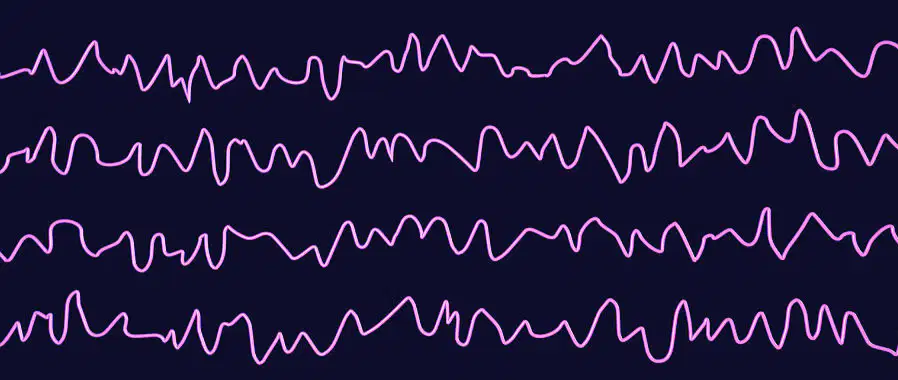
tiny waves for brain activity represent which state?
Awake
Stage 2
Stage 3
Stage 4
When we’re ______, we have rapid, tiny, little staccato waves which indicates that we are processing through information continuously.
we go from short, tiny waves while awake to the big, loopy waves when we’re is what stage of sleep?
stage 4 (restorative sleep)
stage 2 (moderate sleep)
stage 1 (light sleep)
______ are a unique aspect of wave forms that are meant to keep your brain alert and ready for action as you are falling asleep. Have you ever been drifting off, only to pull yourself back from what surely feels like a 40 foot drop? Or have you ever been falling asleep when you suddenly “hear” someone yell out your name?
Sleep spindles
Difficulty in falling asleep or staying asleep. . .
Person stops breathing for brief periods while asleep. . .
Occurs when the person arises and walks around during sleep. . .
Sleepwalking/ somnambulism
Experience of waking up unable to move. . .
Sudden sleep attacks occur in the middle of waking activities. . .
Abrupt awakenings with panic and intense emotional arousal. . .
_______ may be linked to stress, drug use, or, alternatively, body temperature (should be at a low temp by midnight, with rising temp by dawn to signal it’s time to wake up)
insomnia
____ _____ can be caused by tissue obstruction (in obstructive sleep apnea) or it could be caused by a misfire of signaling from the brain that regulates breathing (in central sleep apnea)
________ occurs during deep sleep (stage 3/4). The sleeping person is not paralyzed as they should be.
______ is when the person falls into a sudden REM state.
a _______ is the sudden experience of fear and terror without the context of a nightmare, In other words, there is no tangible reason as to why they person should be terrified, but they suddenly are and it jolts them awake.
which of the following are major characteristics that distinguish dreaming from waking consciousness:. . .
Intense emotion
Illogical thought
Meaningful sensation
Uncritical acceptance
Difficulty remembering
can be a physical form or a psychological dependence. This is a condition where your body needs to have the drug in order to function according to its new normal.
Dependence
s a condition wherein the does of the drug that is taken is no longer effective and a higher does is needed. This is based on biological processes, and it can quickly become something that pulls at you as much as hunger and thirst.
Situation wherein your body is, basically, recovering from the change that happened when you took the drug. You significantly changed your neurological and biological processing when you had the drug in your system, and now that it’s been metabolized your body will need to recover.
Withdrawal
Tolerance
Addiction
Narcotics
Defined as the compulsive use of a drug regardless of the consequences
Tolerance
Withdrawal
serve to slow down your neurological processing
depressants
stimulants
Anxiolytics
Narcotics
speed up your neurological processing
Stimulants
Narcotics
Depressants
Hallucinogens
work to reduce feelings of anxiety and have a number of off-label applications as well. This class of drugs includes barbiturates and benzodiazepines.
Narcotics
Anxiolytics
Hallucinogens
cause sensory experiences that are not based in reality. This can take the form of hearing things, seeing things, feeling things, tasting or smelling things that aren’t actually there.
Hallucinogens
Stimulants
Depressants
Narcotics

