
 Worksheets
Principles of Accounting I Module 11 Quiz Module 11 - Chapter 10
Total questions: 124
Worksheet time: 1hrs 2mins
Payroll taxes are based on the employee's net pay.
True
False
When exchanging equipment, if the trade-in allowance is greater than the book value a loss results.
True
False
Federal unemployment taxes are paid by the employer and the employee.
True
False
Medicare taxes are paid by both the employee and the employer.
True
False
The difference between the balance in a fixed asset account and its related accumulated depreciation account is the asset's book value.
True
False
Revising depreciation estimates affects the amounts of depreciation expense recorded in past periods
True
False
For proper matching of revenues and expenses, the estimated cost of fringe benefits must be recognized as an expense of the period during which the employee earns the benefits.
True
False
The journal entry to record the cost of warranty repairs that were incurred during the current period, but related to sales made in prior years, includes a debit to Warranty Expense.
True
False
An installment note is a debt that requires the borrower to make equal periodic payments to the lender for the term of the note.
True
False
Quick assets include
cash, cash equivalents, receivables, prepaid expenses, and inventory
cash, cash equivalents, receivables, and prepaid expenses
cash, cash equivalents, receivables, and inventory
cash, cash equivalents, and receivables
Each year there is a ceiling for the amount that is subject to all of the following except:
social security tax
federal income tax
federal unemployment tax
state unemployment tax
Federal income taxes withheld increase the employer's payroll tax expense.
True
False
Which of the following is required to be withheld from an employee's gross pay?
both federal and state unemployment compensation taxes
only federal unemployment compensation tax
only federal income tax
only state unemployment compensation tax
Notes payable may be issued to creditors to satisfy previously created accounts payable.
True
False
Receiving payment prior to delivering goods or services causes a current liability to be incurred.
True
False
Form W-4 is a form authorizing employers to withhold a portion of employee earnings for payment of an employee's federal income taxes.
True
False
Employers are required to withhold which of the following taxes from employees?
FICA tax
FICA tax and state and federal unemployment taxes
state unemployment tax
federal unemployment tax
Martin Jackson receives an hourly wage rate of $30, with time and a half for all hours worked in excess of 40 hours during a week. Payroll data for the current week are as follows: hours worked, 46; federal income tax withheld, $350; social security tax rate, 6.0%; and Medicare tax rate, 1.5%. What is the net amount to be paid to Jackson?
$1,470.00
$1,009.75
$1,097.95
$460.25
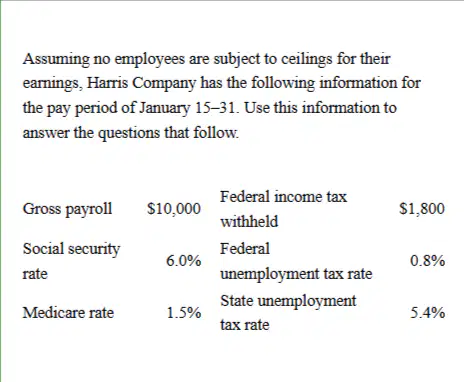
Assuming that all wages are subject to federal and state unemployment taxes, the employer's payroll tax expense would be
$1,370
$750
$620
$2,870
Anderson Co. issued a $50,000, 60-day, discounted note to National Bank. The discount rate is 6%. At maturity, assuming a 360-day year, the borrower will pay:
$53,000
$50,500
$50,000
$49,500
Assuming a 360-day year, when a $50,000, 90-day, 9% interest-bearing note payable matures, total payment will be:
$51,125
$54,500
$1,125
$4,500
Taylor Bank lends Guarantee Company $150,000 on January 1. Guarantee Company signs a $150,000, 8%, 9-month, interest-bearing note. The entry made by Guarantee Company on January 1 to journalize the proceeds and issuance of the note is:
Interest Expense 12,000;
Cash 138,000;
Notes Payable 150,000
Cash 150,000;
Notes Payable 150,000
Cash 162,000;
Interest Expense 12,000;
Notes Payable 150,000
Notes Payable 120,000;
Interest Payable 7,200;
Cash 120,000;
Interest Expense 7,200
Which of the following is the most desirable quick ratio?
2.20
1.80
1.95
1.50
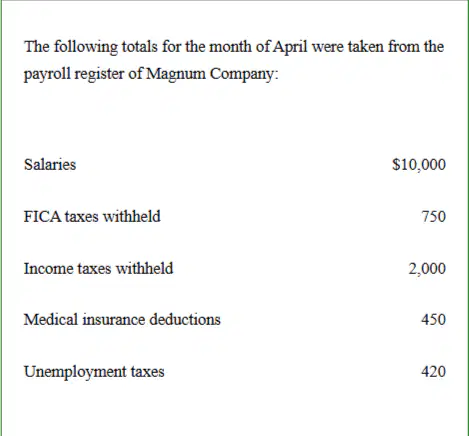
The entry to journalize the accrual of employer’s payroll taxes would include a
debit to Payroll Tax Expense for $1,170
debit to FICA Taxes Payable for $1,500
credit to Payroll Tax Expense for $420
debit to Payroll Tax Expense for $1,620
According to a summary of the payroll of Scotland Company, total salaries were $500,000. Assume that social security taxes are payable at a 6.0% rate and Medicare taxes are payable at a 1.5% rate with no maximum earnings. Federal income tax withheld was $98,000. Also, $15,000 was subject to state (5.4%) and federal (0.8%) unemployment taxes. The entry to journalize accrued salaries would include a
debit to Salaries Payable of $365,250
credit to Salaries Payable of $364,500
debit to Salaries Expense of $364,500
credit to Salaries Expense of $365,250
An employee's take-home pay is equal to gross pay less all voluntary deductions.
True
False
An event is reasonably possible but the related liability is not estimable. It will
be recorded only
be recorded and disclosed
be disclosed only
not be recorded or disclosed
When a borrower receives the face amount of a discounted note less the discount, the amount received is known as the
note proceeds
note discount
note deferred interest
note principal
Which of the following will have no effect on an employee’s take-home pay?
social security tax
unemployment tax
marital status
number of exemptions claimed
Payroll taxes levied against employees become liabilities
on the first of the following month
at the end of the payroll period
when data are entered in a payroll register
at the end of an accounting period
If a company borrows money from a bank as an installment note, the interest portion of each annual payment will
equal the interest rate on the note times the carrying amount of the note at the beginning of the period
remain constant over the term of the note
equal the interest rate on the note times the face amount
increase over the term of the note
Current liabilities are
due and receivable within 1 year
due and to be paid out of current assets within 1 year
due, but not payable for more than 1 year
payable if a possible subsequent event occurs
Wright Company sells merchandise with a 1-year warranty. This year, sales consisted of 2,000 units. It is estimated that warranty repairs will average $15 per unit sold, and 30% of the repairs will be made this year and 70% next year. On this year's income statement, Wright should show warranty expense of
$9,000
$21,000
$30,000
$0
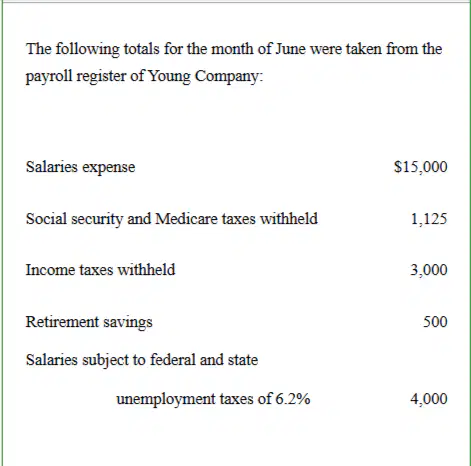
The entry to journalize the accrual of employer’s payroll taxes would include a debit to
Payroll Tax Expense for $2,498
Social Security and Medicare Tax Payable for $2,250
Payroll Tax Expense for $1,373
Payroll Tax Expense for $3,000
On the first day of the fiscal year, Hawthorne Company obtained an $88,000, 7-year, 5% installment note from Sea Side Bank. The note requires annual payments of $15,208, with the first payment occurring on the last day of the fiscal year. The first payment consists of interest of $4,400 and principal repayment of $10,808. The entry Hawthorne would make to journalize the first annual payment due on the note would include a
debit to Cash for $15,208
credit to Notes Payable for $10,808
debit to Interest Expense for $4,400
debit to Notes Payable for $15,208
Based on the following data, what is the quick ratio?
Accounts payable
$ 30,000
Accounts receivable
60,000
Accrued liabilities
5,000
Cash
30,000
Intangible assets
50,000
Inventory
69,000
Long-term investments
80,000
Long-term liabilities
100,000
Marketable securities
30,000
Fixed assets
670,000
Prepaid expenses
1,000
3.4
3.0
2.2
1.8
Zennia Company provides its employees with varying amounts of vacation per year, depending on the length of employment. The estimated amount of the current year’s vacation cost is $135,000. On December 31, the end of the current year, the current month’s accrued vacation pay is
$135,000
$67,500
$0
$11,250
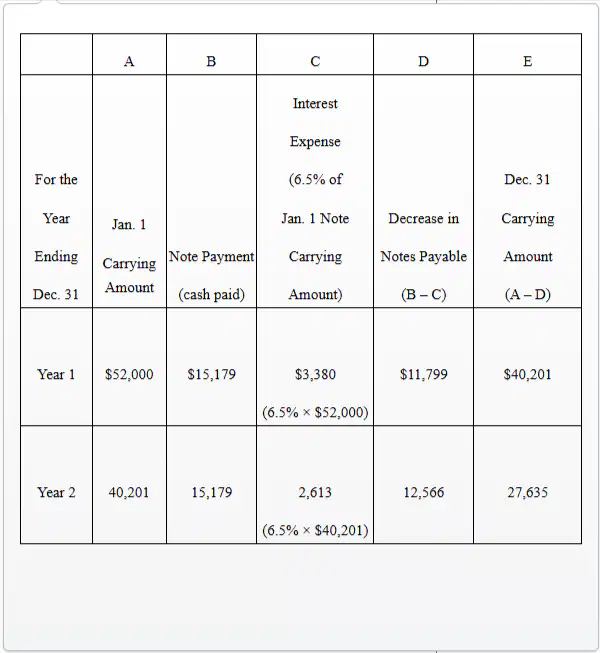
On January 1, Year 1, Zero Company obtained a $52,000, 4-year, 6.5% installment note from Regional Bank. The note requires annual payments of $15,179, beginning on December 31, Year 1. The December 31, Year 2 carrying amount in the allocation of periodic payments table for this installment note will be equal to
$26,000
$27,635
$21,642
$28,402
Assuming a 360-day year, when a $20,000, 90-day, 5% interest-bearing note payable
matures, total payment will be
a. $250
b. $20,250
c. $1,000
d. $21,000
Which of the following would most likely be classified as a current liability?
a. unearned rent
b, bond payable
c. mortgage payable
d. two-year note payable
The current portion of long-term debt should
a. be paid immediately.
b. be reclassified as a current liability.
c. be classified as a non-current liability.
d. not be separated from the non-current portion of debt.
On January 5, Thomas Company, a calendar-year company, issued $1,000,000 of notes
payable, of which $250,000 is due on January 1 each of the next four years. The proper balance
sheet presentation on December 31 is
a. Current Liabilities, $1,000,000
b. Current Liabilities,$250,000; Long-Term Debt, $750,000
c. Long-Term Debt,$1,000,000
d. Current Liabilities, $750,000; Long-Term Debt,$250,000
Proper payroll accounting methods are important for a business for all the reasons below except
A. payroll is subject to various federal and state regulations
B. good employee morale requires timely and accurate payroll payments
C. payroll and related payroll taxes have a significant effect on the net income of most businesses
D. to help a business with cash flow problems by delayed payments of payroll taxes to federal and state agencies
The amount of federal income taxes withheld from an employee's gross pay is recorded as a(n)
A. liability
B. contra account
C. asset
D. payroll expense
Which is not a determinate in calculating federal income taxes withheld from an individual's
pay?
A. Number of exemptions
B. Type of earnings
C. Gross pay
D. Filing status
Which of the following would be used to compute the federal income taxes to be withheld from an employee's earnings?
A. FUTA tax rate
B. wage and tax statement
C. FICA tax rate
D. wage bracket and withholding table
Which of the following taxes would be deducted in determining an employee's net pay?
A. FUTA taxes
B. SUTA taxes
C. FICA taxes
D. all are correct
Which of the following taxes are employers required to withhold from employees?
A. FICA tax
B. FICA tax, state, and federal unemployment tax
C. federal unemployment tax
D. state unemployment tax
Thomas Martin receives an hourly wage rate of $40, with time and a half for all hours worked in excess of 40 hours during a week. Payroll data for the current week are as follows: hours worked, 48; federal income tax withheld, $350; social security tax rate, 6.0%; and Medicare tax rate, 1.5%. What is the gross pay for Martin?
A. $1,730
B. $449
C. $2,080
D. $1,581
Sadie White receives an hourly rate of $30, with time and a half for all hours worked in excess of 40 during a week. Payroll data for the current week are as follows: hours worked, 48; federal income tax withheld, $300; social security tax rate, 6.0%; and Medicare tax rate, 1.5%. What is the net amount to be paid to White?
$1,143.00
$1,260.00
$1,443.00
$1,000.00
Davis and Thompson have earnings of $850 each. The social security tax rate is 6% and the Medicare tax rate is 1.5%. Assuming that the payroll will be paid on December 29, what will be the employer's total FICA tax for this payroll period?
a.$102.00
b. $127.50
c.$96.00
d. $25.50
The following totals for the month of June were taken from the payroll register of Arcon Company:
Salaries expense $14,000
Social security and Medicare taxes withheld 1,050
Income taxes withheld 2,600
Retirement savings 1,000
The entry to record the payment of net pay would include a...
a. credit to salaries expense for $9,350.
b. debit to salaries payable for $14,000.
c. debit to salaries payable for $9,350.
d. credit to salaries payable for $9,350.
Lee Company has the following information for the pay period of December 15-31:
Gross payroll $16,000 Federal income tax withheld $4,000
Social security rate 6% Federal unemployment tax rate 0.8%
Medicare rate 1.5% State unemployment tax rate 5.4%
Assuming no employees are subject to ceilings for taxes on their earnings, Salaries Payable would be recorded for
$16,000
$9,808
$10,800
$11,040
The following totals for the month of April were taken from the payroll register of Magnum Company.
Particulars Amount
Salaries $12,000
FICA taxes withheld 900
Income taxes withheld 2,500
Medical insurance deductions 450
Federal unemployment taxes 32
State unemployment taxes 216
The journal entry to record the monthly payroll on April 30 would include a
a) debit to Salaries Payable for$8,150
b) debit to Salaries Expense for $7,902
c) credit to Salaries Payable for$8,150
d) debit to Salaries Payable for $7,902
An aid in internal control over payrolls that indicates employee attendance is
a. voucher system
b. special payroll bank account
c. time card
d. fringe benefits
The interest rate specified in the bond indenture is called the
A. discount rate
B. contract rate
C. market rate
D, effective rate
A legal document that indicates the name of the issuer, the face value of the bond and such other data is called
a. a convertible bond
b. a bond indenture
c. trading on the equity
d. a bond debenture
Bonds that are subject to retirement prior to maturity at the option of the issuer are called:
a. debentures
b. callable bonds
c. early retirement bonds
d. options
The Glenn Corporation issues 1,000, 10-year, 8%, $2,000 bonds dated January 1 at 96. The journal
entry to record the issuance will show a
A. debit to Cash of$2,000,000
B. credit to Bonds Payable for $1,920,000
C. debit to Discount on Bonds Payable for$80,000
D. credit to Cash for $1,920,000
The Freeman Corporation issues 2,000, 10-year, 8%, $1,000 bonds dated January 1 at 96. The journal
entry to record the issuance will show a
a. credit to Discount on Bonds Payable for $80,000
b. debit to Cash for $2,000,000
c. debit to Cash for $1,920,000
d. credit to Bonds Payable for $1,920,000
When the bonds are sold for more than their face value, the carrying value of the bonds is equal to
A. Face value
B. Face value plus the unamortized discount
C. Face value minus the unamortized premium
D. Face value plus the unamortized premium
On January 1 of the current year, the Barton Corporation issued 10% bonds with a face value of $200,000. The bonds are sold for $191,000. The bonds pay interest semiannually on June 30 and December 31 and the maturity date is December 31, five years from now. Barton records straight-line amortization of the bond discount. The bond interest expense for the year ended December 31 is
$21,800
$10,900
$18,200
$29,000
the journal entry a company records for the payment of interest, interest expense, and amortization of a bond premium is
a. debit Interest Expense, credit Cash, and Premium on Bonds Payable
b. debit Interest Expenses, credit Cash
c. debit Interest Expense and Premium on Bonds Payable credit Cash
d. debit interest Expense, credit Interest Payable, and Premium on Bonds Payable
Franklin Corporation issues $50,000, 10%, 5-year bonds on January 1, for $52,100. Interest is paid semiannually on January 1 and July 1. If Franklin uses the straight-line method of amortization of bond premium, the amount of bond interest expense to be recognized on July 1 is
a. $2,500
b. $2,290
c. $10,290
d. $2,710
If the straight-line method of amortization of bond premium or discount is used, which of the following statements is true?
A. Annual interest expense will increase over the life of the bonds with the amortization of bond premium.
B. Annual interest expense will remain the same over the life of the bonds with the amortization of bond discount.
C. Annual interest expense will decrease over the life of the bonds with the amortization of bond discount.
D. Annual interest expense will increase over the life of the bonds with the amortization of bond discount.
When the market rate of interest on bonds is higher than the contract rate, the bonds will sell
a. at a premium
b. their face value
c. their maturity value
d. a discount
one potential advantage of financing corporations through the use of bonds rather than common stock is
A. The corporation must pay the bonds at maturity.
B. The interest on bonds must be paid when due.
C. A higher earning per share is guaranteed for existing common shareholders.
D. The interest expense is deductible for tax purposes by the corporation.
The Levi Company issued $200,000 of 12% bonds on January 1 at face value. The bonds pay interest semiannually on January 1 and July 1. The bonds are dated January 1, and mature in five years, on January 1. The total interest expense related to these bonds for the current year ending on December 31 is
$2,000
$6,000
$18,000
$24,000
Eddie Industries issues $1,500,000 of 8% bonds at 105, the amount of cash received from the sale is
a.$1,425,000
b. $1,000,000
c.$1,575,000
d. $1,080,000
A corporation issues for cash $1,000,000 of 10%, 20-year bonds, interest payable annually, at a time when the market rate of interest is 12%. The straight-line method is adopted for the amortization of bond discount or premium. Which of the following statements is true?
a. The amount of the annual interest expense is computed at 10% of the bond carrying amount at the beginning of the year.
b. The amount of the annual interest expense gradually decreases over the life of the bonds.
c. The amount of unamortized discount decreases from its balance at issuance date to a zero balance at maturity.
d. The amount of unamortized premium decreases from its balance at issuance date to a zero balance at maturity.
when the maturities of a bond issue are spread over several dates, the bonds are called
A. serial bonds
B. term bonds
C. bearer bonds
D. debenture bonds
If the market rate of interest is 7%, the price of 6% bonds paying interest semiannually with a face value of $500,000 will be
a. equal to $500,000
b. greater than $500,000
c. less than $500,000
d. greater than or less than $500,000, depending on the maturity date of the bonds
if bonds are issued at a discount, it means that the
A. The bondholder will receive effectively less interest than the contractual rate of interest.
B. The market interest rate is lower than the contractual interest rate.
C. The financial strength of the issuer is suspect.
D. The market interest rate is higher than the contractual interest rate.
when the corporation issuing the bonds has the right to redeem the bonds prior to the maturity, the bonds are
a. unsecured bonds
b. debenture bonds
c. convertible bonds
d. callable bonds
Selling the bonds at a premium has the effect of
a. raising the effective interest rate above the stated interest rate
b. attracting investors that are willing to pay a lower rate of interest than on similar bonds
c. causing the interest expense to be higher than the bond interest paid
d. causing the interest expense to be lower than the bond interest paid
Bonds with a face amount $1,000,000, are sold at 98. The entry to record the issuance is:
a. Cash$980,000, Bonds Payable $980,000.
b. Cash$980,000, Premium on Bonds Payable $20,000, Bonds Payable$1,000,000.
c. Cash $1,000,000, Premium on Bonds Payable$20,000, Bonds Payable $980,000.
d. Cash$980,000, Discount on Bonds Payable $20,000, Bonds Payable$1,000,000.
Basil Corporation issues for cash $1,000,000 of 8%, 10-year bonds, interest payable annually, at a time when the market rate of interest is 7%. The straight-line method is adopted for the amortization of bond discount or premium. Which of the following statements is true?
The amount of annual interest paid to bondholders increases over the 10-year life of the bonds.
The carrying amount increases from its amount at issuance date to $1,000,000 at maturity.
The amount of annual interest expense decreases as the bonds approach maturity.
The carrying amount decreases from its amount at issuance date to $1,000,000 at maturity.
the market interest rate related to a bond is also called the
A. stated interest rate
B. effective interest rate
C. contract interest rate
D. straight-line rate
The journal entry a company makes for the payment of interest, interest expense, and amortization of bond discount is:
A. debit interest expense, credit cash, and discount on bonds payable
B. debit interest expense, credit cash
C. debit interest expense and premium on bonds payable, credit cash
D. debit interest expense, credit interest payable, and premium on bonds payable
If $4,000,000 of 12% bonds are issued at 98, the amount of cash received from the sale is:
a.$3,920,000.
b.$4,000,000.
c.$4,080,000.
d.$4,480,000
A corporation issues $2,000,000 of 16%, 10-year bonds, interest payable semi-annually, at a time when the market rate of interest is 18%. The straight-line method is adopted for the amortization of bond discount or premium. Which of the following statements is true?
a. The carrying amount decreases from its amount at issuance date to $2,000,000 at maturity.
b. The amount of interest expense increases as the bonds approach maturity.
c. The carrying amount increases from its amount at issuance date to $2,000,000 at maturity.
d. The amount of interest paid to bondholders decreases over the 20-year life of the bonds
The entry to record the amortization of a premium on bonds payable includes a:
a. debit Premium on Bonds Payable.
b. credit to Premium on Bond Payable.
c. debit to Bonds Payable.
d. credit to Bonds Payable
When the market rate of interest was 12%, Bergerud Corporation issued $1,000,000, 10%, 5-year bonds that pay interest semiannually.
(Present Value tables are on page 12.) The selling price of this bond issue was:
a. $892,680.
b. $1,073,600.
c. $926,405.
d. $1,000,000
The journal entry a company records for the issuance of bonds when the stated rate and the market rate are the same is:
a. debit Bonds payable, credit Cash.
b. debit Cash and Discount on Bonds Payable, credit Bonds Payable.
c. debit Cash, credit Premium on Bonds Payable and Bonds Payable.
d. debit Cash, credit Bonds Payable
Welch Corporation issued $100,000, 8%, 10-year bonds that pay interest semiannually. The issue price was $77,060. Using the straight-line method, the amount of discount or premium to be amortized each interest period would be:
a. $1,147.
b. $22,940.
c. $1,927.
d. $2,294.
Amortizing a discount on bonds payable:
a. increases interest expense.
b. increases periodic cash payments to bondholders.
c. decreases interest expense.
d. decreases periodic cash payments to bondholder
The Premium on Bonds Payable account:
a. is an asset account.
b. causes the carrying value of the bonds to be greater than the par value of the bonds.
c. is a contra-asset account.
d. causes the carrying value of the bonds to be less than the par value of the bonds
Greenwich Company issues $2,000,000 face value, 9%, 10-year bonds payable on January 1, 2019. Interest is paid semi-annually each June 30 and December 31. The bonds sell at $1,960,000; Greenwich uses the straight-line method of amortizing bond discount or premium.
The entry made by Greenwich Company to record issuance of the bonds at January 1, 2019, includes:
a. a debit to Cash of $2,000,000.
b. a debit to Discount on Bonds Payable of $40,000.
c. a credit to Bonds Payable of $1,960,000.
d. a credit to Bond Interest Payable of $40,000
Greenwich Company issues $2,000,000 face value, 9%, 10-year bonds payable on January 1, 2019. Interest is paid semi-annually each June 30 and December 31. The bonds sell at $1,960,000; Greenwich uses the straight-line method of amortizing bond discount or premium.
The carrying value of this liability in Greenwich Company's December 31, 2019 balance sheet is:
a. $2,000,000.
b. $1,960,000.
c. $1,964,000.
d. $1,956,000
Callable bonds can be retired before the bonds maturity date at the option of the :
a. issuing company.
b. bondholder.
c. Only if both the issuing company and the bondholder agree to early retirement
The interest rate that determines the amount of cash paid to bondholders on the interest payment dates is referred to as the:
a. effective rate of interest.
b. market rate of interest.
c. contract (stated) rate of interest.
d. Both (a) and (b) are correct answer
With regard to bond interest rates, which of the following set of terms contains descriptions that have the same meaning?
a. Effective rate, stated rate, market rate.
b. Yield rate, effective rate, market rate.
c. Contract rate, stated rate, market rate.
d. Yield rate, contract rate, stated rate
Which intangible assets are amortized over their useful life?
trademarks
goodwill
patents
all of these choices
The transfer to expense of the cost of intangible assets attributed to the passage of time or decline in usefulness is called amortization
true
false
As a company records depreciation expense for a period of time, cash is accumulated to replace fixed assets as they wear out.
true
false
For a current liability to exist, the liability must be due usually within a year and must be paid out of current assets.
true
false
The use of a separate payroll bank account is not an advantageous control because it creates more complexity in reconciliation functions for a company and invites theft.
true
false
Which of the following is included in the cost of land?
cost of paving a parking lot
broker’s commission
outdoor parking lot lighting attached to the land
fences on the land
Most employers are levied a tax on payrolls for
a. sales tax
b. medical insurance premiums
c. federal unemployment compensation tax
d. union dues
McKay Company sells merchandise with a 1-year warranty. In Year 1, sales consisted of 1,200 units. It is estimated that warranty repairs will average $10 per unit sold, and 30% of the repairs will be made in Year 1 and 70% in Year 2. On the Year 1 income statement, McKay should show warranty expense of
$3,600
$8,400
$12,000
$0
Crafter Company has the following assets and liabilities:
ASSETS
Cash
$28,000
Accounts receivable
15,000
Inventory
20,000
Equipment
50,000
LIABILITIES
Current portion of long-term debt
10,000
Accounts payable
2,000
Long-term debt
25,000
Determine the quick ratio.
5.3
3.6
3.3
2.3
On January 1, Year 1, Zero Company obtained a $52,000, 4-year, 6.5% installment note from Regional Bank. The note requires annual payments consisting of principal and interest of $15,179, beginning on December 31 of the current year. The December 31, Year 1, carrying amount in the allocation of periodic payments table for this installment note will be equal to
$27,635
$40,201
$36,821
$39,000
Which of the following should be included in the acquisition cost of a piece of equipment?
a. testing costs prior to placing the equipment into production
b. installation costs
c. transportation costs
d. all of the choices are correct
Xtra Company purchased a business from Argus for $96,000 above the fair value of its net assets. Argus had developed the goodwill over 12 years. How much would Xtra amortize the goodwill for its first year?
a. $7,000
b. $0 (goodwill is not amortized)
c. cannot be determined with information given
d. $8,000
Which of the following is not a factor in determining federal income taxes withheld from an individual's pay?
marital status
types of earnings
gross pay
number of withholding allowances
Assuming a 360-day year, proceeds of $48,750 were received from discounting a $50,000, 90-day note at a bank. The discount rate used by the bank in computing the proceeds was
6.25%
10.00%
10.26%
9.75%
On June 1, Davis Inc. issued a(n) $84,000, 5%, 120-day note payable to Garcia Company. Assume that the fiscal year of Garcia ends June 30. Using a 360-day year, what is the amount of interest revenue recognized by Garcia in the following year?
$700
$1,600
$1,062
$4,200
Chang Co. issued a $50,000, 120-day, discounted note to Guarantee Bank. The discount rate is 6%. Assuming a 360-day year, the cash proceeds to Chang Co. are
$49,750
$47,000
$49,000
$51,000
The method of determining depreciation that yields successive reductions in the periodic depreciation charge over the estimated life of the asset is the
a. double-declining-balance method
b. straight-line method
c. units-of-production method
d. time-valuation method
The process of transferring the cost of metal ores and other minerals removed from the earth to an expense account is called
a. depreciation
b. amortization
c. depletion
d. deferral
Which of the following are criteria for determining whether to record an asset as a fixed asset?
a. must be an investment and long-lived
b. must be short-lived and tangible
c. must be long-lived and used by the company in its normal operations
d. must be tangible and an investment
Accumulated Depreciation
a. is used to show the amount of cost expiration of intangibles
b. is a contra asset account
c. is used to show the amount of cost expiration of natural resources
d. is the same as Depreciation Expense
The natural resources of some companies include
a. minerals, trademarks, and land
b. timber, equipment, and patents
c. metal ores, copyrights, and supplies
d. timber, metal ores, and minerals
When a company sells machinery at a price equal to its book value, this transaction would be journalized as a
a. debit to Cash and Depreciation Expense and a credit to Accumulated Depreciation
b. debit to Cash and Accumulated Depreciation and a credit to Machinery
c. debit to Cash and Machinery and a credit to Accumulated Depreciation
d. debit to Machinery and a credit to Cash and Accumulated Depreciation
A fixed asset's estimated value at the time it is to be retired from service is called
a. book value
b. market value
c. residual value
d. carrying value
Which of the following is an example of a capital expenditure?
a. cleaning the carpet in the front room
b. tune-up for a company truck
c. replacing an engine in a company car
d. replacing all burned-out light bulbs in the factory
Used machine w/ a purchase price of $36,638, requiring an overhaul costing $9,902, installation costs of $4,716, and special acquisition fees of $23,049, would have a cost basis of
a. $46,540
b. $36,638
c. $74,305
d. $111,972
A characteristic of a fixed asset is that it is
a. used in the operations of a business
b. held for sale in the ordinary course of the business
c. a short-term investment
d. intangible
A machine with cost of $136,000 has estimated residual value of $17,000 and estimated life of 4 years or 17,000 hours. it is to be depreciated by units of activity method. What is the amount of depreciation for the second full year, during which the machine was used 5,400 hours?
a.$20,800
b.$5,400
c.$48,600
d.$37,800
All of the following are needed for the calculation of straight-line depreciation except
a. cost
b. residual value
c. estimated life
d. units produced
Expenditures that add to the utility of fixed assets for more than one accounting period are
a. committed expenditures
b. utility expenditures
c. revenue expenditures
d. capital expenditures
A machine with cost of $68,100 has an estimated residual value of $4869 and an estimated life of 5 years or 18,585 hours. What is the amount of depreciation for the second full year, using the double-declining-balance method?
a.$25,292
b.$27,240
c.$16,344
d.$13,620
If a fixed asset were purchased on Jan 1st, for $3750, with an estimated life of three years and a salvage or residual value of $150, the journal entry for monthly expense under straight line depreciation is
a. DB to depreciation expense and CR to accumulated depreciation for 1,200
b. DB to depreciation expense and CR to accumulated depreciation for 100
c. DB to accumulated depreciation and CR to depreciation expense for 1,200
d. DB to accumulated depreciation and CR to depreciation expense for 1,200
Newport company has sales of $2,025,000 for the current year. the book value of its fixed assets at the beginning of the year was $550,000 and at the end of the year was $800,000. the fixed asset turnover ratio for Newport is
a. 3.0
b. 3.7
c. 3.6
d. 2.5

