
NEW
Font size
 Worksheets
Air law
Total questions: 60
Worksheet time: 30mins
When was the ICAO established?
1944
1945
1947
How many annexes to the Chicago convention are there ?
17
18
19
Which ICAO annex deals with personnel licensing?
Annex 1
Annex 2
Annex 6
Which ICAO annex deals with Rules of the air?
Annex 1
Annex 2
Annex 6
Which ICAO annex deals with Aircraft operation?
Annex 1
Annex 2
Annex 6
Which ICAO annex deals with Airport certification?
Annex 12
Annex 8
Annex 14
How often are permanent changes to the AIP published?
14 days
28 days
30 days
Pilot in comand must comply with the rules of the air
of the airspace of the state he is flying in
of the state the aircraft is registered in
of the state of the departure
May the pilot depart from the rules of the air?
Never
Yes, anytime he thinks it is safe
Only when avoiding immediate danger
Select correct statement
Aircraft must never be flown below 1 000 ft AGL
Aircraft must not be flown below a height that would enable the pilot to make an
emergency landing without danger to persons or property on the surface in
the event of a power unit failure.
Aircraft must never be flown below 500 ft above settlements
Unless we have written permission from the
CAA we must not fly over an organised open-
air assembly below:
500 ft
1 000 ft
A height which would enable us to land clear
of the assembly should the power unit fail, or at 1 000 ft
whichever is the higher.
The minimum flying height outside towns, cities, open-air organised assemblies of people is:
500 ft
1 000 ft
500 m
When flying in SIMULATED IFR conditions with vision restricting device (foggles)
No supplemental rules or conditions apply
Dual controls must be installed and a safety pilot with unrestricted view must be aboard
Safety pilot with unrestricted view must be aboard, but dual controls need not to be installed
Aerodrome Traffic Zone (ATZ) is set up
Around airports with no ATC
Around controlled airports
Where two or more airways meet
When flying an radio equipped aircraft in and out of ATZ
pilot must
report his position and height on entering
and immediately prior to leaving the ATZ
pilot must
report his position and height on entering the ATZ,
but needs not to report immediately prior to leaving the ATZ
pilot does not need to
report his position and height on entering
and immediately prior to leaving the ATZ
Which of the following has the ultimate right of way in the air - helicopter, airplane, airship, glider, baloon
airplane
airship
baloon
Which of the following has the ultimate right of way in the air - airplane, airship, glider
airplane
airship
glider
Which of the following has the ultimate right of way on the ground - airplane, car towing a helicopter, car
airplane
car
car towing a helicopter
You are flying an aircraft having a right of way. There is another aircraft approaching you. What shall you do?
Turn right
Turn left
Keep flying straight and level
You are overtaking a slower aircraft. You shall fly:
To the left of slower aircraft
To the right of slower aircraft
Above the slower aircraft
Unless ground signals dictate
otherwise, or traffic pattern is
established in other way:
All turns shall be to the left
All turns shall be to the right
All turns for airplanes are to the left and for helicopters to the right
Which position light would your aircraft have on your left?
Red
Green
White
Which position light would your aircraft have on your right?
Red
Green
White
Which position light of an aircraft approaching you head-on would you see on the left?
Red
Green
White
Anti-collision light shall be displayed
At night only
Even during the day when stationary on an airport apron with engines/rotors running
In flight only, day and night
Maneouvring area consists of:
Runway+taxiway
Runway+taxiway+apron
Taxiway+apron
Movement area consists of:
Runway+taxiway
Runway+taxiway+apron
Taxiway+apron
TORA stands for
Take-off run available distance
Accellereation stop distance available
Landing distance available
Take-off distance available
TODA stands for
Take-off run available distance
Accellereation stop distance available
Landing distance available
Take-off distance available
ASDA stands for
Take-off run available distance
Accellereation stop distance available
Landing distance available
Take-off distance available
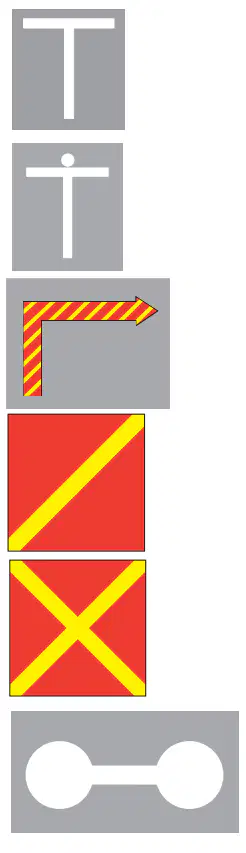
The first picture from the top means:
Land in the direction of the T
Circuits may be flown to the right or to the left
Landing prohibited
Gliders operations at the airfield
The third picture from the top means:
Land in the direction of the T
Circuits are flown to the right
Fly to a nearby airport
Gliders operations at the airfield
The fourth picture from the top means:
Caution on maneuvring area, surface is poor
Circuits are flown to the right
Landing prohibited
Gliders operations at the airfield
The bottom picture means:
Land in the direction of the T
Circuits are flown to the right
Only move aircraft on runways and taxiways
Gliders operations at the airfield

Seeing this would tell you:
Treshold RWY 22 is temporarily displaced
Treshold RWY 22 is permanently displaced
Pre-threshold unfit for the movement of aircraft
Seeing this would tell you:
Pre-threshold available for taxi and take off, but not for landing.
Treshold RWY 22 is permanently displaced
Pre-threshold unfit for the movement of aircraft

The single vertical arrow points to:
Touch-down area
Aiming point
RWY treshold
The two inclined arrows point to:
Touch-down area
Aiming point
RWY treshold
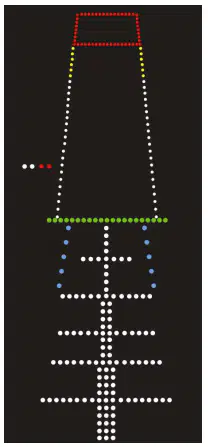
The red square at the farther end of RWY is:
Stopway
Taxiway
Heliport
How many classes of airspace can we have?
7 (A-G)
5 (A-E)
5 (C-G)
Which of the airspace classes are uncontrolled airspace?
F and G
A and B
E, F, G
In which airspace class(es) VFR flights are not allowed?
A
A+B
F+G
Which of the following airspaces is established around controlled airports?
CTR
CTA
ATZ
CTA vertical boundaries are:
from ground level to a certain altitude/level
from a certain altitude/level and up
unlimited
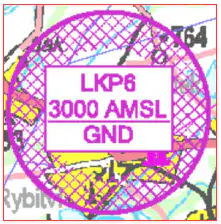
This airspace would be :
Prohibited area
Restricted area
Permitted area
Which ATC service would most likely control aircraft in TMA?
APPROACH or RADAR
TWR
GROUND
DELIVERY
Which ATC service would most likely control aircraft in CTR or from holding point until after take-off?
APPROACH or RADAR
TWR
GROUND
DELIVERY
Which ATC service (if established) would most likely control aircraft moving on the airport up to holding point ?
APPROACH or RADAR
TWR
GROUND
DELIVERY
When the flight information service is provided to the aircraft:
it is responsible for collision avoidance of aircraft
pilots are ultimately responsible for collision avoidance
it provides SAR service
No further exeptions considered, what is the minimum required visibility to fly in C, D, E, F and G class airspace at day below FL100?
5 km
8 km
5 NM
No further exeptions considered, what is the minimum required vertical distance from clouds in C, D, E, F and G class airspace at day below FL100?
1 000 ft
1 500 ft
1 000 m
No further exeptions considered, what is the minimum required lateral distance from clouds in C, D, E, F and G class airspace at day below FL100?
1 500 ft
1 500 m
1 000 m
When flying eastbound VFR, it would be a good practice to fly at:
3 000 ft
4 500 ft
3 500 ft
When flying westbound VFR, it would be a good practice to fly at:
3 000 ft
6 500 ft
6 000 ft
Transponder code 7 000 means:
aircraft in distress
aircraft hi-jacked
loss of communication
general aviation uncontrolled flight
Transponder code 7 700 means:
aircraft in distress
aircraft hi-jacked
loss of communication
general aviation uncontrolled flight
Transponder code 7 500 means:
aircraft in distress
aircraft hi-jacked
loss of communication
general aviation uncontrolled flight
Transponder code 7 600 means:
aircraft in distress
aircraft hi-jacked
loss of communication
general aviation uncontrolled flight
Who controls Search and Rescue (SAR)
ATC
RCC
FIS
The helicopter sustained a minor damage during its operation. The damage is limited to VHF antenna being broken.
Such accident must be reported to the investigation board
Such accident needs not to be reported to the investigation board
Such accident must be reported to the ATC

