
NEW
Font size
 Worksheets
MCQ FMS 1 PART 2
Total questions: 38
Worksheet time: 19mins
Cancer is often the result of activation of ___ to ___ and the annactivation of ___ genes.
Oncogenes, tumor-suppressor genes, proto-oncogenes
Oncogenes, proto-suppressor genes, proto genes
Oncogenes, proto-oncogenes, tumor-suppressor genes
Proto-suppressor genes, suppressors, oncogenes
Proto-oncogenes, oncogenes, tumor-suppressor genes
In 2012, Prof. Yamanaka from Kyoto University was awarded the Nobel Prize in Physiology and Medicine for the development of induced pluripotent stem cells or iPS cells. This discovery has been a promise for an unlimited source of pluripotent cells, although there are pros and cons. What is the disadvantage of iPS cells?
iPS cells can provide unlimited reservoir of stem cells minus the ethical controversy of embryonic materials
iPS cells are universally accessible
iPS cells can produce patient-specific or disease-specific cells of any lineage for therapeutic use
Viruses that integrate into the host cell genome have intrinsic risks
Autologous iPS cells have reduced chances of immune rejection
Each of us has enough DNA to reach from here to the sun and back, more than 300 times. Certain proteins compact chromosomal DNA into the microscopic space of the eukaryotic nucleus. What proteins are integral part of human chromosome?
Heterochromatin
Euchromatin
Histones
Solenoid
Nucleosome
Mrs. Wati (PBL Week 7) was just diagnosed with an aggressive form of breast cancer. The histopathology is interpreted as showing a poorly differentiated carcinoma with negative estrogen-receptor status and HER2-positive. The cancer started because
She has a rare deletion in the BRCA1 gene
Her affected cells have extra genes for epidermal growth factor
Estrogen affects DNA repair
Estrogen receptor is tumor suppressor
Her affected cells have many extra receptors for epidermal growth factor
The heart functions as the motor of the circulatory system, which consists of the heart, blood vessels and blood. A cell from heart muscle would have an unusually high proportion of these organelles:
Golgi bodies
Mitochondria
Cytoskeleton
Lysosomes
mRNA
Alpha-1 antitrypsin deciency is an inherited disorder that may cause lung disease and liver disease. Individuals with S allele of the gene have moderately low levels, and individuals with Z allele have very little alpha-1 antitrypsin protein in their serum. Individuals with SZ allele have an increased risk of developing lung diseases (such as emphysema), particularly if they smoke. This type of inheritance is also called:
Multiple alleles
Incomplete dominance
Co-dominance
Polygenic inheritance
Complete dominance
A woman's body undergoes many transformations during the nine months of pregnancy. Some of these physical changes are visible, such as an expanding belly and weight gain, while others are well known, such as an enlarged uterus. The enlarged uterus of a pregnant woman is an example of which adaptive behavior?
Atrophy
Metaplasia
Dysplasia
Hypertrophy
Hyperplasia
Pentasomy 49, XXXXY incidence is around 1/85000 male births. Signs and symptoms of 49, XXXXY syndrome can vary but may include learning difficulties or intellectual disability; low muscle tone; infertility; delayed growth; distinctive facial features; and a variety of birth defects that may affect the heart, bones, brain and/or kidneys. A 49, XXXXY karyotype is thought to arise from
Maternal non-disjunction in meiosis I and II
Paternal non-disjunction in meiosis I and II
Non-disjunction in meiosis II
Maternal non-disjunction in meiosis I
Paternal non-disjunction in meiosis I
Which one of the following is not stem cell characteristics?
Capable to differentiate into adults cells
Finite
Capable to regenerate into other stem cells
One cell can give rise to an entire organ system
One of the cells responses against viral infection is by the secretion of antiviral cytokine. Cytokines may affect the cell itself and its surrounding. Cytokine receptor is usually associated with
Inositol phospholipid
Calmodulin
Protein serine/threonine kinase
Grb protein
Janus kinase
Gene therapy is an experimental technique that uses genes to treat or prevent disease. In the future, this technique may allow doctors to treat a disorder by inserting a gene into a patient's cells instead of using drugs or surgery. In order for a gene therapy to work, it needs to be delivered to the affected tissue using:
Vector
Transcription factor
Promoter
Bacteria
Vaccine
A tumor is any abnormal proliferation of cells, which may be either benign or malignant. How do the cells of benign and malignant tumors differ? Select one:
Benign cells growth into adjacent tissue; malignant cells displace adjacent tissue
Malignant cells are not encapsulated; benign cells are encapsulated
Benign cells grow fast and are small; malignant cells grow slow but large
Malignant cells have well defined border; benign cells' border are less de ned
All are correct
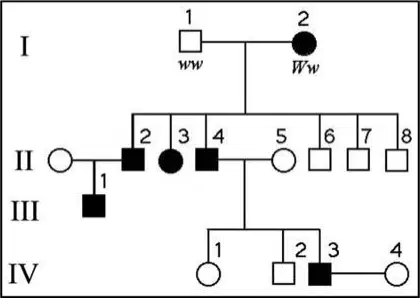
What is the genotype of individual II-5
WW or ww
Ww
Ww or Ww
WW
ww
Blastocyst is the source of embryonic stem cell with consists of inner cell mass and trophoblast. Naturally, trophoblast will proliferate/differentiate into which the of cells?
Pluripotent stem cells
Placenta and extraembryonic tissue
Hematopoietic stem cells
Brain stem cells and specialized brain cells
All types of specialized cells
Knowing what you know about phospholipid bilayers; if you wanted to build your own membrane protein, what would your amino acids need to have in order to stay in the membrane?
Glycosylations
Negatively charged groups
Hydrophobic groups
Hydrophilic groups
Positively charged groups
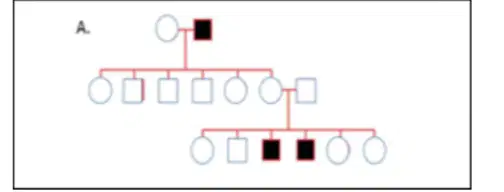
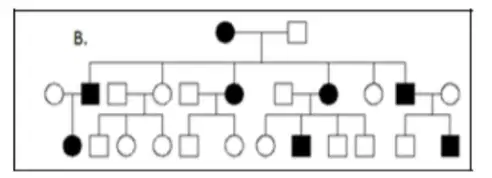
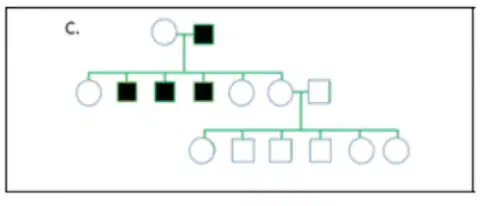
Leber’s hereditary optic neuropathy (LHON) is an inherited form of vision loss. This inheritance applies to genes contained in mitochondrial DNA. Which of the following pedigree best describes the inheritance of LHON?
a.
a.
b.
b.
c.
c.
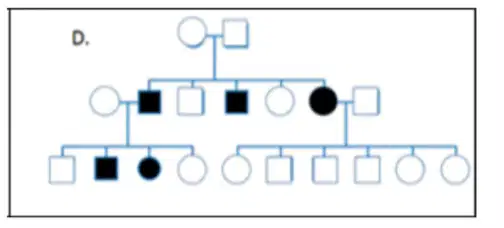
d.
d.
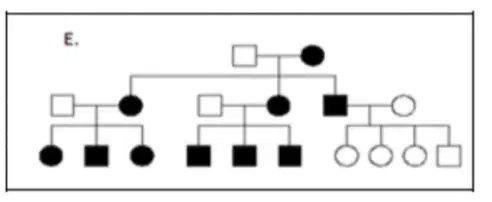
e.
e.
Hereditary Nonpolyposis Colon Cancer (HNPCC) patients have genes with microsatellite instability, in which many gene regions contain abnormal, small loops of unpaired DNA. These DNA loops are the result of a mutation affecting which of the following:
Non Homologous End Joining repair
Mismatch repair
Nucleotide excision repair
Tommy, a 58-year-old man diagnosed with multiple myeloma based on laboratory results, will receive chemotherapy and hematopoietic stem cell (HSC) transplant. Which of the following is not suitable as the source of hematopoietic stem cell for Tommy?
Inner cell mass
Peripheral blood
iPS cell
Cord blood
Myoblast
The ribosome is a highly complex cellular machine found within all living cells. Which of the following statements about ribosomes is true?
They are an integral part of transcription
They are composed of three subunits of unequal size
They are bound together so tightly they cannot dissociate under physiologic conditions
They are composed of RNA, DNA and proteins
They are found in cytoplasm and mitochondria
A mother of a malnourished child has been instructed to include a complete protein in the diet. Which of the following should be recommended?
Wheat
Soy protein
Vegetables
Milk
Nuts
The nuclear envelope (NE) is a highly regulated membrane barrier that separates the nucleus from the cytoplasm in eukaryotic cells. Which of the following statements does not apply to the nuclear envelope?
It is a double membrane
It has pores through which protein enters
It is continuous with the endoplasmic reticulum
It has pores through which material leaves
Its outer layer folds to form cristae
Tommy, a 58-year-old man diagnosed with multiple myeloma, will receive chemotherapy and hematopoietic stem cell (HSC) transplant. Which of the following is not true about HSC transplantation?
Donor and recipient must have perfectly matched HLA
Peripheral stem cell collection produces a lower yield compared to bone marrow collection
Allogenic transplantation is when the donor and recipient are the same species
The higher the degree of mismatched HLA the more complications with engraftment and graft versus host syndrome
Immunosuppressant can be used to prevent GVHD
Cells die through either necrosis or apoptosis. Apoptosis is also called programmed cell death. Which of the following events is NOT a change experienced by a typical cell committed to apoptosis?
Nuclear envelope disassembles
Cytoskeleton collapses
DNA breaks into fragments
Cell swells and bursts
Loss of mitochondrial membrane functions
In a nucleosome, the DNA is wrapped around …
Short arm
Chromosome
Centromere
Chromatids
Histones
The region of a gene located at -10 and -35 with respect to the start of transcription is termed:
Promoters
Coding region
Termination sequence
Control region
Enhancer/silencer
Which type of chloride channel protein is defective in cystic fibrosis?
Calcium ion sensitive chloride channels
Cation-chloride cotransporters
Cystic fibrosis transmembrane conductance regulator
CLC chloride channels and transporters
Non of the above
In analyzing the number of different bases in a DNA sample, which result would be consistent with the base pairing rules?
G=C
G−T
A+T=G+C
A=T
A+G=T+C
There are 3 types of protein transport. One of it requires ATP as the energy. What is it?
RNA polymerase I
ATP-powered pump (ATPase Pump)
Ion channel
Transporter
Uniporter
Daughter strands in a replication are always made of one strand of old DNA and one newly synthesized complementary strand. This nature of DNA replication is referred as:
Bidirectional
Starts from replication forks
Semi-discontinuous
Semiconservative
Conservative
UV radiation can cause DNA damage in form of thymine dimers formation. This DNA damage is usually repaired by the DNA repair mechanism of
MMR
NER
Single-strands damages
BER
Double-strand breaks
Condition at which one or more nucleotides removed from the DNA strand is called …
Deletion mutation
Nonsense mutation
Silent mutation
Insertion mutation
B-thalassemia, common in southeast Asia, is due to a point mutation in b-globin. What mutation causes it?
Stop at position 26 with lysine as the last amino acid
Glutamate is swapped with lysine at amino acid no. 26
Aspartate is swapped with lysine at amino acid no. 26
Excessive amount of protein b-globin
No protein b-globin is made
p53 (also known as TP53) is a gene whose activation induces apoptosis, cell cycle arrest, or senescence in response to distinct stimuli, including DNA damage. Which of the following best describes the role of p53?
Tumor suppressor gene
DNA repair gene
Oncogene
Proto-oncogene
Proto-suppressor gene
Carcinogenesis involves three steps: initiation, promotion and progression. Chemical carcinogens can initiate cells through mutational inactivation of the following pathways, except:
Apoptotic proteins
Tumor suppressors
Growth factor receptors
DNA repair
Anti-oxidant response
Which of the following is true of methyl groups’ effect in the epigenetic mechanism?
They reduce protein stability
They directly inhibit ribosome assembly
They directly inhibit nuclear port transport
They directly inhibit transcription
They directly inhibit protein translation
Which of the following statements is not true about cancer stem cells?
Can start from mutated progenitor cells
May be a result of loss of regulation of mutated stem cell
tumor initiating cell
they can self-renew
not related with changes on niche requirements
Tommy, a 58-year-old man had severe pain in his thoracic region when he was skiing (PBL Case Week 8). The spinal x-ray showed a compression fracture of T4. Tommy is diagnosed to have multiple myeloma (cancer of plasma cell) based on laboratory results i.e. β2-microglobulin of 1966.95 μmol/L, positive Bence-Jones proteins in urine, also high level calcium (12 mg/dL), urea (66 mg/dL) and creatinine (1.9 mg/dL) in serum. Tommy will receive chemotherapy and hematopoietic stem cell (HSC) transplant for the management of the disease. HSC needs to be characterized before transplantation. Which of the following is a characteristic of HSC?
Able to produce embryoid body in vitro
Can be derived from mesenchymal tissue
Cannot undergo apoptosis
CD133+/34
Addition of cytokines such as GM-CSF will cause the cells to differentiate to lymphoid progenitor
Phenylketonuria (PKU) is a disease which causes mental retardation and reduced hair and skin pigmentation. It involves the enzyme phenylalanine hydroxylase, which is encoded by the PAH gene in chromosome 12. This enzyme converts the amino acid phenylalanine to tyrosine. Depending on the mutation involved, conversion of phenylalanine to tyrosine is reduced or stops entirely. Unconverted phenylalanine builds up in the bloodstream and can lead to levels that are toxic to the developing nervous system of newborn and infant children. Which variation to Mendelian Law best describes the phenotype of PKU?
Multiple alleles
Polygenic inheritance
Pleiotropy
Incomplete dominance
Epistasis

