wayground logo

Free Printable Worksheets

Font size

S
M
L
XL
Worksheets

Precollege trig, polynomials, and rationals

Total questions: 111

Worksheet time: 6hrs 42mins

Name
Class
Date
1.
Which is an example of a linear polynomial?
a)
x²-5
b)
6x+4
c)
5x⁵
d)
2x³-9x²
2.
Which is an example of a cubic binomial?
a)
x³+5
b)
x²+3
c)
x²+5x-6
d)
5x³
3.
What is the leading coefficient of the following polynomial?
5x²-3x+6
a)
2
b)
-3
c)
5
d)
6
4.
Add the following polynomials:
(x³-2x²+3)+(2x³+3x²-1)
a)
3x³-2x²+3x+2
b)
3x³+x²+2
c)
3x³-5x²-2
d)
3x³-x²+1
5.
Subtract the following polynomials:
(3x²-3x+2)-(x²-2x+1)
a)
2x²+x+1
b)
2x²-5x+3
c)
2x²-x+1
d)
4x²-5x+3
6.
Subtract the following polynomials:
(2x³+6x²+4x-2)-(x³+4x²-x)
a)
x³+2x²+5x-2
b)
x³+10x²+3x-2
c)
3x³+2x+4x-3
d)
3x³+10x²-3x-2
7.
Classify the polynomial and give the degree:
4x2 + 2x - 1
a)
Binomial, 3
b)
Binomial, 2
c)
Trinomial, 3
d)
Trinomial, 2
8.
Classify the polynomial by its degree.
x2 + 2x3 - 4
a)
A
binomial
b)
B
trinomial
c)
C
quadratic
d)
D
cubic
9.
Classify the polynomial by its number of terms.
 4x² - 2
a)
A
monomial
b)
B
binomial
c)
C
trinomial
d)
D
polynomial
10.
How many terms are in the following polynomial?
3xy - 2y + 8x - 7z -16
a)
A
1
b)
B
2
c)
C
4
d)
D
5
11.
Factor
k2+7x+10
a)
(k+2)(k+5)
b)
(k-2)(k-5)
c)
(k+10)(k+4)
d)
(k+2)(k-5)
12.
Factor
n2 + 16n + 63
a)
(n-7)(n+4)
b)
(n+7)(n-9)
c)
(n-3)(n-10)
d)
(n+7)(n+9)
13.
Factor
k2 -2k - 24
a)
(k+4)(k-6)
b)
(k+4)(k+6)
c)
(k+6)(k-1)
d)
(k-4)(k+6)
14.
Factor
n2-13n+40
a)
(n-5)(n-8)
b)
(n+5)(n-8)
c)
(n-5)(n+8)
d)
(n+6)(n+1)
15.

Find the factors of

x2 + x - 6

a)

(x - 6)(x - 9)

b)

(x + 3)(x + 2)

c)

(x + 3)(x - 2)

d)

(x + 2)(x + 4)

16.

What is the first step in factoring this problem?

x2 - 5x - 36

a)

Multiply

b)

List the factors of -36

c)

Add the factors of -36

d)

Factor out the GCF

17.

Find the factors of

x2 - 5x - 36

a)

(x + 4)(x - 9)

b)

(x - 4)(x + 9)

c)

(x - 9)(x + 6)

d)

(x + 4)(x + 9)

18.
Factor completely:
y2 - 7y + 12
a)
(y - 3) (y - 4)
b)
(y + 3) (y - 4)
c)
(y + 3) (y + 4)
d)
(y - 2) (y - 6)
19.
Factor Completely: x2-17x+72
a)
(x-9)(x+8)
b)
(x-9)(x-8)
c)
x(x-3)
d)
(x+9)(x+8)
20.
Factor Completely: x2-7x-8
a)
(x+1)(x-8)
b)
(x+1)(x+8)
c)
5(x+4)(x+5)
d)
(x-1)(x+8)
21.
If you are given the opposite side and hypotenuse, which trig function should you use?
a)
sine
b)
cosine
c)
tangent
d)
cotangent
22.
If you are given the two sides that are not the hypotenuse, which trig function should you use?
a)
sine
b)
cosine
c)
tangent
d)
cotangent
23.
a)
24/32
b)
32/24
c)
32/40
d)
24/40
24.
a)
27/36
b)
27/45
c)
45/36
d)
45/27
25.
If you are given 2 of the sides to an obtuse triangle, which trig function should you use to find the other side?
a)
sine
b)
cosine
c)
tangent
d)
You can only use trig functions on right triangles.
26.
What is the correct ratio?
a)
sin 40 = w/28
b)
cos 40 = w/28
c)
tan 40 = w/28
d)
sin 40 = 28/w
27.
a)
A
b)
B
c)
C
d)
D
28.
a)
A
b)
B
c)
C
d)
D
29.
Which one is the easy way to remember trigonometric ratios?
a)
Sah Coh Toa
b)
Soh Cah Toa
c)
Soh Cah Tao
d)
Soh Ceh Toa
30.
a)
14/48
b)
48/50
c)
14/50
d)
48/14
31.
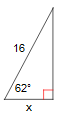
Solve for x. Round to the nearest tenth.
a)
7.5
b)
34.1
c)
14.1
32.
Find the length of side y.
a)
22.32 cm
b)
36.5 cm
c)
76.34 cm
d)
87.76 cm
33.
What is the length of side x?
a)
6.57 cm
b)
7 cm
c)
7.44 cm
d)
26.33 cm
34.
Find the length of side w.
a)
21.4 cm
b)
18.0 cm
c)
36.5 cm
d)
43.6 cm
35.
Solve for x. Round to the nearest tenth.
a)
5.3
b)
6.2
c)
8.5
36.
If you are given the opposite side and hypotenuse, which trig function should you use?
a)
sine
b)
cosine
c)
tangent
d)
cotangent
37.
If you are given 2 of the sides to an obtuse triangle, which trig function should you use to find the other side?
a)
sine
b)
cosine
c)
tangent
d)
You can only use trig functions on right triangles.
38.
What is the cosine of angle P?
a)
p/q
b)
q/r
c)
p/r
d)
r/q
39.
Find the measure of the missing angle.
a)
64o
b)
26o
c)
61o
d)
.008o
40.
Find the measure of the missing angle.
a)
49o
b)
50o
c)
41o
d)
33o
41.
sin π/4
a)
√2∕2
b)
1/2
c)
√3/2
d)
0
42.
cos 5π/6
a)
-1/2
b)
1/2
c)
√3/2
d)
-√3/2
43.
cos 4π/3
a)
-√3/2
b)
√3/2
c)
1/2
d)
-1/2
44.
sin 7π/6
a)
1/2
b)
-1/2
c)
√3/2
d)
-√3/2
45.
sin 2π/3
a)
1/2
b)
-1/2
c)
√3/2
d)
-√3/2
46.

cos(300°)

a)

0

b)

1/2

c)

√3/2

d)

1

47.

cos 150o

a)

-1/2

b)

1/2

c)

√3/2

d)

-√3/2

48.
What is the radius of a unit circle?
a)
1
b)
2
c)
1/2
d)
0
49.
What is the exact value of sin 150°
a)
-1/2
b)
-√3/2
c)
1/2
d)
√3/2
50.
What are the coordinates of 60° on the unit circle?
a)
(0, 1)
b)
(1/2, √3/2)
c)
(√3/2, 1/2)
d)
(√2/2, 1/2)
51.
sinθ is positive in
a)
the 1st and 2nd quadrants
b)
the 1st and 3rd quadrants
c)
the 1st and 4th quadrants
d)
the 2nd and 3rd quadrants
52.
cosθ is positive in
a)
the 1st and 2nd quadrants
b)
the 1st and 3rd quadrants
c)
the 1st and 4th quadrants
d)
the 2nd and 3rd quadrants
53.

What is cos 90°?

a)

½

b)

undefined

c)

1

d)

0

54.

What is cos 30°?

a)

√3/2

b)

½

c)

√2/2

d)

1

55.
sin π/4
a)
√2∕2
b)
1/2
c)
√3/2
d)
0
56.
What is the exact coordinates of  3π/4 on the unit circle?
a)
(−√2∕2, √2∕2)
b)
(−√2∕2, −√2∕2)
c)
(−√3∕2, −√2∕2)
d)
(√2∕2, −√2∕2)
57.
sin 2π/3
a)
1/2
b)
-1/2
c)
√3/2
d)
-√3/2
58.
cos(π)=
a)
0
b)
1
c)
-1
d)
1/2
59.

What is sin(0o)?

a)

1

b)

-1

c)

0

d)

√2/2

60.

cos(11π6)\cos\left(\frac{11\pi}{6}\right)  

a)

-1

b)

22\frac{\sqrt{2}}{2}  

c)

32\frac{\sqrt{3}}{2}

d)

12-\frac{1}{2}  

61.

Simplify

sinθ(cscθsinθ)\sin\theta\left(\csc\theta-\sin\theta\right)  

a)

secθ\sec\theta  

b)


cos2θ\cos^2\theta  

c)

sin2θ\sin^2\theta  

d)

sin2θcos2θ\frac{\sin^2\theta}{\cos^2\theta}  

62.

cosθ cscθ\cos\theta\ \csc\theta  can be written in a single trigonometric identity as: 

a)

cosθ\cos\theta  

b)

sinθ\sin\theta  

c)

secθ\sec\theta  

d)

cotθ\cot\theta  

63.

1cos2θcos2θ\frac{1-\cos^2\theta}{\cos^2\theta}  can be written in a single trigonometric identity as: 

a)

cos2θ\cos^2\theta  

b)

sin2θ\sin^2\theta  

c)

sec2θ\sec^2\theta  

d)

tan2θ\tan^2\theta  

64.

tanθcosθ\tan\theta\cos\theta  can be written in a single trigonometric identity as: 

a)

cosθ\cos\theta  

b)

sinθ\sin\theta  

c)

secθ\sec\theta  

d)

cotθ\cot\theta  

65.

sin2θ + cos2θ = 1\sin^2\theta\ +\ \cos^2\theta\ =\ 1

 Solve  for  cos2θ\cos^2\theta  .

a)

cot2θ+1\cot^2\theta+1  

b)

sec2θ1\sec^2\theta-1  

c)

tanθ+1\tan\theta+1  

d)

1sin2θ1-\sin^2\theta  

66.

tanθ =\tan\theta\ =  

a)

sinθcosθ\frac{\sin\theta}{\cos\theta}  

b)

cosθsinθ\frac{\cos\theta}{\sin\theta}  

c)

1cosθ\frac{1}{\cos\theta}  

d)

cotθ\cot\theta  

67.

Simplify

tanxcscxcosx\tan x\csc x\cos x  

a)

1cosx\frac{1}{\cos x}  

b)

1

c)

cotx\cot x  

d)

-1

68.

Simplify (secθ1)(secθ+1)\left(\sec\theta-1\right)\left(\sec\theta+1\right)  

a)

2secθ2\sec\theta   

b)

cot2θ\cot^2\theta  

c)

tan2θ\tan^2\theta  

d)

sec2θ+1\sec^2\theta+1  

69.

tanθ =\tan\theta\ =  

a)

sinθcosθ\frac{\sin\theta}{\cos\theta}  

b)

cosθsinθ\frac{\cos\theta}{\sin\theta}  

c)

1cosθ\frac{1}{\cos\theta}  

d)

cotθ\cot\theta  

70.

sin2θ + cos2θ = 1\sin^2\theta\ +\ \cos^2\theta\ =\ 1

 Solve  for  cos2θ\cos^2\theta  .

a)

cot2θ+1\cot^2\theta+1  

b)

sec2θ1\sec^2\theta-1  

c)

tanθ+1\tan\theta+1  

d)

1sin2θ1-\sin^2\theta  

71.

tanθcosθ\tan\theta\cos\theta  can be written in a single trigonometric identity as: 

a)

cosθ\cos\theta  

b)

sinθ\sin\theta  

c)

secθ\sec\theta  

d)

cotθ\cot\theta  

72.

1cos2θcos2θ\frac{1-\cos^2\theta}{\cos^2\theta}  can be written in a single trigonometric identity as: 

a)

cos2θ\cos^2\theta  

b)

sin2θ\sin^2\theta  

c)

sec2θ\sec^2\theta  

d)

tan2θ\tan^2\theta  

73.

cosθ cscθ\cos\theta\ \csc\theta  can be written in a single trigonometric identity as: 

a)

cosθ\cos\theta  

b)

sinθ\sin\theta  

c)

secθ\sec\theta  

d)

cotθ\cot\theta  

74.

Simplify

  cot2θ(1+tan2θ)\cot^2\theta\left(1+\tan^2\theta\right)  

a)

csc²θ

b)

sec²θ

c)

cscθ

d)

1

75.

Simplify

sinθ(cscθsinθ)\sin\theta\left(\csc\theta-\sin\theta\right)  

a)

secθ\sec\theta  

b)


cos2θ\cos^2\theta  

c)

sin2θ\sin^2\theta  

d)

sin2θcos2θ\frac{\sin^2\theta}{\cos^2\theta}  

76.

Simplify

tanxcscxcosx\tan x\csc x\cos x  

a)

1cosx\frac{1}{\cos x}  

b)

1

c)

cotx\cot x  

d)

-1

77.

Simplify (secθ1)(secθ+1)\left(\sec\theta-1\right)\left(\sec\theta+1\right)  

a)

2secθ2\sec\theta   

b)

cot2θ\cot^2\theta  

c)

tan2θ\tan^2\theta  

d)

sec2θ+1\sec^2\theta+1  

78.

Simplify

  csc x(cosx+sinx)\csc\ x\left(\cos x+\sin x\right)  

a)

csc x

b)

tan x + 1

c)

cot x

d)

cot x + 1

79.

Simplify tanx(cotx + cscx)\tan x\left(\cot x\ +\ \csc x\right)  

a)

1 + secx1\ +\ \sec x  

b)

1 + cscx1\ +\ \csc x  

c)

secx1\sec x-1  

d)

tan2x\tan^2x  

80.

1cos2θtan2θ\frac{1-\cos^2\theta}{\tan^2\theta}   can be simplified as

a)

cot2θ\cot^2\theta  

b)

tan2θ\tan^2\theta  

c)

sin2θ\sin^2\theta  

d)

cos2θ\cos^2\theta  

81.

What happens when you multiply two reciprocal functions?

a)

You get a pythagorean identity

b)

It equals 1

c)

You get a quotient identity

d)

It equals 0

82.

Which of the following would be a step to prove the following identity?  cscxsecx=cosxsinxsinxcosx\csc x-\sec x=\frac{\cos x-\sin x}{\sin x\cos x}  

a)

1sinx1cosx\frac{1}{\sin x}-\frac{1}{\cos x}  

b)

cosxsinxsinx\frac{\cos x-\sin x}{\sin x}  

c)

cosxsinxcosx\frac{\cos x-\sin x}{\cos x}  

d)

1sinxcosx\frac{1}{\sin x\cos x}  

83.


One step in proving the identity below would be:


sec2θ1sec2θ\frac{\sec^2\theta-1}{\sec^2\theta}  

a)

sec2θsec2θ1sec2θ\frac{\sec^2\theta}{\sec^2\theta}-\frac{1}{\sec^2\theta}  

b)

tan2θsec2θ\frac{\tan^2\theta}{\sec^2\theta}  

c)

Both A and B

d)

Neither A nor B

84.

tanθ+cotθtanθ\frac{\tan\theta+\cot\theta}{\tan\theta}  can be simplified as:

a)

csc2θ\csc^2\theta  

b)

cot2θ\cot^2\theta  

c)

sin2θ\sin^2\theta  

d)

cos2θ\cos^2\theta  

85.

sinθcotθ secθ\sin\theta\cot\theta\ \sec\theta  

a)

00  

b)

11  

c)

sinθ\sin\theta  

d)

cosθ\cos\theta  

86.

Simplify (secθ1)(secθ+1)\left(\sec\theta-1\right)\left(\sec\theta+1\right)  

a)

2secθ

b)

cot²θ

c)

tan²θ

d)

sec²θ + 1

87.

Simplify

  csc x(cosx+sinx)\csc\ x\left(\cos x+\sin x\right)  

a)

csc x

b)

tan x + 1

c)

cot x

d)

cot x + 1

88.

Rewrite  tanx\tan x  in terms of  sinx\sin x  and cosx\cos x

a)

tanx=cosxsinx\tan x=\frac{\cos x}{\sin x}  

b)

tanx=1cotx\tan x=\frac{1}{\cot x}  

c)

tanx=sinxcosx\tan x=\frac{\sin x}{\cos x}  

d)

tanx=oppositeadjacent\tan x=\frac{opposite}{adjacent}  

89.

1cos2θtan2θ\frac{1-\cos^2\theta}{\tan^2\theta}   can be simplified as

a)

cot2θ\cot^2\theta  

b)

tan2θ\tan^2\theta  

c)

sin2θ\sin^2\theta  

d)

cos2θ\cos^2\theta  

90.

What happens when you multiply two reciprocal functions?

a)

You get a pythagorean identity

b)

It equals 1

c)

You get a quotient identity

d)

It equals 0

91.

sinθcotθ secθ\sin\theta\cot\theta\ \sec\theta  

a)

00  

b)

11  

c)

sinθ\sin\theta  

d)

cosθ\cos\theta  

92.

Rewrite  tanx\tan x  in terms of  sinx\sin x  and cosx\cos x

a)

tanx=cosxsinx\tan x=\frac{\cos x}{\sin x}  

b)

tanx=1cotx\tan x=\frac{1}{\cot x}  

c)

tanx=sinxcosx\tan x=\frac{\sin x}{\cos x}  

d)

tanx=oppositeadjacent\tan x=\frac{opposite}{adjacent}  

93.

What type of function is this?

a)

Polynomial

b)

Quadratic

c)

Rational

d)

Radical

94.

Rewrite g(x)=x+3xg\left(x\right)=\frac{x+3}{x}  

a)

g(x)=13xg\left(x\right)=1-\frac{3}{x}  

b)

g(x)=1+3xg\left(x\right)=1+\frac{3}{x}  

c)

g(x)=3+1xg\left(x\right)=3+\frac{1}{x}  

d)

g(x)=31xg\left(x\right)=3-\frac{1}{x}  

95.

What's the horizontal asymptote of the function?

f(x)=3x+2x2+1f\left(x\right)=\frac{3x+2}{x^2+1}  

a)

y = 3

b)

No horizontal asymptote

c)

y = 0

d)

y = 2

96.

What is the equation of this rational function

a)

f(x)=21x+2f\left(x\right)=2-\frac{1}{x+2}  

b)

f(x)=2+1x+2f\left(x\right)=2+\frac{1}{x+2}  

c)

f(x)=21x2f\left(x\right)=2-\frac{1}{x-2}  

d)

f(x)=21x+2f\left(x\right)=-2-\frac{1}{x+2}  

97.

The rational function, f(x)=3+2x4f\left(x\right)=3+\frac{2}{x-4}   has a horizontal asymptote at...

a)

y = -4

b)

y = 2

c)

y = 3

d)

y= 4

98.

Which rational function has a vertical asymptote at x = -3

a)

y=1x3y=\frac{1}{x-3}  

b)

y=1x+3y=\frac{1}{x+3}  

c)

y=13y=\frac{1}{3}  

d)

y=3xy=\frac{3}{x}  

99.

A vertical asymptote always has the equation...

a)

x = __

b)

y = __

100.

This rational function is undefined at...

a)

x = 4

b)

x = -4

c)

x = 0

d)

x = 5

101.

The rational function, y=1x+7y=\frac{1}{x+7}  has a vertical asymptote at...

a)

y = -7

b)

x = 7

c)

y = 1

d)

x = -7

102.

Rational functions always have exactly 1 vertical asymptote.

a)

True

b)

False

103.

What is the horizontal asymptote?

a)

x = 2

b)

y = 2

c)

x =-2

d)

y=-2

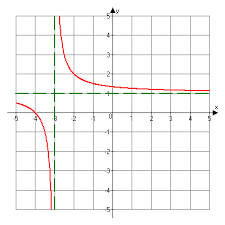
104.
What are the asymptotes?
a)
x = -3        y = 1  
b)
x = 3         y = 1
c)
x = -3        y = -1
d)
x = 3         y = -1
105.

What is an asymptote?

a)

an imaginary line that your function never touches

b)

a part of your function

c)

a point on your graph

d)

a type of fruit

106.
A vertical asymptote is found by setting the _________= to zero and solving for x 
a)
Numerator
b)
Denominator
c)
Right side 
d)
Left side
107.

what band is this?

a)

Weezer

b)

Alice In Chains

c)

Green Day

d)

Fleetwood Mac

108.

what band is this?

a)

Foo Fighters

b)

Nirvana

c)

Weezer

d)

Alice in Chains

109.

What band is this?

a)

Blur

b)

Oasis

c)

Black Sabbath

d)

The Beatles

110.
Who is not a member of AC/DC?
a)
Chris Slade
b)
Cliff Williams
c)
Kerry King
d)
Stevie Young
111.
Who is not from Motorhead?
a)
Larry Wallis
b)
 Lucas Fox
c)
Ian Fraser "Lemmy" Kilmister
d)
James Hetfield