
 Worksheets
unit 112 challenging, sources and distribution: Introduction
Total questions: 31
Worksheet time: 16mins
Which task is a core responsibility for plumbers working on cold water systems?
Design, install, test and maintain systems
Only install pipework and leave testing
Maintain systems without advising users
Advise users but avoid system testing
Why is advising customers on good water usage part of a plumber’s role?
Water is becoming valuable and costly
Customers require entertainment services
Pipes cannot function without advice
Regulations ban maintaining cold systems
As water becomes more important and expensive, what consequence follows for industry practice?
Greater emphasis on water conservation
Less need for maintenance checks
Shift away from cold water systems
Reduced responsibility for plumbers
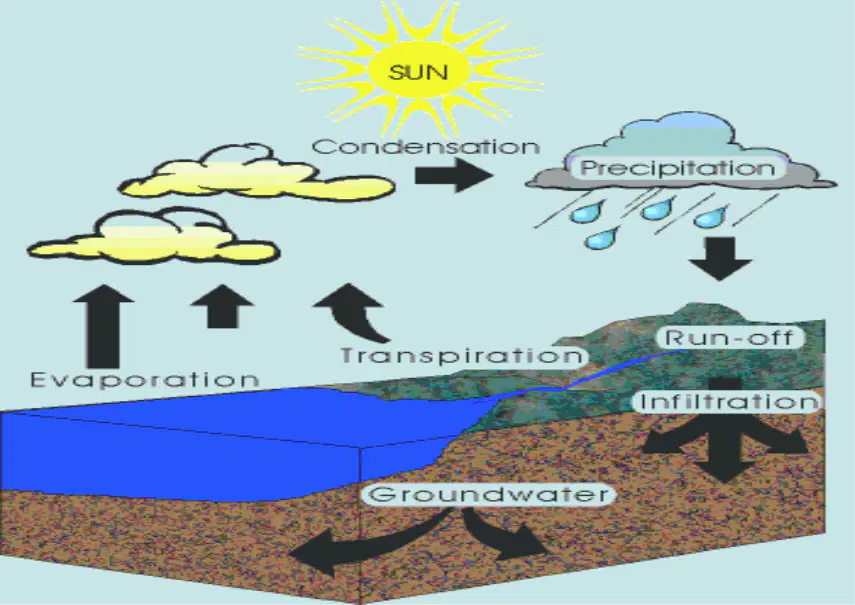
In the diagram, which process describes liquid water changing to vapor due to the sun’s energy?
Condensation above cool air
Evaporation from surfaces
Precipitation from clouds
Infiltration into soil
Which statement best defines precipitation for plumbing studies?
Water molecules disperse widely
Water molecules condense and fall
Groundwater moves through soil
Surface flow enters channels
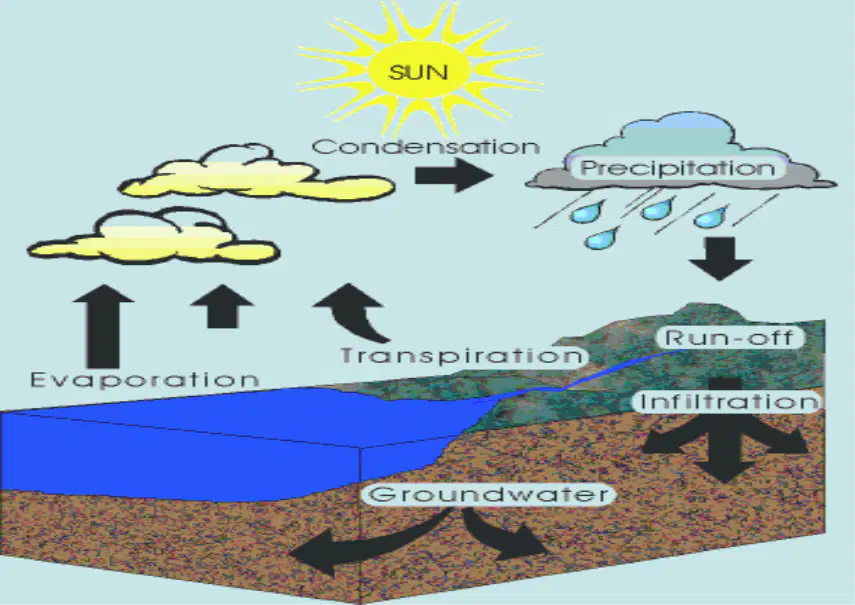
After rain reaches land, which two pathways divide the water’s movement?
Infiltration into ground
Run-off across surface
Condensation into fog
Sublimation to vapor
Deposition as frost
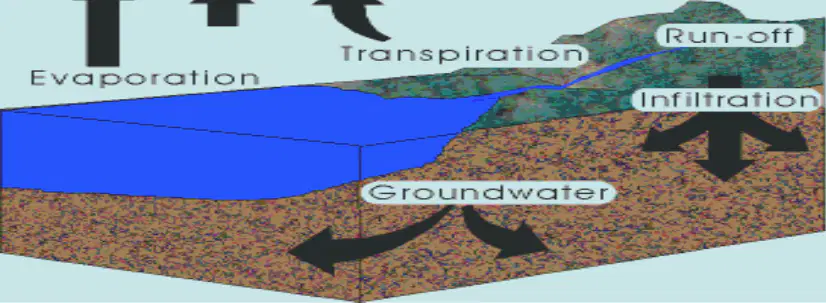
Which option best describes infiltration in the rainwater cycle?
Water flowing above ground
Water soaking into ground
Water condensing in air
Water evaporating from sea
Which sequence correctly orders four stages shown across the materials?
Condensation → Evaporation → Run-off → Precipitation
Evaporation → Condensation → Precipitation → Run-off
Run-off → Precipitation → Infiltration → Condensation
Precipitation → Evaporation → Groundwater → Condensation
What is the key difference between lakes and reservoirs in water supply planning?
Lakes are natural, reservoirs are man-made
Lakes are smaller, reservoirs are always larger
Lakes are saline, reservoirs are freshwater
Lakes store little, reservoirs store nothing
Which surface water source is most likely to have rapid flow and variable quality after storms?
Streams with steep gradients
Lakes with broad shorelines
Reservoirs with lined embankments
Coastal bays behind seawalls
Which chemicals are added specifically for sterilisation?
Chlorine and ammonia
Fluoride and sodium
Lime and alum
Ozone and carbon
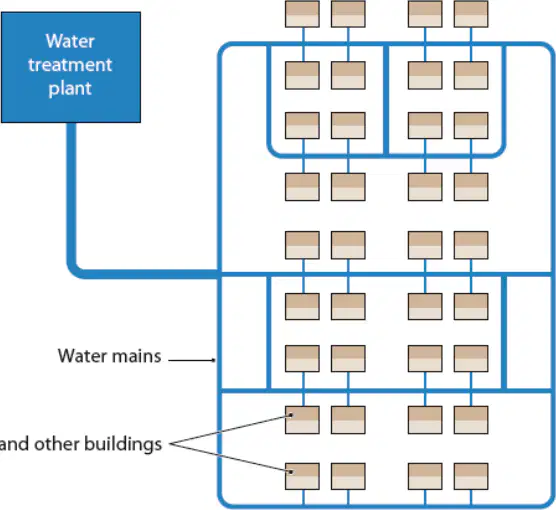
In the diagram of a mains distribution system, what is the primary source feeding the network?
Water treatment plant
Underground service valves
Domestic cold water tanks
Groundwater abstraction boreholes
Neighbourhood booster pumps
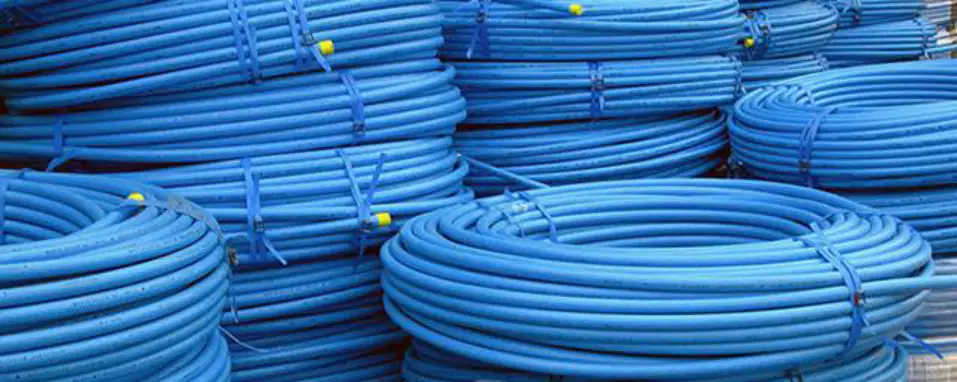
According to the mains pipes slide, what material now commonly replaces cast iron for water mains?
MDPE (medium density polyethylene)
PVCu (unplasticised PVC)
HDG steel (galvanised)
GRP (glass reinforced plastic)
Copper tube Type K
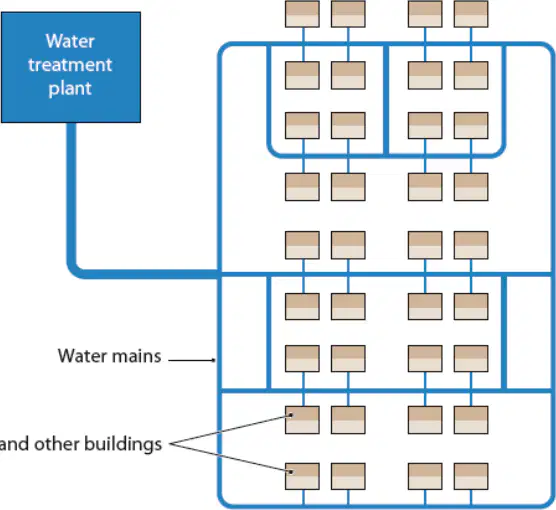
In the distribution diagram, what do the numerous small rectangles most likely represent?
Houses and other buildings
District pressure-reducing valves
Service reservoirs on hills
Water treatment filters
Sewage pumping stations
Private underground supplies are often not provided by a water undertaker. What is a likely implication?
They must meet stricter national standards
They are not covered by water regulations
They are monitored every month by authorities
They require no treatment before usage
Which scenario most likely requires the property owner to manage water treatment directly?
Connection to municipal mains supply
Abstraction from a private spring
Use of water company standpipe
Delivery by public water tanker
Which pair correctly matches source type with example equipment or feature?
Well — hand-dug lined shaft
Borehole — drilling rig setup
Spring — flow from ground fissure
Deep well — shallow water table
Artesian well — no pressure head
Which risk is specific to unregulated private underground supplies compared with public mains?
Higher certainty of legal compliance
Less consistent quality monitoring
Guaranteed chlorine residual levels
Better emergency response coverage
Which combination correctly lists the three main types of wells introduced in this unit?
Deep, shallow, artesian
Shallow, borehole, spring
Artesian, river, reservoir
Deep, municipal, surface

In the diagram, which feature supplies water from below an impervious layer within a confined aquifer, typically yielding good quality water?
Shallow well near water table
Deep well into confined aquifer
Unconfined aquifer seepage
Lake surface abstraction
Land spring at hillside
Which statement best describes a deep well in construction water supply practice?
Hand-dug pit above perched water
Machine-dug well below impervious layer
Shallow intake within topsoil zone
Open pond collecting runoff
Trench intercepting storm water
Which characteristic most likely applies to water from a shallow well?
Usually very good quality
Generally contaminated water
Self-flowing under pressure
Sourced from confined aquifer
Requires no pumping equipment
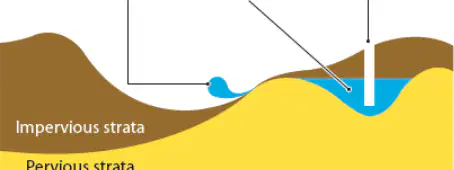
In the upper diagram, the shallow well draws from which hydrogeological unit?
Confined aquifer under pressure
Unconfined aquifer water table
Impervious stratum barrier
Perched artesian reservoir
Deep fracture flow zone
What condition allows an artesian well to bring water to the surface without pumping?
High evaporation above ground
Well head above lake level
Natural pressure in confined aquifer
Wind-driven suction at casing
Capillary rise from topsoil
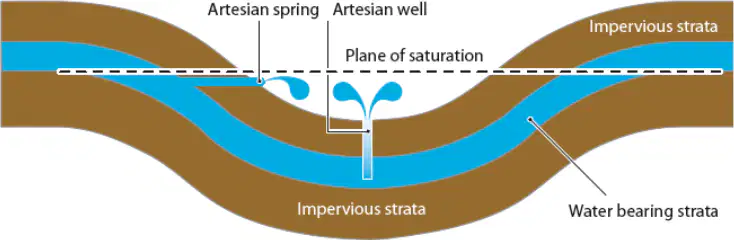
According to the lower diagram, an artesian spring emerges when the plane of saturation intersects what?
Top of impervious strata
Ground surface downslope
Deep borehole casing
Shallow trench drain
Open lake shoreline
Which pair correctly matches the water source with a concise description?
Deep well – water from below impervious layer
Shallow well – only reaches initial water table
Artesian well – rises under its own pressure
Borehole – large open-diameter hand-dug shaft
Spring – pumped from drilled pipework
Which is a modern, small-diameter water abstraction that requires pumping to bring water to the surface?
Traditional dug well
Artesian spring
Drilled borehole
Shallow trench
Catchment pond
Which statement about springs is most accurate for site water considerations?
They are pumped using electric submersibles
They are naturally occurring outflows to surface
They only occur in unconfined aquifers
They begin only below lake levels
They are less reliable than rooftop tanks
Which risk is highest for a shallow well used on a construction site?
Contamination from surface sources
Collapse of impervious strata
Excessive artesian pressure
Saltwater intrusion from deep strata
Permanent loss of recharge basin

Which visual cue in the upper diagram helps distinguish a deep well from a shallow well?
Depth relative to lake shoreline
Connection to pervious stratum only
Penetration into confined aquifer layer
Location at hill crest surface
Alignment with plane of saturation line
Which combination indicates water quality likely to be best under typical conditions?
Deep well water quality normally good
Shallow well water generally contaminated
Artesian well water normally very good
Borehole water always polluted
Spring water always requires chlorination

