
 Worksheets
Unit 102: Access Equipment and Safe Working Practices
Total questions: 20
Worksheet time: 10mins
Benjamin is about to climb a ladder to access electrical equipment at a job site. What should he perform before ascending?
Safety checks
Financial audits
Marketing analysis
Product design review
Imagine you are preparing to use a new type of access equipment in an electrical installation job. What steps would you take to ensure your safety before using the equipment?
Review the requirements for safe use, identify the type of equipment, and perform necessary safety checks.
Ignore safety procedures and start using the equipment immediately.
Ask a colleague to use the equipment for you.
Only check the equipment after you have finished using it.
Why is access equipment required for work above 1.5 meters?
To ensure safety and prevent falls
To make the work faster
To reduce the cost of labor
To avoid using any tools
What colours are used to indicate a Class EN 131 ladder?
Green or Yellow
Blue
Red
Silver
Explain how an extension ladder is designed to reach different heights. Use evidence from the concept of multi-section ladders.
It is split into sections that can be extended.
It is made of a single fixed piece.
It folds in half for storage.
It has wheels for easy movement.
What should you do before climbing a ladder to ensure safety?
Ignore any visible damage
Check for loose or missing parts
Stand on the top rung
Use the ladder in poor lighting
According to ladder safety guidelines, what should be done if a ladder is longer than 3 meters?
It must be secured, or someone must 'foot' the ladder.
It should be painted red.
It must be used only indoors.
It should be placed horizontally.
What is the recommended procedure when moving ladders more than a few metres?
They should be lowered.
They should be carried upright.
They should be dragged.
They should be left in place.
A worker needs to place a ladder to reach a roof. The roof is 4 meters high. According to the safety diagram, how far should the base of the ladder be from the wall?
1 meter
2 meters
4 meters
0.5 meter
A worker is about to use a ladder and notices that the anti-slip feet are worn and there is grease on the rungs. What should the worker do before using the ladder?
Replace or repair the anti-slip feet and clean the grease off the rungs
Ignore the issues and use the ladder as it is
Paint over the grease to hide it
Use the ladder only for light tasks
Which of the following best describes a static tower scaffold?
It remains in one place and cannot be moved.
It can be moved to different locations when needed.
It is always made of wood.
It is used only for painting walls.
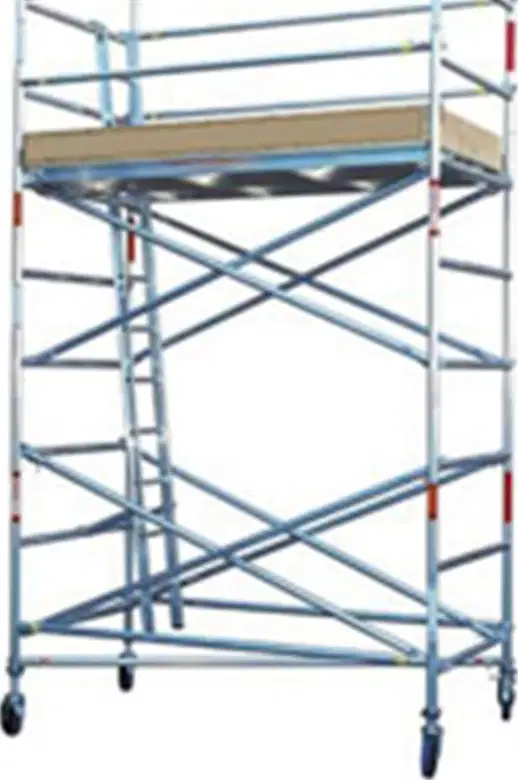
What is a proprietary tower scaffold?
Made for a particular job and constructed in situ
Made by a manufacturer with standard sections which fit together
Built only by hand on site
Designed for temporary use only
Why should sole plates be used when setting up a scaffold tower on soft ground?
To provide even weight distribution.
To make the scaffold taller.
To prevent rust.
To decorate the scaffold.
What is the primary purpose of toe boards on scaffolding platforms?
To prevent tools and materials from falling off the edge
To provide extra support for the scaffold structure
To make the scaffold look more attractive
To help workers climb onto the scaffold
When are toe boards required to be used on scaffolding?
Only if the scaffold is higher than 10 meters
Only when working indoors
When the weather is rainy
Whenever there is a risk of objects falling from the platform

Who is allowed to operate a MEWP on site?
Supervisors and project managers.
Any operative who feels happy to use it.
Operatives authorised by the HSE.
Only trained and authorised operatives.
The acronym PASMA stands for?
Public Access Manufacturers Association.
Prefabricated Access Suppliers and Manufacturers Association.
Platforms and Access Suppliers Association.
Platform and Access Manufacturers Association.
Which one of the following shows the working platform known as a "Hop up"?


Which one of the following shows the working platform known as a "Podium"?

Which of the following is the reason that ladders should never be painted?
The paint will eventually peel off.
Damaged parts may be hidden putting users at risk.
The paint may damage the ladder
The paint may cause rungs to get slippery

