
 Worksheets
Foundation Plumbing Unit 101 ppt4
Total questions: 24
Worksheet time: 12mins
What is one major benefit of having a network of easily accessible transport links in a country?
It restricts people to their hometowns.
It enables people to choose where they live.
It increases the cost of living.
It reduces the number of towns and cities.
Which of the following is NOT mentioned as a factor influencing where individuals choose to live?
Social and cultural needs
Availability of local retail and entertainment
Climate and weather patterns
Security and safety in the community
Why might someone choose to live in a more remote location, according to the text?
To have better access to public transport
To enjoy outdoor spaces and a peaceful lifestyle
To be closer to entertainment facilities
To find more job opportunities
Explain how local development and town planning contribute to the choices people have about where to live. Use evidence from the text to support your answer.
They make it harder for people to move between towns.
They provide the necessary infrastructure and planning for accessible transport and community facilities.
They limit the number of available homes.
They focus only on building entertainment centers.

What is the typical duration of a local authority's development plan?
Five or ten years
One or two years
Twenty or thirty years
Three or four years
Why were homes, local industry, and commercial premises built close together during the 19th and early 20th centuries?
Because the working-class often did not have their own transport
Because there was more available land
Because it was required by law
Because of environmental concerns
Which of the following was a result of the development of public and private transport and changes in public attitudes?
Demands for cleaner, healthier places to live
Decrease in housing estates
Elimination of commercial businesses
Increase in agricultural land
How did local authorities respond to demands for cleaner and healthier living environments in towns and villages?
By segregating industrial and commercial businesses from domestic housing
By building more factories in residential areas
By reducing public transport options
By combining all types of developments in one area
Explain how the approach of segregating industrial and commercial businesses from domestic housing influenced the development of modern communities.
It led to the creation of distinct housing estates, industrial estates, and shopping complexes.
It caused a decline in public transportation.
It resulted in fewer commercial businesses.
It made communities less organized.
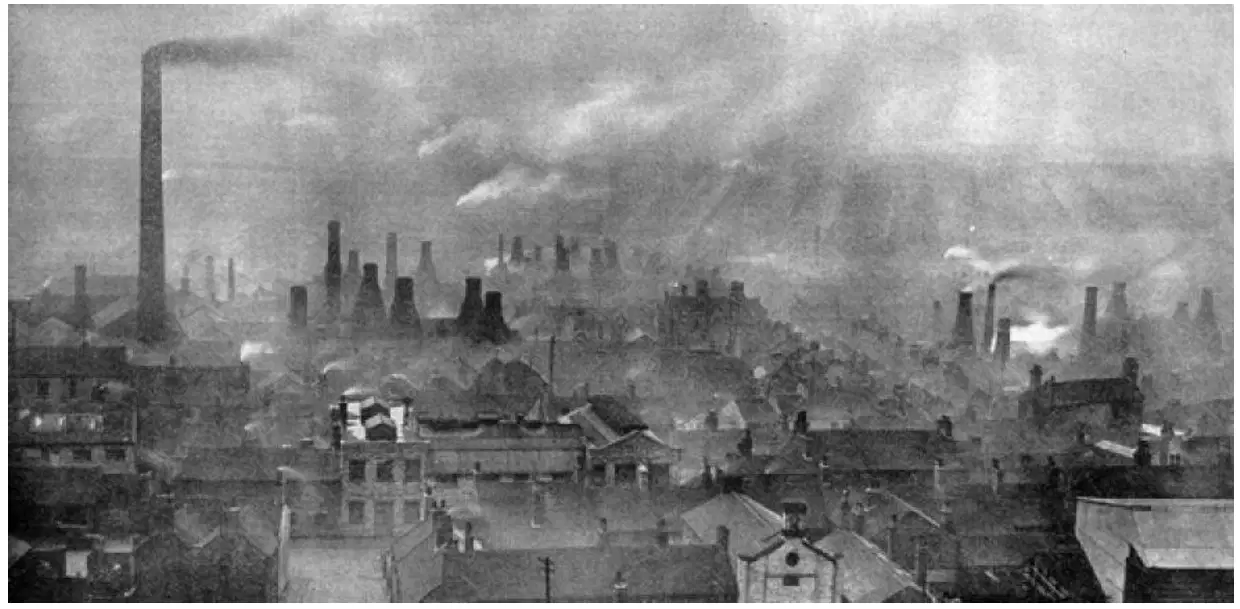
What does the image illustrate about industrial towns before the introduction of town planning?
The image shows a well-organized and clean industrial town.
The image illustrates the crowded and polluted conditions of industrial towns before town planning.
The image depicts a modern city with green spaces.
The image shows a rural village with few buildings.
Why was town planning important for industrial towns, based on the example shown?
To increase the number of factories
To reduce pollution and improve living conditions
To make towns more crowded
To remove all industrial activity

Based on the image, what was a common feature of industrial towns before town planning?
Large parks and open spaces
Organized residential areas
Numerous factories with smoke emissions
Clean air and clear skies
What is the main topic of the learning material page shown?
Post-town planning – Cardiff today
Ancient architecture in London
Modern construction in Paris
Urban planning in New York
Which city is featured in the post-town planning example on this page?
London
Cardiff
Manchester
Birmingham

Based on the image, which of the following best describes the layout of Cardiff today?
Dense high-rise buildings with little green space
A mix of historic and modern buildings with significant green areas
Only residential buildings with no commercial areas
Industrial zones dominating the city center
What is the main purpose of building regulations?
To ensure new buildings, extensions, conversions, or renovations meet minimum safety and energy efficiency standards
To increase the cost of construction projects
To limit the number of buildings in a city
To make buildings look more attractive
Which of the following is NOT a reason for having building regulations?
To ensure buildings are energy efficient
To ensure buildings meet minimum safety standards
To ensure buildings are completed quickly
To ensure renovations meet acceptable standards
Building regulations are divided into a series of parts. What does each part cover?
A specific area
A different city
A different construction company
A different year

What does the diagram most likely represent in the context of building regulations?
The different parts of building regulations, each covering a specific area
The steps in building a house
The types of construction materials
The stages of a construction project
Why is it important for building regulations to require energy efficiency?
To reduce energy consumption and promote sustainability
To make buildings more expensive
To increase the size of buildings
To limit the number of renovations
Which part of the building regulations approved documents covers "Fire safety"?
Part B
Part F
Part L
Part Q
What is the main focus of Part G in the building regulations approved documents?
Ventilation
Sanitation, hot water safety and water efficiency
Electrical safety
Security
Which part of the building regulations deals with "Protection from falling, collision and impact"?
Part K
Part J
Part H
Part M
If a building project needs to ensure "Conservation of fuel and power," which part of the building regulations should be consulted?
Part L
Part E
Part Q
Part D

