
 Worksheets
Chemistry through Energy Review
Total questions: 200
Worksheet time: 3hrs 42mins
_____ substances have a pH range of 0 - 6.9 and turn pH indicators red
Basic
Acidic
Neutral
_____ substances have a pH of 7
Basic
Acidic
Neutral
_____ substances have a pH range of 7.1 - 14 and turn pH indicators blue
Basic
Acidic
Neutral
Which statement best defines a force in mechanics?
A push or pull with strength and direction
A quantity describing speed without direction
An object's resistance to thermal change only
A property measured only in kilograms of mass
Which unit is used to measure force in SI?
Newton
Joule
Pascal
Watt
Which pair lists two forces that oppose motion through contact or air?
Friction and air resistance
Gravity and normal force
Tension and spring force
Torque and centripetal force
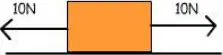
A 10 N rightward force and a 6 N leftward force act on a block on a frictionless surface. What is the net force and direction?
4 N to the right
16 N to the right
6 N to the left
4 N to the left
Two students pull a cart in the same direction with 7 N and 9 N. What is the net force?
16 N forward
2 N forward
0 N forward
8 N backward
Balanced forces on an object imply which outcome?
Zero net force and no change in motion
Positive net force and speeding up
Negative net force and slowing down
Zero mass and infinite inertia
Unbalanced forces acting on an object will most directly cause which effect?
Acceleration changing the object's motion
Temperature increase without motion change
Mass increase while speed stays constant
Only a change in direction at zero speed
Newton’s First Law describes inertia. Which scenario illustrates it best?
A puck glides at constant velocity on ice until friction acts
A ball speeds up when a larger force is applied
A rocket accelerates as exhaust gases exit
A falling object reaches a highest point then drops
According to Newton’s Second Law, which change doubles an object’s acceleration when net force is constant?
Halving the mass of the object
Doubling the mass of the object
Reducing time of motion
Increasing distance traveled
A net force of 12 N acts on a 3 kg cart. What is the acceleration?
4 m/s^2
3 m/s^2
36 m/s^2
0.25 m/s^2
Two ice skaters push off each other. Which statement matches Newton’s Third Law?
Forces are equal in magnitude and opposite in direction
The heavier skater experiences a larger force applied
Each skater exerts a force without any reaction
Only the lighter skater accelerates due to friction
When a rocket launches, the action–reaction pair is best described as which interaction?
Gases pushed downward and rocket pushed upward
Gravity pulling rocket down and thrust pushing up
Pilot pushing lever and engines ignite upward
Air pushing sideways and fins cutting the air
Which statement correctly distinguishes mass and weight for an astronaut?
Mass stays constant; weight changes with gravity
Mass changes with gravity; weight stays constant
Both mass and weight change between planets
Neither mass nor weight change between planets
On Earth, what is the weight of a 50kg×9.8m/s2 astronaut (take g = 9.8 m/s^2)?
490 N downward
50 N downward
9.8 N upward
540 N upward
Gravity depends on mass and distance. Which comparison is correct?
Greater mass or closer distance means stronger pull
Greater mass or farther distance means weaker push
Smaller mass and closer distance means weaker pull
Smaller distance and smaller mass means stronger push
Which force directly opposes gravity on a skydiver during a steady fall?
Air resistance (drag) upward
Normal force upward
Tension force downward
Centripetal force sideways
Terminal velocity occurs when which condition is met for a falling object?
Drag equals weight with opposite directions
Drag exceeds weight with same direction
Net force equals mass times distance
Gravity equals mass with same direction
A 2 kg object experiences a net force of 6 N to the left while moving right. What is its acceleration and how will its speed change?
3 m/s^2 left; speed decreases
3 m/s^2 right; speed increases
12 m/s^2 left; speed increases
3 m/s^2 left; speed increases
Which statement best defines friction in mechanics?
Force opposing motion between contacting surfaces
Force causing motion along contacting surfaces
Force acting only when objects are airborne
Force that always increases object’s speed
Static friction is most accurately described as the force that
resists start of motion between contacting surfaces
opposes motion as flat surfaces slide
acts when a round object rolls forward
acts when an object moves through fluid
A puck slides on ice with nearly constant speed. The primary friction type opposing its motion is
sliding friction between flat surfaces
static friction between stationary objects
rolling friction on a flat surface
fluid friction due to a dense liquid
Which scenario is best modeled by rolling friction?
A bike tire moving over pavement
A crate being dragged across floor
A swimmer moving through water
A book resting on a desktop
Which step is NOT part of constructing a free-body diagram for an object?
Draw arrows for each force with direction and size
Choose the object and draw a box or dot
Label each force type and magnitude clearly
Sketch the object’s path and its future velocity
A 1.5 kg book rests on a horizontal table. Which set of forces must appear and balance in its free-body diagram?
Weight downward and normal upward equal in size
Weight downward and friction forward equal in size
Normal upward and applied forward equal in size
Friction backward and tension upward equal in size
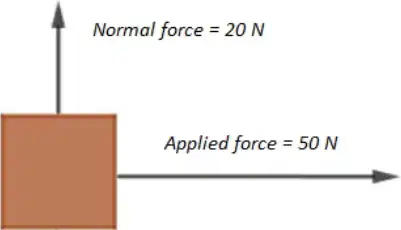
An object on a rough horizontal surface is pulled right by 50 N while friction is 10 N left, normal is 20 N up, and weight is 20 N down (as shown). The net horizontal force is
40 N to the right
60 N to the right
10 N to the left
0 N horizontally
A crate initially at rest requires a small push to start moving, then less force to keep it moving steadily. Which explanation best fits?
Static friction maximum exceeds kinetic sliding friction
Rolling friction becomes larger than fluid friction
Weight increases causing normal force to drop
Normal force vanishes once motion begins
A book is pushed rightward across a desk and speeds up to the right. Which free-body diagram best represents the horizontal forces?
Rightward push larger than leftward friction
Rightward push equal to leftward friction
Leftward friction larger than rightward push
No horizontal forces on the book
A book is pushed rightward across a desk at constant velocity. Which statement about horizontal forces is correct?
Push and friction are equal in magnitude
Push is greater than friction
Friction is greater than push
No friction acts on the book
Which set lists the four forces most likely acting on a book sliding across a desk while being pushed?
Applied push, friction, normal, weight
Applied push, tension, drag, buoyant
Thrust, lift, drag, weight
Magnetic, electric, weight, thrust
Momentum p is defined as which expression and has which SI units?
p = m v, units kg·m/s
p = m/a, units N·s
p = F t, units kg/s
p = v/t, units m/s²
Impulse J equals which quantity and corresponds to which physical change?
J = F Δt; equals change in momentum
J = m v; equals change in speed
J = F/m; equals change in force
J = Δx/Δt; equals change in position
A 0.40 kg soccer ball moving at 12 m/s to the right is stopped by a goalie in 0.060 s by a constant force. What is the magnitude of the average force on the ball?
80 N
4.8 N
8.0 N
48 N
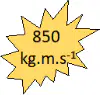
A 90 kg sprinter at 8.5 m/s increases mass to 100 kg while keeping the same speed in another season. How does momentum change?
Increases from 765 to 850 kg·m/s
Stays the same at 765 kg·m/s
Decreases from 850 to 765 kg·m/s
Doubles from 765 to 1530 kg·m/s
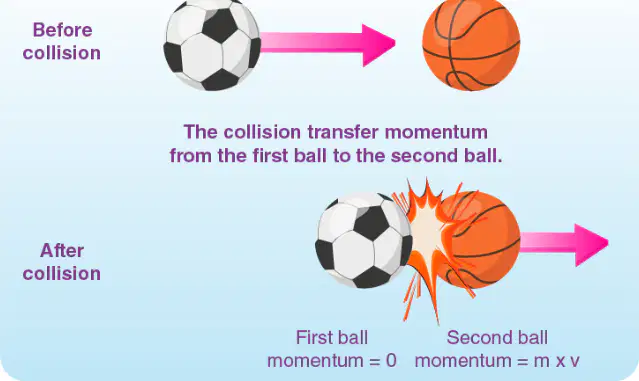
Two balls collide head‑on on a frictionless surface: ball A transfers all its momentum to ball B. Which statement best describes total momentum?
Total momentum is conserved and unchanged
Total momentum increases during collision
Total momentum decreases to zero
Total momentum depends on shapes only
A 1.5 kg cart moving at 3.0 m/s to the right collides and sticks to a 0.5 kg cart initially at rest. What is the speed of the combined carts immediately after?
2.25 m/s right
3.0 m/s right
1.5 m/s right
0.75 m/s right
A book is pushed to the right and moves at constant velocity while the push stops. What happens immediately after the push ends, considering friction?
The book slows down due to friction
The book keeps speed due to inertia
The book speeds up due to friction
The book moves left due to push
Which statement best describes a reference point in studying motion?
A stationary object used to judge another's motion
Any moving object used to compare velocities
The starting location chosen by the traveler
An origin on a coordinate grid by default
What is meant by a frame of reference?
The observer's viewpoint for describing motion
The map scale used to measure distance
The path an object follows through space
The instrument used to record positions
Which quantity is a scalar?
Time interval of 5 minutes
Velocity of 12 m s south
Displacement of 30 km east
Force of 8 newtons west
Which option correctly identifies a vector?
A speed of 25 kilometers per hour
A mass of three kilograms
A displacement of 6 meters north
An energy of fifty joules
A hiker walks 4 km east, then 2 km east. What are the distance and displacement?
Distance 6 km, displacement 6 km east
Distance 6 km, displacement 2 km east
Distance 2 km, displacement 6 km east
Distance 4 km, displacement 2 km east
A car travels 4 km east, then 2 km west along the same road. What is the displacement?
2 km east
2 km west
6 km east
0 km
An athlete runs a winding trail totaling 750 km and ends 400 km southeast of the start. Which statement is correct?
Distance is 750 km and displacement is 400 km SE
Distance is 400 km SE and displacement is 750 km
Distance equals displacement because paths match
Displacement is undefined without path direction
If you start and end at the same point after walking 10 m east and 10 m west, what are distance and displacement?
Distance 20 m and displacement 0 m
Distance 0 m and displacement 20 m
Distance 10 m and displacement 10 m east
Distance 20 m and displacement 20 m
Two vectors act along a straight line in opposite directions, 8 m east and 3 m west. The resultant displacement is
5 m east
11 m east
5 m west
11 m west
Which change would most affect whether an object appears to move?
Changing the observer's frame of reference
Changing units from meters to kilometers
Changing the color of the object observed
Changing the time of day for observation
Which expression correctly defines average speed?
Total distance divided by total time
Displacement divided by total time
Change in velocity over time
Distance covered in a specific moment
Which statement best distinguishes velocity from speed?
Velocity includes direction of motion
Velocity excludes magnitude information
Speed includes displacement vector
Speed and velocity are always identical
Which unit is appropriate for acceleration in SI?
m s⁻²
m s⁻¹
km h⁻¹
m
A car moves 150 km in 3 hours along a highway. What is its average speed?
50 km h⁻¹
45 km h⁻¹
60 km h⁻¹
55 km h⁻¹
Which scenario represents instantaneous speed?
Speed shown at a single speedometer reading
Unchanging speed over a long trip
Total distance divided by drive time
Average velocity in a fixed direction
Which change always indicates acceleration?
Turning while maintaining constant speed
Maintaining straight motion at steady speed
Resting at a stoplight with engine on
Moving equal distances each equal time
A runner’s velocity changes from 2.0 m s⁻¹ east to 6.0 m s⁻¹ east in 4.0 s. What is the acceleration?
+1.0 m s⁻² east
+2.0 m s⁻² east
+0.5 m s⁻² east
+1.5 m s⁻² east
Which option correctly matches the type of acceleration with its description?
Negative acceleration: slowing down
Positive acceleration: turning right
Changing direction: speed unchanged only
Positive acceleration: decreasing speed
A cyclist moves at 8 m s⁻¹ north and then turns east at the same speed. Which statement is true about acceleration during the turn?
There is acceleration because direction changes
There is no acceleration because speed stays same
Acceleration is zero because displacement stops
Acceleration is negative because velocity decreases

In a distance–time graph like the one shown, what does a horizontal line segment represent about the object's motion?
Object moving forward at steady speed
Object moving backward at steady speed
Object stopped with zero speed
Object accelerating at increasing rate

On a distance–time graph, which slope indicates faster motion over the same time interval?
Steeper positive slope line
Shallower positive slope line
Horizontal zero slope line
Curved line bending downward
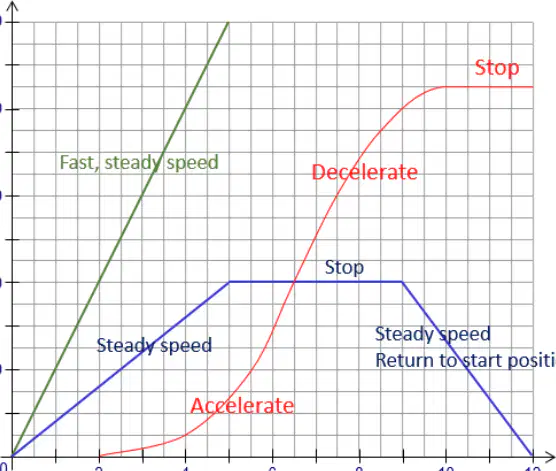
In the distance–time graph panel, the red curve transitions from steep to gentler slope. What does this change indicate?
Object is decelerating over time
Object is accelerating over time
Object maintains constant speed
Object reverses direction abruptly

Which statement best describes a negative slope on a distance–time graph?
Object moves away from origin faster
Object moves backward toward origin
Object is stationary at origin
Object speeds up away from origin
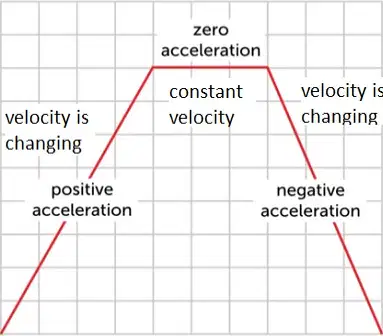
Refer to the velocity–time graph with piecewise linear segments. What does a horizontal line above the time axis signify?
Constant velocity with zero acceleration
Zero velocity with constant acceleration
Increasing velocity with positive acceleration
Decreasing velocity with negative acceleration
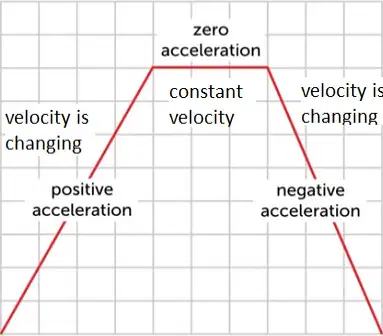
In the velocity–time graph, a line with positive constant slope indicates the object is
Speeding up in the positive direction
Slowing down toward zero velocity
Moving backward at constant speed
Stopped with no displacement change
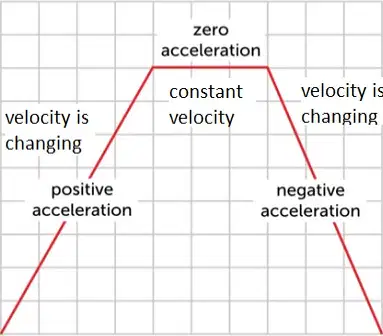
From a velocity–time graph, how do you determine the object's acceleration during a straight-line segment?
Read the y-intercept directly
Compute the slope of the segment
Calculate the area under the curve
Measure the maximum velocity value
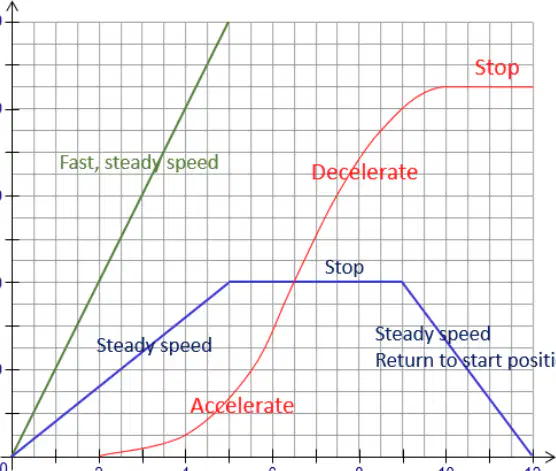
In a distance–time graph, a curved line that becomes steeper with time most likely shows
Positive acceleration of the object
Negative acceleration of the object
Constant velocity throughout
Intermittent stopping behavior
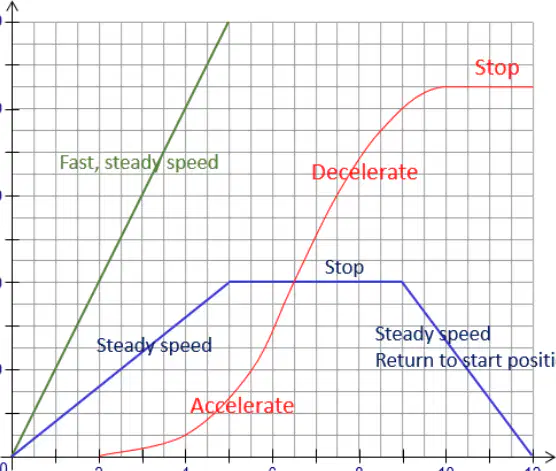
Consider the blue polyline on the distance–time graph that rises, flattens, then drops back to zero distance. Which sequence best matches its motion?
Speed up, continue faster, stop suddenly
Move at steady speed, stop, return steadily
Accelerate quickly, decelerate slowly, stop
Oscillate around zero, then remain stopped
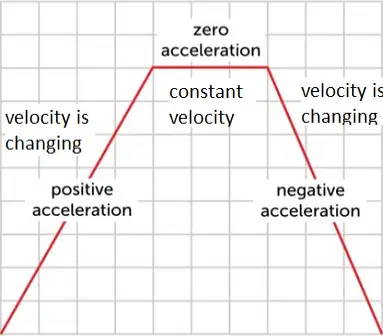
If the velocity–time graph crosses the time axis from positive to negative velocity with a straight negative slope, what is true about the motion?
Object keeps moving forward faster
Object slows to rest then reverses
Object remains at rest throughout
Object moves backward at constant speed only

Which feature distinguishes changing velocity from constant velocity on graphs?
Curved distance–time line or sloped v–t line
Horizontal distance–time line or curved v–t line
Steeper distance–time line with same slope
Any line segment parallel to the x-axis
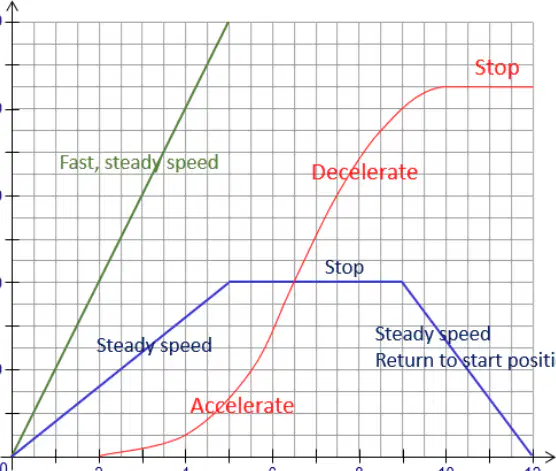
Two runners are shown on a distance–time graph with straight lines from the origin: Runner A has a steeper line than Runner B. What can you conclude?
Runner A has greater constant speed
Runner B has greater constant speed
Both have equal constant speed
Runner A starts later but finishes sooner
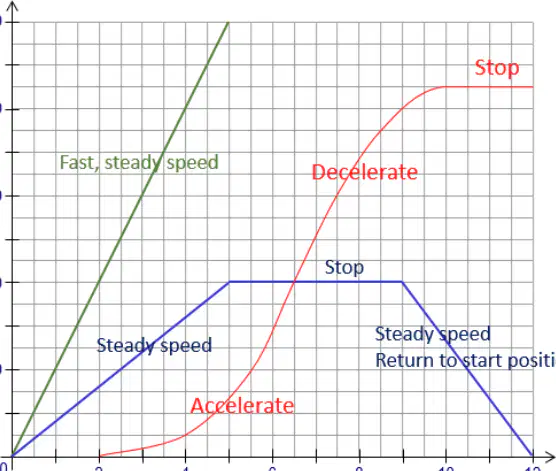
On a distance–time graph, what does a section labeled 'Stop' at a nonzero distance imply about position and velocity during that interval?
Position fixed, velocity zero
Position decreasing, velocity negative
Position increasing, velocity positive
Position oscillating, velocity varying
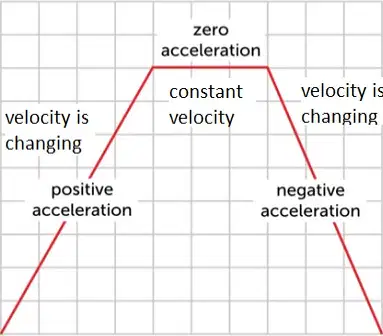
The area under a velocity–time graph between t1 and t2 represents which quantity?
Change in acceleration
Change in displacement
Average acceleration
Instantaneous speed
Which statement best describes a chemical equation?
It shows how atoms combine and react
It lists atomic masses for each element
It displays electron configurations for atoms
It records temperatures for physical changes
Which observation is a reliable sign that a chemical reaction occurred?
Bubbling indicating gas formation
Increase in mass without cause
Temporary warming by sunlight
Phase change from melting only
In a chemical equation, what are reactants?
Substances that go into the reaction
Substances that come out as products
Small numbers showing atom counts
Arrows indicating direction of yield
What does the coefficient in 2H2O represent?
Number of molecules present
Number of oxygen atoms only
Charge on the water molecule
Number of hydrogen atoms only
According to the law of conservation of mass, which statement is true?
Mass is neither created nor destroyed
Mass may increase with temperature
Products always weigh less than reactants
Mass is created during combustion
Which part of an equation indicates “to produce”?
The reaction arrow symbol
The plus signs between terms
The subscripts near elements
The parentheses in formulas
Balancing chemical equations primarily ensures what?
Equal numbers of each atom on both sides
Equal numbers of molecules on both sides
Equal volumes of gases at all conditions
Equal moles of reactants and products
Which change would you make first to balance an unbalanced equation?
Adjust coefficients before subscripts
Change subscripts before coefficients
Alter element symbols if needed
Remove species that seem extra
Which reaction type combines two or more reactants into one product?
Synthesis reaction pattern
Decomposition reaction pattern
Single replacement pattern
Double replacement pattern
Identify the reaction type: 2HgO → 2Hg + O2
Decomposition reaction type
Synthesis reaction type
Combustion reaction type
Double replacement type
Which scenario illustrates single replacement?
Zn + CuCl2 → ZnCl2 + Cu
H2 + O2 → H2O formed
KBr + AgNO3 → KNO3 + AgBr
CH4 + O2 → CO2 + H2O
Double replacement reactions generally involve which pattern?
Two compounds exchange ions
One compound splits apart
Element replaces another element
Fuel reacts with oxygen gas
Which feature defines a combustion reaction of a hydrocarbon?
Reactant includes O2 and forms CO2 and H2O
Reactant excludes O2 and forms only CO
Products include metals and halides
Reactants are two ionic compounds only
A student balances H2 + O2 → H2O as H2 + O2 → 2H2O. What error remains?
Oxygen atoms are not balanced yet
Hydrogen atoms are not balanced yet
Too many coefficients were reduced
Subscripts for hydrogen were altered
Which statement about subscripts versus coefficients is correct?
Coefficients change molecule counts; subscripts change atom counts
Subscripts change molecule counts; coefficients change atom masses
Coefficients change charges; subscripts change mole ratios
Subscripts change charges; coefficients change oxidation
How many valence electrons do most atoms seek to achieve stability under the octet rule?
Six electrons in outer shell
Eight electrons in outer shell
Ten electrons in outer shell
Two electrons in outer shell
Which statement best describes a covalent bond?
Between metal and nonmetal, electrons transferred
Between nonmetals, electrons shared
Between metals, electrons move freely
Between noble gases, electrons paired
In an ionic bond, what happens to electrons and what particles result?
Electrons shared, molecules form
Electrons transferred, ions form
Electrons delocalized, lattice forms
Electrons excited, radicals form
Which pair of elements is most likely to form an ionic compound?
Carbon and hydrogen
Nitrogen and oxygen
Magnesium and chlorine
Oxygen and sulfur
When drawing a Lewis dot structure for a molecule, what do the dots represent?
Protons in the nucleus
Core electrons of atoms
Valence electrons involved
Neutrons in isotopes
A metal–metal bond is characterized by which electron behavior?
Electrons fixed in pairs
Electrons shared in specific bonds
Electrons transferred to nonmetals
Electrons in a sea moving freely
Hydrogen and helium are exceptions to the octet rule. What stable valence count do they seek?
Four electrons total
Six electrons total
Two electrons total
Eight electrons total
Which description correctly matches cation and anion in ionic bonding?
Cation negative nonmetal, anion positive metal
Cation positive metal, anion negative nonmetal
Cation neutral atom, anion charged molecule
Cation noble gas, anion halogen
Which rule correctly describes naming for ionic compounds?
Nonmetal first, then metal
Metal first, then nonmetal
Use prefixes for both elements
Always include Roman numerals
In ionic formulas, what do subscripts indicate?
Average atomic masses
Oxidation-number-based atom counts
Electron configurations of ions
Number of valence shells
What is the oxidation number in compound naming?
Charge after losing or gaining electrons
Number of atoms in a molecule
Position in the periodic table
Total protons in the nucleus
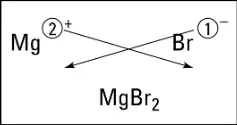
Using the criss-cross method, which formula results from Mg2+ and Br−?
MgBr
MgBr3
MgBr2
Mg2Br
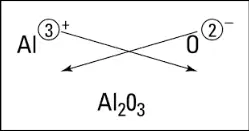
Which name matches Al2O3, following ionic naming rules?
Aluminum trioxide
Dialuminum oxide
Aluminum oxide
Aluminum(II) oxide
For covalent compounds, how are names formed?
Metal first, then nonmetal
Use prefixes from subscripts for both elements
Add Roman numerals to metals
Drop all prefixes for monoatomic pairs
What is the correct prefix for a subscript of 7 in covalent naming?
Hepta-
Hexa-
Octa-
Nona-
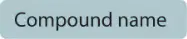
Name N2O3 using covalent naming conventions.
Dinitrogen trioxide
Dinoxide trinitrogen
Nitrogen dioxide three
Trioxygen dinitride
Who organized the known elements into the periodic table based on similar characteristics?
Dmitri Mendeleev
John Dalton
Niels Bohr
Marie Curie
What does a period represent on the periodic table?
Horizontal row and energy levels
Vertical column and valence count
Diagonal line and atomic radius
Block region and electron subshell
Elements in the same group share which feature most directly?
Similar chemical properties
Identical atomic masses
Same number of protons
Equal number of neutrons
Which statement best distinguishes metals from nonmetals?
Metals conduct heat; nonmetals are poor conductors
Metals are brittle; nonmetals are malleable
Metals are gases; nonmetals are mostly liquids
Metals have low melting points; nonmetals have high
Which property is characteristic of metalloids?
Semi-conductive and somewhat malleable
Always gaseous at room temperature
Completely non-conductive insulators
Liquid state and highly ductile
Which element family typically has 1 valence electron and is highly reactive?
Alkali Metals
Halogen Family
Noble Gases
Alkaline Earth Metals
Alkaline Earth Metals generally tend to:
Lose two electrons when reacting
Gain two electrons when reacting
Remain inert under all conditions
Form gaseous diatomic molecules
Halogens most commonly achieve stability by:
Gaining one electron to form anions
Losing one electron to form cations
Sharing eight electrons in metals
Releasing two electrons as photons
Noble gases are generally nonreactive because:
They have full valence shells
They have empty valence shells
They have unstable nuclei
They possess liquid phases
Transition metals are best described as:
Variable valence and good conductors
Fixed valence and poor conductors
Gaseous at room temperature
Metalloids with stair-step traits
Which statement about valence electrons and groups is correct?
Same group means same valence number
Same period means same valence number
Group number equals total electrons
Period number equals valence count
Hydrogen is not considered a typical member of which family in this summary?
Alkali Metals
Halogen Family
Noble Gases
Transition Metals
Which set correctly pairs family with reactivity trend?
Halogens: highly reactive nonmetals
Noble gases: highly reactive metals
Alkali metals: nonreactive solids
Transition metals: highly reactive gases
An element is shiny, ductile, and a good conductor at room temperature. Which classification fits best?
Metal with typical metallic properties
Nonmetal with poor conductivity
Noble gas with full shell
Metalloid with brittle character
Given an element in Group 17 and Period 3, predict its most likely behavior in reactions with sodium.
It gains one electron forming NaCl
It loses one electron forming NaF
It shares two electrons forming Na2
It remains inert forming no salt


Which statement best defines matter?
Anything that has mass and takes up space
Anything that can be seen with the naked eye
Anything made only of elements and compounds
Anything that can be dissolved in a liquid
Which description matches a pure substance?
Fixed composition with consistent properties
Variable composition with visible parts
Combination that can be separated by settling
Mixture whose particles scatter light
Which example is an element?
Gold with symbol Au
Water with formula H2O
Sodium chloride NaCl
Milk in a glass
What distinguishes a compound from an element?
Two or more elements chemically combined
Two or more substances physically mixed
Single type of atom in the sample
Particles that settle out over time
Which statement about mixtures is correct?
Components retain their original properties
Components form new chemical substances
Composition is always fixed ratio
Particles are always single atoms
A homogeneous mixture where particles are fully dissolved is called a:
Solution with uniform appearance
Colloid with dispersed droplets
Suspension with large particles
Heterogeneous mixture sample
Which property most reliably distinguishes a solution from a colloid?
Tyndall effect shows no light scattering
Particles settle after standing
Components are visibly different
Made only from elements not compounds
Which mixture will scatter a beam of light but not settle over time?
Colloid such as milk or fog
Solution such as saltwater
Suspension such as sand water
Homogeneous alloy mixture
Which mixture is most likely to settle upon standing?
Suspension with large particles
Colloid with medium particles
Solution with ions molecules
Homogeneous mixture sample
A clear sports drink appears uniform and does not scatter light. What classification fits best?
Solution with dissolved particles
Colloid with dispersed droplets
Suspension with large solids
Heterogeneous visible mixture
Which scenario best uses the Tyndall effect for identification?
Shining a light to see scattering in milk
Weighing a sample to find its mass
Heating a sample to boil away water
Measuring color with a spectrometer
Which pair correctly matches mixture type with particle size trend?
Solution—very small; Suspension—large
Solution—large; Colloid—largest
Colloid—ions; Suspension—molecules
Suspension—smallest; Solution—largest
A lab sample looks uniform. After one hour, solid material settles to the bottom, and a beam of light was scattered before settling. What is the best classification?
Suspension due to settling observed
Solution due to uniform appearance
Colloid due to light scattering
Pure substance due to single phase
Which statement best describes a chemical equation?
It shows how atoms combine and react
It lists atomic masses for each element
It displays electron configurations for atoms
It records temperatures for physical changes
Which observation is a reliable sign that a chemical reaction occurred?
Bubbling indicating gas formation
Increase in mass without cause
Temporary warming by sunlight
Phase change from melting only
In a chemical equation, what are reactants?
Substances that go into the reaction
Substances that come out as products
Small numbers showing atom counts
Arrows indicating direction of yield
What does the coefficient in 2H2O represent?
Number of molecules present
Number of oxygen atoms only
Charge on the water molecule
Number of hydrogen atoms only
According to the law of conservation of mass, which statement is true?
Mass is neither created nor destroyed
Mass may increase with temperature
Products always weigh less than reactants
Mass is created during combustion
Which part of an equation indicates “to produce”?
The reaction arrow symbol
The plus signs between terms
The subscripts near elements
The parentheses in formulas
Balancing chemical equations primarily ensures what?
Equal numbers of each atom on both sides
Equal numbers of molecules on both sides
Equal volumes of gases at all conditions
Equal moles of reactants and products
Which change would you make first to balance an unbalanced equation?
Adjust coefficients before subscripts
Change subscripts before coefficients
Alter element symbols if needed
Remove species that seem extra
Which reaction type combines two or more reactants into one product?
Synthesis reaction pattern
Decomposition reaction pattern
Single replacement pattern
Double replacement pattern
Identify the reaction type: 2HgO → 2Hg + O2
Decomposition reaction type
Synthesis reaction type
Combustion reaction type
Double replacement type
Which scenario illustrates single replacement?
Zn + CuCl2 → ZnCl2 + Cu
H2 + O2 → H2O formed
KBr + AgNO3 → KNO3 + AgBr
CH4 + O2 → CO2 + H2O
Double replacement reactions generally involve which pattern?
Two compounds exchange ions
One compound splits apart
Element replaces another element
Fuel reacts with oxygen gas
Which feature defines a combustion reaction of a hydrocarbon?
Reactant includes O2 and forms CO2 and H2O
Reactant excludes O2 and forms only CO
Products include metals and halides
Reactants are two ionic compounds only
A student balances H2 + O2 → H2O as H2 + O2 → 2H2O. What error remains?
Oxygen atoms are not balanced yet
Hydrogen atoms are not balanced yet
Too many coefficients were reduced
Subscripts for hydrogen were altered
Which statement about subscripts versus coefficients is correct?
Coefficients change molecule counts; subscripts change atom counts
Subscripts change molecule counts; coefficients change atom masses
Coefficients change charges; subscripts change mole ratios
Subscripts change charges; coefficients change oxidation
Which statement best defines energy in physics?
The ability to do work
The rate of doing work
Force applied over distance
The capacity to move time
Kinetic energy depends directly on which two quantities?
Mass and speed
Force and time
Height and gravity
Charge and voltage
Which formula correctly gives kinetic energy for an object of mass m and speed v?
KE equals one half m v squared
KE equals m g h
KE equals force times distance
KE equals work over time
Gravitational potential energy near Earth’s surface depends on which variables?
Mass, gravity, height
Force, distance, time
Charge, field, distance
Pressure, volume, temperature
Which equation gives gravitational potential energy?
PE equals m g h
PE equals one half m v squared
PE equals work over time
PE equals force times distance
Mechanical energy of a system is defined as
The sum of KE and PE
Only the kinetic energy
Only the potential energy
The product of KE and PE
Which choice lists only forms of electromagnetic energy?
Light, UV, X-rays
Heat, sound, pressure
Bonds, nuclei, charge
Wind, tides, friction
According to the law of conservation of energy, in a closed system energy
Cannot be created or destroyed
Is used up during motion
Is created by doing work
Is destroyed when transferred
Work done on an object is defined as
Force multiplied by distance
Force divided by time
Mass multiplied by speed
Energy divided by power
Power is best described as
Work done per unit time
Force applied per unit mass
Energy stored per unit height
Distance moved per unit force
A 0.10 kg bird flies at 8 m/s. What is its kinetic energy?
3.2 joules
0.8 joules
6.4 joules
1.6 joules
A 50 kg diver stands on a 10 m platform. What is the diver’s gravitational potential energy relative to the water? Use g = 9.8 m/s^2.
4,900 joules
500 joules
980 joules
50,000 joules
Two students push identical carts 20 m. Student A uses 50 N in 10 s; Student B uses 50 N in 5 s. Which statement is correct?
Both do equal work, B has greater power
A does more work, B has less power
B does more work, A has greater power
Both have equal power, equal work

