
 Worksheets
Ch-01 Electric Charges & Fields
Total questions: 100
Worksheet time: 1hrs 15mins
The electric flux through a closed gaussian surface depends upon
Permittivity of the medium
Net charge enclosed only
Net charge enclosed and permittivity of the medium
Net charge enclosed, shape and size of the Gaussian surface and permittivity of the medium
What is the angle between the electric dipole moment and electric field strength due to it on the axial line?
0°
90°
180°
None of these
Which of the following statements is not true about Gauss’s law?
Gauss’s law is true for any closed surface.
The term q on the right side of Gauss’s law includes the sum of all charges enclosed by the surface.
Gauss’s law is not much useful in calculating electrostatic field when the system has some symmetry.
Gauss’s law is based on the inverse square dependence on distance contained in the coulomb’s law.
The charges on two spheres are +7mC and –5mC respectively. They experience a force F. If each of them is given an additional charge of –2mC, the new force of attraction will be
F
F/2
F/√3
2F
When 2 × 10¹¹ electrons are removed from a neutral metal sphere, the charge on the sphere becomes:
-16 nC
16 nC
-32 nC
32 nC
Three charges each equal to 2 μC are placed at the corners of an equilateral triangle. If force between any two charges is 2F, then the net force on either will be:
2√3F
√2F
3F
2F
Electric flux emanating through a surface element dS = 10î placed in an electric field E = 2î + 3ĵ + 4k̂ is
10 units
20 units
4 units
16 units
A charge q is placed at one corner of the cube. The electric flux passing through any one of its face is
q/ε₀
q/2ε₀
q/4ε₀
q/24ε₀
Cathode rays travelling from west to east enter into region of electric field directed towards south to north in the plane of paper. The deflection of cathode rays is towards:
East
West
North
South
In the figure the net electric flux through the area A is φ=E⋅A when the system is in air. On immersing the system in water, the net electric flux through the area:
becomes zero
remains same
increases
decreases
Two-point charges 2μC and 4μC are placed 2 cm apart. The ratio of the Coulomb’s force experienced by them is
1 : 2
2 : 1
1 : 1
4 : 1
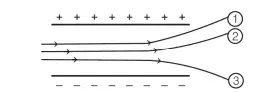
The given figure shows tracks of three charged particles in a uniform electrostatic field. Which of them is probably an α-particle?
1
2
3
None of the above
The dimensional representation of ε₀ will be
[MLT²A²]
[M⁻¹L⁻³T⁴A²]
[ML⁻²T²A²]
none of these
A parrot comes and sits on a bare high-power line. It will
experience a mild shock
experiences a strong shock
get killed instantaneously
not be affected at all
The force between two charges, when placed in free space, is 5N. If they are in a medium of relative permittivity 5, the force between them will be
1N
25N
2.5N
1/5N
10^6 electrons are taken out of a pith ball. The positive charges on the pith ball is
1.6x10^{-13} C
1.6x10^{-19} C
1.6x10^{-25} C
none of these
When a person standing barefoot on the ground comes in contact with a high-power line, he is likely to
experience a total shock
experience a mild shock
experience a moderate shock
remain unaffected
Two charges od 2μC and 5μC are placed 2.5 cm apart. The ratio of the Coulomb’s force experienced by them is
1:1
2:5
√2:√5
4:25
Two balls carrying charges -5μC and +8μC attract each other with a force F. If a charge of -3μC is added to both the balls, then the force between then will become
2F
F/2
F
zero
A hollow copper sphere is positively charged. The electric field at its center will be
same as that on the surface
more than that on the surface
less than that on the surface nut not zero
zero
What is the angle between an electric dipole moment and then electric field strength due to it on its equatorial line?
0°
90°
180°
none of these
The magnitude of a charge q at the center of two equal and like charges Q so that the three charges are in equilibrium
Q
Q/2
Q/4
–Q/4
A glass rod acquires charge by rubbing it with silk cloth. The charge on glass rod is due to:
Friction
Conduction
Induction
Radiation
Charge on a body is integral multiple of e. It is given by the law of –
Conservation of charge
Conservation of mass
Conservation of energy
Quantization of charge
In the process of charging, the mass of the negatively charged body-
Increases
Decreases
Remains Constant
None of the above
When a soap bubble is given an electric charge
It contracts
It expands
Its size remains the same
It expands or contracts depending upon whether the charge is positive or negative
The distance between two-point charges is increased by 10%. The force of interaction approximately
Increased by 10%
Decrease by 10%
Decrease by 17%
Decrease by 21%
If a charge q is placed at the center of the line joining two equal charges Q such that the system is in equilibrium, then the value of q is
Q/2
-Q/2
Q/4
-Q/4
Let ε₀ denote the dimensional formula of the permittivity of vacuum. If M=mass, L=length, T=time and I=electric current, then
[M⁻¹L⁻³T⁴I]
[M⁻¹L⁻³T⁴I⁴]
[M⁻¹L⁻²T⁻¹I²]
[M⁻¹L⁻²T⁻¹]
A negatively charged oil drop is prevented from falling under gravity by applying a vertical electric field 100 V/m. If the mass of the drop is 1.6 × 10⁻¹³g, the number of electrons carried by the drop is (g=10m/s²)
10¹⁸
10¹⁵
10¹²
10⁹
Charge in motion within the Gaussian surface gives changing physical quantity
Electric field
Electric flux
Charge
Gaussian surface area
There is a point charge q located at the center of a cube. What is the electric flux of this point charge, through a face of the cube?
q/ε₀
q/6ε₀
q/3ε₀
It will depend upon the size of the cube
A charge Q is enclosed by a Gaussian spherical surface of radius R. If the radius is doubled, then the outward electric flux will
Increase four times
Be reduced to half
Remain the same
Be doubled
Law stating that, force is directly proportional to product of charges and inversely proportional to square of separation between them, is
Newton’s law
Coulomb’s law
Gauss’s law
Ohm’s law
When a body charges by conduction, its mass
Remains same
Increases
Decreases
Increase or decrease
Electric charge between two bodies can be produced by
Sticking
Rubbing
Oiling
Passing AC current
The insulation property of air, breaks down at E = 3 × 10^6 V/m. The maximum charge that can be given to a sphere of radius 2.5 m is approximately
2×10⁻²C
2 × 10^-3 C
3×10⁻⁶C
3×10⁻⁵C
A point charge +q is placed at a distance 5 cm directly above the centre of a square of side 10 cm, as shown in Fig. What is the magnitude of the electric flux through the square?
q / ε₀
6q / ε₀
q / 6ε₀
2q / ε₀
A plane surface is rotated in a uniform electric field. When is the flux of the electric field through the surface maximum?
When the surface is perpendicular to the field
When the surface is parallel to the field
When the surface is at an angle of 45° with the field
When the surface is at an angle of 60° with the field
Two unlike charges separated by a distance of 1m attract each other with a force of 0.108N. If the charges are in the ratio 1:3, the weak charge is
2μC
4μC
6μC
5μC
Three charges +3q + q and Q are placed on a st. line with equal separation. In order to keep the charge q at equilibrium, the value of Q will be:
+3q
+2q
-3q
-4q
If an electric dipole is kept in a uniform electric field then resultant electric force on it is:
always zero
never zero
depend upon capacity of dipole
None
The number of electron-taken out from a body to produce 1 micro coulomb of charge will be:
6.25×10¹³
625×1018
6.023×10²³
None
If sphere of bad conductor is given charge then it is distributed on:
surface
inside the surface
only inside the surface
None
The dielectric constant of a metal is:
0
1
∞
-1
Each of the two-point charges are doubled and their distance is halved. Force of interaction becomes p times, where p is:
1
4
1/16
16
When placed in a uniform field, a dipole experiences:
a net force
a torque
both a net force and torque
neither a net force nor a torque
An electron is sent in an electric field of magnitude 9.1 × 10^6 NC^-1. The acceleration produced in it is:
1.6 ms^-2
1.6 × 10¹⁸ ms^{-2}
3.2×10¹⁸ms−2
0.8 × 10¹⁸ ms^{-2}
Two parallel large thin metal sheets have equal surface charge densities of 4.427 × 10⁻¹¹ C m⁻² of opposite signs. The electric field between the plates is
2 N/C
0.5 N/C
5 N/C
10 N/C
Which of the following statement is correct?
A body can have a charge of 0.8 × 10⁻¹⁹ C
Q₁ + Q₂ = 0 Signifies that the two charges are equal and opposite.
When a body acquires positive charge, its mass increases.
Charges cannot reside on the surface of a conductor.
Two-point charges of +2 μC and +6 μC repel with a force of 12 N. If each is given an additional charge of -4 μC, the new force between them will be:
+4 N
-4 N
0
3 N
The SI unit of the surface integral of electric field is:
Nm²C⁻¹
Nm⁻²C⁻¹
NC²m⁻¹
N/C
Which of the following is not a characteristic of Electrostatic force or Coulomb’s force between two charges?
It is not spherically symmetric.
It is a central force
It is a conservative force
It obeys inverse square law
The electric field intensity due to a dipole is zero
At mid-point of the dipole
at the location of either charge
On equatorial line
at infinity
The ratio of the electrostatic force between two-point charges in air and in a medium of dielectric constant K is:
K :1
1: K
K² :1
1 :1
An electric dipole of dipole moment ‘p’ lies in a stable equilibrium in a uniform electric field E. The work done in rotating the dipole from its position to unstable equilibrium is:
pE
-2pE
2 pE
0
Two-point charges are kept ‘d’ distance apart in air. The distance between them when kept in a medium of dielectric constant (K=9) such that the Coulomb’s force between them remains same is:
d = d/9
d = 3d
d = 9d
d = d/3
Two-point charges +Q and +q is separated by a certain distance. If +Q > +q, then in between the charges, the electric field is zero at a point:
Closer to +Q
closer to +q
exactly at the midpoint of line segment joining +Q and +q
nowhere on the line segment joining +Q and +q
Electric field intensity is 400 V/m when the distance is 2m from a point charge. At what distance it becomes 100 V/m?
8 m
16 m
4 m
0.5 m
The value of relative permittivity for all the dielectrics is always:
Less than unity
greater than unity
zero
equal to unity
The unit V/m is equivalent to:
N/C2
N/C
NC/m
Nm/C
When the vector area is held parallel to the field lines, then the magnitude of electric flux is:
Maximum
minimum
zero
negative
Two identical particles each having a charge of 10 μC are tied with two strings of equal length 1m at a common point. If both the strings makes an angle of 30° with vertical, then mass of each particle will be:
0.1 kg
1 kg
0.15 kg
0.5 kg
A point charge q = 10⁻¹¹ C is placed at 4 cm above a square plate (8 cm x 8 cm) having charge density 0.5 x 10⁸ C/m². Find the flux related with it.
0.188 V·m
0.12 V·m
0.288 V·m
0.388 V·m
An electric dipole is placed in a non-uniform electric field, then it experiences:
a force which must be zero
a torque which must be non-zero
a force which must be non-zero
both a force and a torque which may be non-zero
Two positive charges each of equal magnitude q are placed at a separation 2a perpendicular to X-axis. Another negative charge of mass m, is placed midway between the two charges on X-axis. If this charge is displaced from equilibrium state to a distance x(x << a), then the particle:
will execute simple harmonic motion about its its equilibrium position
will oscillate about its equilibrium position but will not execute simple harmonic motion
will not return back to the equilibrium position
will stop at equilibrium position
An electron travels a distance of 0.10 m perpendicular to an electric field of intensity 3200 V/m, entering with a velocity 4 x 10⁷ m/s. What is the deviation in its path?
1.76 mm
17.6 mm
176 mm
0.176 mm
Force per unit charge is known as
field flux
electric field
torque
electric current
A 5C charge experiences a force of 2000 N when moved between two points along the field separated by a distance of 2 cm in a uniform electric field. The potential difference between the two points is:
8 volts
80 volts
800 volts
8000 volts
Lightning phenomenon is seen in sky due to
volcanic eruption
tides
thunderstorm
All of the above
An electric charge q is placed at the centre of a cube of side a. The electric flux on one of its faces will be
q/6ε₀
q/ε₀a²
q/4πε₀a²
q/ε₀
The electric field intensity due to an infinite cylinder of radius R and having charge q per unit length at a distance r(>R) from its axis is
directly proportional to r²
directly proportional to r³
inversely proportional to r
inversely proportional to r²
A point charge q is placed at a distance a/2 directly above the centre of a square of side a. The electric flux through the square is
q/ε₀
q/4ε₀
q/πɛ₀
q/6ε₀
When a glass rod is rubbed with silk, it
Gains electrons from silk
Gives electrons to silk.
Gains protons from silk.
Gives protons to silk.
A charge Q is divided into two parts of q and Q-q. If the coulomb repulsion between them when they are separated is to be maximum, the ratio of Q/q should be
2:1
½
4:1
1/4
Two charges q₁ and q₂ are separated by a distance ‘d’ from each other in vacuum. If the product of their charges (q₁ × q₂) is positive then the nature of electrostatic force acting between them
Attractive
Repulsive
Either repulsive or attractive
Insufficient data
Two charges q₁ and q₂ are separated by a distance ‘d’ from each other in vacuum. If the sum of their charges (q₁ + q₂) is negative, then the nature of electrostatic force acting between them
Attractive
repulsive
Either repulsive or attractive
Insufficient data
Two pith balls each having equal mass ‘m’ and equal charge ‘q’ on them, are suspended by two insulating string of equal length. If a mica sheet is inserted between them, then the electrostatic force acting between them will:
Increase
Decrease
Remain same
Change in force will be equal to the weight of the mica sheet.
The force between two charges is 100N. If the distance between the two charges is doubled, the force will be
25 N
50N
200N
400N
A charge +10μC is placed at origin of Cartesian co-ordinate. If another charge +2μC is moved from (1,0) to (2,0) on x-axis, the work done by the field will be
Positive
Negative
Zero
May be positive or negative
The dimensions of electric flux is:
[ML²T⁻³A⁻¹]
[ML³T⁻³A⁻¹]
[ML³T²A⁻¹]
[ML³T⁻³A⁻²]
In the process of charging, the mass of the negatively charged body
Increases
Decreases
Remains Constant
None of the above
Which Quantity is vector Quantity among the following
Electric flux
Electric charge
Electric field
Electric potential
Charge on a conducting metal sphere cause the electric field lines around it,
Perpendicular on the surface of sphere
Inside and outside the sphere
Outside the sphere in random directions.
Only inside of sphere
What will be the total flux through the faces of the cube with side of length ‘a’ if a charge of ‘q’ is placed at the corner of the cube?
q/ε₀
q/2ε₀
q/4ε₀
q/8ε₀
Consider an equilateral triangle ABC of side ‘a’. If two equal charges ‘q’ each are placed at the vertices A and B, then the magnitude of electric field intensity at C will be:
q/(4πε₀a²)
2q/(4πε₀a²)
q√3/(4πε₀a²)
q√2/(4πε₀a²)
An electric dipole is placed in an external non-uniform electric field.
It must experience force but not torque.
It must experience force and may experience torque.
It will experience neither force nor torque.
It may experience force and must experience torque.
Two point charges each of +2μC are placed at certain distance (in meters). If their locations are (i + j + k) and (3i + 2j + 3k), then the electrostatic force between them will be:
1 × 10³ N
2 × 10³ N
3 × 10³ N
4 × 10-³ N
Which of the following is a property of an electric dipole moment?
Its magnitude is equal to the product of charge and distance between charges.
It is directed from negative charge to positive charge.
Net force on the dipole placed in external uniform electric field is zero.
All of these.
What is the value of minimum force acting between two charges placed at 1 m apart from each other (Symbols have their usual meaning)
K.e^2
K.e2/2
K.e2/4
K.e2/8
What will be the value of electric field at the centre of the electric dipole:
Zero
Equal to the electric field due to one charge at centre
Twice the electric field due to one charge at centre
half the value of electric field due to one charge at centre
Charge Q is distributed to two different metallic spheres of radii R and 2R such that both spheres have equal surface charge density. Then charge on large sphere is
4Q/5
Q/4
3Q/5
5Q/4
In the process of charging, the mass of the negatively charged body-
Increases
Decreases
Remains Constant
None of the above
Electric field lines contracts lengthwise, It shows
Repulsion between the same charges.
Attraction between opposite charges
No relation between force & contraction.
Electric field lines does not moves on straight path
In a parallel plate capacitor, the capacitance depends on:
Dielectric material between the plates
All of the above
Area of the plates
Distance between the plates
Which of the following is a property of electric field lines?
They are always circular
They are always straight
They can cross each other
They point from positive to negative charge
What happens to the electric field strength when the distance between two point charges is doubled?
It doubles
It remains the same
It decreases by a factor of four
It increases by a factor of four
What is the electric field strength at a distance r from a point charge Q?
None of these
Q/4πε₀r²
Q/r
kQ/r²
When two identical charges are brought closer, the force between them will:
Decrease
Become zero
Remain the same
Increase
What is the electric field strength at a distance r from a point charge Q?
Q/r²
Q/4πε₀r²
kQ/r²
kQ/r

