
 Worksheets
8.3 curved mirror
Total questions: 97
Worksheet time: 24hrs 15mins
The image of an object as formed by a plane mirror is located ____.
in front of the mirror surface
on the mirror surface
behind the mirror surface
any of the above, depending on the object's locaiton

Type of mirror used as a side mirror on a vehicle to provide a wide angle view...
Plane
Convex
Concave
During reflection of a ray of light, the angle of (a) is equal to the angle of reflection.
For a spherical mirror, the focal length is equal to
the radius of curvature
the diameter of curvature
half radius of curvature
half diameter of curvature

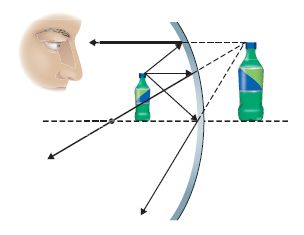
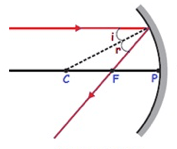
This ray diagram is for which mirror?
concave
convex
plane
window
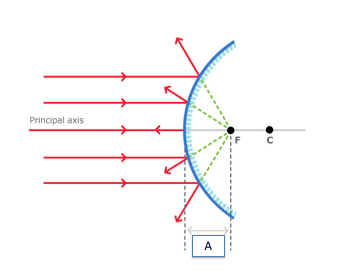
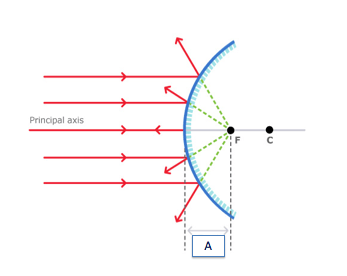
In the image, all the rays meet at F, What is F
focal length
focal point
center of curvature
reflection

Name the mirror that curves inwards
plane mirror
convex mirror
concave mirror
spherical mirror

An object placed at the center of curvature will form an image that is .............. the size of the object.
larger than
the same as
smaller than
A real image is always
virtual
upright
behind the mirror
in front of the mirror
All rays that pass through the focal point in a concave mirror reflect
Towards the focal point
Away from the focal point
Towards the center of curvature
Away parallel to the principal axis
A virtual image is always
virtual
upright
behind the mirror
in front of the mirror
An image behind the mirror is...
virtual
real
inverted
upright
An image that points below the principal axis is (choose 2)...
virtual
real
upright
inverted
If the object is beyond C (2F)...
image is real, smaller and inverted
image is real, smaller and upright
image is virtual, smaller and inverted
image is real, bigger and upright
This ray diagram is for which mirror?
concave
convex
plane
window
In the image, all the rays meet at F, What is F
focal length
focal point
center of curvature
reflection
This image is showing a convex mirror because the image is (choose 2 answers)
real light rays meet behind the mirror
real light rays don't meet
the focal point is in front of the mirror
the focal point is behind the mirror
This type of mirror is used in supermarkets to see around bends
concave
convex
plane
window
Real images are :
Always inverted
can be larger or smaller than the object
can be obtained on screen
all the above
A dentist uses a small dental mirror to help magnify teeth in your mouth. What type of mirror is this?
a convex mirror
a concave mirror
a convex lens
a concave lens
The side view mirrors on your car help shrink the image on both sides of the car, allowing you to see a larger field of view. What type of mirror is this?
a convex mirror
a concave mirror
a convex lens
a concave lens
An image that forms when light rays actually meet
virtual image
real image
diffuse reflection
regular reflection
Virtual images are
always upright
can be obtained on screen
always smaller
If the object is between C and f, the image is ...
image is real, smaller, and inverted
image is real, smaller, and upright
image is virtual, smaller, and inverted
image is real, bigger, and inverted
If the object is between f and the mirror, the image is ...
image is real, smaller, and inverted
image is virtual, larger, and upright
image is virtual, smaller, and inverted
image is real, bigger, and inverted
What kind of mirror is used as surveillance mirror in groceries?
plane mirror
concave mirror
convex mirror
Which of the following best describes the image formed by a concave mirror when the object is placed between the focus and the mirror?
inverted and smaller
inverted and bigger
upright and bigger
upright and smaller
Which does NOT belong to the group?
Dentist’s mirror
Flashlight mirror
Side view mirror

What kind of mirror is shown?
(a)

A person views his image in front of a mirror. His image is virtual, upright, and smaller than him. What kind of mirror is he using?
plane
concave
convex
Which of these mirrors will ALWAYS form a virtual image?
plane and concave mirror
plane mirror only
convex mirror only
convex and plane mirror
Virtual image is always upright, formed by the convergence of actual reflected light rays, and smaller than the object.
True
False
The following statements describes a real image EXCEPT _________
Formed by the actual convergence of reflected light rays
Always larger than the object
Can be projected on a screen
Always inverted
Which image is REAL?
Image of cars on a side view mirror
Image of your face in front of a make up mirror
Image of a sink on bathroom mirror
Image of your hand in front of a large metal spoon
A ray of light parallel to the principal axis will be reflected passing through the (a) of a concave mirror.
A mirror used by dentist in magnifying the area behind your teeth to check on cavities and tooth decay.
concave
convex
Mirrors used for illuminating purposes such as headlights of cars, flashlights, and spotlights.
concave
convex
A mirror that gives a wider view field making bigger objects appear to be smaller than their original form.
concave
convex
A mirror used as surveillance mirrors in groceries and parking spaces
concave
convex
A mirror that always produces reduced and virtual image
concave
convex
A mirror that is used in shaving and applying make up
concave
convex
A mirror that produces upright and enlarged image when the object is very near
concave
convex
A mirror that produces an inverted and smaller image when the object is far from it
concave
convex
A mirror that focuses parallel light rays
cocave
convex
A real image is always inverted, can be projected on a screen, and produced by the actual intersection of reflected light rays
True
False
curved mirrors have bent (curved) reflecting surfaces. they are part of a hollow,
there are 2 types of curved mirrors which are :
lexicon mirrors
confess mirrors
convex mirror
concave mirror
they are mirrors whose reflective surfaces are curved inwards
example: a surface if a spoon is curved inwards
convex mirror
concave mirror
they are mirrors whose reflective surfaces are curved outwards
For example a surface of a spoon bulged inwards
convex mirror
concave mirror
This image is showing a convex mirror because the image is (choose 2 answers)
real light rays meet behind the mirror
real light rays don't meet
the focal point is in front of the mirror
the focal point is behind the mirror
An object is positioned between a concave mirror's center of curvature and its focal point. The image produced by the mirror is located
beyond the center of curvature.
at the center of curvature.
between the center of curvature and the focal point.
at the focal point.
A person kept an object at beyond 'C' of a concave mirror. Where should a screen be kept if he needs to project the image on it?
At F
At C
Between F and P
Between C and F
A candle is kept between F and P of a concave mirror. Can this image be projected on a screen?
Yes it can be
No it cannot be
Cannot be predicted
At which position of the object, will a concave mirror produces magnified and erect image?
At C
Between F and P
Between C and F
At F
If you wish to get enlarged image of any object, which mirror will u select?
Convex mirror
Plane mirror
None of these
Concave mirror
How to you decide that a mirror is concave or convex without touching it?
By observing the surface
By keeping them in sunlight so that surfaces can be clearly seen
By keeping them in front of your face and observing the kind of image we obtain
By moving mirrors here and there
A point object is placed at a distance of 20 cm from a convex mirror of focal length 20 cm. The image will form at:
at infinity
at focus
at the pole
behind the mirror
An object is placed at 100 mm in front of a concave mirror which produces an upright image (erect image). The radius of curvature of the mirror is:
Less than 100 mm
Between 100 mm and 200 mm
Exactly 200 mm
More than 200 mm
Two big mirrors A and B are fitted side by side on a wall. A man is standing at such a distance from the wall that he can see the erect image of his face in both the mirrors. When the man starts walking towards the mirrors, he finds that the size of his face in mirror A goes on increasing but that in mirror B remains the same:
Mirror A is concave and mirror B is convex
Mirror A is plane and mirror B is concave
Mirror A is concave and mirror B is plane
Mirror A is convex and mirror B is concave
A concave mirror gives real, inverted and same size image if the object is placed
At f
At infinity
At C
Beyond C
In which of the following cases distance between object and its image formed will be zero
When object is placed at center of curvature of convex mirror
When object is placed at center of curvature of concave mirror
when object is placed at focal point of concave mirror
When object is placed between center of curvature and focal point of concave mirror
An object at a distance of + 15 cm is slowly moved towards the pole of a convex mirror. The image will get
shortened and real
enlarged and real
enlarged and virtual
diminished and virtual
In the image, all the rays meet at F, What is F
focal length
focal point
center of curvature
reflection
This image is showing a convex mirror because the image is (choose 2 answers)
real light rays meet behind the mirror
real light rays don't meet
the focal point is in front of the mirror
the focal point is behind the mirror
An image behind the mirror is...
virtual
real
inverted
upright
An image that points below the principal axis is (choose 2)...
virtual
real
upright
inverted
If the object is beyond C (2F)...
image is real, smaller and inverted
image is real, smaller and upright
image is virtual, smaller and inverted
image is real, bigger and upright
This ray diagram is for which mirror?
concave
convex
plane
window
In the image, all the rays meet at F, What is F
focal length
focal point
center of curvature
reflection
This image is showing a convex mirror because the image is (choose 2 answers)
real light rays meet behind the mirror
real light rays don't meet
the focal point is in front of the mirror
the focal point is behind the mirror
This type of mirror is used in supermarkets to see around bends
concave
convex
plane
window
Real images are :
Always inverted
can be larger or smaller than the object
can be obtained on screen
all the above
A dentist uses a small dental mirror to help magnify teeth in your mouth. What type of mirror is this?
a convex mirror
a concave mirror
a convex lens
a concave lens
The side view mirrors on your car help shrink the image on both sides of the car, allowing you to see a larger field of view. What type of mirror is this?
a convex mirror
a concave mirror
a convex lens
a concave lens
An image that forms when light rays actually meet
virtual image
real image
diffuse reflection
regular reflection
Virtual images are
always upright
can be obtained on screen
always smaller
If the object is between C and f, the image is ...
image is real, smaller, and inverted
image is real, smaller, and upright
image is virtual, smaller, and inverted
image is real, bigger, and inverted
If the object is between f and the mirror, the image is ...
image is real, smaller, and inverted
image is virtual, larger, and upright
image is virtual, smaller, and inverted
image is real, bigger, and inverted

