
 Worksheets
Semester Review
Total questions: 32
Worksheet time: 16mins
Name
Class
Date
1.
How did the geography of China influence its development?
a)
There were few people who lived there due to the harsh climate
b)
There were lots of tourists due to the beautiful scenery
c)
There were fewer wars and less trade with other countries due to the natural barriers
d)
There were no languages being spoken
2.
Zhou rulers claimed that they had won the Mandate of Heaven because they
a)
brought the Warring States period to an end.
b)
were victorious over the Shang dynasty.
c)
were chosen as rulers by Shang priests.
d)
served the interests of powerful warlords.
3.
What were the new important belief systems that developed in China during the Zhou dynasty? (Choose two)
a)
Buddhism
b)
Confucianism
c)
Hinduism
d)
Daoism
4.
Who was the Terracotta Army Built for?
a)
Marco Polo
b)
Kublai Khan
c)
Confucius
d)
Emperor Shi Huangdi
5.
How did the reunification of China under the Tang Dynasty impact the region?
a)
It helped promote the spread of Buddhism
b)
It increased the influence of Europe in the region
c)
It created an alliance between Japan and China
d)
It created an economic depression in China
6.
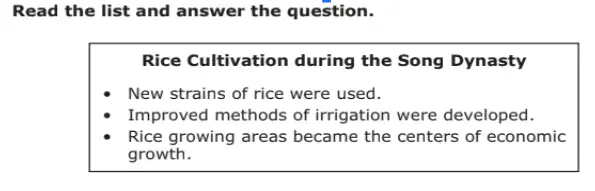
Why were the technologies in the list so important to the Song Dynasty?
a)
Mountainous terrain improved access to foreign goods
b)
Higher farm activity was needed to sustain an expanding civilization
c)
Desert conditions improved access to rivers for the growth of crops
d)
Taxes on foreign agricultural products led to food shortages
7.
The Song Dynasty was responsible for which invention?
a)
gunpowder
b)
irrigation
c)
steel
d)
wheel
8.
Song Dynasty, China (960 – 1280)
Tea production expanded • Fast-growing rice introduced • Canal system expanded • Fine porcelain developed
Which statement best summarizes the significance of these achievements?
a)
Overseas colonies were established
b)
Commercial activity expanded
c)
Agricultural prices increased
d)
The Chinese adopt Japanese
9.
Who founded the Mongol Empire, conquered most of Eurasia, and encouraged religious tolerance?
a)
Constantine
b)
Siddhartha Gautama
c)
Justinian
d)
Genghis Khan
10.
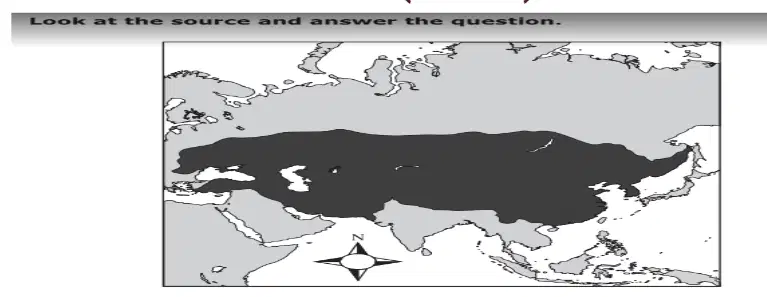
Which TWO statements best describes the empire highlighted in the picture below?
a)
It established the Yuan Dynasty in China
b)
It conquered Southern China under Kublai Khan
c)
It reached the height of power under the leadership of Mehemmed II
d)
It peacefully expanded into European territrories
e)
It conducted the first trade route along the Silk Road
11.
Which events helped increase European influence in China in the 1200's? Select TWO
a)
explorations of Marco Polo
b)
military alliances between India and China
c)
increased trade on the Silk Road
d)
the reconstruction of the Great Wall
12.
About 405 AD, the Japanese court officially adopted the Chinese writing system. During the sixth century, Buddhism was introduced. These two events revolutionized Japanese culture and marked the beginning of a long period of Chinese cultural influence. — U.S. Department of State
Which factor most contributed to the 405 AD events described in the source?
a)
invasion of Japan by Mongols during the Yuan Dynasty
b)
overseas expansion of China
c)
location of the Yangtze River
d)
diffusion of Chinese culture through the Korean peninsula
13.
Japan became a military society in the late twelfth century in part thanks to samurai owing allegiance to the shogun instead of the emperor.
a)
True
b)
False
14.
Which title best describes a soldier and protector of daimyo in 12th Century Japan?
a)
consul
b)
king
c)
pharaoh
d)
samurai
15.
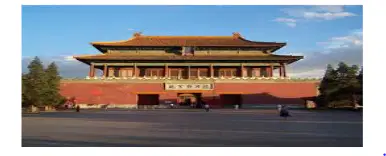
Which ancient civilization created the structure in this picture?
a)
Byzantine Empire
b)
Ming Dynaty
c)
Mongolian Empire
d)
Holy Roman Empire
16.
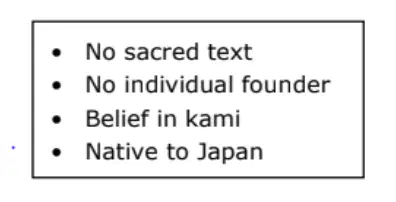
Which belief system is associated with these characteristics?
a)
Shintoism
b)
Buddhism
c)
Confucanism
d)
Hinduism
17.
Which of the following is inspired by the teachings of Shinto?
a)
Shinto focuses on human inventions
b)
Shinto supports the belief of one god
c)
Shinto supports the practice of religious pilgrimage
d)
Shinto focuses on the spirits of nature
18.
Which period is best known for the growth of art and writing in Japanese history?
a)
Heian Period
b)
Samurai Period
c)
Tang Dynasty
d)
Yuan Dynasty
19.
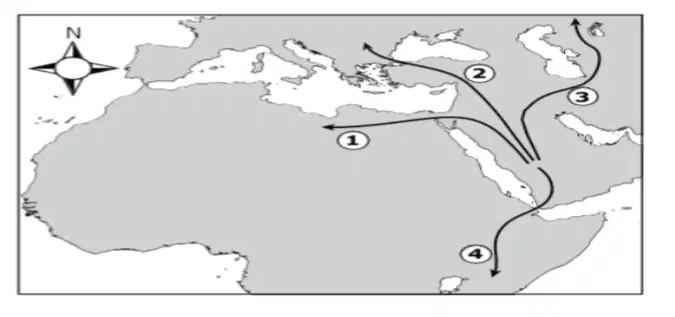
Which route shows Islamic expansion beyond the Arabian peninsula?
a)
1
b)
2
c)
3
d)
4
20.
Complete the Five Pillars of Islam: Declaration of Faith, mandatory prayer, compulsory giving, fasting during Ramadan, and..
a)
college education
b)
military service
c)
pilgrimage to Mecca
d)
study of Judaism
21.
Which holy texts are important to Islam?
Select two that apply.
a)
Brahmanas
b)
Qur'an
c)
Sunnah
d)
Sutras
e)
Talmud
22.
Which statement explains the historical significance of the Qur’an?
a)
It is an ancient text for the Shinto religion.
b)
It is part of traditional beliefs of Judaism.
c)
It is part of the core belief system of Buddhism.
d)
It is the foundational text for the religion of Islam.
23.

Which region is credited with these mathematics contributions?
a)
West Africa
b)
East Asia
c)
Western Europe
d)
The Middle East
24.
This list of accomplishments was achieved by which historical figure: led the Ottoman Empire in the 15th century, conquered Constantinople, and led many social reforms
a)
Zeng He
b)
Justinian
c)
Genghis Khan
d)
Mehmed the Conqueror
25.
Which phrase describes the correct transfer of goods along the Silk Road?
a)
the transport of rice during Zheng He's sea voyages
b)
the movement of spices throughout Central Asia
c)
the exchange of gems during Jacques Cartier's expeditions
d)
the spread of glass throught northern Europe
26.
Trade routes through the Middle East helped connect European and Asian civilizations to civilizations on which other continent?
a)
Africa
b)
Australia
c)
North America
d)
South America
27.
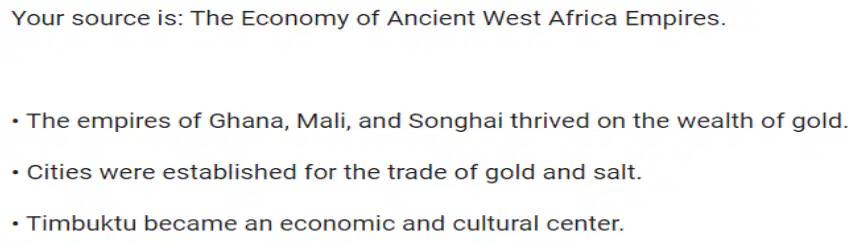
Which conclusion is best supported by the source?
a)
African rulers limited the manufacture of finished goods
b)
Trans-Saharan trade routes helped maintain regional commerce
c)
African rulers limited trade with overseas nations
d)
Trans-Saharan trade routes were controlled by nomadic warlords
28.
Why did the Kingdom of Mali become the main power of West Africa?
a)
The kingdom had a very small population
b)
The kingdom refused to trade with Europe
c)
The kingdom was the birthplace of Islam
d)
The kingdom controlled the regional gold trade
29.
What factor led to the growth of the city of Djenne?
a)
the opening of the Silk Road
b)
the spread of Arabic learning
c)
the start of European exploration
d)
the expansion of the Mongolian empire
30.
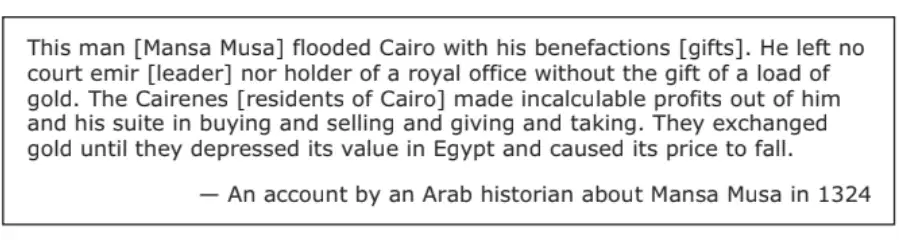
Which statement explains the effect of Mansa Musa's journey to Egypt?
a)
He spending led to a decreased demand for local goods
b)
His caravan introduced new political ideas
c)
His wealth overwhelmed the local economy
d)
His caravan created new empires in the region
31.
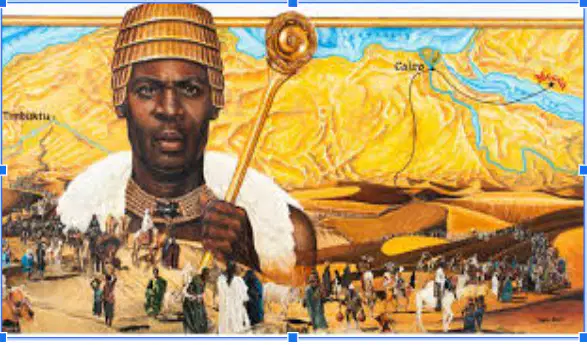
Which historical figure was a king of Mali?
a)
Constantine
b)
Justinian
c)
Kublai Khan
d)
Mansa Musa
32.
Which event completes the timeline of events in European history?
Rome built on Ancient Greece - Germanic invaders destroyed the Western Roman Empire - ????
a)
Genghis Khan invaded the Byzantine Empire
b)
Jerusalem was named the new capital of the Byzantine Empire
c)
The Byzantine Empire continued the traditions of the Roman Empire
d)
The Byzantine Empire invented democratic government
100 %

