
 Worksheets
HS-Inspection Tools
Total questions: 66
Worksheet time: 33mins
Why is it important to be careful around voltage supplies, especially in places like homes and schools?
Because voltage supplies can be dangerous and cause electric shocks.
Because voltage supplies are always safe to touch.
Because voltage supplies are only used for decoration.
Because voltage supplies do not need any safety rules.

When lifting something heavy, what is the correct way to handle it according to the old saying for manual handling?
Bend your knees not your BACK
Bend your back not your knees
Lift with your arms only
Twist your body while lifting

In an emergency, are you allowed to use your mobile phone?
YES as time is essential
No, you should wait for help
Only if you have permission
Never use your phone in emergencies

Which of the following information is important and relevant to pass on to emergency services?
Address, nature of emergency, exact location, number of people injured and types of injuries, your contact details
Your favorite color and food
The weather outside
The time you woke up today

If you are given a set of electrical supplies, tools, and equipment for your class, what should you do to make sure they are suitable for use?
Assess them to check if they are appropriate
Ignore them and use them anyway
Only use the tools without checking
Ask someone else to use them first

When working on a construction site, how can you make sure you are using the correct voltages for plant and equipment?
Identify the recommended voltages for distribution
Use any voltage available
Guess the voltage needed
Ignore voltage requirements

How can you determine the voltage used for socket outlets in a safe way?
Use the colour code for voltage identification
Plug in any device and see if it works
Ask a friend for advice
Use the highest voltage available

If someone touches a high voltage electrical wire on a construction site, which of the following injuries could they experience?
Electric shock
Sunburn
Broken bone
Frostbite

Which of these is a possible result of an electrical accident on a work site?
Electrical burns
Paper cuts
Sprained ankle
Allergic reaction

What can happen to a person's muscles if they are injured by electricity?
Loss of muscle control
Muscle growth
Muscle relaxation
Muscle itching

Which of the following can be caused by electrical supplies on a construction site?
Fires arising from electrical causes
Flooding
Loud music
Heavy traffic

What is a danger that can happen when electricity jumps and creates a bright flash?
Arcing and explosion
Thunder
Short circuit
Flash
If you see a broken equipment case exposing internal bare live connections, what should you do to stay safe?
Throw it away
Report it to the site manager
Try to fix it yourself
Ignore it and walk away
Why can a cracked equipment case be dangerous?
It can make the equipment look old
It can cause 'tracking' from internal live parts to the outside, making it unsafe to touch
It makes the equipment heavier
It makes the equipment work faster
What is a possible danger if the supply cord insulation is damaged?
The cord will look colorful
The cord will be longer
Bare live conductors may be exposed, which can cause electric shock
The cord will be easier to carry
If you see a broken plug exposing bare live connections, what should you do?
Plug it in and use it
report it
Try to fix the plug
Put tape on it and use it

Which of the following is an example of an electrical danger that you might find at home?
Damaged toaster
Damaged radiator
Damaged Door lock
Damaged Patio door

If you see a cable with its wires showing, what kind of electrical danger is this?
Exposed conductors
Shiny shoes
Painted walls
Closed windows
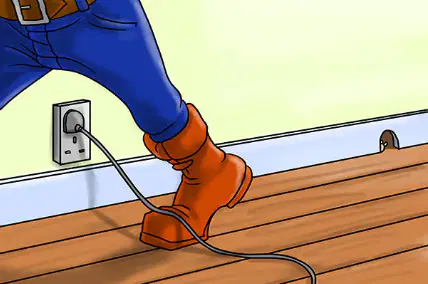
Why should you be careful with cables that are lying across the floor?
They can cause someone to trip and get hurt
They make the room look pretty
They help you walk faster
They keep the floor clean
Which of these is NOT a danger related to electricity?
Damaged insulation
Worn electrical cables
Trailing cables
Toaster in the kitchen
Which of the following is an advantage of using battery-powered tools in the building services industry?
They have no trailing leads.
They always need to be plugged in.
They are heavier than other tools.
They cannot be used without electricity.
Why are battery-powered tools considered safer in terms of electric shock?
They use voltage levels that mean there is no risk of electric shock.
They use very high voltage.
They must be used near water.
They have long trailing wires.
How do battery-powered tools help when there is no mains electricity supply available?
They can be used if the batteries are charged elsewhere.
They cannot be used at all.
They need to be plugged into the wall.
They stop working immediately.
What is one benefit of battery-powered tools related to movement?
They offer greater mobility.
They are always fixed in one place.
They are too heavy to move.
They need long wires to move around.
Why is it important for portable electric tools to have different means of maintaining safety in relation to their electrical supply?
To make the tools look more interesting
To protect users from electric shock
To make the tools heavier
To use more batteries
How are electrical equipment for protection against electric shock classified?
By their color
By their size
Into three groups: Class I, Class II, and Class III
By their price
If you are using a portable electric tool, which sources of electrical supply might it use?
Water and air
Mains and battery
Sunlight and wind
Oil and gas

What do the three symbols represent?
Symbols for different types of electrical equipment safety classes
Symbols for different types of batteries
Symbols for different types of Cables
Symbols for different types of switches
Which of the following is a feature of Class I electrical appliances?
They have three cables and a metal Earth pin.
They are always made of plastic.
They do not need to be earthed.
They never have a fuse in the plug.
What is the purpose of earthing the external conductive parts of a Class I appliance?
To protect users from electric shock.
To make the appliance work faster.
To keep the appliance cool.
To reduce noise from the appliance.
Which of these is an example of a Class I appliance?
Refrigerator
Wooden chair
Plastic cup
Book

How can you confirm if an appliance is Class I?
By looking for the Class I symbol on the appliance.
By checking if it is heavy.
By seeing if it is colorful.
By asking a friend.

Why do Class II appliances not need an earth connection?
Because they have double insulation
Because they use more electricity
Because they are always made of metal
Because they are very small
Which of the following is an example of a Class II appliance?
Hair dryer
Refrigerator
Washing machine
Oven
What is the purpose of the plastic casing in Class II appliances?
To provide backup protection
To make the appliance look nice
To help the appliance use less power
To keep the appliance cool
If a Class II appliance has an internal fault, what prevents the external parts from becoming live?
Adequate insulation between external and internal parts
The earth connection
The metal casing only
The power switch

Why is the Class III method of protection used in electrical appliances?
To prevent electric shock completely
To reduce the severity of electric shock and make it more survivable
To increase the voltage supply
To make appliances work faster
Which of the following is an example of a Class III appliance?
Refrigerator
Laptop
Washing machine
Electric oven
What is the maximum supply voltage allowed for Class III appliances?
100 V AC
230 V AC
50 V AC
12 V AC
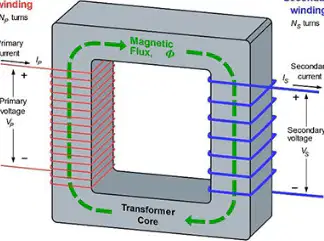
What does a safety isolating transformer do in Class III appliances?
Increases the voltage to the appliance
Connects the appliance directly to the power source
Separates the power source from the appliance using coil windings
Makes the appliance heavier
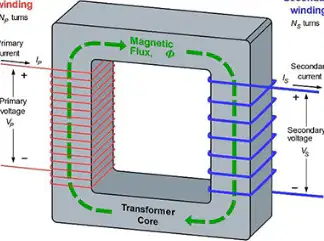
What are the two coil windings in a transformer called?
Main and Extra windings
Primary and Secondary windings
First and Second windings
Core and Circuit windings

If you are working with a fixed plant such as a crane on a construction site, which voltage is recommended for its electrical supply?
400V
230V
110V
SELV
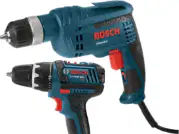
Which voltage should be used for portable tools and hand lamps on a construction site?
400V
230V
110V
SELV

What is the recommended voltage for site offices and fixed flood lighting on construction sites?
400V
230V
110V
SELV

Which type of electrical supply is recommended for portable lamps used in damp and confined places?
400V
230V
110V
SELV
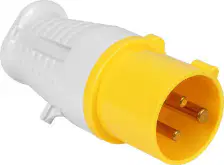
If a socket outlet is coloured yellow, what voltage does it identify?
110V
25V
230V
400V
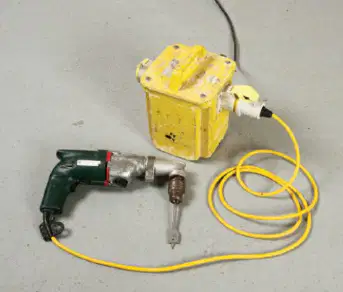
Why is it safer to reduce the system voltage to around 50V when working with electrical supplies?
Because the current flow through the body will be significantly reduced
Because the colour of the socket changes
Because the tools work faster
Because the voltage becomes zero

Match the socket outlet colour to its voltage: Blue is used for which voltage?
230V
25V
50V
400V
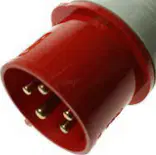
If you see a socket outlet coloured red, what voltage should you expect?
400V
110V
25V
50V
Why is a reduced low voltage system considered safer than using mains-operated (230 V) equipment?
Because it uses more wires
Because it has a lower potential shock voltage
Because it is more expensive
Because it is a Class III system
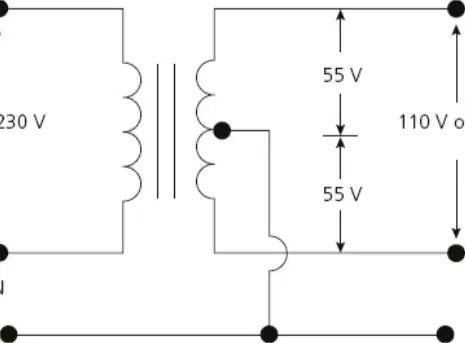
What is the maximum voltage to earth from a 230/110 V step-down transformer with a centre-tapped secondary winding?
230 V
110 V
55 V
12 V
In the UK, what type of transformer is commonly used for low-voltage electrical supplies to reduce the risk of electric shock?
Single-wound transformer
Double-wound step-down transformer
Step-up transformer
Solar transformer
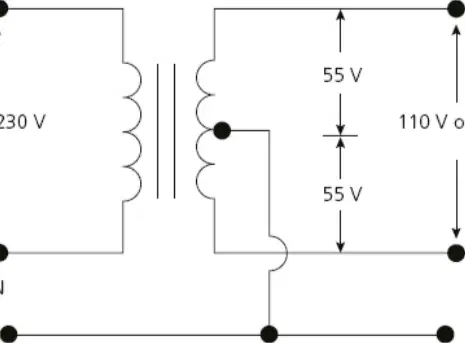
What happens if you touch either pole and earth in a centre-tapped transformer system?
You receive a shock of 230 V
You receive a shock of 110 V
You receive a shock of 55 V
You do not receive any shock
Why is it important to regularly inspect and test portable appliances?
To confirm the equipment remains in a safe condition
To make the equipment look new
To increase the speed of the equipment
To reduce the size of the equipment
Which of the following is NOT a category of in-service inspection or testing for portable tools and equipment?
User checks (pre-use inspections)
Periodic formal inspection or checks
Periodic combined inspection and testing
Painting the equipment
What is the main purpose of Portable Appliance Testing (PAT)?
To ensure electrical appliances are safe to use
To make appliances work faster
To change the color of appliances
To make appliances lighter
How do user checks help maintain safety in using portable equipment?
By checking for signs of damage or obvious defects before use
By cleaning the equipment every day
By turning off the equipment after use
By storing the equipment in a box
If you are checking a portable appliance, which of the following is a correct way to inspect the casing?
Make sure the casing has no visible damage and is free from dents and cracks.
Ignore any dents or cracks in the casing.
Only check the color of the casing.
Only check if the casing is made of metal.
When inspecting supply leads, what should you do to make sure they are safe?
Check that they are free from cuts or fraying.
Only look at the color of the supply lead.
Ignore any damage to the supply lead.
Only check if the supply lead is long enough.
What is important to check about the switches on portable equipment during a visual inspection?
Make sure the switches operate correctly.
Only check if the switches are clean.
Ignore the switches during inspection.
Only check if the switches are made of plastic.
How should the cord or cable connections of a supply lead plug be during inspection?
The connections should be correct and secure.
The connections can be loose.
The connections should be ignored.
The connections should be tangled.
Why is it important that there are no visible exposed conductor insulation or exposed live conductors in supply leads?
To prevent electrical accidents and keep the appliance safe.
To make the supply lead look colorful.
To make the supply lead lighter.
To make the supply lead longer.
Why is visual examination considered an essential part of electrical safety checks for portable appliances?
Because it can find all types of electrical defects.
Because some defects can only be found by testing.
Because some electrical safety defects cannot be detected by testing alone.
Because it is faster than testing.
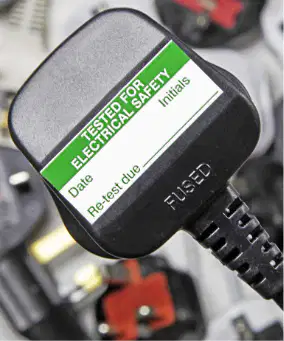
What should be done if a portable appliance is found to be unsafe during a visual inspection?
Continue using the equipment as normal.
Remove it from service immediately and label it as unsafe.
Ignore the fault and do nothing.
Only test the equipment again.
If no defects are found during a visual inspection of a portable appliance, what record needs to be kept?
A detailed report must be written.
No record is needed.
A photo of the appliance must be taken.
The appliance must be tested again.
What percentage of faults can be identified if user checks are carried out as described?
50%
75%
95%
100%

