
 Worksheets
Netacad Exam: Modules 5 and 6 STP & Etherchannel
Total questions: 34
Worksheet time: 17mins
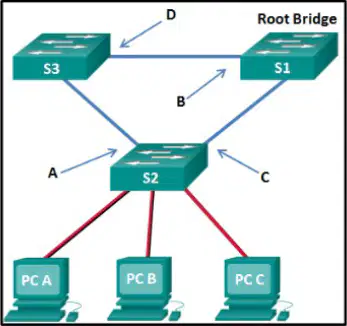
What are the possible port roles for ports A, B, C, and D in this RSTP-enabled network?
alternate, root, designated, root
designated, root, alternate, root
designated, alternate, root, root
alternate, designated, root, root
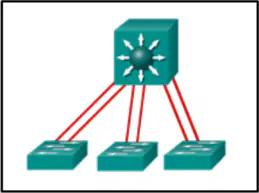
Which switching technology would allow access layer switch links to be aggregated to provide more bandwidth between each Layer 2 switch and the Layer 3 switch?
EtherChannel
HSRP
Trunking
PortFast
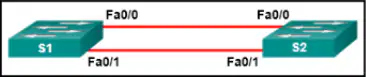
An administrator wants to form an EtherChannel between the two switches by using the Port Aggregation Protocol. If switch S1 is configured to be in auto mode, which mode should be configured on S2 to form the EtherChannel?
on
off
desirable
auto
Which set of configuration commands issued on S1 will successfully create the EtherChannel link between S1 and S2?
interface Port-channel 1; no shutdown
interface GigabitEthernet0/1; channel-group 2 mode desirable
interface GigabitEthernet0/1; channel-group 2 mode desirable interface GigabitEthernet0/2; channel-group 2 mode desirable
interface GigabitEthernet0/1; no shutdown
Which spanning tree standard supports only one root bridge so that traffic from all VLANs flows over the same path?
PVST+
Rapid PVST
802.1D
MST
Which port role is assigned to the switch port that has the lowest cost to reach the root bridge?
non-designated port
disabled port
root port
designated port
When the show spanning-tree vlan 33 command is issued on a switch, three ports are shown in the forwarding state. In which two port roles could these interfaces function while in the forwarding state?
disabled
alternate
blocked
designated
root
What is the value used to determine which port on a non-root bridge will become a root port in a STP network?
the VTP revision number
the lowest MAC address of all the ports in the switch
the path cost
the highest MAC address of all the ports in the switch
What is the outcome of a Layer 2 broadcast storm?
Routers will take over the forwarding of frames as switches become congested.
ARP broadcast requests are returned to the transmitting host.
New traffic is discarded by the switch because it is unable to be processed.
CSMA/CD will cause each host to continue transmitting frames.
What are two drawbacks to turning spanning tree off and having multiple paths through the Layer 2 switch network?
The switch acts like a hub.
The MAC address table becomes unstable.
Broadcast frames are transmitted indefinitely.
Port security becomes unstable.
Which protocol provides up to 16 instances of RSTP, combines many VLANs with the same physical and logical topology into a common RSTP instance, and provides support for PortFast, BPDU guard, BPDU filter, root guard, and loop guard?
MST
Rapid PVST+
PVST+
STP
A set of switches is being connected in a LAN topology. Which STP bridge priority value will make it least likely for the switch to be selected as the root?
61440
32768
4096
65535
What is a characteristic of spanning tree?
It is used to discover information about an adjacent Cisco device.
It has a TTL mechanism that works at Layer 2.
It is enabled by default on Cisco switches.
It prevents propagation of Layer 2 broadcast frames.
In which two port states does a switch learn MAC addresses and process BPDUs in a PVST network?
disabled
learning
listening
forwarding
blocking
Which two network design features require Spanning Tree Protocol (STP) to ensure correct network operation?
implementing VLANs to contain broadcasts
redundant links between Layer 2 switches
static default routes
removing single points of failure with multiple Layer 2 switches
link-state dynamic routing that provides redundant routes
A small company network has six interconnected Layer 2 switches. Currently all switches are using the default bridge priority value. Which value can be used to configure the bridge priority of one of the switches to ensure that it becomes the root bridge in this design?
A. 28672
B. 1
C. 61440
D. 32768
E. 31416
What is the purpose of the Spanning Tree Protocol (STP)?
allows Cisco devices to exchange routing table updates
prevents Layer 2 loops
prevents routing loops on a router
creates smaller broadcast domains
creates smaller collision domains
Which two parameters must match on the ports of two switches to create a PAgP EtherChannel between the switches?
Port ID
VLAN information
Speed
MAC address
PAgP mode
Which statement is true regarding the use of PAgP to create EtherChannels?
It increases the number of ports that are participating in spanning tree.
It requires full duplex.
It is Cisco proprietary.
It mandates that an even number of ports (2, 4, 6, etc.) be used for aggregation.
It requires more physical links than LACP does.
A network administrator has configured an EtherChannel between two switches that are connected via four trunk links. If the physical interface for one of the trunk links changes to a down state, what happens to the EtherChannel?
The EtherChannel will transition to a down state.
Spanning Tree Protocol will recalculate the remaining trunk links.
Spanning Tree Protocol will transition the failed physical interface into forwarding mode.
The EtherChannel will remain functional.
What is a requirement to configure a trunking EtherChannel between two switches?
The participating interfaces must be assigned the same VLAN number on both switches.
The participating interfaces must be physically contiguous on a switch.
The allowed range of VLANs must be the same on both switches.
The participating interfaces must be on the same module on a switch.
Which two channel group modes would place an interface in a negotiating state using PAgP?
active
on
desirable
auto
passive
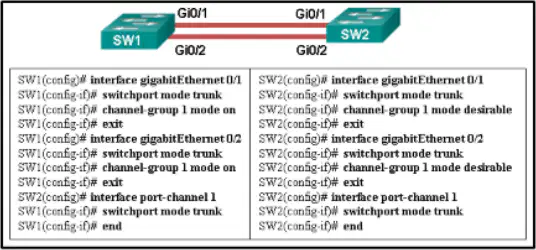
A network administrator is configuring an EtherChannel link between two switches, SW1 and SW2. Which statement describes the effect after the commands are issued on SW1 and SW2?
The EtherChannel is established after SW1 initiates the link request.
The EtherChannel fails to establish.
The EtherChannel is established without negotiation.
The EtherChannel is established after SW2 initiates the link request.
When EtherChannel is configured, which mode will force an interface into a port channel without exchanging aggregation protocol packets?
on
auto
desirable
active
Which statement describes a characteristic of EtherChannel?
It consists of multiple parallel links between a switch and a router.
It can bundle mixed types of 100 Mb/s and 1Gb/s Ethernet links.
It can combine up to a maximum of 4 physical links.
It is made by combining multiple physical links that are seen as one link between two switches.
A network administrator configured an EtherChannel link with three interfaces between two switches. What is the result if one of the three interfaces is down?
One interface becomes an active link for data traffic and the other becomes a backup link.
The remaining two interfaces continue to load balance traffic.
The EtherChannel fails.
The remaining two interfaces become separate links between the two switches.
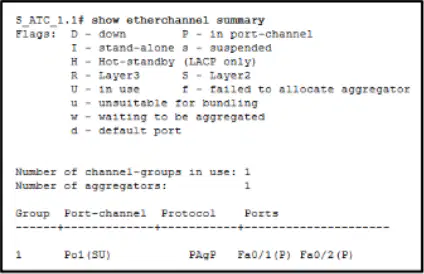
On the basis of the output that is shown, what can be determined about the EtherChannel bundle?
The EtherChannel bundle is operating at both Layer 2 and Layer 3.
Two Gigabit Ethernet ports are used to form the EtherChannel.
A Cisco proprietary protocol was used to negotiate the EtherChannel link.
The EtherChannel bundle is down.
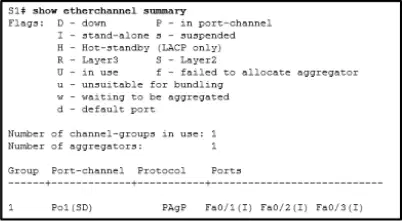
A network administrator issued the show etherchannel summary command on the switch S1. What conclusion can be drawn?
FastEthernet ports Fa0/1, Fa0/2, and Fa0/3 do not join the EtherChannel.
The EtherChannel is not functional.
The port aggregation protocol PAgP is misconfigured.
The EtherChannel is suspended.
A network administrator is configuring an EtherChannel link between switches SW1 and SW2 by using the command SW1(config-if-range)# channel-group 1 mode auto. Which command must be used on SW2 to enable this EtherChannel?
SW2(config-if-range)# channel-group 1 mode desirable
SW2(config-if-range)# channel-group 1 mode on
SW2(config-if-range)# channel-group 1 mode passive
SW2(config-if-range)# channel-group 1 mode active
What are two load-balancing methods in the EtherChannel technology?
source MAC to destination MAC
source IP to destination IP
combination of source MAC and IP to destination MAC and IP
combination of source port and IP to destination port and IP
source port to destination port
A switch is configured to run STP. What term describes a non-root port that is permitted to forward traffic on the network?
disabled
designated port
alternate port
root port
Which statement describes an EtherChannel implementation?
EtherChannel operates only at Layer 2.
PAgP cannot be used in conjunction with EtherChannel.
A trunked port can be part of an EtherChannel bundle.
EtherChannel can support up to a maximum of ten separate links.
What is the outcome of a Layer 2 broadcast storm?
Routers will take over the forwarding of frames as switches become congested.
New traffic is discarded by the switch because it is unable to be processed.
CSMA/CD will cause each host to continue transmitting frames.
ARP broadcast requests are returned to the transmitting host.
Which two network design features require Spanning Tree Protocol (STP) to ensure correct network operation?
static default routes
implementing VLANs to contain broadcasts
redundant links between Layer 2 switches
link-state dynamic routing that provides redundant routes
removing single points of failure with multiple Layer 2 switches

